Last updated 2026-07-11
TL;DR
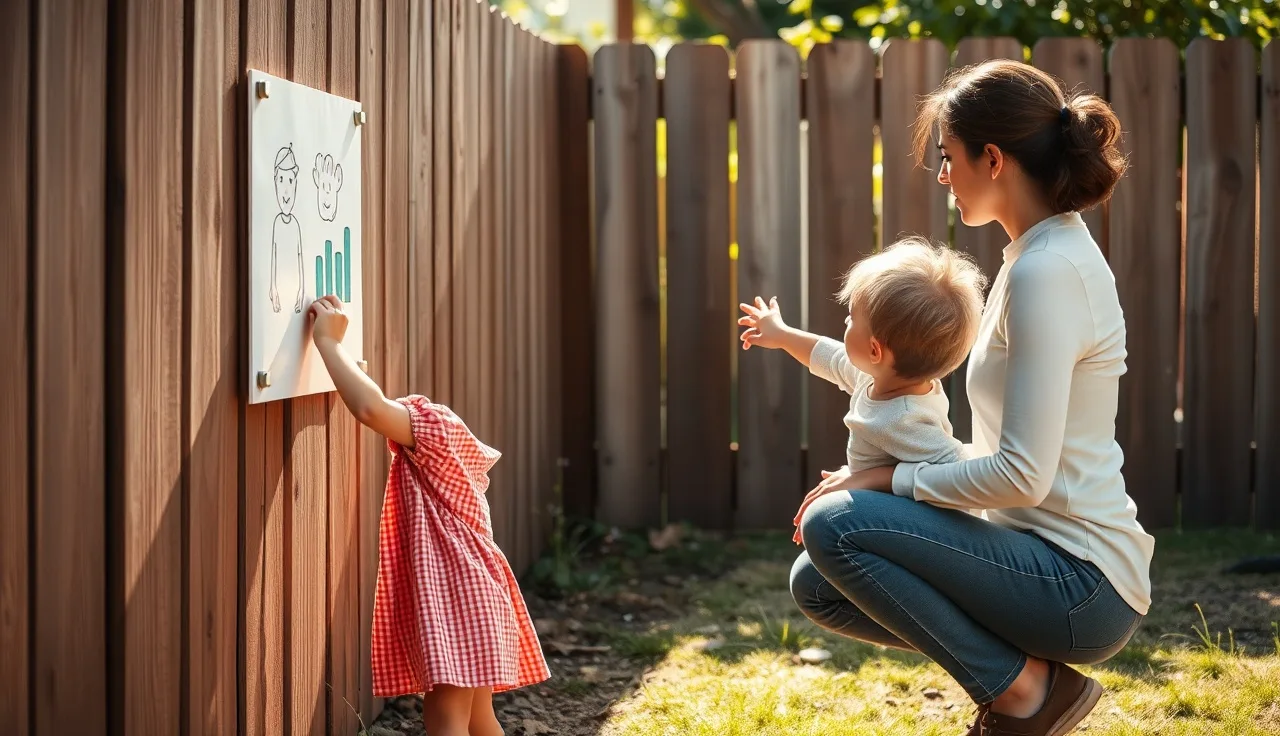
A communication board brings picture symbols or words to the playground, sandbox, or backyard so a child who doesn't yet speak reliably can still ask for a turn, name what they see, or say they're done. Laminate a small board, clip it to a lanyard or fence hook, and point to it yourself every time you talk. That modeling, done every session, is the whole method.
A communication board is a low-tech AAC (augmentative and alternative communication) tool: a flat surface printed with picture symbols, photographs, or written words that a child points to instead of, or alongside, spoken words [1]. Unlike a speech-generating device, it costs almost nothing to make, and once it's laminated it survives sand, mud, and rain without complaint. Outdoor play happens to be one of the hardest settings for late talkers and kids who use AAC. It's loud, it moves fast, and there are people everywhere. A child who does fine at a quiet table can go silent on the playground because too much is pulling at their attention at once. The board gives them a low-effort way to stay in the conversation even when everything around them is chaotic. The American Speech-Language-Hearing Association classifies low-tech communication boards as a recognized form of AAC appropriate across the severity spectrum [1]. They don't replace speech therapy; they work best alongside it, and if you haven't connected with a speech-language pathologist yet, the page on speech therapy and what a speech-language pathologist does walks through what an evaluation looks like. Here's something that surprises a lot of parents: giving a child a strong way to communicate doesn't reduce their drive to talk. A 2015 review in the American Journal of Speech-Language Pathology found "no evidence that AAC inhibits speech development" and some evidence it supports it [2].
Choosing what goes on the board
Start with function, not vocabulary size. A board with 9 to 16 symbols covering the outdoor actions and requests a child actually uses beats a 60-symbol board nobody can find anything on.
| Category | Example symbols |
|---|---|
| Requests | more, stop, help, my turn, all done |
| Social | hi, bye, look, wait, yes, no |
| Play actions | push, swing, throw, dig, run, jump |
| Sensory/comfort | hot, cold, hurt, loud, scared, happy |
| Names | each regular playmate or sibling |
Keep "more," "help," and "all done" on every version of the board no matter what else changes. Those three cover most urgent needs, and they're the same symbols the child already uses indoors, which keeps things consistent.
Photographs of the actual toys and equipment in your yard tend to work better than generic clipart, especially for autistic children who process concrete images more readily [3]. If your child already uses a specific AAC app or device indoors, put the same symbol set on the paper board so the vocabulary matches across settings. For a broader comparison of options, see the article on AAC devices.
Setting it up so kids can actually reach it
The most common reason outdoor communication boards fail is dull and fixable: nobody can find them when they're needed. The board has to be physically present and within reach at every outdoor session, not zipped inside a bag.
A few placement options that hold up in practice:
- Lanyard around the child's neck (good for toddlers and preschoolers, use a breakaway clasp for safety)
- Binder ring clipped to a belt loop or stroller handle
- Velcro strip on the fence or a plain outdoor hook near the gate
- Waterproof sleeve attached to the sandbox edge or water table leg
- Small laminated card tucked into a jacket pocket
For children who use a wheelchair or adaptive stroller, mount the board on the tray or armrest in the same spot every session so they always know exactly where to look.
Lamination isn't optional outdoors. A home laminator with 5 mil pouches handles normal weather fine, and a UV-resistant laminate slows fading if the board lives outside full-time. Reprint and re-laminate every three to four months during the preschool years, since language moves fast then and vocabulary needs keep shifting. Size matters too: young children and kids with motor challenges do better with symbols at least 2 inches square, and anything under 1.5 inches is hard to point to accurately once a child is moving.
Teaching a child to use it, step by step
The method with the strongest evidence behind it is aided language stimulation, sometimes called modeling or ALgS [4]. The adult points to symbols on the board while speaking, matching their own words to the pictures, and doesn't wait for the child to point first. You model constantly, the same way you'd model spoken words.
Here's what it looks like in practice. Your child runs to the swing. You walk over, point to the "push" symbol, say "push," then push the swing. You point to "more" and say "more?" before each push. The moment they reach for the board, or even glance at it, you push again. Model, opportunity, respond, that's the whole sequence.
For the first week: introduce one symbol at a time, starting with whichever one is most motivating for your child (often "more" or "swing"). Model that symbol yourself every time the concept comes up, across at least two or three play sessions. Build an obvious opportunity to communicate, pausing before pushing the swing or holding the ball just out of reach, and wait 5 to 10 seconds without filling the silence. When the child points, touches, or even glances at the symbol, respond fast and warmly, since speed matters more than anything else early on. Add a second symbol only once the first one shows up on its own two or three times across different sessions.
A 2013 study in the Journal of Early Intervention found that parents who received just two to three hours of AAC modeling training used AAC far more during play routines, and their children's symbol use rose within weeks [5]. You don't need to be a professional to do this well, but you do need to point to the board yourself, every time.
If the child points to the wrong symbol, resist the urge to correct them. Just model the right one calmly and keep going. Correction slows things down and adds stress to something that's supposed to feel like play.
When the child ignores the board completely
This happens constantly in the first few weeks, and it doesn't mean the strategy is failing.
Start with the logistics. Is the board actually in the child's line of sight? Kids with sensory processing differences may not scan their environment the way other kids do, so position the board between you and the child during the activity rather than off to the side.
Then ease off the prompting and model more instead. Parents instinctively ask "what do you want?" while waving at the board, but that can feel like a test. Swap it for narration: point and name things as you play, with no expectation that the child responds. That takes the pressure off and keeps things fun.
Check the vocabulary match too. If a child only wants to dig in the sandbox and the board has no digging words, there's no reason for them to touch it. Follow whatever outdoor activities genuinely light your child up, and build the vocabulary around those first.
If a child keeps avoiding the board after four to six weeks of steady modeling, that's a sign to bring in a speech-language pathologist for a hands-on look. They can tell whether motor, sensory, or cognitive factors are shaping the response, and early intervention services often cover this kind of assessment for children under three at no cost to families under IDEA Part C [6].
How is outdoor AAC different for autistic children versus other late talkers?
The board itself can look identical, but a few things shift when a child is autistic.
Sensory overload weighs heavier. A child already flooded by noise, bright light, or texture has less attention left over for a communication tool. In those moments, a simpler board (two or three symbols, even) works better than a busy 16-symbol grid. Some families keep a stripped-down "low demand" version for high-sensory settings and a fuller one for calmer times.
Many autistic children also use echolalia, repeating phrases they've heard, as part of how they communicate. That's functional language, not noise, and it often runs alongside AAC rather than against it. The article on echolalia covers how to respond to it during play.
When a child has childhood apraxia of speech alongside autism, motor planning problems can make pointing unreliable. A speech-language pathologist familiar with childhood apraxia of speech can set up modified access methods, eye gaze or partner-assisted scanning among them, that hold up outdoors.
Autistic children who get AAC support inside broader autism spectrum speech therapy tend to make stronger gains than kids who get either one alone, according to a 2019 systematic review in Augmentative and Alternative Communication [7]. The outdoor setting, precisely because it's socially rich and always changing, can speed up vocabulary generalization once that foundation is in place.
Getting other kids and caregivers on the same page
This part gets underrated. A communication board only works if the people around the child know to look at it and answer it.
For family members and regular caregivers, the fastest training is a five-minute side-by-side: you model the board yourself, then hand it off. Talking someone through it rarely sticks. Show them the three most-used symbols, explain the "wait five seconds, then respond" rule, and have them try it once while you watch.
Other kids at a shared playground pick this up fast. A simple "my kid points to pictures to talk, if they point to push, that means push" is usually all it takes. Children under five adapt especially quickly, since they don't carry the self-consciousness adults have about getting it right.
When someone new is supervising, a small printed card on the back of the board reading "to talk to me, look for what I point to," plus two or three instructions, works as a self-contained guide. Some families add a QR code linking to a short video.
Consistency across settings, home, backyard, public playground, is one of the strongest predictors of AAC success. When vocabulary and access methods stay the same everywhere, children generalize faster [8].
Can a phone or tablet app work as an outdoor board?
Yes, plenty of families do this. A tablet running an AAC app in a protective case with a wrist strap or tray mount holds up outside fine. The tradeoffs are real, though.
Screens are hard to see in direct sun. Most consumer tablets wash out badly at 1000+ lux, which is just a normal bright day outside. If you're using a device outdoors, a matte screen protector and full brightness help, or simply turn the child so they face away from the sun.
Devices get dropped, wet, and sandy. A rugged case (OtterBox Defender class) and a short lanyard loop help a lot. Many families keep a laminated paper board as backup and only pull the device out when the child wants the extended vocabulary.
The Little Words app fits this kind of quick-access outdoor use: you can pull up a play-context board in one tap, which matters when a child is mid-swing and has zero patience for navigation menus. Take the quiz at /start to see whether the app fits your child's current communication profile.
For a full comparison of device options, including dedicated speech-generating devices, see aac devices.
How do you know if the board is actually working?
Progress with AAC is slower and quieter than most parents expect, and that gap is exactly why a lot of families quit too early.
Worth tracking: how many times per session the child spontaneously touches or points to any symbol, unprompted; which symbols they start themselves versus only respond to; whether they combine two symbols ("more" plus "swing" is a two-word message with real communicative value); and how long they stay engaged with a play activity when the board is present versus absent.
A simple tally in your phone's notes app, just a count per session, gives you a week-over-week picture that beats memory every time. Most SLPs want at least four to six weeks of steady use before drawing conclusions, because early data is noisy.
ASHA's guidance on AAC outcomes notes that communication rate (total intentional communicative acts per minute) is a more sensitive early indicator than vocabulary size [1]. A child who points to one symbol five times in a 20-minute session is communicating more than a child who has 40 symbols and uses none of them.
If you're working with an SLP, bring your tally to each session. It sharpens the feedback you get and helps them adjust the symbol set and modeling plan.
Common mistakes with outdoor communication boards
A few patterns show up again and again. Making the board too big is one: a 60-symbol board suits a child who already uses AAC fluently and understands a large vocabulary, but a beginner should start at 9 to 16 symbols and grow only as each new symbol gets used spontaneously.
Leaving the board inside is another. The board needs to go out with the child every single time. It takes about two weeks of steady presence before most children start initiating, and one missed session breaks that momentum.
Some parents model only during "teaching moments," but aided language stimulation works because it lives inside natural activity, not because it creates little lessons. Point to symbols during casual play more than during structured routines.
Others expect the board to kill the child's urge to talk. It doesn't, and that's fine. Some children start imitating the words modeled alongside the symbols; others don't say more but communicate far more successfully. Both outcomes count.
And some families skip the SLP entirely. Plenty of families start a communication board without professional guidance and do it well, but an SLP evaluation every few months catches what parents miss, a pointing habit that looks like AAC but isn't actually communicative, say, or a motor issue quietly limiting access. Online speech therapy has made these check-ins much easier to book.
What the research says about AAC outcomes in young children
The evidence base for AAC in early childhood is genuinely strong, though most studies test structured settings rather than outdoor play.
A widely cited 2012 meta-analysis in the American Journal of Speech-Language Pathology, covering 24 single-case studies, found that AAC interventions produced meaningful increases in expressive communication for the vast majority of children who received them, including nonspeaking and minimally verbal kids [9]. Effect sizes ran largest for children who started before age five.
The specific mechanism of aided language stimulation has been tested most rigorously by Goossens (1989) and in later replication work [4]. The finding holds up: adults who model AAC use during natural routines produce faster symbol acquisition than adults who only prompt children to use it.
For children who are late talkers without autism or another diagnosis, the picture is murkier. Many catch up on their own by age four or five [10]. AAP guidance, laid out in its 2020 policy statement on developmental surveillance, recommends developmental screening at 9, 18, and 30 months and referral if concerns show up, without prescribing any specific AAC approach [11]. In practice, that means a communication board during outdoor play is low-risk, low-cost, and helpful whether a child turns out to be a true late talker or just on the slower end of typical.
Nobody has good data specifically on outdoor play as its own AAC context. The closest evidence comes from studies of naturalistic aided language stimulation across varied settings [5], which suggest the outdoors is actually favorable, since the strong pull of preferred play activities raises the number of communicative opportunities per session.
Outdoor communication boards: common questions
You can start using a communication board with a child as young as 12 to 18 months. There's no minimum age for AAC, and ASHA states plainly that there's no developmental or cognitive prerequisite for using it [1]. For very young children, begin with a 4-symbol board using large photographs. In early sessions the adult does most of the pointing while the child watches, and imitation follows gradually.
A common worry is that a board will slow down talking. It won't. A 2015 review in the American Journal of Speech-Language Pathology found no studies showing AAC inhibits speech, and several showing it actually supports it [2]. The likely reason is that symbol-based communication cuts frustration and raises the odds a child gets understood, which in turn drives more attempts to communicate, spoken ones included. Most SLPs pair AAC directly with spoken language goals rather than treating them as competing paths.
You don't need special software to build one. Google Slides or PowerPoint works fine: set each cell to 2x2 inches, add photographs or free clipart with a text label underneath, then print on cardstock and get it laminated at a local print shop for about $1 to $3 per sheet. Boardmaker is the professional standard, but a basic outdoor board doesn't require it. Mulberry symbols are free and open-source if you'd rather use one consistent image set.
For a beginner, 9 to 16 symbols in a simple grid is the right size: small enough to scan quickly during active play, big enough to cover requests, social words, and a few activity-specific terms. Only grow to 20 to 32 symbols once the child is using several of the current ones spontaneously across multiple sessions. Adding too many symbols too soon tends to overwhelm a new user rather than help. The outdoor board shouldn't be a different vocabulary from the indoor one. Keep core words like "more," "help," "stop," "all done," yes, and no identical everywhere, then layer on location-specific pages or overlays. A symbol that means the same thing in every setting gets learned faster; two unrelated boards for inside and outside just slow generalization. Treat it as one vocabulary system with add-ons for context, not separate systems.
If your child won't point but looks at symbols or gestures toward them, that still counts as real AAC access. A consistent gaze toward a symbol is a communicative act, and it deserves an immediate response. For children with motor challenges, an SLP can set up partner-assisted scanning, where you name symbols aloud and the child signals yes or no. A pointing finger isn't a requirement.
Weather is manageable. Lamination handles most conditions, and for very wet play you can slide the laminated board into a clear zip-lock bag so the child can still point through the plastic (some families prefer dry-erase pouches). Don't take an unlaminated paper board outside, and if the board does get damaged, replace it quickly: even a few days without it can break the habit for a beginning user.
It's also common for a child to use the board confidently at home and then go quiet with it at a public playground. New environments reset behavior for a lot of kids, especially autistic children and those with sensory processing differences, and a playground is louder, less predictable, and socially more complicated than your backyard. Bring the board anyway, lower your expectations for the first several visits, and model more while prompting less. Generalizing to public spaces usually takes two to four times as long as learning the board in a familiar place did.
Siblings and peers often pick this up faster than adults do. A quick, casual explanation is enough: show a sibling or playmate two or three symbols and tell them what each one means, and for kids who play together regularly, ask them to pause and wait for a point before reacting. Once they know what to watch for, children respond to successful communication naturally, without any formal lesson.
A parent-made board itself is a support strategy, not a clinical service. Formal early intervention under IDEA Part C provides evaluation and therapy through state programs for children under three with developmental delays [6]. Any caregiver can put a board in a child's hands at any time, but an SLP evaluation is what determines whether more support is needed and which AAC approach actually fits the child.
Plan to review the symbols every two to three months, or sooner if the child's play interests shift noticeably. Add new games, seasonal activities like swimming or snow play, or symbols for new playmates. When a symbol isn't needed anymore, move it to a second page instead of deleting it, since interests tend to cycle back, and refreshing the board seasonally also keeps it more engaging.
Finally, aided language stimulation, meaning you point to the board while you talk, modeling the exact symbols that match your words, is the most effective known way to teach symbol use [4]. There's no substitute for doing it yourself: children learn what symbols mean by watching you use them, not by being told. Five minutes of modeling per outdoor session is enough to start.
Sources
- ASHA, Augmentative and Alternative Communication overview: Low-tech communication boards are a recognized form of AAC appropriate across the severity spectrum; communication rate is a sensitive early outcome indicator
- Millar, Light, & Schlosser (2006), American Journal of Speech-Language Pathology, 'The impact of AAC on the speech production of individuals with developmental disabilities': Review found no evidence that AAC inhibits speech development and some evidence it supports it
- ASHA, Autism Spectrum Disorder practice portal: Photographs of actual objects and environments are often more accessible than abstract symbols for autistic children
- Goossens, C. (1989), Aided communication intervention before assessment: A case study of a child with cerebral palsy, Augmentative and Alternative Communication: Adults who model AAC use during natural routines produce faster symbol acquisition than adults who only prompt children to use AAC
- Kaiser & Roberts (2013), Journal of Early Intervention, parent-implemented enhanced milieu teaching with AAC: Parents who received two to three hours of AAC modeling training increased their modeling and child symbol use rose within weeks
- U.S. Department of Education, IDEA Part C Early Intervention Program: IDEA Part C provides evaluation and early intervention services at no cost for children under age three with developmental delays
- Ganz et al. (2019), Augmentative and Alternative Communication, systematic review of AAC for autistic individuals: Autistic children receiving AAC support within broader speech-language therapy context showed stronger gains than those receiving either alone
- ASHA, Augmentative and Alternative Communication practice portal, generalization across environments: Consistency of vocabulary and access methods across environments is a strong predictor of AAC generalization
- Ganz et al. (2012), American Journal of Speech-Language Pathology, meta-analysis of AAC in early childhood: AAC interventions produced meaningful increases in expressive communication for the vast majority of young children, with largest effect sizes for children starting before age five
- Rescorla, L. (2011), ASHA, Late talkers: Do good predictors of outcome exist?: Many late talkers without other diagnoses catch up to peers by age four or five without formal intervention
- American Academy of Pediatrics, Developmental Surveillance and Screening policy, 2020: AAP recommends developmental screening at 9, 18, and 30 months with referral when concerns are identified