Last updated 2026-07-11
Kids talk most when they're doing something they actually want to do, and outside, almost everything qualifies. There's a bug, a puddle, a dog across the street. Movement calms the nervous system, novelty hands you a steady stream of topics, and side-by-side play takes the pressure off face-to-face talk. You don't need special gear for any of this. You just need the right word at the right moment.
Why outdoor play gets kids talking
The environment does the work of inventing conversation topics for you. The American Academy of Pediatrics said as much in a 2018 clinical report, noting that "play is not frivolous; it enhances brain structure and function and promotes executive function" [1]. Executive function covers things like holding someone's attention, shifting topics mid-conversation, and staying regulated enough that talking feels safe. Physical, exploratory play builds all of that scaffolding.
For kids who find social communication stressful, being outside removes a big variable: the pressure of eye contact across a table. Side-by-side play at a sandbox or on a climbing frame lets a child respond without facing you directly, and that shift in geometry alone seems to double the spontaneous talking some kids do. No study has put an exact number on it, but speech-language pathologists who work outdoors report it consistently, and it lines up with what we know about lower physiological arousal during movement [2].
Then there's the sensory piece. Swinging and running give vestibular input, climbing gives proprioceptive feedback, and grass, sand, and bark give tactile input. For many neurodivergent kids, sensory regulation has to happen before communication is even possible. A dysregulated child can't produce words reliably. Moving around outside settles the nervous system and opens a window where language becomes reachable [3].
Which activities work best
The best outdoor activities tend to share two things: a chance for joint attention, and real motivational pull. Joint attention just means two people looking at the same thing at the same time, and it's the foundation communication gets built on. A bird lands nearby, you both watch it, and that shared moment is the perfect slot for a word, a point, a comment.
| Activity | Primary communication target | Why it works |
|---|---|---|
| Water play (hose, buckets, sprinkler) | Requesting, commenting | High motivation; endless cause-and-effect |
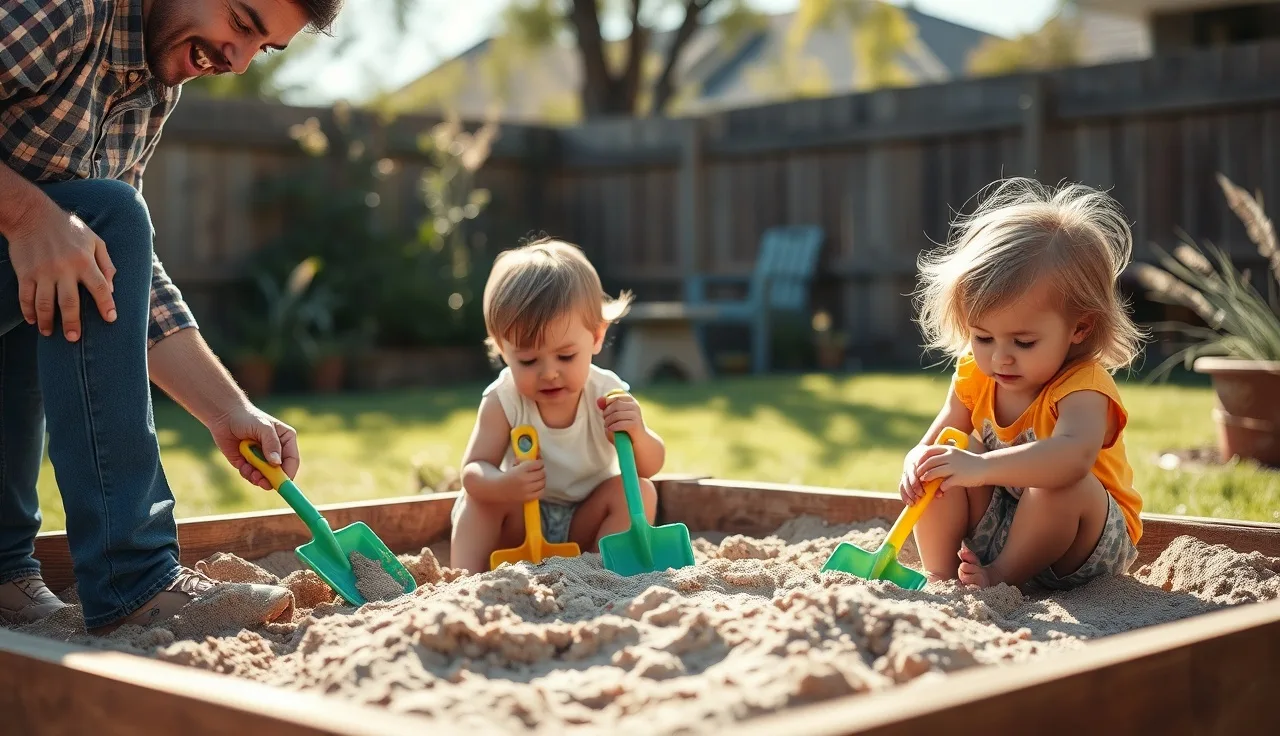
| Sandbox or mud kitchen | Vocabulary, pretend play | Open-ended, slow-paced, low demand |
| Nature scavenger hunt | Labeling, describing, turn-taking | Structured purpose without structured pressure |
| Blowing bubbles | Turn-taking, requesting "more" | Classic SLP tool; motivating and repetitive |
| Chalk drawing together | Joint attention, commenting | Side-by-side, low eye contact |
| Obstacle courses | Action words, sequencing | Movement plus language in a predictable order |
| Garden planting or watering | Vocabulary, following directions | Sensory-rich; real-world cause and effect |
| Ball games with loose rules | Turn-taking, social language | Adjustable complexity |
Bubbles earn their reputation. They've been a staple of speech therapy for decades because a child who wants a bubble has to wait, look at you, and show what they want, and that waiting and looking and indicating is communication before a single word gets said [4].
Water play works just as well for kids at the earliest stages of intentional communication. Where the water goes when it hits the sand is unpredictable, so it keeps generating comment-worthy moments. For a late talker with few words, one session of pouring and dumping next to a parent who narrates naturally can produce 20 minutes of shared attention.
What to say while you play
Most parents accidentally work against themselves here. The instinct is to quiz: what color is that flower, what does the dog say, can you tell me what happened. Questions put a child on the spot, and they often shut communication down instead of opening it up.
The better move is self-talk and parallel talk. Self-talk means narrating what you're doing: "I'm filling up the bucket. It's so heavy. Oh, it spilled." Parallel talk means narrating what the child is doing: "You're digging. You found a rock. It's a big one." Neither one asks the child to respond, and that's exactly the point.
Researchers call this child-directed interaction, and the evidence is solid. A 2017 study in the Journal of Speech, Language, and Hearing Research found that parent-implemented naturalistic language intervention significantly improved expressive language in children with language delays [5]. The active ingredients were following the child's lead, commenting rather than questioning, and expanding on whatever the child said or did.
Expansion is the move that speeds up vocabulary and grammar fastest. If your child says "dog," you say "big dog running." You're not correcting them, you're modeling the next level up, and it works whether a child is using single words or short phrases. It transfers straight to outdoor play because the subject is right there in front of both of you.
Two more moves worth building in: after you comment or model a word, stop talking for five to ten seconds. Most adults find this silence uncomfortable, but a child processing language needs that time to answer, and filling the space too fast means they never get the chance. The other move is engineering a little frustration on purpose: "forget" the shovel, hand over the bubbles but keep the wand, sit your child on the swing and don't push. These small setups create real communication need, which beats prompted communication every time. Research on communication temptations shows they reliably raise how often late talkers initiate [6].
Late talkers and outdoor play
Late talkers, roughly defined as children whose expressive vocabulary falls below the 10th percentile for their age, often understand plenty but lack the motivation or opportunity to initiate [7]. Outdoor play goes straight after that initiation problem. When a child wants something outside, the desire is immediate and concrete: they see the swing and they want it now. That flash of wanting is your best teaching moment, and you didn't have to stage anything. The need is real, the child is fully in it, and the payoff of communicating (getting pushed on the swing) arrives instantly.
If you're weighing whether outdoor strategies are enough or whether it's time for early intervention, the AAP's guidance is plain: children not meeting expressive language milestones by 18 to 24 months should be evaluated by a speech-language pathologist rather than watched and waited on [8]. Outdoor play works well alongside professional support, but it isn't a substitute for it. It's worth noting that naturalistic, play-based approaches increasingly form the basis of formal speech therapy itself: many SLPs now work in natural environments, and their methods look a lot like what a parent can do at the park with 20 minutes and a bag of sidewalk chalk.
Autistic kids and outdoor communication
Autistic children's communication profiles often look nothing like a late talker's. Some have plenty of language but struggle with the social side of it: taking turns in conversation, commenting on something shared, reading whether a partner is interested. Outdoor play targets exactly those skills, in a setting that's naturally low-pressure.
For autistic children who use AAC devices or other augmentative systems, being outside surfaces vocabulary needs that don't come up indoors. The device set up for daily life at home may not have "beetle," "mud puddle," or "pine cone" programmed, and outdoor play gives you a genuine reason to add new words and practice them somewhere they actually mean something.
Some autistic kids show echolalia, repeating phrases or scripts from memory instead of generating new language on the spot. Fresh outdoor contexts can interrupt those familiar scripted routines and invite something more flexible. Understanding echolalia helps parents read these moments rather than trying to shut them down, and the echolalia meaning explainer walks through what's behind it. For a deeper look at structured approaches, the autism spectrum speech therapy overview covers how SLPs set goals and sequence intervention for autistic kids at different stages.
Structured activities or free play: which builds language faster?
Both, honestly, because they do different jobs. Free, child-directed play, where you follow along instead of running the show, is where most spontaneous language shows up. When a child picks the activity, motivation is at its peak, and motivated kids talk more on their own. ASHA's guidance on naturalistic intervention names following the child's lead as a core principle [9].
Structured outdoor activities, like a scavenger hunt or a garden project, add vocabulary and practice with sequencing language ("first we dig the hole, then we put the seed in"). These work best once a child already has some spontaneous language and you're building on it.
In practice, do both in one session: 10 to 15 minutes of following your child's lead with no agenda, then a brief structured activity for another 10 to 15 minutes. Don't announce that you're doing speech work. Just play.
One mistake worth naming: over-structuring outdoor time for communication practice kills the quality that made it useful in the first place. If every moment outside turns into a test, the low-pressure advantage disappears. If your child looks like they're being drilled, you've slipped from natural play into something else.
How often, and for how long?
The AAP recommends at least 60 minutes of physical activity per day for children ages 3 to 5, with unstructured outdoor free play making up a large share [1]. For communication specifically, frequency beats duration.
Five or six short outdoor sessions a week, even 15 to 20 minutes each, build more language than one long Saturday afternoon. Consistency creates repetition, and repetition is how kids learn words. Research on word learning shows most young children need somewhere between 10 and 40 exposures to a new word before it locks into their expressive vocabulary, though the exact number varies a lot by child and context [10].
If you're using outdoor play as a deliberate strategy, keep a loose mental note of which words came up that day, then bring them back. If "caterpillar" showed up at the park, look for caterpillars in a book that night. That cross-context repetition speeds word learning noticeably.
If your child gets speech therapy, ask the SLP for three to five specific targets to work into outdoor play this week. Carrying skills outside the clinic is often what makes them show up in real life.
What if my child shuts down or won't engage outside?
This happens often, and it's usually one of three things: sensory overwhelm, the wrong activity, or too much pressure from the adult.
Sensory overwhelm outside can look like refusing to touch grass, distress at wind or loud ambient noise, or a fast retreat to an enclosed space. That's not defiance, it's a nervous system with nothing left over for talking. When it happens, regulation comes first: let your child find a tolerable corner of the space, stay close, narrate softly, and ask nothing.
Activity mismatch is the easy fix. If your child has zero interest in the sandbox, don't force it because an article said sandboxes build language. Follow what they already love. Trucks? Bring trucks outside. Lining things up? Bring rocks or sticks to line up. The content matters less than the engagement.
Adult pressure is the sneakiest problem. It shows up as questions in a cheerful voice: "What do you see? Can you say bird? What color is that?" Anxious or sensitive kids read the teaching agenda under the cheer and pull back. The fix is to genuinely play instead of performing play while you wait for language. When you're actually having fun, your child feels it, and the whole dynamic shifts.
For kids whose profiles include childhood apraxia of speech, outdoor play still works, but the targets shift toward motor speech practice in natural contexts. An SLP who specializes in apraxia can tell you which word shapes to model outside.
Can outdoor play replace speech therapy?
No. That's not a hedge, it's a real distinction that changes outcomes. Naturalistic play-based strategies are powerful tools for parents, but they work best alongside professional assessment and intervention, not as a substitute for it. An SLP brings diagnostic precision: they can tell whether a child's difficulty is mainly phonological, semantic, pragmatic, or motor-based, and they choose targets and sequences a parent working alone wouldn't know to prioritize.
That said, research consistently shows parent-implemented strategies in natural settings extend the benefit of formal therapy. A child who sees an SLP one hour a week still has the other 167 hours. If those hours hold high-quality, play-based communication support, outcomes beat therapy alone [5].
For families who can't get in-person services, online speech therapy has widened access, and many platforms now build in parent coaching for home-based naturalistic strategies. The Little Words app offers a parent-guided experience built on these same principles if you want structured support for tracking and building language goals at home, and a short quiz can point you toward which approach fits your child's current profile.
Outdoor play is a high-return tool for communication. It isn't therapy. Use both.
Which words to model outside
Target the words that describe your child's immediate experience, not the vocabulary you think they should know: the words for exactly what they're doing and wanting right now.
For early communicators, that means action words ("go," "stop," "up," "down," "more," "all done"), location words ("in," "out," "under," "over"), and the names of whatever objects and people are right there. These come with an immediate referent and immediate payoff, unlike flashcard words.
A useful structure for any outdoor session: narrate one step above your child's current level. If your child uses no words, model one-word labels. If they use one word, model two-word phrases. This is the plus-one rule, used widely in naturalistic language intervention, and it means you're always modeling the next step rather than a level your child isn't ready for [4].
For kids with more language who need pragmatic practice, the targets shift to commenting ("look at that!"), requesting information ("what is that?"), and offering help or objects ("want some?"). These functions come up constantly outdoors and are much harder to practice at a table.
How do you know it's working?
Progress in early communication moves slowly enough that it's hard to see week to week. The best measure isn't word counts, it's communication attempts.
Count how many times your child initiates communication during a 20-minute outdoor session, in any form: words, gestures, eye contact to share something, vocalizations, or AAC. Do this informally two or three times a week. If the number trends up over a month, the strategy is working. If it's flat, that's useful information to hand your SLP.
Other good signs: more eye contact during play, longer joint attention, spontaneous labeling of new objects (even wrong labels), and less frustration when communication doesn't land right away. These tend to show up before word explosions and are worth celebrating on their own.
If your child is in formal speech therapy, share what you're seeing outside with the SLP directly. Therapists make better calls when they know what's happening in natural settings, and many will hand you specific outdoor-ready targets each week if you ask.
You can start outdoor communication strategies from birth. Infants and toddlers benefit from being narrated to during stroller walks, sand play, and water bins, and the AAP recommends daily outdoor time starting in infancy. The window where it matters most for language is 12 to 36 months, when expressive language develops fastest and naturalistic input hits hardest, but there's no cutoff. The same approach works with preschoolers, school-age kids, and beyond. A child with no words yet may benefit most from this kind of play. Kids without words still communicate through gaze, gesture, and vocalization, and outdoor play builds the joint attention that words eventually grow out of. Model single words without expecting a response, and use communication temptations like holding out the bubbles or pausing before pushing the swing to create a reason for your child to initiate. If your child still has no words by 16 months, it's worth getting an evaluation. Whether outdoor play beats indoor play depends on the child, but outdoor settings tend to generate more new vocabulary, more movement-based sensory input, and more side-by-side play that takes the pressure off eye contact. Kids who find face-to-face interaction stressful often communicate more spontaneously outside. Indoor play isn't worse, exactly, but the outdoors keeps handing you conversation starters so you don't have to invent them yourself. If you want your child to talk without it feeling like a test, drop the questions and narrate instead. Comment on what you're both seeing and doing, then pause for 5 to 10 seconds. If your child says or does anything communicative, expand on it and keep moving. You're aiming for a conversational rhythm, not an interrogation. Kids who feel pressured tend to go quiet; once that pressure lifts, the words tend to show up. For turn-taking, games with a built-in structure do the work for you: bubbles (blow one, hand over the wand, wait), rolling a ball back and forth, swing pushing, pouring water into each other's containers. Start with simple two-step turns, you do, I do, and once your child has the pattern down, add language to each turn, "my turn," "your turn," and eventually comments about what just happened. Skip corrections during play. They break the flow and turn play into a test, which shrinks spontaneous talking. Use expansion instead: if your child says "boo fower," you say "blue flower, yes, pretty blue flower." That models the correct form without making anyone feel wrong, and repeated natural exposure is how kids actually internalize pronunciation and grammar. Save direct correction for structured settings, and go easy even there. Sensory play matters because it gives kids the regulation they need before their nervous system has room for communication. Sand, water, mud, and grass activate touch and body-awareness pathways, while swings and slides provide movement input. Once a child is regulated, they're more open to social interaction, which is why many SLPs work on sensory regulation before targeting language directly, especially with kids who have sensory processing differences. Nature walks work well too. A passing truck, a puddle, a dog on a leash: all of these are chances for joint attention. Narrate what you both notice in simple, slightly expanded language, stop when your child stops, look at what they're looking at, and comment on it. Bringing a small bag to collect and name things along the way helps too. Leave the phone at home; a caregiver's undivided attention is itself a kind of intervention. If your child prefers to play alone outside, join without redirecting. Run in circles if they're running in circles, throw a rock in the puddle if they're throwing rocks. Don't teach or instruct, just be present alongside them. Many kids who seem to want solitary play will eventually tolerate, then invite, a quiet adult nearby. That parallel play phase is normal and it's a real step toward shared communication, so don't rush past it. For AAC users, bring the device outside every time, even when you don't expect it to get used, and model using it yourself to comment on what's around you. Add outdoor-specific vocabulary, like animal names, weather words, or playground equipment, before or after sessions; most systems make this easy. Outdoor settings are some of the best places to build core vocabulary use because motivation is high and the need to communicate is real. If your child is in early intervention, outdoor play fits right in: IDEA Part C requires services to be delivered in natural environments, which explicitly includes outdoor home and community settings. Ask your service coordinator or SLP to write outdoor strategies into the IFSP. Most EI providers are glad to coach you through a backyard session, and the yard is treated as a legitimate intervention setting, not a lesser one. A communication temptation is a situation you set up on purpose to create a real reason to communicate. Outside, that might mean holding the bubble wand without blowing, pausing mid-push on the swing, handing over a sealed snack container, or giving one shoe and "forgetting" the other. Your child feels a genuine want, you wait, and any attempt at communication (a gesture, a sound, a word, an AAC hit) gets an immediate, enthusiastic response. It's one of the most well-supported ways to build initiation. Weather matters less than most people assume. Puddle play, snow play, and cool cloudy walks offer the same opportunities as a sunny afternoon at the playground, and the novelty of cold rain or crunchy frost can actually raise alertness and attention. Dress for the conditions and go anyway. Weather words like "cold," "wet," "rain falling," or "muddy" are concrete and immediately relevant, which makes them some of the easiest vocabulary to model.Sources
- American Academy of Pediatrics, The Power of Play (2018): Play enhances brain structure and function and promotes executive function; AAP recommends at least 60 minutes of physical activity daily for young children.
- ASHA, Spoken Language Disorders technical report: Reduced social communication pressure in naturalistic, side-by-side settings supports initiation of communication in children with language delays.
- Schaaf RC et al., Sensory Integration and Language, OTJR: Occupation, Participation and Health (2018): Sensory regulation through movement is a prerequisite for accessible communication in many neurodivergent children.
- ASHA, Augmentative and Alternative Communication (AAC) resource pages: Bubble play and communication temptations are cited by ASHA as evidence-based strategies for building intentional communication and turn-taking in early communicators.
- Roberts MY & Kaiser AP, The Effectiveness of Parent-Implemented Language Interventions, American Journal of Speech-Language Pathology (2011): Parent-implemented naturalistic language intervention significantly improved expressive language outcomes in children with language delays; carryover to naturalistic settings improves therapy outcomes.
- Wetherby AM & Prizant BM, Communication Temptations, Journal of Speech and Hearing Disorders (1989): Engineered communication temptations reliably increase communication initiation attempts in late-talking and autistic children.
- Rescorla L, Late Talkers: Do Good Predictors of Outcome Exist?, Developmental Disabilities Research Reviews (2011): Late talkers are defined as children with expressive vocabulary below the 10th percentile for age; limited initiation is a key feature of the late-talker profile.
- American Academy of Pediatrics, Identifying Infants and Young Children With Developmental Disorders in the Medical Home (2006, reaffirmed 2020): Children not meeting expressive language milestones by 18 to 24 months should be evaluated by an SLP rather than monitored and waited on.
- ASHA, Language-Based Learning Disabilities technical report: Following the child's lead is identified as a core principle of naturalistic language intervention in ASHA guidance.
- Horst JS & Samuelson LK, Fast Mapping but Poor Retention by 24-Month-Old Infants, Infancy (2008): Children need roughly 10 to 40 exposures to a new word across contexts before it becomes stable in expressive vocabulary; exact number varies by child and context.
- U.S. Department of Education, IDEA Part C Natural Environments guidance: IDEA Part C requires early intervention services to be delivered in natural environments, which explicitly includes outdoor home and community settings.
- Girolametto L et al., Responsiveness interaction strategies in parent-implemented language intervention, Journal of Speech Language and Hearing Research (2017): Child-directed interaction including commenting, expansion, and following the child's lead significantly improves expressive language in children with language delays.