Last updated 2026-07-11
TL;DR
Play therapy for selective mutism leans on low-pressure, child-led activities to bring anxiety down far enough that speech can slip out on its own. Puppets, art, and predictable games work because they shift attention away from talking and onto the play itself. Most children still need a trained therapist using CBT-based methods like stimulus fading, but parents can run these approaches at home every day.
Selective mutism is an anxiety disorder. It isn't stubbornness and it isn't a language delay. A child with it can speak, and usually does at home or with a few trusted people, but consistently can't get words out in specific settings, most often school or other public places. The DSM-5 groups it with social anxiety disorder, and it affects roughly 0.7 to 1.9 percent of children, though estimates shift depending on how strictly the criteria get applied [1].
The freeze is fear, plain and simple. Just anticipating a speaking situation triggers an anxiety response that shuts the words down before they start. Forcing the issue, praising loudly when speech does happen, or even naming the silence out loud tends to backfire, because it all adds to the child's self-consciousness about talking.
Play works because it takes the pressure off. When a child is absorbed in a game, a puppet, or a drawing, nobody's watching them to perform. Anxiety drops, and speech gets a quiet opening. That's really the whole mechanism behind using play as a treatment vehicle.
What the research actually shows
The strongest evidence for treating selective mutism belongs to Cognitive Behavioral Therapy built around stimulus fading and systematic desensitization. A 2015 systematic review in Clinical Child and Family Psychology Review found behavioral and CBT-based treatments had the most consistent evidence for reducing symptoms [2]. Play-based techniques usually get folded into those behavioral plans rather than used on their own.
Pure non-directive, child-led play therapy (the Rogerian kind) has thin controlled-trial evidence specific to selective mutism. The American Speech-Language-Hearing Association notes that treatment works best when it lowers anxiety and builds in gradual exposure to speaking situations, which is exactly what structured play therapy is designed to do [3].
So here's the honest picture: play-based approaches work best as one piece of a larger plan, not as a standalone fix. They're good for building the relationship, lowering baseline anxiety, and setting up conditions where exposure work can take hold. Nobody has strong randomized trial data on play therapy alone for this condition. The closest evidence is case series and clinical reports, so treat confident-sounding success rates with some skepticism.
One thing does hold up well: early intervention matters. Children treated before age seven tend to do better than those treated as teenagers, once social anxiety patterns have settled in more firmly [4].
Core techniques therapists use
Puppets and dolls are among the most common tools because they put distance between the child and the words. The child isn't talking, the puppet is, and that gap is often enough to loosen the anxiety response. A parent or therapist can talk through their own puppet, ask the child's puppet a question, then simply wait, with no obligation for the child to answer. Over weeks, many children start speaking through the puppet without even noticing the shift.
Art works on a similar principle: it gives the child something to focus on besides the conversation itself. Draw alongside them, narrate what you're doing ("I'm making mine green"), and drop in casual comments that invite a response without demanding one. Comment on the work rather than the child: "That dragon has a lot of teeth" lands very differently than "Tell me about your dragon."
Board games and card games like Go Fish or Uno create predictable language slots. When it's always your turn to say "Go Fish," the phrase becomes routine instead of socially loaded. A good sequence starts with nonverbal games and slowly adds ones that require small, fixed phrases: classic stimulus fading.
Storytelling helps too. Some therapists use story stems, starting a story and inviting the child to add to it aloud or through figures and props. That shifts communication from personal disclosure into invented narrative, which feels much safer.
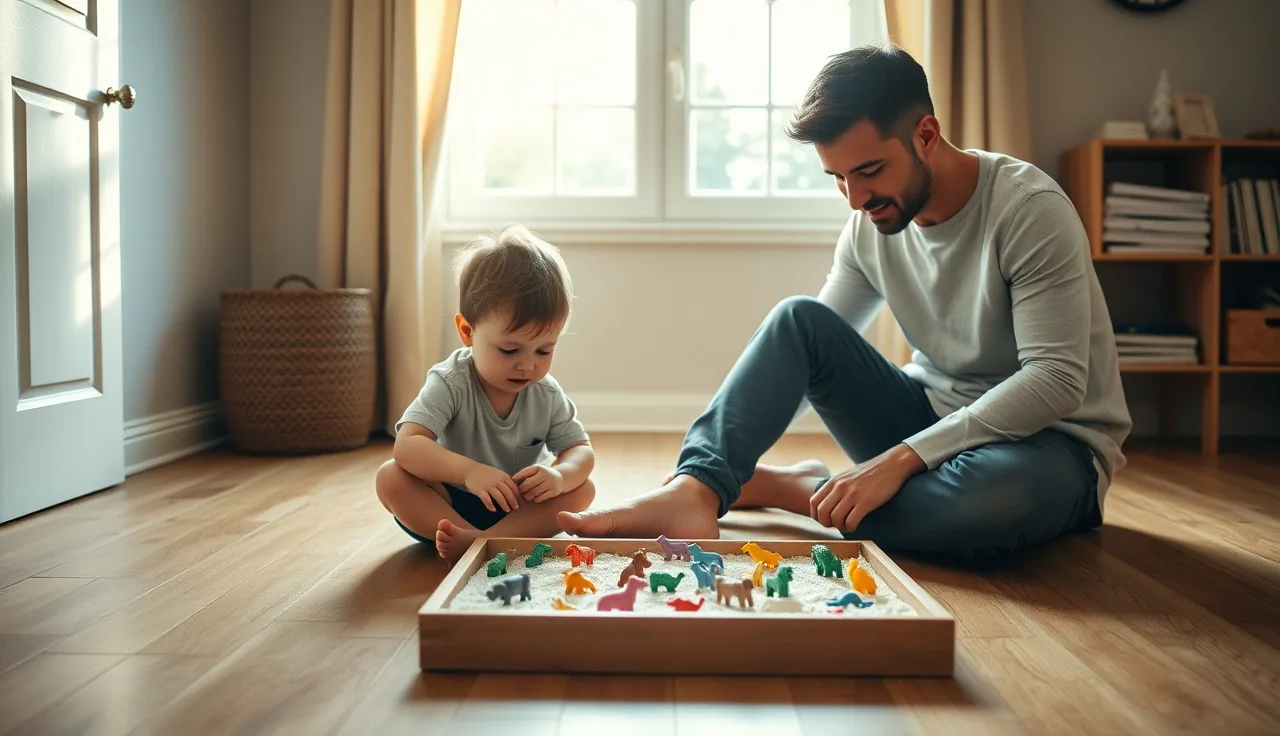
Sandtray therapy, common across child therapy generally, has the child arrange miniature figures in a tray of sand to build scenes, while the therapist comments without questioning. For selective mutism, this lets nonverbal communication lead, building trust before speaking is even on the table.
For younger children, and there's real overlap between selective mutism and autism presentations, sensory bins, kinetic sand, and movement games bring physiological anxiety down. A lower baseline means a lower bar for speech to clear.
Stimulus fading: the mechanism behind the games
Stimulus fading is the backbone of most evidence-based selective mutism treatment, and play is just the vehicle it rides in. The idea is simple: start where the child already speaks comfortably, then introduce new elements very slowly, keeping comfort high enough that speech stays possible [2].
In practice, it might look like this. If a child speaks freely with a parent at home, a therapist joins that parent-child play session at home first, without addressing the child directly, just talking to the parent and playing alongside. Nothing is required of the child. After several sessions, the therapist starts dropping brief, incidental comments nearby. Eventually the therapist plays directly with the child while the parent stays close, then further away, then out of the room entirely. The whole sequence can take weeks or months, and rushing it tends to reset progress. The child should always be working at a level where speaking feels possible, even on the sessions where it doesn't happen.
A similar fade works for the move from home to school: play sessions at home, then a neutral location, then school with one peer, then gradually bigger groups. The activity stays the same throughout; only the surrounding environment widens.
For parents doing this at home, one principle covers everything: never make speech the goal of a play session. Make connection the goal, and speech will show up once anxiety is low enough to let it.
What parents can do at home
Parents are the most powerful agents in selective mutism treatment. You already have your child's trust and you're there every day. A weekly therapy session matters, but what happens the other six days matters more.
The single most useful thing you can do is create low-pressure talking opportunities. Play alongside your child without asking questions, narrating your own actions instead ("I'm putting the red block here"). Comments create conversation; questions create pressure.
A few specific strategies help. Parallel play with narration, sitting next to your child and playing with your own materials while talking quietly about what you're doing, shows that talking is pleasant and carries no consequences, since you're not asking your child to respond at all. Whisper games work well too: some children with selective mutism can whisper in an anxious situation well before they can speak at full volume, so games that normalize whispering (telephone, secret-sharing games) give them a stepping stone. It also helps to invite nonverbal responses first, asking yes/no questions where a nod is fine, or using gesture games, so communication keeps flowing and your child stays in the habit of responding to you rather than shutting down. And when the anxious context is somewhere specific, like school, try bringing a familiar game there gradually: play it at home first, then in the car outside school, then in the parking lot, then in the hallway. The familiar object carries a sense of safety into the new place. If your child is also a late talker or has other speech differences, it's worth reading about getting an early start with intervention and how working with a speech therapist fits alongside this kind of work.
A few things to avoid: effusive praise when speech happens ("Oh my goodness, you talked!"), visible relief, or putting the child on the spot to show off progress. Each of these signals that talking is a high-stakes event, which is exactly the opposite of what helps.
When to bring in a speech-language pathologist
If selective mutism is stopping your child from functioning at school, making friends, or accessing their education, it's time for professional support. Home play strategies genuinely help, but they don't replace a clinician who specializes in childhood anxiety.
ASHA lists selective mutism within the scope of practice for speech-language pathologists, since it involves communication [3]. In practice, the strongest teams pair an SLP with a mental health clinician (a psychologist or licensed clinical social worker) who knows CBT and anxiety disorders well. Not every SLP has deep training in selective mutism, so when you interview providers, ask directly whether they've worked these cases before and whether they use stimulus fading or CBT-based protocols. Those two questions alone will filter out most mismatches. Under the Individuals with Disabilities Education Act (IDEA), a child whose selective mutism affects school performance may qualify for services there [5]. A written evaluation request to the district gets things moving, and the school's own SLP can help build and run the plan.
For children who also have autism, things get more tangled, since two sets of communication challenges stack on each other. Reading about autism spectrum speech therapy can help you figure out what to ask for. Teletherapy has also grown a lot, and some families find it works well for selective mutism, since the child is speaking from home where anxiety already runs lower. If in-person specialists aren't nearby, online speech therapy is worth a look.
How this differs from other communication differences
Parents often ask whether selective mutism is the same as being a late talker, having autism, or having apraxia of speech. These are separate conditions, though they can overlap.
Late talkers haven't developed speech yet. A child with selective mutism has fully developed speech and simply can't access it in certain situations because of anxiety. If your child chatters at home but goes silent elsewhere, that isn't late talking. If your child barely speaks anywhere, get an evaluation to sort out which is going on.
Apraxia of speech is a motor planning disorder that makes speech physically hard to produce, and anxiety has nothing to do with it. Some children have both apraxia and anxiety, but treating the motor issue won't fix the anxiety, and the reverse is true too. There's more on apraxia of speech if that's relevant to your child.
Autism and selective mutism do co-occur, though estimates vary widely. A 2013 study in the Journal of Autism and Developmental Disorders found selective mutism features in a subset of children with autism, with reported rates ranging from 6 to 64 percent depending on the sample and how it was measured [6]. In autism, communication challenges run deeper and are developmental in nature. In selective mutism, the main driver is situational anxiety. When both show up together, treatment has to address both. Here's a quick side-by-side of the four presentations.
| Feature | Selective mutism | Late talker | Apraxia | Autism with communication differences |
|---|---|---|---|---|
| Speaks at home? | Usually yes | Depends | Difficult everywhere | Varies |
| Primary cause | Anxiety | Developmental delay | Motor planning | Neurodevelopmental |
| Age of concern | 3-5 years typically | Before age 2-3 | Any age | By 18-24 months |
| Play therapy role | Central | Supportive | Supportive | Central |
| SLP involvement | Yes | Yes | Yes | Yes |
Building a home play session
A home session doesn't need to feel clinical. Twenty minutes, three to five times a week, beats one long weekly session. Here's a rough shape you can adapt. Start with two or three minutes where the child picks the activity. That choice matters: it signals this time belongs to them. Offer two or three options if a wide-open choice feels like too much. Next, spend five to ten minutes playing alongside them with your own materials, narrating quietly, no questions, no instructions, no comments on what they're doing right or wrong. Then give five to ten minutes of shared engagement: join the child's activity when invited, or when the moment feels natural, narrate together and follow their lead. If speech happens, respond the way you'd respond to any sentence, without making a thing of it. Close with a two-minute wind-down, ending on a good note before the child gets tired or frustrated. "We can keep going tomorrow" works well. Predictable endings cut down on end-of-session anxiety. Keep a quiet mental note of what the child did and said, not in front of them and not as a formal chart. It helps you track slow progress and gives your therapist real information to work with. If you want something to support communication practice between sessions, the Little Words quiz at littlewords.ai/start can help pinpoint where your child is and suggest what to work on next.
Where siblings and peers fit in
Most selective mutism programs eventually bring a peer into the plan, since the real goal is talking with people beyond the parents. Siblings are often the best starting point, since they already share the home where the child speaks freely. Sibling play sessions become a bridge between speaking with parents and speaking with peers at school. The therapist usually coaches the sibling beforehand: use parallel play, skip direct questions, and stay flat, no big reaction, whether the child speaks or stays silent. For peer work, the same fading sequence applies. Start with one peer the child knows a little and likes, and play a highly engaging, low-verbal game, with the therapist or parent facilitating from a comfortable distance. Over time the peer group grows and the adult steps back further. School-based programs often use a "lunch bunch" model: two or three children eat lunch with the selective mutism child and an SLP or counselor, using games to create natural chances to talk inside the school [4]. Tell the school about the diagnosis and the strategies you're using at home. A child sitting silently through class often gets misread as defiant or checked out, and once a teacher understands the anxiety behind the behavior, it changes how the whole classroom gets set up.
What not to do
Some well-meaning moves make selective mutism worse. Don't ask a child to perform speech in front of others: "Say hi to Grandma" triggers a freeze, then shame, and builds dread around greetings instead of skill. Don't offer visible relief or big praise when speech happens either, since that tells the child talking was a huge deal, which raises the stakes for next time. Avoid setting up "speech traps" in play, where the only way to keep the game going is to talk. That kind of coercion sours the safe space you're trying to protect. Don't let the silence become a family topic: discussing the child's mutism in front of them, or comparing them to siblings who talk easily, adds shame and anxiety. And don't wait years hoping they'll grow out of it. Some children do, but many don't, and acting early beats acting later. The research consistently supports intervening at the first sign of persistent mutism in social settings [4].
Tracking progress without making speech a performance
Progress in selective mutism is slow and doesn't move in a straight line. Parents watching closely often notice it before anyone else does, and they're also the ones who notice the regressions that feel crushing but are usually temporary. A simple method: keep a private note on your phone. Log the context (where, who was present, what the activity was) and what communication happened (a gesture, a whisper, one word, a full sentence). Don't share the log with the child or mention it in front of them, but do bring it to therapy sessions, since it gives the therapist genuinely useful data. For most children, milestones tend to unfold roughly in this order of difficulty:
- Nonverbal communication (pointing, nodding, gesture) in anxious contexts
- Whispering in anxious contexts
- Whispering to one trusted peer or adult outside the home
- Speaking at normal volume one-on-one outside the home
- Speaking in small group settings at school
- Speaking to unfamiliar adults
Not every child moves through these steps in order, and the timeline varies enormously. Some make visible progress within a few months of steady work; others take years. The research doesn't offer clean time-to-resolution estimates, because the samples and severity ranges are all over the map.
Frequently asked questions
Can selective mutism go away on its own without therapy?
Some children with very mild selective mutism start speaking more broadly as anxiety eases with age, but waiting is a gamble. Research consistently shows better outcomes with early intervention, and untreated selective mutism in school-age kids can harden into social anxiety that carries into adolescence and adulthood. If the problem has lasted more than a month in school settings, get a professional evaluation.
At what age does selective mutism usually appear?
Selective mutism usually becomes noticeable between ages three and five, often when children enter preschool or kindergarten and are expected to talk with teachers and peers. It can show up earlier in children with high social anxiety. DSM-5 criteria require symptoms to last at least one month, not counting the first month of school, when some adjustment silence is expected.
Is selective mutism related to autism?
They can co-occur. A 2013 study in the Journal of Autism and Developmental Disorders found selective mutism features in a subset of children with autism, with reported rates ranging from 6 to 64 percent depending on the sample. Selective mutism is an anxiety disorder, while autism involves broader neurodevelopmental differences in communication and social interaction. A thorough evaluation can tell them apart and flag whether both are present.
What qualifications should a therapist have to treat selective mutism?
Look for a licensed mental health clinician (psychologist, LCSW, or licensed therapist) with real experience in pediatric anxiety and CBT-based approaches, ideally with direct selective mutism cases. An SLP with selective mutism training adds value on the communication side. Ask two questions when interviewing: Have you treated selective mutism? Do you use stimulus fading protocols? Those filter out most mismatches quickly.
How long does play therapy for selective mutism take?
Duration varies widely with severity, age, and how consistent the practice is. Some children improve significantly within three to six months of steady intervention. Others need a year or more. Early identification and starting before age seven are linked to better outcomes. There are no large controlled trials giving clean median resolution times, so most numbers come from case series and clinical program reports.
Can selective mutism therapy be done online or at home?
Yes, and teletherapy can actually be an advantage for selective mutism, because the child speaks from a familiar home where anxiety runs lower. Many families start with online sessions and then transfer the gains to school using stimulus fading. Parent coaching is a big part of any home-based approach, and it is fully deliverable online.
What is stimulus fading and how is it used in play therapy?
Stimulus fading is a behavioral technique where you start in a comfortable speaking context (usually home with a parent) and very slowly bring in new people or settings while keeping anxiety low enough that speech stays possible. In play therapy, the activity itself is the comfort anchor. A new person joins the play session without demanding speech. The environment expands while the play context stays safe and familiar.
Should I tell my child's school about the selective mutism diagnosis?
Yes. Teachers who understand that selective mutism is an anxiety disorder, not defiance or a learning problem, can adjust: no cold-calling, accepting nonverbal responses at first, and supporting peer interactions. Under IDEA, children whose selective mutism affects educational performance may qualify for school-based services. A written evaluation request to the district starts that process.
What play materials are most helpful for selective mutism?
Puppets and small figures work well because they let the child project and keep distance from self-expression. Sensory materials (kinetic sand, playdough) bring baseline anxiety down. Games with brief, predictable scripts like Uno or Go Fish create low-pressure talking slots. Art materials support side-by-side narration with no demands. With any material, the goal is engagement that pulls focus away from the expectation to speak.
Is medication ever used alongside play therapy for selective mutism?
For moderate to severe cases that have not responded to behavioral treatment alone, a child and adolescent psychiatrist may consider an SSRI (often fluoxetine). Medication is not first-line for most children, and it does not replace behavioral therapy. Some clinical literature suggests lowering baseline anxiety pharmacologically can make behavioral work more effective, but that call belongs to a physician who knows the child well.
How do I explain selective mutism to my child's teacher?
Keep it short and frame it around anxiety, not ability. Try: 'My child has selective mutism, which is an anxiety disorder. They speak at home, but anxiety makes speaking extremely hard at school. It is not defiance, and drawing attention to the silence tends to make it worse. We are working with a therapist and would love to share strategies for the classroom.' Most teachers respond well once they understand the anxiety basis.
Are there support groups or resources for parents of children with selective mutism?
The Selective Mutism Association (selectivemutism.org) is the main US nonprofit, with parent resources, a therapist directory, and annual conferences. The SMart Center offers training for parents and clinicians. The Anxiety and Depression Association of America also has materials on selective mutism. These are solid starting points for finding therapists experienced with the condition.
Sources
- American Psychiatric Association, DSM-5 diagnostic criteria for selective mutism: Selective mutism is classified as an anxiety disorder in the DSM-5; prevalence estimates range from 0.7 to 1.9 percent of children
- Oerbeck B et al. systematic review, Clinical Child and Family Psychology Review, 2015: Behavioral and CBT-based treatments including stimulus fading have the most consistent evidence for reducing selective mutism symptoms in children
- American Speech-Language-Hearing Association, Selective Mutism scope of practice: ASHA identifies selective mutism as within the scope of practice for speech-language pathologists and notes that treatment is most effective when it reduces anxiety and incorporates gradual exposure
- Muris P & Ollendick TH, Clinical Psychology Review, 2015; early intervention outcomes in selective mutism: Children treated before age seven tend to have better outcomes than those treated in adolescence; the school-based lunch bunch model is a described peer-inclusion approach
- US Department of Education, Individuals with Disabilities Education Act (IDEA): Under IDEA, a child whose selective mutism affects educational performance may qualify for school-based evaluation and services
- Kaat AJ & Lecavalier L, Journal of Autism and Developmental Disorders, 2013: Selective mutism features were present in a subset of children with autism, with prevalence estimates ranging from 6 to 64 percent depending on sample and measurement approach
- CDC, Data and Statistics on Autism Spectrum Disorder: Background data on autism spectrum prevalence and co-occurring communication differences in children
- American Academy of Pediatrics, Anxiety and Social Emotional Development guidance: AAP guidance supporting early identification and treatment of childhood anxiety disorders including selective mutism
- Selective Mutism Association, professional and parent resources: Main US-based nonprofit providing therapist directory, parent resources, and conference information for selective mutism
- NIMH, Social Anxiety Disorder information page: Selective mutism shares the same DSM-5 anxiety disorder category as social anxiety disorder; background prevalence and treatment context