Last updated 2026-07-10
TL;DR
Toddlers learn to talk through play, not drills. Research from ASHA and the AAP shows that child-led, face-to-face play builds vocabulary, turn-taking, and joint attention faster than flashcards or word quizzes. You don't need special toys, just time on the floor, the discipline to follow your child's lead, and a few specific techniques you can start using today.
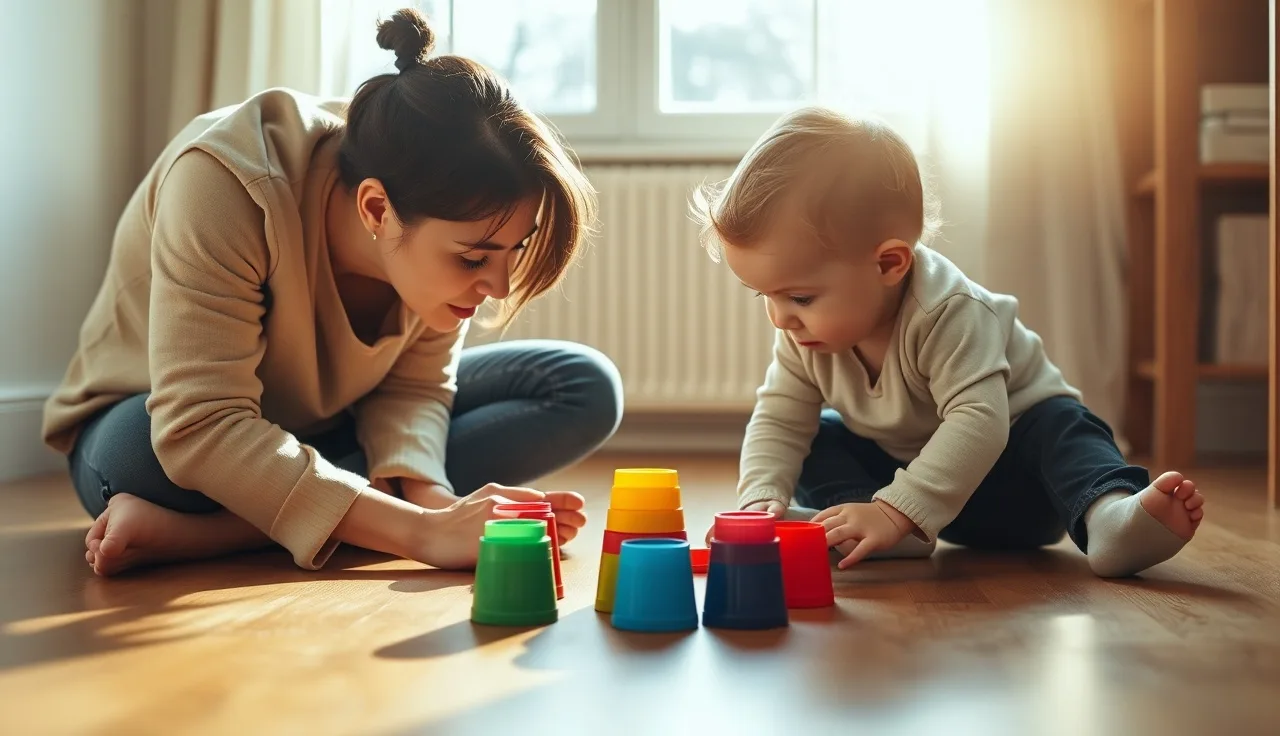
Why play beats direct teaching
Toddlers don't learn language by being quizzed. They learn it the way most young mammals learn high-stakes skills: through low-pressure, motivated, repeated experience. Play gives them all three at once.
The American Academy of Pediatrics published a clinical report in 2018 stating that "playful learning... promotes the skills that children need for success." The report points to back-and-forth play with a responsive caregiver as the mechanism that builds both vocabulary and executive function [1]. Responsive is the key word here. A caregiver who reacts to what the child does, rather than steering them toward a script, creates a setting where communication gets practiced hundreds of times an hour, and the child never feels corrected.
Joint attention comes first. Before a toddler says a word, they have to share focus on something with another person: looking at the same toy, pointing at the same bird together. Research in the Journal of Child Language found that how closely a mother followed her child's attentional lead at 11 to 14 months predicted vocabulary size at 18 months and again at 24 months [2]. Following your child's attention during play isn't a passive act. It may be the single most predictive thing you can do early on.
Flashcards and labeling drills don't produce joint attention. They produce compliance. For a child with a language delay, or a neurodivergent child who already feels pressure around communication, drilling can suppress spontaneous talk rather than build it.
What child-led play looks like
Child-led play means your toddler picks the activity and you follow along instead of directing it. It sounds simple, but most parents find it hard the first few times because it fights the instinct to teach.
Here's the concrete version. Your child grabs a dump truck and starts filling it with blocks. Rather than asking what color the block is, you pick up another truck and do the same thing beside them, narrating as you go: "Filling it up. More blocks." No quiz, no redirect toward something you'd rather they do. You match their energy and their topic.
Speech-language pathologists call this responsive interaction. A randomized trial in the American Journal of Speech-Language Pathology compared responsive interaction with a milieu teaching approach and found both improved communication, but responsive interaction produced more child-initiated communication turns [3]. Initiated turns matter because they're the child communicating for their own reasons, not just answering an adult.
Most speech-language pathologists use a rough 4-to-1 rule: for every one thing you ask or prompt, you should already have made four comments or copied four things the child did. That ratio keeps things low-pressure and floods the child with models of communication instead of questions about it.
Which activities build communication fastest
Not all play is equal for language. Activities with predictable routines, clear cause and effect, and face-to-face moments give you the most chances to model communication.
| Play type | Why it helps communication | Example |
|---|---|---|
| Cause-and-effect toys | Creates natural "more" and "again" moments | Pop-up toys, bubbles, wind-up cars |
| Simple pretend play | Builds vocabulary for actions and objects | Toy kitchen, dolls, toy animals |
| Sensory play | Reduces sensory defensiveness; opens attention | Water table, playdough, kinetic sand |
| Peek-a-boo and chase | Teaches anticipation and turn-taking | Classic peek-a-boo, tickle games |
| Book-sharing (interactive) | Builds joint attention and labeling | Board books pointed at, not read aloud |
| Building and knocking down | Creates shared excitement and a predictable script | Blocks, stacking cups |
Bubbles deserve a special mention. They're probably the most commonly recommended low-tech communication tool among speech-language pathologists, and the reasons add up: they're mesmerizing (attention), they pause naturally (turn-taking), they need a request to keep going (motivation), and the adult controls the supply (opportunity). ASHA's parent resources list blowing bubbles as a top early communication activity [4].
The same activities work for children who are minimally verbal or who use AAC devices. You just place a device or a picture symbol next to the activity so the child has a way to make requests.
Parallel play: modeling without pressure
Parallel play, where you play beside your child doing something similar without demanding interaction, is one of the safest modeling contexts around. Most parents skip right past it.
When you play next to your toddler and narrate what you're doing as if talking to yourself, the child hears language tied to actions they already understand, with zero pressure to respond. This has a name: self-talk narrates your own actions ("I'm stacking the red one"), while parallel talk narrates the child's ("You're pushing the car fast").
The evidence goes back decades. A 2004 review in Topics in Language Disorders found that self-talk and parallel talk consistently increased mean length of utterance (MLU, the standard measure of language development) in late talkers when caregivers used them over 8 to 12 weeks [5].
One adjustment does most of the work: pitch your language one step above where your child is now. If they're using single words, model two-word phrases. If they're at two words, model three. This is sometimes called telegraphic input, or targeting the zone of proximal development. Skip the full grammatical sentences if your child isn't there yet: "Car goes fast" beats "The car is going very fast." Shorter models are easier to copy.
The role of imitation
Imitation runs both ways. You copying your child matters as much as your child copying you, and probably more at the earliest stages.
When you copy what your toddler does, a sound, a gesture, an action with a toy, you're telling them several things at once: I'm watching you, what you do changes what I do, and communication goes two ways. That last point is the seed of conversational turn-taking.
A 2006 study in Infancy found that when mothers imitated their 9-to-12-month-old infants' object-directed actions, the infants produced significantly more object-related vocalizations and looked at their mother's face more than in non-imitation conditions [6]. More looks to the face means more joint attention. More vocalizations means more communication attempts. Both are exactly what you're after.
For autistic children and children with apraxia of speech, imitating the child is often a stated part of early intervention. It lowers anxiety, builds rapport, and proves to the child that their behavior counts as communication. If you've never spent a full 10-minute play session doing nothing but mirroring your child, try it once. The shift in engagement is usually immediate.
Creating opportunities without drilling
Creating chances to communicate without turning it into a drill comes down to two techniques speech-language pathologists lean on constantly: arranging the environment and leaving things strategically unfinished.
Environmental arrangement means putting wanted things just out of reach, or in plain sight but locked away. A child who can see the bubbles on the shelf but can't grab them has a reason to communicate. A child who wants more crackers at snack has a reason to signal. The setup creates real motivation that no drill can fake.
Strategic incompleteness means starting a familiar routine and pausing right before the good part. If you always sing "Row, row, row your boat" in the bath, stop before "merrily" and wait. The pause is an invitation, so don't rush it. Research on expectant waiting shows that pausing 3 to 5 seconds with an expectant face, eyebrows up, leaning slightly toward the child, produces more child communication attempts than jumping straight to a prompt [3].
A few more moves worth trying: offer a choice between two items, holding both up so the child can look at or reach for one. "Forget" a step in a familiar routine, so if you always put the hat on the doll, put it on your own head instead and wait. Play dumb: when a child points and says "uh," look at several wrong things with a puzzled face before landing on the right one, which creates a repair sequence, a genuine communicative act. Or sabotage a toy by handing over a wind-up car that's already wound down. Now they need you.
None of this needs a curriculum. It needs attention and a few small, motivated moments, repeated often.
How much play-based interaction does a toddler need each day?
The AAP recommends at least 15 to 20 minutes of uninterrupted, child-led play with a caregiver each day for toddlers, and notes this produces more language than screen-based or solo toy play [1]. There's no magic number beyond that, just a floor worth hitting.
Fifteen minutes sounds like nothing, but done with full attention and no phone, it's more than most families manage. A 2019 study in JAMA Pediatrics found parents of toddlers spend an average of under 5 minutes per hour in direct interactive play [7]. The gap between that number and the recommendation is where most language growth quietly disappears.
You don't have to script all 15 minutes, and you shouldn't. The point is that during those minutes you're on the floor, at eye level, following your child's lead. Bath time, meals, getting dressed: all of it counts, as long as you're actually interacting rather than narrating at your child while you rush through the task.
If your child is in early intervention or seeing a speech therapist, follow whatever number of daily practice minutes they assign. And on the days it feels like too much, remember that 5 minutes of real floor play beats 20 minutes of sitting nearby while you scroll.
Does this work differently for autistic toddlers?
The core principles hold: follow the child's lead, drop the pressure, imitate, use the environment to build motivation. But the application shifts in a few ways.
Joint attention, which shows up almost on its own in neurotypical toddlers, often needs deliberate support for autistic children. The Early Start Denver Model (ESDM), one of the most studied autism speech therapy approaches for toddlers, is built almost entirely on play-based interaction using these same techniques: following the child's lead, imitating, using warmth and animation to build social motivation. A randomized controlled trial published in Pediatrics in 2010 found ESDM delivered by therapists 20 hours a week produced significant gains in language, adaptive behavior, and diagnostic scores over a community-treatment control group [8]. Sensory differences drive which toys and games actually land. An autistic toddler who's hypersensitive to sound won't engage with a noisy cause-and-effect toy. One who's hyposensitive to touch might love deep-pressure sensory play. Finding that sensory sweet spot isn't a nice extra, it's the prerequisite. A dysregulated child can't learn language.
For autistic children who haven't developed functional speech by age 4 or 5, play pairs naturally with AAC. A child can use an AAC device during play the same way you'd want them to use speech: to comment, request, protest, connect. There's no evidence AAC slows speech development, and real evidence it supports it [8].
If your child repeats phrases from shows during play, that's echolalia, and it's communicative. Work with it, not against it.
Which toys actually help, and which are a waste of money?
Here's a real opinion: the priciest toys are usually the worst for communication.
Electronic toys that talk, sing, or react on their own do the communicating for the child. The child just watches and listens. No turn-taking, no joint attention, no reason to say anything. A 2016 study in JAMA Pediatrics found electronic toys were tied to reduced adult word count, fewer child vocalizations, and fewer conversational turns compared to traditional toys and books across matched 30-minute play sessions [9]. The effect wasn't small.
The best communication-building toys are open-ended and depend on you to work: bubbles and balloons you control, wind-up toys you wind, puzzles where you hand over one piece at a time, playdough where you control access to the tools, blocks and stacking cups with no batteries and endless language built in, toy food and dishes with ready-made scripts for requesting and commenting.
Board books aren't toys in the usual sense, but they belong on this list. Interactive book-sharing, where you point, label, make sounds, and respond to whatever the child does with the book, is one of the most research-backed early language activities there is. The goal isn't reading the words. It's a back-and-forth conversation about each page.
Spend your money on a mesh bag of balls, a bottle of bubbles, and a secondhand toy kitchen before you buy anything with batteries.
How do you know if it's working?
Progress isn't always new words. Early on, the signs are quieter and more meaningful than word counts. Watch for more eye contact during play (brief is fine, any increase counts), more vocalizing even if it's not words yet, more reaching or pointing or showing objects to share attention, the child starting interactions instead of just waiting to be prompted, imitation of what you model, and more tolerance for closeness and back-and-forth games.
A useful informal benchmark comes from ASHA's communication milestones: by 12 months a child should use gestures like pointing and waving, respond to their name, and babble with varied sounds. By 18 months, at least 10 words and pointing to show things. By 24 months, at least 50 words and starting to combine two words [4].
If you've done 4 to 8 weeks of consistent daily play with these techniques and seen no new behaviors, that's a signal to call a speech-language pathologist, not a reason to push harder on your own. Play-based techniques don't replace therapy when therapy is needed. They're what a good therapist teaches you to do between sessions, because sessions happen once a week and your child needs practice every day.
The Little Words app was built for that gap. It gives parents a structured way to run play-based communication activities at home, track early communication behaviors, and get guidance on when a professional evaluation makes sense. You can start a short quiz to see whether your child's profile fits what the tool is designed for.
When should you stop relying on play alone?
Play-based strategies are powerful, but they aren't a treatment for every situation, and knowing the line matters. Call your pediatrician or request a speech-language evaluation if your child has no words at 16 months, loses words they previously had at any age (regression always warrants a look), doesn't point or wave by 12 months, doesn't respond consistently to their name by 12 months, doesn't combine two words by 24 months, or if you simply have a gut feeling something's off, even if you can't name it.
Under the Individuals with Disabilities Education Act (IDEA), children from birth to age 3 are entitled to free early intervention evaluations and services if they have a developmental delay [10]. You don't need a doctor's referral, you can call your state's early intervention program directly. Services are delivered in natural environments, meaning at home and during play, by design.
For children 3 and older, services move to the school district under Part B of IDEA, which must complete an evaluation within 60 days of a parental request in most states.
Earlier help pays off. A study published in Pediatrics found children who received speech-language services before age 3 had significantly better language outcomes at age 5 than those who started after, even after controlling for initial severity [11]. Don't wait for a pediatrician to raise it if you're already worried.
How is this different from actual speech therapy?
Play-based speech therapy looks a lot like what parents do at home, and that's on purpose. The difference is clinical precision, not the activity itself.
A speech-language pathologist starts with a formal read on exactly where a child's communication is breaking down: joint attention, motor planning (see childhood apraxia of speech), vocabulary comprehension, social use of language, or something else. That assessment decides which techniques get priority, in what order, and at what level of challenge.
In a session, the SLP is also catching things most parents can't see yet: the intent behind an ambiguous gesture, the quality of eye contact, the motor patterns inside a sound. They adjust their own language complexity moment to moment based on how the child responds.
What parents do at home fills the hours between sessions, and the math makes the case for why that matters. A child in weekly 30-minute therapy gets roughly 26 hours of therapy a year. That same child is awake around 3,000 hours a year. Home is where the real volume of practice happens, and a therapist who never teaches parents these techniques is walking away from most of the potential.
If you have access to online speech therapy, many telehealth providers now build in parent coaching sessions where you learn the techniques live. That model, parent-implemented intervention guided by an SLP, has strong evidence behind it and is often easier to access than in-person services.
Frequently asked questions
What is the best way to encourage a late talker to talk during play?
Get down on the floor and join whatever your child is already doing instead of trying to steer it. Narrate the two of you in short phrases just a notch above where they're talking now, then pause for 3 to 5 seconds after you've set up a moment where they might want to say something. Comments work better than questions here. Less pressure, more fun, and you'll see more attempts to communicate.
How many words should a 2-year-old have?
ASHA's milestone guidance puts a 24-month-old at 50 words minimum, with two-word combinations starting to appear, things like "more juice" or "daddy go." There's a wide range among typically developing toddlers, but fewer than 50 words or no two-word phrases by 24 months is reason enough to ask for a speech-language evaluation. Early intervention before age 3 is free in the US under IDEA.
Can I really teach communication through daily routines, or does it have to be dedicated play time?
Routines often work better than dedicated play time, since they happen constantly and already matter to your child. Bath time, diaper changes, meals, getting dressed: all of these have predictable scripts you can build pauses and choices into. The only trick is staying interactive through them instead of rushing through the steps while your child stays passive on the sidelines.
My toddler doesn't seem interested in playing with me. What do I do?
Watch what they do on their own for a few minutes first, then start doing the same thing nearby without asking them to interact. A lot of children warm up once you stop redirecting them. Match their sensory style: if they spin things, spin something next to them; if they line up cars, line up your own cars beside theirs. Wanting to play with you tends to grow out of feeling understood, not the other way around.
Do screen-free play requirements mean no TV or videos at all?
The AAP recommends no screen media at all under 18 months (except video calls), and about an hour a day of high-quality programming for ages 2 to 5. The real issue is opportunity cost: time in front of a screen is time not spent in the interactive play that builds language. A short video watched together, with a caregiver commenting and asking questions, does far less harm than the same show watched alone.
What is joint attention and how do I build it during play?
Joint attention is two people focused on the same thing at the same moment: both watching a bird, both reacting to a toy. It's the foundation communication is built on. To build it, follow your child's gaze instead of redirecting it, point at things they already like, and watch whether they check your face. Imitating their actions helps too. Joint attention grows out of being noticed, not directed.
Does bilingual or multilingual exposure slow communication development in toddlers?
No. Research consistently shows bilingual children reach communication milestones on the same timeline as monolingual children once you count words across both languages together. Mixing languages (code-switching) is normal and not a sign of confusion. If a bilingual toddler is behind in both languages combined, that's worth looking into, but bilingualism itself isn't the cause of a delay.
Should I correct my toddler when they mispronounce words or use wrong grammar?
Leave direct corrections out of it. They don't work, and they add pressure that makes kids clam up. Use expansions instead: if your child says "dat buh" while pointing at a bus, you say "yes, that's a bus, big bus." You're modeling the correct form without putting a spotlight on the mistake. Research backs recasting and expanding over correction, and it keeps the conversation going instead of stalling it.
My child uses the same phrases from TV shows instead of spontaneous language. Is that a problem?
That's delayed echolalia, and it's common in autistic children and some late talkers. It's communicative, not meaningless, since many children use scripted lines from shows to express real feelings or needs. The better approach is responding to what they're trying to say through the script rather than trying to eliminate the script. A speech-language pathologist can help spontaneous language grow alongside it.
How long does it typically take to see results from play-based communication strategies?
Most research on parent-implemented play strategies shows measurable change within 8 to 12 weeks of consistent daily practice. Behavioral signs usually show up before verbal ones: more eye contact, more vocalizing, more reaching or pointing. Actual word growth tends to lag behind those early social gains. If 8 weeks of steady effort brings no change at all, that's the point to get an evaluation.
What role does reading aloud play in toddler communication?
Interactive book-sharing is one of the strongest evidence-based tools for building early vocabulary, and the point isn't reading the text word for word but talking about the pictures: pointing, labeling, making sounds, responding to whatever your child does. A 2019 meta-analysis in Pediatrics found shared reading interventions significantly improved language outcomes in children ages 0 to 5. Five minutes of that kind of back-and-forth beats 20 minutes of being read at.
Can play-based strategies help if my child is nonverbal?
Yes, and they matter even more here. The goal shifts away from producing words and toward joint attention, intentional communication, and turn-taking, the groundwork any communication system needs, whether that's speech, AAC, or signing. Many nonverbal children who get early play-based support plus AAC go on to develop functional verbal communication. Start now rather than waiting for speech to show up before building the rest of the foundation.
Sources
- American Academy of Pediatrics, Clinical Report: The Power of Play (2018): AAP states that playful learning with a responsive caregiver promotes vocabulary and executive function in toddlers, and recommends at least 15-20 minutes of child-led play with a caregiver daily
- Tomasello & Farrar, Journal of Child Language (1986), with replication work showing maternal attentional following at 11-14 months predicts vocabulary at 18 and 24 months: Amount of time a mother followed the child's attentional lead at 11-14 months predicted vocabulary size at 18 and 24 months
- Yoder & Warren, American Journal of Speech-Language Pathology (2002), randomized trial of responsive interaction vs milieu teaching: Responsive interaction training produced more child-initiated communication turns than milieu teaching; expectant waiting of 3-5 seconds produces more child communication attempts than immediate prompting
- American Speech-Language-Hearing Association (ASHA), Communication Milestones: ASHA milestones: 10 words by 18 months, 50 words and two-word combinations by 24 months; bubbles listed as top early communication activity
- Heimann et al., Infancy (2006), infant vocalizations and looks to mother during imitation conditions: When mothers imitated their 9-12 month infants' object-directed actions, infants showed significantly more vocalizations and more looks to mother's face than in non-imitation conditions
- Madigan et al., JAMA Pediatrics (2019), screen time and parent-child interaction study: Parents of toddlers spend an average of under 5 minutes per hour in direct interactive play
- Dawson et al., Pediatrics (2010), randomized controlled trial of Early Start Denver Model: ESDM delivered 20 hours per week produced significant gains in language, adaptive behavior, and diagnostic scores vs community treatment; no evidence AAC slows speech development
- Sosa, JAMA Pediatrics (2016), electronic toys and language in infants: Electronic toys were associated with reduced adult word count, reduced child vocalizations, and fewer conversational turns compared to traditional toys and books
- Individuals with Disabilities Education Act (IDEA), Part C early intervention, U.S. Department of Education: Children birth to age 3 are entitled to free early intervention evaluations and services under IDEA Part C; no doctor's referral is required to request an evaluation
- Glogowska et al., Pediatrics (2000), outcomes of speech-language therapy before vs after age 3: Children who received speech-language services before age 3 showed significantly better language outcomes at age 5 than children starting services after age 3, controlling for initial severity
- Flack et al., Pediatrics (2019), meta-analysis of shared reading interventions ages 0-5: Shared reading interventions significantly improved language outcomes in children ages 0-5 in meta-analysis