Last updated 2026-07-10
Squeeze a cold ball of slime, splash in a water table, or feel sand shift underfoot, and something happens in the brain that also drives early talking. Water play, shaving cream, messy food, and movement games create little jolts of surprise that naturally pull sounds, words, and requests out of a child who might otherwise stay quiet. Speech-language pathologists lean on sensory-motor experiences constantly when building early communication, especially with late talkers and autistic children. What matters most isn't the material itself but what you do around it: model a word, pause, and actually wait.
Why sensory play helps kids talk
Sensation and vocalization share circuitry. When a child squeezes cold slime or feels sand shift, the nervous system lights up, and that arousal makes a child more alert and more likely to make a sound. Speech-language pathologists often describe this through sensory-motor integration: the idea that movement and sensation prime the motor systems used for communication. The American Speech-Language-Hearing Association ties early communication development to sensory and motor experiences, particularly in infants and toddlers [1]. Cut sensory input and you often see less communicative intent. Add it back in, playfully and without pressure, and sounds tend to follow.
There's a social piece too. Sensory play produces real emotional reactions: surprise, delight, a little disgust, laughter. Those reactions are exactly the shared moments that invite a comment or a protest. A child with no words yet will often let out a vowel sound or a squeal simply because the sensation was too unexpected to sit through quietly.
Nobody has clean randomized trial data on sensory play as a standalone intervention for vocalization. The closest evidence comes from studies of naturalistic developmental behavioral interventions, which build sensory and play-based routines into communication teaching and show gains in expressive language [2]. Sensory play is the delivery mechanism, not the magic itself. The magic is the communication opportunity you build into it.
Which sensory activities pull out the most sounds
The activities that work best for drawing out sound share three things: a clear physical reaction, easy repeatability, and a natural pause where you can wait for a response. Some sensory play is better suited to calming a child down. This kind is built for communication.
Tactile play is the most studied and easiest to set up. Shaving cream on a tray, kinetic sand, water beads, cooked spaghetti, slime, finger paint: the child's hands stay busy, the sensation is new, and the second you stop, they often look at you or vocalize to get it going again. That look or sound is communication, so reward it by continuing right away.
Movement play is underrated for this purpose. Spinning in a desk chair, bouncing on a therapy ball, swinging, rough-and-tumble games: these raise arousal in most kids and tend to produce involuntary laughs, squeals, and proto-words. Occupational therapists and SLPs sometimes co-treat for exactly this reason, since movement input before a speech session can raise a child's readiness to communicate [3].
Deep-pressure play, like heavy lifting, pushing a loaded laundry basket, crashing into pillows, or wearing a weighted lap pad, calms rather than excites. That makes it useful for children who shut down instead of vocalizing under typical conditions; getting regulation right first is sometimes what has to happen before any sound shows up at all.
Sound-based play deserves its own mention. Musical instruments, sound toys, and cause-and-effect apps with instant audio feedback are sensory experiences in their own right, and children drawn to sound often vocalize just to recreate or extend an interesting noise. This helps children who show strong auditory interests or echolalia; our article on echolalia goes into more depth on how repeated sounds function developmentally.
Oral sensory play, things like chewing on textured chew tools, blowing bubbles, or using a vibrating toothbrush, works the same muscles and nerves used in speech. ASHA's technical reports note that oral-motor activities work best folded into functional communication tasks rather than practiced on their own [1]. Bubbles are the classic example: you blow, the child laughs, you wait, the child reaches or approximates "more." That loop is the whole point.
The sensory-motor link to early speech
Speech is a motor skill, and that's easy to forget. Before a child can say "mama," they need hundreds of thousands of oral-motor practice reps, enough breath support to sustain phonation, enough body regulation to stay calm and alert, and enough sensory feedback to know what their own mouth is doing. Sensory play works on several of these at once.
Research on sensory processing through the STAR Institute shows that sensory modulation differences, meaning how children register and respond to sensation, directly affect participation in daily activities including communication [3]. A child who's under-responsive to sensation may need more intense input before vocalizing feels worth the effort. A child who's over-responsive may need gentler, more predictable input so they aren't too dysregulated to engage with a communication partner.
The most directly relevant study here is Kasari and colleagues' 2014 randomized trial of the JASPER intervention, published in the Journal of Child Psychology and Psychiatry. JASPER (Joint Attention, Symbolic Play, Engagement and Regulation) uses play-based routines with naturalistic prompting and showed real gains in spontaneous communication acts among minimally verbal autistic children [4]. Sensory play was built into many of the routines, and children who received JASPER made greater gains in initiating joint attention and producing communication acts than the control group.
For late talkers without an autism diagnosis, the same pattern holds. The AAP's guidance on early intervention notes that play-based activities in natural environments are among the most effective contexts for language stimulation in toddlers [5]. You don't need a clinic. You need an activity the child actually wants, and a parent who knows how to wait.
Setting up a session that actually gets sounds out
The setup matters more than whatever material you pick. Put the interesting item slightly out of reach, or hold it yourself at first; speech therapists sometimes call this "sabotage." The moment a child wants something they can't get on their own, they have a reason to communicate, and that's your opening.
Get down on the child's level and do the activity with them rather than for them. Put your own hands in the shaving cream. Narrate what you feel in short phrases: "Cold! Ooh, cold." This models the words and sounds that label the experience without pressuring the child to repeat anything.
Then wait, on purpose. After doing the activity together, stop, look at the child expectantly, and count silently to ten. This time delay is one of the most evidence-supported prompting strategies in speech-language pathology [6]. Most parents rush to fill the silence; resist that urge, because the silence is doing the work.
React big to any sound the child makes, even a rough approximation. Respond right away, with real enthusiasm, and restart the activity as the reward. This is natural reinforcement rather than a formal reward chart, and it teaches the child that sound has power over what happens next.
Pick one core word for the session, something like "more," "go," "stop," "up," or "open." Model it every time the child seems to want the activity to continue or change, without asking them to say it back. Just say it yourself, in context, over and over. Across enough sessions, the word starts to attach itself to the experience.
And keep sessions short. Fifteen to twenty minutes of sensory play a child is genuinely into beats an hour of structured activity they're just tolerating. Watch for the moment they start to disengage, and stop before you get there.
Which sensory activities get the most sounds out of kids?
Based on what SLPs and early intervention specialists report, some materials work far more reliably than others.
Water play tops the list. Almost every child likes it, it can go on forever, and it produces natural exclamations on its own. Filling and dumping cups, splashing, pouring through funnels, hiding small toys underwater: all of these build in moments where a child has something to say. "More" tends to show up first, then "splash," "wet," "pour," "go."
Bubbles are a speech therapy staple for good reason. They catch the eye, they disappear (which forces a request for more), they invite pointing and eye contact, and blowing them gives a child oral-motor practice. If your child has low oral-motor strength, just have them watch you blow bubbles and wait for any response at all. That's a solid starting point.
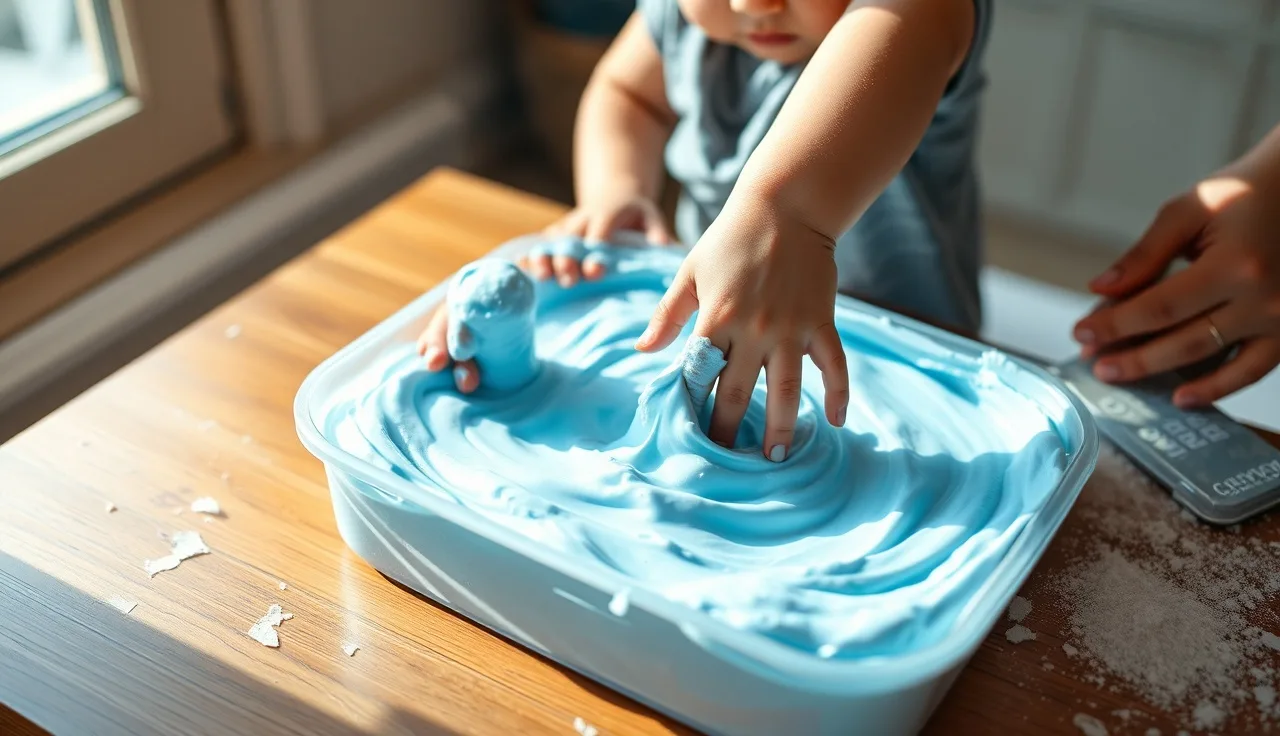
Slime and goo pull strong reactions out of kids. A child who's tactilely defensive might resist at first, then loosen up once they watch a caregiver enjoying it. The "ew" and "wow" these materials trigger are exactly the emotional exclamations that come before real words.
Swings and spinning reliably get spontaneous sounds out of sensory-seeking children in particular. The trick is to control it: push the swing a few times, then stop and wait. The child looks at you, reaches for you, or vocalizes to ask for more. All of that counts as communication.
Drums, shakers, and simple xylophones work the same way. Stop the music and wait, and the child has to do something to get the sound going again.
Messy food play, smashing cooked peas, squishing a banana, painting with yogurt, sits somewhere between sensory play and feeding therapy. For kids with food texture aversions it can also open a path toward eating new foods, though that's a separate goal. For vocalizations, it's the reaction to an unexpected texture that pays off.
Does this look different for autistic kids versus late talkers?
The activities overlap a lot. What changes is why the child isn't vocalizing, and how you shape the play around that.
A late talker without other diagnoses usually understands plenty already and wants to communicate, but expressive language lags behind. Sensory play works here mostly by raising motivation and creating natural openings. Many of these kids have a real burst in vocalizing once they realize that making a sound gets a result, and the stop-and-wait strategy tends to work especially well with this group.
Autistic children vary more. Some are sensory-seeking and respond hard to input, with more vocalizing, scripted sounds, or vocal stimming, all of which can be a starting point for communication. Others are sensory-defensive and need a slow, predictable introduction to new materials before they can even focus on a play partner. Pushing a sensory-defensive child into messy play won't produce vocalizations; it will produce distress. AAC belongs in this conversation too. For minimally verbal autistic children, pairing sensory play with an AAC system bridges the gap between wanting to communicate and being able to say the word out loud. ASHA's Practice Portal notes that AAC use doesn't inhibit speech development and may actually support it [1]. Our overview of AAC devices covers the tool options in more depth.
For children with childhood apraxia of speech (CAS), sensory play plays a smaller role. The motor planning problem means even a motivated child struggles to produce consistent sounds. Oral-sensory input, vibration, texture on the face and mouth, can help with awareness and feedback, but it doesn't replace the intensive, repeated motor practice apraxia requires. Our piece on childhood apraxia of speech covers this in full.
Whatever your child's profile, a formal evaluation is worth getting before you settle on an approach. Early intervention services are free for children under three in the United States under IDEA Part C [7], and you don't need a diagnosis to get an evaluation started.
Can parents do this without a therapist?
Yes, and the research backs it up.
Parent-coaching models like the Parent-implemented Communication Strategies (PiCS) framework show that when parents are trained to build communication facilitation into everyday play, children make real gains in early communication [8]. The key word is trained. A few sessions with an SLP who shows you exactly what to do and what to watch for will beat reading about it, this article included.
Still, you have enough here to start today. Set up a water bin, sit with your child, do it together, stop and wait, react to every sound. Do that for fifteen minutes a day and you're already doing more than most families do.
If your child is under three with no words or very few, contact your state's early intervention program. It's free, an SLP will evaluate, and if your child qualifies, services follow. Past age three, the school district takes over under IDEA Part B [7]. If waitlists are long, online speech therapy is worth considering: research on telepractice shows outcomes comparable to in-person care for many children [9].
Little Words (littlewords.ai) can be a useful companion between therapy sessions. It's built for neurodivergent kids and walks parents through play-based communication activities with modeling prompts. You can take the quiz at littlewords.ai/start to see if it fits your child's current stage. It's not a replacement for an SLP and doesn't claim to be.
The honest version of this answer: home practice works best once a professional has pointed you toward the right strategies for your specific child, and you run those strategies consistently. The framework above applies broadly; the fine-tuning depends on your kid.
What about sensory sensitivities?
Some children actively avoid certain textures or inputs. A child who won't touch anything wet or sticky isn't being difficult, their nervous system is genuinely responding differently. Forcing contact backfires: the child learns to associate that material with distress, which makes future communication attempts around it even harder.
Start with distance. Put the shaving cream on a tray and let the child watch you play with it, no pressure to touch. Narrate what you feel, react to it yourself. Some kids will touch it within a single session; others need weeks.
Tools help too. A spoon, popsicle stick, or paintbrush lets a child interact with a texture without direct skin contact. That's not cheating, it's graduated exposure building tolerance over time.
Watch for signs the input is too much: covering ears, fleeing, shutting down, aggressive behavior, a sudden jump in stereotyped movement. Those are signals to dial back, not to push harder.
If sensory defensiveness is getting in the way of daily life, an occupational therapist with sensory integration training is the right person to bring in. SLPs and OTs often co-treat for exactly this reason: the OT handles sensory preparation while the SLP handles communication, and a joint session can be remarkably efficient. Speech therapy for autistic kids often involves exactly this kind of team approach.
How long before you see more vocalizing?
It varies enormously, and there isn't great data on timelines for sensory play specifically.
The NDBI literature shows children in naturalistic, play-based intervention starting to show gains in communication within eight to twelve weeks of consistent practice [2]. The Kasari 2014 JASPER study found gains in spontaneous communication within ten weeks of intervention at around five hours a week [4], but that's structured, therapist-led work, more intensive than home sensory play. Home practice with parent coaching tends to follow a similar trajectory but often takes longer, since implementation isn't as consistent. For a late talker without other diagnoses, parents often report the first sound reliably tied to a specific activity within two to four weeks of daily practice. That's not a word yet, it's a proto-word or a consistent sound linked to context, but it's a real milestone.
If you've done daily sensory play for six weeks with no change at all in vocalizing or communicative intent, that's worth paying attention to and worth raising with a speech-language pathologist. Some kids need more structured prompting, some have motor or sensory differences that need a professional look, and some, like kids with apraxia, need more than sensory play alone can offer. An SLP evaluation will help clarify what's going on.
Consistency beats perfect execution here. A daily fifteen-minute session with a caregiver who reacts to every sound will outperform a weekly "sensory play event" the child isn't even motivated to join.
What does the research actually say about sensory play and speech?
Sensory play shows up as a solid piece of naturalistic communication interventions, but almost nobody has studied it as a standalone variable. Most of the supporting evidence comes from studies of interventions that combine sensory play with modeling, time delay, and joint attention.
The National Research Council's 2001 report 'Educating Children with Autism' identified naturalistic behavioral interventions, many of them sensory and play-based, as among the approaches with the strongest evidence base [10]. The What Works Clearinghouse has reviewed several of these. JASPER, for one, has 'strong evidence' of efficacy by WWC standards [4].
A 2010 systematic review by Flippin, Reszka, and Watson in the American Journal of Speech-Language Pathology looked at parent-implemented language interventions and found 'moderate evidence' that parents coached in naturalistic strategies produced gains in child communication [8]. The play-based activities in those studies were sensory-rich: toys, water, physical play, cause-and-effect materials.
The AAP's 2022 clinical report on autism notes that early communication intervention should begin as soon as developmental concerns arise and should happen in natural environments using play-based strategies [5], and it calls the evidence for intervention before age three particularly strong.
What we don't have is a randomized trial comparing, say, shaving cream play to no sensory play in otherwise identical intervention conditions. Nobody has run that study. So when this article says sensory play helps, it means sensory play is a component of interventions that work, and the link between sensation, arousal, and vocalization is neurologically plausible and matches what speech-language pathologists see in practice day to day. That's enough to act on. It's not enough to call proven on its own.
If your child is enrolled in early intervention services, ask your SLP how they use sensory play in sessions, and ask them to show you so you can copy it at home. The partnership between therapist and parent is where results actually come from.
Fitting sensory play into the bigger picture
Sensory play is one tool among several. A good communication support plan has layers.
The foundation is relationship and responsiveness. Children communicate more with caregivers who notice and answer their earliest signals, whether that's a reach, eye contact, or a pre-verbal sound. Before any specific activity, the most powerful thing a parent can do is slow down and follow the child's lead.
On top of that comes language input: speaking simply, labeling experiences, narrating what's happening without demanding a response. Sensory play gives you plenty to narrate. "Wet! It's so cold. More water? Yeah, more."
Then come specific prompting strategies, things like time delay, modeling, and expectant waiting. These fit inside any sensory activity without much extra effort.
For some children, especially those who are minimally verbal, a speech-generating device or picture-based system sits alongside the play. Touching "more" on a device after a sensory activity produces the same motor and cause-effect learning as saying the word out loud.
For children with motor-based speech challenges, you layer in the techniques used in apraxia therapy, which prioritize consistent motor practice over sensory stimulation. Sensory input still helps with awareness, but it isn't the main event there.
Little Words can support the narration and modeling piece at home, especially for parents unsure what to say or when to say it during play. Visit littlewords.ai to see how the app structures this kind of guided support.
No single strategy works for every child. What actually moves the needle is a good evaluation, a clear sense of how your child communicates and processes sensation, and consistent daily practice with a caregiver who knows what to look for.
Frequently asked questions
When should I start using sensory play to encourage talking?
You can start in the first year of life. Sensory play supports communication well before words show up, because it builds joint attention, arousal regulation, and the back-and-forth patterns between caregiver and child that come before language. The AAP recommends play-based language stimulation beginning in infancy, and if you're seeing delays at 12, 15, or 18 months, sensory play alongside early intervention services is a reasonable place to start.
My child vocalizes during sensory play but the sounds aren't words. Is that progress?
Yes. Vowel sounds, consonant-vowel combinations, and emotional sounds like laughing or exclaiming are all developmental steps toward words, and ASHA's communication milestones count them as meaningful. If your child makes a consistent sound tied to a specific activity or want, that's already a communication act. Keep modeling and reacting to it, and words tend to follow.
Can sensory play help a child who doesn't respond to their name?
Sensory play by itself won't fix limited name response, which can be a sign that a full developmental evaluation is needed. But a highly motivating sensory activity can create more moments of joint attention, when your child turns toward you and shares focus with you, and those moments are practice for the social referencing that name response depends on. If your child isn't consistently responding to their name by 12 months, contact your pediatrician and ask for a developmental screening.
What if my child plays alone with the materials and never looks at me?
Put yourself in their line of sight, between the child and the material, so you become the gatekeeper to the thing they want. Hold the container of water beads and wait. Parallel play with the occasional friendly intrusion is a fine place to start: you're teaching your child that another person is the source of the good thing, which is exactly the social referencing that leads to joint communication. Don't take the material away, just control how much of it flows.
Is water play actually safe for toddlers in a speech therapy context?
Water play is standard in early intervention and pediatric speech therapy. Use shallow water in a bin or sensory table, stay within arm's reach, and supervise the whole time. A few inches of water in a plastic bin isn't a drowning risk with an attentive adult right there. Room-temperature water also helps avoid a strong aversive reaction, which matters especially for sensory-sensitive children.
Do I need special toys or materials for this?
No. A bowl of dry rice, cooked pasta, water, a sandbox, dish-soap bubbles, or a bin of dry cereal all work, and many SLPs simply use whatever is already in a family's home during early intervention visits. What matters is what you do with the material: get involved, narrate simply, pause and wait, react to every sound your child makes. A bag of dried beans works just as well as an expensive sensory kit.
Can sensory play replace actual speech therapy sessions?
No, but it's a legitimate way to extend learning between sessions and into daily routines. Research on parent coaching models shows that gains from therapy are larger and stick better when parents carry the strategies home. Sensory play at home is the daily practice that makes the weekly therapy session go further, not a substitute for professional evaluation and treatment.
My child with autism loves to stim with sensory materials. Is that still useful for communication?
Often it's even more useful. A child who's strongly drawn to a specific sensory input is showing a clear want, and that's the foundation communication is built on. Use that preferred material as a motivator: control access to it, wait for any communicative signal, then hand it over. Watching how your child stims with materials also tells you which kinds of input are most likely to produce vocalizations.
How do I know if it's a sensory processing issue or my child just doesn't like certain materials?
There's no hard line here; sensory differences exist on a spectrum. If avoidance or seeking behavior is getting in the way of daily life, feeding, dressing, or joining in play and learning, an occupational therapist trained in sensory integration can help sort out a typical preference from something that needs attention. Disliking one texture is normal. Distress across multiple everyday sensory experiences is worth having evaluated.
Should I talk a lot during sensory play, or stay quiet and give my child space?
Both matter, and the right balance depends on the child. Generally, model short phrases, three words or fewer, then pause. You're demonstrating language, not lecturing. A real pause after you speak signals that you're expecting a response and gives your child room to fill it. The common mistake is narrating nonstop, which leaves no gap for your child to jump into. Narrate, pause, react.
Are there sensory activities I should avoid for late talkers?
Avoid anything that reliably dysregulates your particular child. Crying, fleeing, shutting down, or aggression are signs of distress, not steps toward communication. Strong smells, loud or unpredictable sounds, and intense tactile input can overwhelm some kids. Start with predictable, low-intensity experiences and build up from there based on what your child actually tolerates and enjoys.
Can I use mealtimes as sensory play to help with talking?
Yes, it's often a natural fit. Finger foods and foods with interesting textures or temperatures double as sensory input and feeding practice, and children who treat food as something to explore often grow more comfortable with the oral-tactile demands of eating. Keep the mood low-pressure; food play is messy on purpose. Mealtimes also bring rich chances to request, comment, and refuse, all real communication.
My child makes sounds during sensory play but goes silent when I try to model words. What's going on?
That's common and not a bad sign. When you suddenly start modeling words, the social demand shifts, and some children go quiet in response. Try modeling while you're both focused on the activity instead of looking directly at your child, facing the materials rather than each other. That way your words become part of the background of play instead of a demand. As your child gets used to the routine, the silence during modeling usually fades.
How does sensory play connect to AAC for nonverbal children?
Sensory play creates strong motivation, and that's exactly when AAC is most natural to use. If your child wants the swing to keep going, putting an AAC device or a picture card for "more" or "go" within reach gives them a tool to act on that want. Pairing a high-desire sensory experience with consistent AAC access and modeling is a core strategy in augmentative communication practice, and ASHA explicitly supports using AAC alongside natural speech development.
Sources
- American Speech-Language-Hearing Association (ASHA), Practice Portal: Late Language Emergence: ASHA notes that early communication development is tied to sensory and motor experiences; AAC use does not inhibit speech development and may support it
- Schreibman et al., 'Naturalistic Developmental Behavioral Interventions,' Journal of Autism and Developmental Disorders, 2015: NDBIs that embed sensory and play-based routines into communication teaching consistently show gains in expressive language; children show gains in communication acts within 8-12 weeks
- STAR Institute for Sensory Processing, Research Overview: Sensory modulation differences directly affect participation in daily activities including communication; vestibular input before a speech session can raise communicative readiness
- Kasari et al., 'Communication Interventions for Minimally Verbal Children with Autism,' Journal of Child Psychology and Psychiatry, 2014: JASPER intervention showed significant gains in spontaneous communication acts and joint attention in minimally verbal autistic children within 10 weeks; WWC rates it 'strong evidence'
- American Academy of Pediatrics, Autism resources and 2022 Autism Clinical Report: AAP recommends play-based language stimulation beginning in infancy; early communication intervention should begin as soon as developmental concerns arise and occur in natural play-based environments; evidence for intervention before age three is particularly strong
- Snyder et al., 'Time Delay Procedures in Early Childhood Special Education,' Journal of Early Intervention, 2015: Time delay is one of the most evidence-supported prompting strategies in speech-language pathology for eliciting child communication
- U.S. Department of Education, Individuals with Disabilities Education Act (IDEA), Part C and Part B: Early intervention services are available free for children under three under IDEA Part C; over age three, school districts provide services under IDEA Part B
- Flippin, Reszka, & Watson, 'Effectiveness of the Picture Exchange Communication System (PECS) on Communication and Speech,' American Journal of Speech-Language Pathology, 2010: Systematic review found moderate evidence that parent coaching in naturalistic strategies produces gains in child communication; play-based activities with sensory-rich materials appeared in supporting studies
- ASHA, 'Telepractice,' Practice Portal: Telepractice outcomes are comparable to in-person services for many pediatric speech-language populations
- National Research Council, 'Educating Children with Autism,' National Academies Press, 2001: Naturalistic behavioral interventions, many of which are sensory and play-based, are among the approaches with the strongest evidence base for autism communication intervention