Last updated 2026-07-10
TL;DR
YouTube can genuinely help a late talker, but only if you treat it as something you do together rather than something that babysits. Pause often, narrate what's on screen, imitate characters, and choose videos with slow, clear speech and repeating language. Watched alone, none of that happens. Watched side by side, with your attention locked onto the same thing your child is looking at, it can build real language, especially for kids who already love video.
Does YouTube actually help, or is it just screen time?
It depends almost entirely on how you use it.
Passive screen time, the kind where a child watches alone while you do something else, hasn't been shown to build expressive language in late talkers. The American Academy of Pediatrics says plainly that solo video viewing doesn't teach language the way live interaction does, and a 2019 study in JAMA Pediatrics found that more handheld screen time at 18 months was linked to expressive speech delays at 24 months [1][2]. That finding was about unstructured solo use.
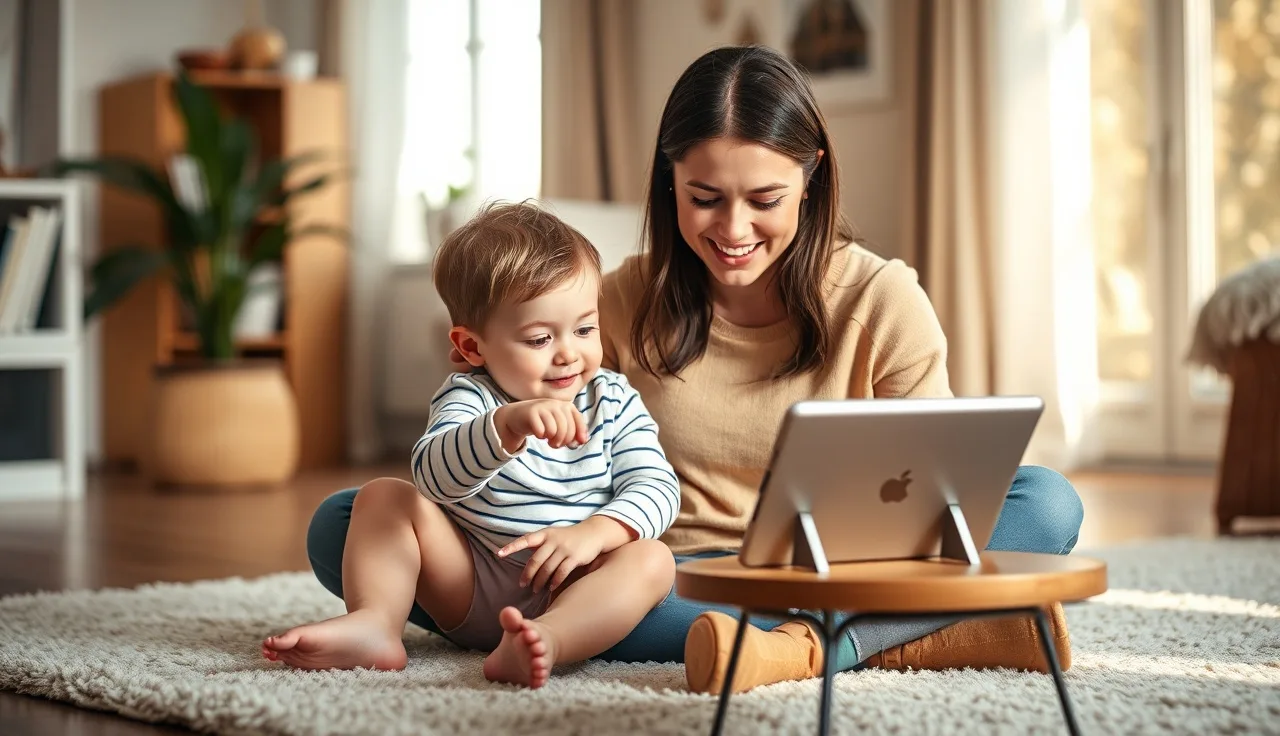
The picture changes when you sit next to your child, pause the video, talk about what's happening, and respond to any sound or word they make. That pattern (joint media engagement) mirrors what speech-language pathologists call "aided language stimulation": you model language in real time, tied to something the child already cares about. The video becomes the shared focus, and you become the language scaffold wrapped around it.
So no, YouTube isn't a therapy replacement. It's also not automatically harmful. Think of it less as a teaching tool and more like a picture book that happens to move and talk: useful mainly when you read it together.
What the research actually shows
The research is genuinely mixed, and anyone who gives you a clean answer in either direction is oversimplifying.
On the cautionary side, a widely cited study by Zimmerman et al. (2007) in the Archives of Pediatrics and Adolescent Medicine found that baby DVD viewing was associated with lower vocabulary scores, not higher [3]. The video deficit effect is real and has been replicated: children under roughly 30 months learn words far less well from video than from a live person saying the same things. Researchers think this is partly because infants and toddlers struggle to map 2D images onto 3D reality, and partly because video simply doesn't respond to them. On the hopeful side, video works better under certain conditions. A 2014 study in Child Development found that video chat (like FaceTime) produced better word learning than recorded video, because the person on screen responded to the child in real time [4]. That contingent response, the screen "reacting" to what the child does, seems to be the deciding factor. It's exactly why you, sitting next to your child and pausing to respond, can approximate that same contingency even with a recorded video.
For autistic children specifically, some research has looked at video modeling, where a child watches a peer or adult perform a skill and then imitates it. A meta-analysis in the Journal of Positive Behavior Interventions found video modeling effective for teaching a range of skills, including communication, to children with autism spectrum disorder [5]. The trick is keeping the video short and targeted, then giving the child a chance to practice right away.
Nobody has good population-level data on YouTube specifically as a therapy tool. The closest we can get is extrapolating from the video modeling and joint media engagement research.
How to actually watch together
This is the practical version, drawn from what SLPs do in sessions.
Pause constantly. This is the single most important habit. Every 20 to 30 seconds, stop and say what you just saw: "The dog jumped! Jump, jump." Give your child a second to respond with any sound, word, or gesture, and don't rush past the silence. That pause is where the learning happens.
Narrate in simple language, matched to one or two words above where your child is right now. If your child isn't talking yet, use single words: "ball," "go," "up." If your child says one word, answer in two-word phrases. SLPs call this "expansion," or following the child's lead, and ASHA lists it as a core parent-implemented strategy [6]. Imitate what the video does, physically. If a character jumps, jump. If a character claps, clap together. Tying movement to language helps some children, especially kinesthetic learners or kids with limited imitation skills, and it keeps the whole thing fun, which matters for motivation.
Comment instead of quizzing. Resist asking "what's that?" every thirty seconds, since questions can put a child on the spot and produce silence or frustration instead of speech. Comment instead: "Oh, a big truck." "She's eating, yum." Comments model language without demanding a performance, and if your child labels something on their own, celebrate it. Watch the same video over and over. Repetition isn't laziness, it's how children learn language. The tenth time your child watches a video about buses, they might finally say "bus," because the word has become predictable and safe. Novelty is overrated in early language learning. Keep sessions short. Fifteen to twenty minutes of active joint watching beats an hour of passive solo viewing. If your child checks out, stop and do something else.
Which videos actually work best
Not all kids' content is equal for language learning. Look for slow, clear speech (Signing Time and simple nursery rhyme channels do this well) because it's easier for emerging listeners to parse. Repetitive language, like a repeating chorus or script, builds prediction and word retrieval. Minimal on-screen text keeps focus on spoken language rather than reading, which is why puppet shows and simple animations tend to work. Real objects or faces, the Mr. Rogers style of direct address, or videos of cooking with kids, reduce the video deficit effect. Short clips under five minutes match a toddler's attention span, and calm, slow-paced animations without fast cuts or flashing keep sensory overload down.
| Feature | Why it helps | Examples of video types |
|---|---|---|
| Slow, clear speech | Easier for emerging listeners to parse | Signing Time, simple nursery rhyme channels |
| Repetitive language | Builds prediction and word retrieval | Videos with repeating choruses or scripts |
| Minimal on-screen text | Keeps focus on spoken language | Puppet shows, simple animations |
| Real objects or faces | Reduces the video deficit effect | Mr. Rogers-style direct address, cooking with kids |
| Short clips (under 5 min) | Matches toddler attention span | YouTube Kids short clips |
| No fast cuts or flashing | Reduces sensory overload | Calm, slow-paced animations |
If your child is drawn to one specific thing, a train, an animal, a color, lean into it. A kid obsessed with garbage trucks who watches garbage truck videos with you is picking up rich vocabulary around something they actually care about. Interest-based learning is a real scaffold, not a shortcut.
Steer away from videos with rapid scene changes, loud sound effects every two seconds, or several characters talking over each other. Those formats grab attention but don't support language, and plenty of popular kids' channels optimize for engagement and color rather than clear speech, so "made for kids" doesn't mean "good for language."[7]
What about echolalia?
Yes, video can help here too, and it's one of the more interesting angles.
Many children, particularly autistic children, use echolalia, repeating phrases from videos, songs, or scripts they've heard. For a long time this got dismissed as non-communicative or even harmful. The current view is more nuanced: Prizant and Duchan documented as early as 1981 that echolalic utterances often serve real communicative functions, and the field has largely moved toward treating echolalia as a developmental starting point rather than a problem to erase [8].
For children who echo video scripts, YouTube can work as a bridge. If your child has memorized a phrase from a video, use it as a communication anchor: say the beginning of the familiar script and pause, letting your child finish it. That's a real exchange, even if the words started on a screen. Over time, scripted language often loosens into flexible language as children discover the words work in new contexts.
If your child leans heavily on video scripts, mention it to a speech therapist, who can help you spot which scripts are already functional and how to build new language from them. For more on what this looks like developmentally, see echolalia meaning.
Using video modeling at home
Video modeling is a technique where a child watches a short clip of someone doing a target behavior, then gets a chance to imitate it. It's been studied most in autism intervention, but the basic idea can work for any child who learns well visually. To try a simple version at home, find or record a very short clip (30 to 90 seconds) of someone doing or saying exactly what you want your child to practice: asking for a snack, waving hello, saying a two-word phrase. Watch it together once or twice, then immediately set up a real chance for your child to try the same thing.
Video modeling works best for children who already imitate a bit. If your child doesn't yet reliably copy actions or sounds in person, this technique will do less than working on live imitation first, so it's worth asking your SLP whether your child is a good fit for it. One practical note: you can record yourself or family members on your phone and play the clip back on any video app. Grandma saying "hi, wave!" and waving might land better than a stranger doing the same thing, since familiar faces reduce the video deficit effect.
How much screen time is okay if I'm using it for speech practice?
The AAP's media guidance says to avoid digital media other than video chat before 18 months, to cap high-quality programming at one hour a day for children 2 to 5, and to make sure media never replaces sleep, physical activity, or face-to-face time [7]. Those are the official numbers, but the AAP itself says quality and context matter more than the minutes on the clock.
For late talkers, the point isn't to use up your full hour. It's to make whatever time you do use as interactive as possible. Twenty minutes of watching together, talking about what's on screen, isn't the same thing as twenty minutes of your child watching alone, and it's a mistake to count them the same way.
If your child already gets more than an hour a day of solo viewing, the fix is to convert some of that into joint sessions with you, not to add more screen time on top of what's already there.
Screen time guilt is common among parents of late talkers, so it's worth saying plainly: there's no study showing that a child who watched a well-chosen video with an engaged parent for 15 minutes a day ended up with worse language. The research on harm is about unstructured, solo, extended viewing. Keep your sessions short and interactive, and don't let video be the only thing you're doing to build language.
Should I use YouTube instead of speech therapy, or alongside it?
Alongside, always. If your child qualifies for services, YouTube should never replace them.
What you do with YouTube at home is a parent-implemented support. It can extend what happens in speech therapy, but it can't replace it. A speech-language pathologist evaluates your child's language, phonology, oral motor skills, and social communication, sets goals from that evaluation, and uses techniques matched to your child specifically. No video does that.
If you haven't had an evaluation yet and you're concerned, the first move is early intervention through your state's Part C IDEA program for children under 3, or the school district's Child Find process for children 3 and up [9]. These services are free, and waiting rarely helps.
If you're on a waitlist, between evaluations, or supplementing private therapy, YouTube strategies are genuinely useful there. Think of them as homework that reinforces what your SLP is already working on. If you don't have an SLP yet, online speech therapy is much easier to access now and can shorten the wait.
For autistic children, autism spectrum speech therapy often uses video modeling and scripts on purpose, so the line between screen time and therapy activity can get blurry. Ask your SLP how they want video used at home so you're not working against the plan.
Are there YouTube channels SLPs actually recommend for late talkers?
There's no official list, and what works depends on the child's age, interests, and stage. Still, a few names keep coming up in parent groups and among SLPs.
Signing Time and its successor, Rachel and the TreeSchoolers, pair spoken words with sign, which research supports as a bridge for children who aren't verbal yet. Signing gives kids a way to communicate with their hands while speech is still developing.
Slow, clearly articulated nursery rhyme channels with repetitive lyrics tend to work well for very young late talkers. The repetition helps kids predict what word comes next, which supports word retrieval.
For kids who respond better to real objects than songs, channels showing simple processes like sorting, pouring, or stacking with clear narration work because the vocabulary is concrete and visible at the same moment it's spoken.
For children with sound or motor difficulties such as apraxia of speech, video alone won't be enough. Childhood apraxia of speech requires motor-based therapy with a trained SLP, and YouTube can only supplement that work. Apraxia Kids has parent resources built specifically for this, far more targeted than anything generic on YouTube.
One honest caveat: no matter how carefully you curate, YouTube's algorithm will eventually surface something inappropriate or overstimulating. Use YouTube Kids rather than the main app, and build playlists by hand so you know what plays next.
How does this fit with AAC or other communication supports?
If your child uses AAC devices or is being evaluated for augmentative and alternative communication, YouTube can work with that, not against it.
Try keeping the AAC device open while a video plays. When something on screen matches a symbol on the device, model it: "The dog is running. Run," then press the "run" symbol. That's aided language stimulation applied during video time, and it teaches your child that the words on their device apply to the world, including the world on screen.
Some children use their device more readily when there's shared context, and a favorite video creates exactly that. If your child presses "more" because they want the video to continue, that's a real, motivated communication act worth celebrating.
For families just starting with AAC, watching a video together can lower the pressure. A child absorbed in something they love is sometimes more willing to try a new way of communicating. Nothing elaborate is needed here, even a low-tech core board works fine alongside a video.
Apps like Little Words can give children practice with language concepts between therapy sessions, which pairs naturally with this kind of structured video time. The goal throughout is more language in and out, from as many sources as possible across the day.
Signs YouTube is doing more harm than good
A few patterns suggest it's time to change course rather than stay the course.
If your child has stopped engaging with you during videos, pulling away or melting down whenever you pause, the video has become a solo escape rather than something shared. Ease off the pausing for a while, or switch to a different video.
If your child scripts heavily from videos but shows no flexible, novel language in daily life, that's not automatically a red flag on its own since scripting has real value, but if the phrases stay completely disconnected from any function, bring it up with an SLP.
If video sessions are replacing books, pretend play, or outdoor time rather than sitting alongside them, it's worth recalibrating.
And if you're seeing more dysregulation, sleep trouble, or hard transitions when screens go off, that's a sign the content is overstimulating or the sessions are running too long, regardless of how therapeutic the plan looked on paper.
None of this means stopping for good. It means adjusting, checking in with your SLP, and remembering that no single strategy works for every child. The goal is a child who communicates more, not one who watches more.
Common questions about using YouTube with a late talker
Under 18 months, the American Academy of Pediatrics recommends avoiding solo screen media entirely (video chat aside), so live interaction and play should come first. Once a child is between 18 and 24 months, most speech-language pathologists would say joint viewing with a parent becomes reasonable, but only in short, highly interactive stretches, not as a stand-in for play.
There's a real difference between educational YouTube and using YouTube therapeutically. Educational videos try to teach concepts like numbers or letters through passive watching. Therapeutic use looks different: you sit beside your child, pause the video, narrate what's happening, imitate sounds, and respond to whatever your child does. The video becomes a shared focus rather than the teacher. A child can watch the same "educational" video alone for months and pick up nothing, while that same video watched alongside an engaged parent can build vocabulary and turn-taking.
If your child watches one video on repeat, that's not automatically a red flag. Repetition is actually how children learn language, and rewatching the same content can speed up word learning because the child starts predicting what comes next, which supports word retrieval. The exception is if any change to the routine causes major distress. That kind of rigidity is worth mentioning to an SLP or pediatrician, since it points to something beyond screen habits.
For a child with no words yet, video can help, but only as a support, not a starting point. The priority for a pre-verbal child is joint attention and social engagement, which live interaction builds best. Watching together can add to that if you narrate, point, and respond to every sound or gesture. What matters more, though, is getting an evaluation through early intervention if your child has no words after 12 to 15 months. Captions are usually not worth turning on for toddlers and preschoolers, since they can't read yet and the text can pull attention away from faces and objects on screen. For children five and up who are starting to read, or who have auditory processing difficulties, captions may actually reinforce word recognition. It's worth asking your SLP whether they fit your child specifically.
If your child runs off or won't sit through a video with you, don't push it. Some kids, particularly those with sensory sensitivities or high activity levels, just don't enjoy sitting still for screens, and no approach to YouTube is going to change that. Live play-based strategies, movement, and sensory-motor activities tend to work better for these children, and an SLP can help you find what actually clicks.
Signing along with videos is genuinely useful for many late talkers, since it gives them a physical way to communicate before words are ready. Channels like Signing Time pair signs with spoken words consistently, supporting communication through more than one channel at once. Research backs sign use as a bridge, not a replacement for speech, and most children drop the signs naturally as talking develops, so there's little reason not to try it.
When judging whether a video is good for language development, look for slow, clear speech, repeated phrases or songs, and simple vocabulary tied to things your child can see. Steer away from fast edits, loud sound effects, or characters talking over each other. Watch a minute yourself first: if you can't follow what's being said, your child won't either.
YouTube can't replace formal speech therapy. A licensed SLP evaluates your child's specific profile, sets measurable goals, and applies techniques tuned to that child, none of which a video can do. Think of YouTube strategies as homework you do between sessions or while waiting for services, not as therapy itself. If your child has a diagnosed delay, getting formal services through early intervention or a private SLP still comes first.
If your child scripts entire videos word for word, that's not necessarily a reason to cut off access. Scripting, a form of echolalia, often serves real communicative and self-regulatory purposes, and the current clinical approach is to work with scripts rather than eliminate them. An SLP can help you identify which scripts are already functional and show you how to expand them into more flexible language. Pulling the video away abruptly tends to raise anxiety without helping communication.
Music deserves a mention here too. Songs make language more predictable and memorable through rhythm and melody, and many late talkers say words in song well before they use them in conversation. Research on young children supports song-based word learning, which is why many SLPs use music deliberately. Song-heavy videos are often a good starting point, especially if you sing along and pause to let your child fill in the next word.
It helps to keep a running note on your phone of any new sounds, words, or gestures that come up during or right after a session, along with which video and roughly when. That log is worth sharing with your SLP, since it shows what grabs your child's attention, and it makes progress visible over weeks in a way that's hard to notice day to day.
As for YouTube Shorts or TikTok-style clips, it's best to skip them. Short-form vertical video is built for rapid scene changes and instant stimulation, which is the opposite of what supports language learning, since the pacing leaves no time to process one idea before the next arrives. Longer content, 3 to 10 minutes for toddlers and up to 15 for preschoolers, with a consistent narrator and predictable structure, works much better.
Sources
- JAMA Pediatrics, Madigan et al. (2019) – Screen Time and Child Development: Greater handheld screen time at 18 months was associated with expressive speech delays at 24 months in a prospective cohort study.
- American Academy of Pediatrics – Media and Young Minds policy statement: AAP recommends avoiding digital media other than video chat for children younger than 18 months.
- Archives of Pediatrics and Adolescent Medicine, Zimmerman et al. (2007): Baby DVD/video viewing was associated with lower vocabulary scores in children 8 to 16 months old.
- Child Development, Roseberry et al. (2014) – Live video chat and word learning: Toddlers learned words significantly better from contingent video chat than from non-contingent recorded video.
- Journal of Positive Behavior Interventions, Bellini & Akullian (2007) meta-analysis on video modeling: Video modeling and video self-modeling were effective interventions for improving social-communication skills in children with autism spectrum disorder.
- American Speech-Language-Hearing Association (ASHA) – Parent-Implemented Language Intervention: ASHA endorses parent-implemented language interventions including expansion and following the child's lead as evidence-based strategies for late talkers.
- American Academy of Pediatrics – Media Use in School-Aged Children and Adolescents: AAP recommends limiting to one hour per day of high-quality programming for children ages 2 to 5 and ensuring media use does not replace sleep, physical activity, or face-to-face interaction.
- Journal of Speech and Hearing Disorders, Prizant & Duchan (1981) – Functions of immediate echolalia: Echolalic utterances in children with autism often serve real communicative functions including turn-taking, rehearsal, and self-regulation.
- U.S. Department of Education – IDEA Part C Early Intervention: IDEA Part C requires states to provide free early intervention services to eligible children under age 3 with developmental delays.
- ASHA – Late Language Emergence evidence map: ASHA identifies aided language stimulation and parent-implemented naturalistic strategies as evidence-based approaches for late language emergence.
- Developmental Psychology, Kirkorian et al. (2009) – Joint media engagement: Children's comprehension and learning from video is significantly higher when a parent co-views and elaborates on content compared to solo viewing.
- Journal of Child Language, Naigles & Mayeux (2001) – Television as a language tool: Television can support vocabulary development in children over 30 months when content is linguistically appropriate and viewing is contextually supported.