Last updated 2026-07-09
TL;DR
Most children say their first word by 12 months, use 50+ words by 24 months, and speak in short sentences by 36 months. Missing two or more milestones by age 2 is a strong signal to request a speech-language evaluation. Early intervention before age 3 beats waiting. Most kids need 30 to 60 sessions before meaningful gains show up.
What are speech and language milestones, exactly?
Speech milestones are the average ages at which most children reach specific communication benchmarks. They cover two things parents often mix up: speech (the physical production of sounds) and language (understanding and using words to mean something). A child can have a speech delay with no language problem, or a language delay with perfectly clear articulation. Which one you are dealing with shapes the entire therapy plan.
The American Speech-Language-Hearing Association (ASHA) publishes developmental norms organized by age range. [1] These are averages, not hard cutoffs. A child who hits a milestone two or three months late and is otherwise developing typically is usually no cause for alarm. A child who is consistently six months or more behind in multiple areas is a different story.
The American Academy of Pediatrics (AAP) adds an important overlay: they recommend developmental surveillance at every well-child visit and formal developmental screening at the 9-, 18-, and 30-month checkups, with autism-specific screening at 18 and 24 months. [2] That schedule exists because earlier identification leads to better outcomes, and pediatricians are the first line of detection for most families.
What are the key speech milestones from birth to age 5?
The table below reflects the ranges ASHA and the AAP use clinically. These are the benchmarks a speech-language pathologist (SLP) checks first.
| Age | Receptive language | Expressive language | Speech sounds |
|---|---|---|---|
| 6 months | Responds to name, turns toward sound | Coos, babbles (ba, ma, da) | Vowels + a few consonants |
| 12 months | Follows simple directions with gesture | 1-3 true words, waves bye-bye | p, b, m, h, w |
| 18 months | Points to 1-2 body parts, knows ~50 words | 10-25 spoken words | Adds n, d, t |
| 24 months | Follows 2-step directions | 50+ words, starting to combine ("more milk") | ~50% intelligible to strangers |
| 36 months | Understands "who", "what", "where" questions | 200-500 words, short sentences | ~75% intelligible to strangers |
| 48 months | Follows 3-step directions | Tells simple stories, asks many questions | ~90% intelligible; most consonants present |
| 60 months | Understands most of what adults say | Uses complex sentences, names most letters | ~100% intelligible; r, l, th still developing |
Two numbers come up in almost every evaluation: the 50-word mark at 24 months and the 75% intelligibility standard at 36 months. [1] If a child cannot be understood by an unfamiliar adult three-quarters of the time at age 3, that alone justifies a full evaluation.
Separate receptive from expressive development when you watch your own child. Some kids understand far more than they say. That gap matters clinically. A toddler who clearly understands "go get your shoes" but says nothing is presenting very differently from a toddler who neither understands nor speaks.
When should you actually call a speech therapist?
Call earlier than you think you need to. The system is slow. Getting an evaluation scheduled, completing it, receiving results, and starting services can easily take two to four months even in areas with good resources. If you wait until you are fully convinced there is a problem, you have already lost weeks.
ASHA lists specific red flags that warrant immediate referral, not watchful waiting. [1] These include:
- No babbling by 12 months
- No gestures (pointing, waving) by 12 months
- No single words by 16 months
- No two-word phrases by 24 months
- Any loss of previously acquired language or social skills at any age
That last one is the most urgent. Regression, meaning a child stops doing something they used to do, is a flag for autism evaluation and should never be blamed on a new sibling or a move without a professional ruling out other causes.
For late talkers specifically, many pediatricians still advise "let's wait and see" for children under 2. Some waiting is reasonable for a child with good comprehension, good social connection, and only mild expressive delay. But the research on early intervention is clear enough that most SLPs would rather evaluate and discharge than miss a window. [3] If your gut says something is off, trust it and make the call.
You can request an evaluation two ways: through your child's school district under the Individuals with Disabilities Education Act (IDEA), which mandates free evaluation and services for children from birth to 21 [4], or privately through a pediatric SLP in a clinic or via online speech therapy. Both paths are legitimate. The school-based route is free. The private route is usually faster.
What does speech therapy for a young child actually look like?
Most pediatric speech therapy sessions run 30 to 60 minutes. For children under 3, sessions are often play-based and look, from the outside, like a really engaged adult playing with toys. That is on purpose. Young children do not learn language by drilling. They learn through joint attention, imitation, and back-and-forth interaction embedded in play. [5]
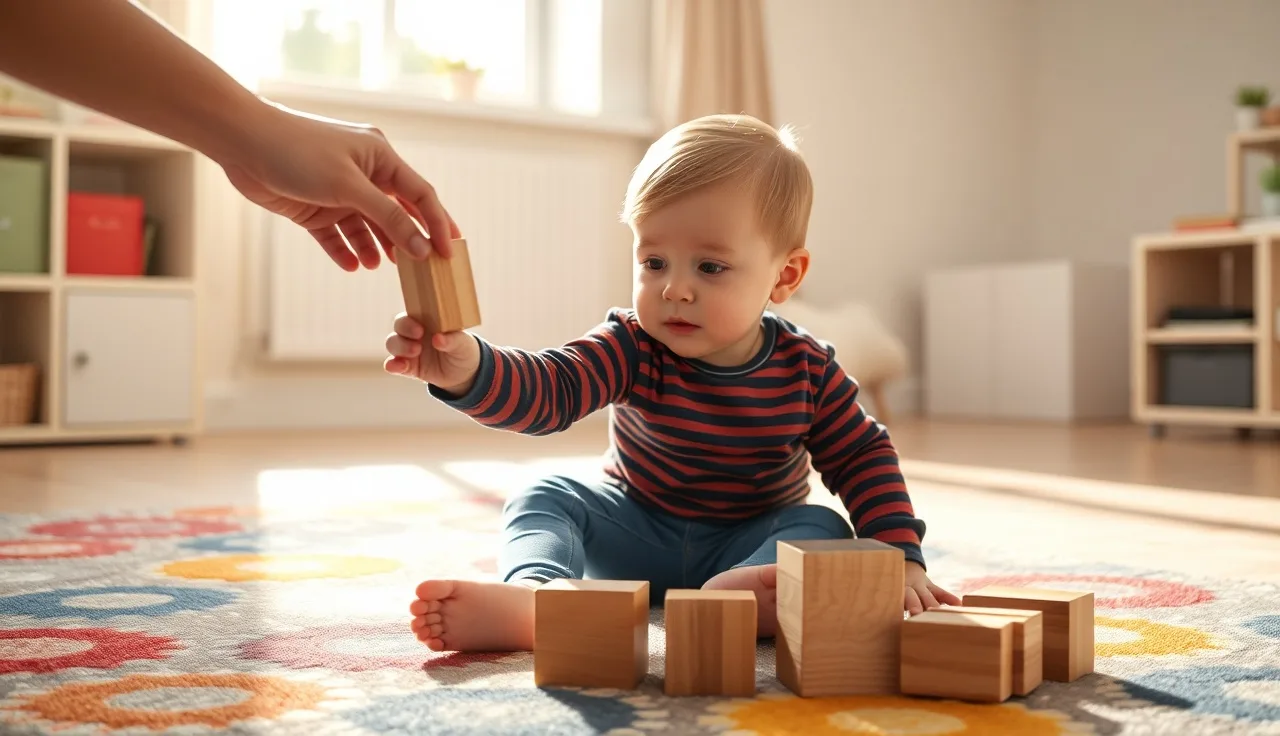
A typical session with a 2-year-old might have a therapist and child playing with blocks while the therapist models short phrases, pauses to give the child a turn, and responds with real enthusiasm to any attempt at communication, including pointing, reaching, or a single syllable. The therapist is targeting very specific skills from the child's individualized plan, even if it looks casual.
For school-age children, therapy shifts. Sessions may include direct articulation work, picture-naming drills, narrative retelling, or phonological awareness tasks depending on the diagnosis. A child with apraxia of speech gets very different therapy from a child with a phonological delay or a child whose main challenge is pragmatic language (the social use of language).
Parent involvement matters enormously. Research consistently shows children make faster progress when caregivers carry strategies into daily life. [6] A good SLP gives you specific things to do at home between sessions. If yours never does that, it is fair to ask directly: "What should I be practicing with him this week?"
Frequency varies. Two sessions per week is common for children with moderate delays. One session per week, combined with heavy home practice, is often used for milder cases or when families have travel constraints. Intensive programs (five days per week) exist for specific conditions like childhood apraxia of speech, where motor learning needs high repetition.
How long does it take to see progress in speech therapy?
Honest answer: it varies more than most people want to hear, and the research gives us ranges rather than guarantees.
For late talkers with no other diagnosis, a 2018 study in the Journal of Speech, Language, and Hearing Research found that roughly 60-70% of children identified as late talkers at age 2 caught up to peers by kindergarten, with or without therapy. [7] But "catching up" is not the same as optimal. The children who caught up on their own still showed higher rates of reading and language difficulty in school compared to peers who were never delayed. That is the argument for therapy even when a child seems to be progressing solo.
For children with diagnosed conditions, timelines differ:
- Mild articulation errors (a lisp, one or two sound substitutions): often resolved in 6-20 sessions
- Phonological disorders: typically 6-12 months of regular therapy
- Expressive language delay: highly variable, 6 months to several years depending on severity and cause
- Childhood apraxia of speech: often 1-3 years of intensive work [8]
- Autism spectrum: communication goals are usually ongoing and shift in focus as the child develops
Progress is not linear. Many children plateau, then have a burst. A plateau does not mean therapy is failing. What you should see, if therapy is working, is a child who is more willing to attempt communication, more responsive, and slowly adding new words or skills even when the pace feels crawling.
Six months in with no measurable gains your SLP can name? Ask for a reassessment. Goals should be reviewed and updated at least every 3-6 months under a formal Individualized Family Service Plan (IFSP) or Individualized Education Program (IEP).
What do speech therapy milestones look like for autistic kids specifically?
Autistic speech development does not follow a single pattern. Some autistic children speak in full sentences by 2 and have challenges that are entirely pragmatic: reading humor, catching social cues, taking turns in conversation. Others are minimally verbal at 5 and may always rely partly or fully on augmentative and alternative communication (AAC). Most autistic kids sit somewhere between those poles, and the same child's profile can change a lot over time.
For autistic children who use echolalia, which is repeating phrases heard from others, the milestone framework looks different. Echolalia is not simply a delay. It is often a legitimate communication strategy you can build on. A child who echoes "do you want a snack?" to mean "yes I want a snack" is using language functionally. Therapy that treats echolalia purely as something to erase misses that. There is more on what this means developmentally at echolalia meaning.
The National Autism Center and ASHA both recognize that AAC use does not slow or prevent speech development in autistic children. [9] That myth persists and causes real harm. If your child's team hesitates to introduce aac devices because they want to "encourage natural speech first," that position is not supported by current evidence. AAC and verbal speech can and do develop in parallel.
For a broader look at how therapy is structured for autistic children at different ages, see our guide on autism spectrum speech therapy.
What is the difference between a speech delay and a language disorder?
This distinction drives treatment decisions, so get clear on it.
A speech delay means a child is late reaching sound-production milestones but the underlying language system (understanding, vocabulary, grammar) is intact or close to it. A 2-year-old who knows 60 words but pronounces half of them so unclearly that only parents understand has a speech delay.
A language disorder means the system itself is affected. The child may have limited vocabulary, struggle to form grammatical sentences, or have real comprehension problems. Developmental Language Disorder (DLD) affects about 7-10% of children and is one of the most common childhood conditions most parents have never heard of. [10] It does not clear up on its own the way some speech delays do, and untreated it has real consequences for literacy.
A child can have both. Autism often involves both. Childhood apraxia of speech is neither a delay nor a language disorder in the usual sense. It is a motor planning condition where the brain struggles to coordinate the movements needed for speech, even when the child knows exactly what they want to say. [8] Each of these needs a different therapeutic approach, which is why an accurate diagnosis is more than paperwork.
If you are handed "speech delay" as a catch-all, ask your SLP to get specific: is this a speech production issue, a language issue, or both? What is the working hypothesis about the cause?
How does early intervention work and why does the timing matter so much?
Under Part C of IDEA, children from birth to age 3 who have a developmental delay or a condition that typically causes delay are entitled to a free evaluation and, if eligible, free services. [4] This is the early intervention (EI) system, and it is one of the most underused resources in child development.
The "early" in early intervention is more than marketing. The first three years are a period of rapid brain development where the neural circuits for language get laid down. Intervention during this window has a documented advantage over the same intervention started at age 4 or 5. A 2020 review in Pediatrics summed up the evidence: "Early intervention services provided in the first years of life have demonstrated positive effects on language, cognitive, and social-emotional outcomes." [3]
To access EI, contact your state's Part C coordinator. In most states you do not need a doctor's referral. Any parent can request an evaluation, and it must be completed within 45 days of referral under federal law. [4] Once a child turns 3, services transition to the school district under Part B of IDEA.
That transition at age 3 is often rocky. Services may change, therapist relationships end, and gaps happen. Knowing the transition is coming at least six months ahead gives families time to prepare. Ask your EI coordinator to start the transition process early so the IEP is in place before your child's third birthday.
For more on how to work through the referral and evaluation process, the guide on early intervention is a good next read.
What can parents do at home between therapy sessions?
Home practice is not optional if you want faster progress. Sessions once or twice a week give a child maybe two hours per week with an SLP. The other 100-plus waking hours are yours. What happens in those hours matters.
The home strategies with the strongest evidence for toddlers and preschoolers:
- Self-talk and parallel talk: narrate what you are doing and what your child is doing in simple, short phrases. "I'm pouring juice. You're eating cracker." This is not baby talk. It is deliberate input at the child's level.
- Expand: when a child says "dog," respond "big dog" or "dog running" instead of just agreeing. This shows them the next level of complexity without demanding it yet.
- Wait expectantly: give a child 5-10 full seconds to respond before filling in the answer. Most parents wait about 2 seconds. That is not long enough.
- Reduce questions, increase comments: questions pressure a child to perform. Comments invite a response without demanding one. "Oh look, a truck" is more useful than "What's that?"
- Read together daily: shared book reading at the child's language level is one of the strongest predictors of vocabulary growth. [6]
If your child is working toward specific goals, your SLP should be turning those goals into concrete at-home activities. A target like "uses two-word combinations" should come with real routines where you can practice it, more than a note in a binder.
Apps can supplement practice. Little Words, for example, is built as an AI speech companion that supports communication practice between formal therapy sessions. It is not a replacement for an SLP, but structured daily practice has value, especially for children who need high repetition. To see whether it fits your child's goals, take the quiz at littlewords.ai/start.
For a structured overview of what therapy itself looks like, the speech therapy speech therapist guide covers what to look for in a provider and how to judge quality of care.
How much does speech therapy cost and is it covered by insurance?
Costs vary enormously depending on setting, location, and payer.
Private pediatric SLP sessions in the United States typically run $100-$350 per session out of pocket as of 2024, with higher rates in metro areas. [11] For a child attending twice-weekly therapy, that is $800-$2,800 per month before insurance.
Most commercial health plans cover speech therapy for diagnosed conditions under the essential health benefits rules set by the Affordable Care Act. The catch is that "medically necessary" definitions vary by plan. Some insurers require a formal diagnosis code. Others cover evaluation and treatment for developmental delays more broadly. Request a pre-authorization and get the coverage decision in writing before you start.
For children who qualify under IDEA (birth to 3 through EI, or 3-21 through school-based services), therapy is free to families. School-based therapy costs nothing but is focused on educational impact, not the child's maximum possible development. That distinction sometimes means school-based therapy is less intensive than a family wants, which leads many families to run school and private services at the same time.
Medicaid and CHIP cover speech therapy for eligible children, and several states have autism-specific insurance mandates that require coverage of behavioral and communication therapies regardless of other eligibility. The Kaiser Family Foundation tracks state autism insurance laws and is a good place to check your state's rules. [12]
Teletherapy, delivered by video by a licensed SLP, usually costs about the same as in-person private therapy but cuts travel time and often has more open scheduling. Evidence supports its effectiveness for most speech and language goals, though some hands-on articulation work is harder to replicate remotely.
What should you look for in a speech therapist for a child with delays or autism?
Credentials first: in the United States, look for the CCC-SLP credential (Certificate of Clinical Competence in Speech-Language Pathology) from ASHA. [1] State licensure is also required. These are baseline. They tell you nothing about approach or fit.
Beyond credentials, the things that actually predict a good experience:
Specialization matters. An SLP who mostly treats adult stroke patients is not the right fit for a 2-year-old with autism. Ask directly: what percentage of your caseload is children? What age range? What conditions?
Approach transparency. Ask the SLP to explain their treatment approach in plain terms. For young children, you want to hear about naturalistic developmental behavioral interventions (NDBIs) like JASPER or ESDM, or at minimum an approach grounded in play and functional communication rather than drill-based repetition. For apraxia specifically, look for someone trained in DTTC (Dynamic Temporal and Tactile Cueing) or the Nuffield Dyspraxia Programme. [8]
Parent involvement. A therapist who parks you in the lobby for 45 minutes and sends your child out with no feedback is not setting you up to succeed. You should be in the room at least part of the time, learning to carry strategies home.
Data. Good SLPs track progress with measurable data, not impressions. Ask how they will track whether goals are being met and how often they will review and revise the plan.
And trust your instincts about fit. A child who is shut down, resistant, or distressed at every session for months is more than "adjusting." The therapeutic relationship is real, and it matters. Changing providers is fine if something feels off.
How is milestone progress tracked during speech therapy?
Progress tracking in speech therapy is more structured than most parents expect. A formal evaluation at the start of services sets a baseline using standardized assessments. Common tools include the Preschool Language Scales (PLS-5), the Clinical Evaluation of Language Fundamentals (CELF), and the MacArthur-Bates Communicative Development Inventories (CDIs) for younger toddlers. These give age-equivalent scores and standard scores you can compare over time.
Between formal re-evaluations, therapists track progress toward specific goals with session data: percentage of correct productions, number of spontaneous word attempts, frequency of functional communication acts per session. This is how they know whether the approach is working, more than whether the child seems happier in the room.
For children under 3 in EI, the IFSP is reviewed every six months and updated annually. For school-age children with IEPs, annual reviews are required, with shorter progress reports tied to report card periods. [4] Parents have the right to request a re-evaluation at any time if they believe their child's needs have changed or if progress has stalled.
At home, informal tracking helps too. Keep a simple word log for a toddler (a notes app where you add new words as they appear). It gives you real data for conversations with the SLP and helps you spot plateaus. Plenty of families find that what felt like "no progress" turns into 15 new words over 8 weeks once they write it down.
For families weighing whether Little Words could support this tracking, the app was built to support communication practice and log interaction patterns between formal sessions, which can add useful detail to what the SLP sees in a 45-minute window once a week.
Frequently asked questions
What is the most important speech milestone at age 2?
The 50-word expressive vocabulary and the start of two-word combinations (like "more juice" or "daddy go") are the benchmarks clinicians watch most closely at 24 months. A child who does not have at least 50 words or is not combining words by their second birthday should be evaluated by a speech-language pathologist, not observed further. ASHA and the AAP both flag this as a meaningful threshold.
Can a child catch up without speech therapy?
Some late talkers do catch up without formal therapy, especially those with good comprehension and strong social engagement. Research estimates 60-70% of children identified as late talkers at age 2 reach typical language levels by kindergarten. But those children still show higher rates of reading difficulty later. For any child missing multiple milestones or showing comprehension gaps, waiting is riskier than acting early.
What is the difference between a speech delay and a language delay?
A speech delay is about how sounds are produced. A language delay involves the underlying system: vocabulary, grammar, comprehension, or all three. A child can have one without the other. The distinction matters because treatment approaches differ significantly. An SLP evaluation can tease apart which is at play, and sometimes both are present at once.
At what age is speech therapy most effective?
Earlier is generally better. The brain is most plastic for language learning in the first three years, and federal law guarantees free evaluation and services from birth under IDEA Part C. That does not mean therapy after age 3 fails, it absolutely works, but the evidence favoring earlier intervention is consistent across many studies. Missing the birth-to-3 window is not permanent, but it is a real loss.
How many words should a 3-year-old have?
Most 3-year-olds use between 200 and 1,000 words, with ASHA citing roughly 200-500 as the typical expressive range and understanding far more. More telling than the exact count is whether a child can be understood by unfamiliar adults about 75% of the time, uses at least 3-word sentences, and can follow 2-step directions. Any combination of these missing warrants evaluation.
Does speech therapy work for nonverbal children with autism?
Yes, though the goals shift. For minimally verbal or nonverbal autistic children, speech therapy focuses on building any functional communication, whether that is spoken words, signs, picture exchange, or high-tech AAC devices. Research does not support withholding AAC to "push" verbal speech. Using AAC does not block natural speech development and often supports it. Every child deserves a reliable way to communicate, whether or not verbal speech emerges.
How do I get speech therapy for my child through the school district?
Submit a written request for a special education evaluation directly to your school district's special education director. The district must respond within a timeline set by state law (usually 15-60 days) and evaluate at no cost to you. If your child is under 3, contact your state's Part C early intervention coordinator instead. You do not need a doctor's referral to make either request.
What happens if my child misses speech therapy sessions?
Missing sessions slows progress, especially for conditions like childhood apraxia of speech where motor learning depends on consistent repetition. A few missed sessions from illness are normal. Consistent gaps of weeks or months can mean regression on skills that were not yet automatic. If your schedule makes regular attendance hard, talk to the SLP about restructuring: fewer in-person sessions with more structured daily home practice can sometimes hold progress steady.
Is online speech therapy as effective as in-person therapy for kids?
For most language and pragmatic goals, teletherapy by a licensed SLP shows comparable outcomes to in-person therapy in published research. Some articulation work requiring tactile cues is harder to deliver remotely. Younger toddlers under 2 are trickier to engage over a screen. For school-age children with good attention and families who can join sessions at home, online therapy is a legitimate and often more accessible option.
How often should a child see a speech therapist?
Frequency depends on the diagnosis and severity. Once a week is standard for mild to moderate delays. Twice a week or more is common for childhood apraxia of speech or significant language disorders. Intensive programs (daily for several weeks) exist for specific conditions. The SLP's recommendation should be driven by what the child needs to make progress, not by insurance limits alone, though cost and access are real constraints for many families.
What are red flags for autism-related speech issues specifically?
Key red flags include no babbling by 12 months, no pointing or waving by 12 months, no single words by 16 months, no two-word phrases by 24 months, and any loss of previously acquired language or social skills at any age. Inconsistent response to their name, unusual intonation, and heavy reliance on echoing others' phrases rather than generating spontaneous language are also worth raising with a pediatrician or SLP.
Can speech therapy help with reading problems later?
Yes, and this link is underappreciated. Phonological awareness, the ability to hear and manipulate sounds in words, is the foundation of both spoken language and reading. Children who receive early speech-language intervention often show better phonological awareness outcomes, which translates to stronger reading in the early grades. SLPs are trained in phonological awareness and literacy-related language skills, not only spoken communication.
What should an IFSP or IEP speech goal actually look like?
A well-written speech goal is specific, measurable, and time-bound. A good example: "By June 2026, child will produce the /s/ sound correctly in word-initial position in 80% of opportunities across 3 consecutive sessions." Vague goals like "improve communication skills" are a warning sign. If your child's plan has goals you cannot picture measuring, ask the SLP to make them concrete. You have the right to request revisions.
Sources
- ASHA, Speech and Language Developmental Milestones: ASHA publishes developmental norms by age range covering speech sounds, expressive language, and receptive language milestones
- American Academy of Pediatrics, Developmental Surveillance and Screening: AAP recommends developmental screening at 9, 18, and 30 months and autism-specific screening at 18 and 24 months
- Pediatrics, Early Intervention for Children with Developmental Delays (2020): Early intervention services in the first years of life have demonstrated positive effects on language, cognitive, and social-emotional outcomes
- U.S. Department of Education, IDEA Individuals with Disabilities Education Act: IDEA mandates free evaluation and services for children with developmental delays from birth to 21; Part C covers birth to 3, evaluations must be completed within 45 days of referral
- ASHA, Early Intervention in Speech-Language Pathology: Play-based naturalistic intervention is the evidence-based approach for speech-language services in children under 3
- ASHA, Parent-Implemented Intervention for Early Language Development: Shared book reading and caregiver-implemented language strategies are strongly associated with vocabulary growth in young children
- Journal of Speech, Language, and Hearing Research, Late Talker Outcomes (2018): Approximately 60-70% of children identified as late talkers at age 2 reached typical language levels by kindergarten, though residual literacy risk remained
- ASHA, Childhood Apraxia of Speech: Childhood apraxia of speech is a motor planning disorder often requiring 1-3 years of intensive therapy using approaches like DTTC
- ASHA, Augmentative and Alternative Communication (AAC): AAC does not inhibit natural speech development; current evidence supports concurrent AAC and verbal speech therapy in autistic and minimally verbal children
- Developmental Language Disorder, RADLD.org evidence summary: Developmental Language Disorder affects approximately 7-10% of children and is one of the most common childhood developmental conditions
- ASHA, Health Care Economics in Speech-Language Pathology: Private pediatric SLP session costs typically range from $100-$350 per session depending on region and setting
- Kaiser Family Foundation, State Autism Insurance Laws: Several U.S. states have autism-specific insurance mandates requiring coverage of communication and behavioral therapies
- CDC, Learn the Signs. Act Early. Milestone Tracker: CDC publishes developmental milestones updated in 2022 in collaboration with the AAP, used by pediatricians for surveillance