Last updated 2026-07-09
TL;DR
Online speech therapy (teletherapy) means live one-on-one video sessions with a licensed speech-language pathologist. Research shows outcomes match in-person therapy for most speech and language goals. Private sessions run $80 to $250 an hour, though insurance, early intervention, and schools can bring that to zero. It works best when a caregiver joins in and the child can attend for 30 to 45 minutes.
Does online speech therapy actually work?
Yes, for most kids and most goals. A 2019 systematic review in the International Journal of Language and Communication Disorders pooled 14 studies comparing telepractice to in-person speech-language therapy and found outcomes were equivalent across articulation, language, fluency, and voice goals [1]. That's a research finding, not a sales pitch.
Here's the nuance. Online therapy works best when a caregiver sits in the room, joins in, and can physically turn a young child back toward the screen. A three-year-old who wanders is harder to manage remotely than a seven-year-old who follows instructions on their own. If your child needs hands-on oral motor work, or has sensory needs that make screens genuinely painful, in-person may be the better place to start.
For late talkers, autistic kids, and children building articulation or expanding their language, the evidence is solid. ASHA (the American Speech-Language-Hearing Association) recognizes telepractice as an appropriate service delivery model and has published guidance on it since 2005 [2].
Don't let anyone tell you online therapy is second-rate. It's a different modality, not a lesser one.
How does online speech therapy work, session by session?
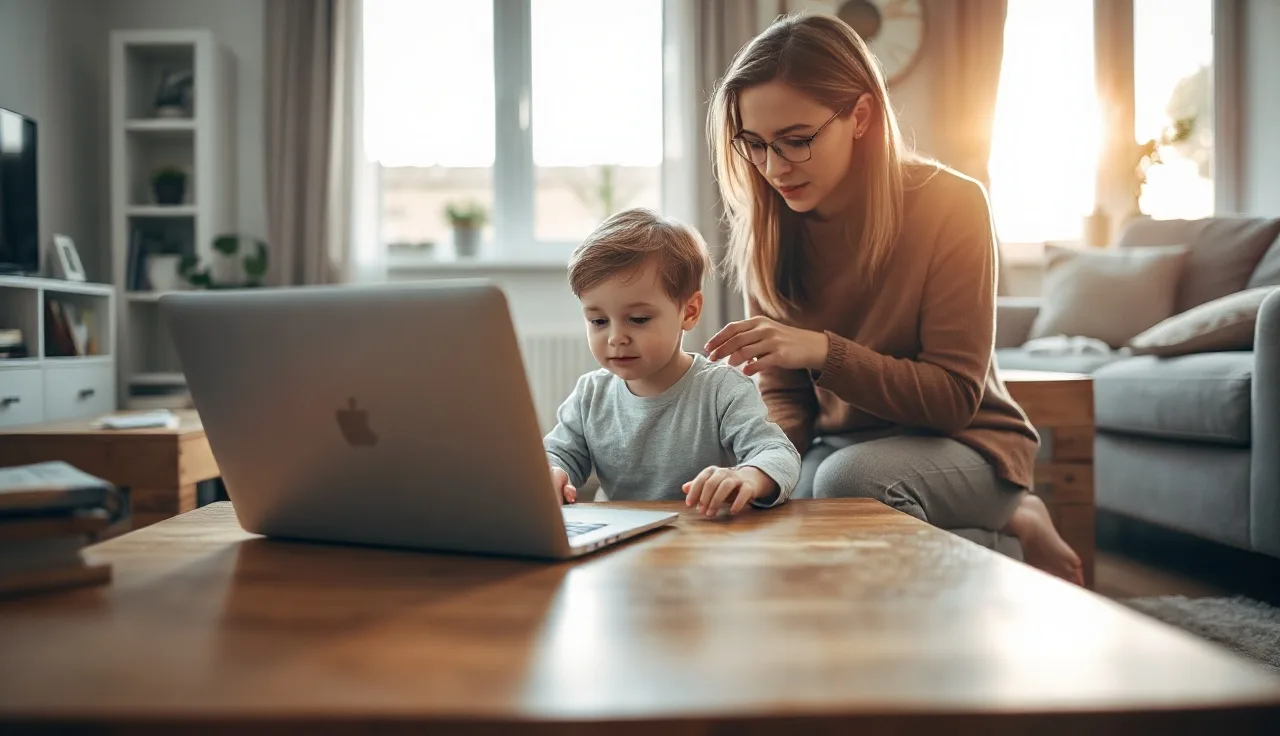
A session runs 30 to 60 minutes over video, and the caregiver is part of it. The SLP and child connect through Zoom, a HIPAA-compliant telehealth platform, or a practice's own tool. The therapist shares their screen to run games, picture cards, and interactive activities. You sit nearby, especially with toddlers, ready to prompt or redirect.
Most sessions follow the same shape: a quick check-in, a warm-up the child already knows, two or three activities aimed at specific goals, and a caregiver debrief where the SLP tells you what to practice before next week. That debrief is one of the best parts of teletherapy. You're already in the room watching, so coaching happens live instead of arriving as a secondhand summary later.
Between sessions the SLP sends home practice. The research is clear that how often a child practices matters more than how long any single session runs, so what happens in the other 167 hours of the week does most of the work [3].
The tech is simple. A stable internet connection, a device with a working camera and mic, and a quiet-ish space. A tablet or laptop covers it. A ring light helps but nobody needs one.
What does online speech therapy cost in 2025?
Cost depends entirely on your route: insurance, an agency, a platform, or a private SLP paying out of pocket.
| Route | Typical cost per session | Notes |
|---|---|---|
| Private pay, independent SLP | $100 to $250 | Most flexibility; no insurance paperwork |
| Teletherapy platform (e.g., Expressable, SpeechEasy) | $80 to $180 | Monthly subscription or per-session |
| Insurance-covered | $0 to $50 copay | Requires diagnosis code and prior auth |
| School district (FAPE) | Free (for eligible kids) | Must qualify under IDEA; school controls goals |
| Early intervention (under age 3) | Free or sliding scale | Varies by state; federally funded under IDEA Part C [4] |
Coverage got much better after 2020. As of 2024, most major commercial insurers and Medicaid in most states cover telehealth speech therapy at parity with in-person care, though you'll want to confirm your own plan. The Health Resources and Services Administration (HRSA) runs a telehealth policy page that helps you check your state's Medicaid rules [5].
If money is the wall you keep hitting, check whether your child qualifies for early intervention (birth to 3) or school-based services (3 and up). Both come through the Individuals with Disabilities Education Act and cost families nothing out of pocket [4].
My honest take: subscription platforms are fine for mild articulation goals. For complex language delays or autism-related communication needs, I'd pay for a licensed SLP with real experience in your child's area before I'd chase the cheapest monthly rate.
How do you find a qualified online speech therapist for a child?
Start with ASHA's ProFind directory at asha.org/profind. You can filter by specialty (child language, autism, AAC, fluency), by service delivery model (telepractice), and by state of licensure [2]. Every SLP listed there holds ASHA's Certificate of Clinical Competence (CCC-SLP), which takes a master's degree, a supervised clinical fellowship, and a passing score on the national Praxis exam.
State licensure matters for telehealth. The SLP has to be licensed in the state where the child is physically located during the session, not where the therapist sits. Most states set their own requirements, though the ASLP-IC interstate compact is working toward mutual recognition across member states.
Before you commit, ask a few pointed questions:
- What populations do you specialize in? (You want someone who works with kids regularly, not mostly adults.)
- How do you involve caregivers during sessions and in home practice?
- What assessment tools do you use remotely?
- What do you do when a child won't stay on screen?
A good SLP answers all of these without hedging. If they're vague, keep looking. There's no shortage of qualified people offering online services now.
For autistic kids or children with significant communication delays, look for SLPs with experience in AAC (augmentative and alternative communication) and applied verbal behavior. Our guide to autism spectrum speech therapy covers what to look for in a specialist.
Is online speech therapy covered by insurance?
Often yes, but the details ride on your state, your plan, and whether your child has a diagnosis code that justifies services. Since 2020 most states passed telehealth parity laws requiring insurers to reimburse video visits at the same rate as in-person visits. As of 2023, 43 states plus Washington D.C. have payment parity laws for telehealth [5]. Medicaid covers telehealth speech therapy in nearly every state, though the billing codes and approved platforms differ.
To get coverage, you'll usually need:
1. A referral or prescription from your pediatrician (some plans require this, some don't) 2. A diagnosis code (speech delay, language disorder, autism spectrum disorder, and so on) 3. Prior authorization for a set number of sessions 4. A provider who is in-network with your plan
The ICD-10 codes you'll see most are F80.0 (phonological disorder), F80.1 (expressive language disorder), F80.2 (mixed receptive-expressive language disorder), and F84.0 (autism spectrum disorder). The SLP's office handles the paperwork, but knowing the terrain helps. Our speech delay ICD-10 article explains how diagnosis codes shape coverage.
One thing nobody warns you about: even when coverage exists, prior authorization can take two to four weeks to clear. Don't wait for the paperwork to start looking for a therapist.
What ages does online speech therapy work for?
Online speech therapy has been studied and used from toddlerhood through old age. The logistics just shift a lot with age.
With toddlers (18 months to 3 years), you're the co-therapist. A skilled SLP spends most of the session coaching you to prompt language during play, meals, and daily routines. The child might engage the screen for parts of it or mostly just play while you run strategies the SLP feeds you in real time. This is parent-implemented intervention, and the evidence for it is strong [3].
With preschoolers (3 to 5 years), sessions turn more directly to the child. The SLP uses digital games, virtual flashcards, and shared-screen activities to hit goals. A parent still needs to be present, but the child engages more on their own.
School-age kids (6 and up) are often ideal for online therapy. They follow video instructions, use a keyboard or mouse, and sit through a full 45- to 60-minute session.
Teens and adults do well online too, especially for stuttering, voice, and language goals. Our article on speech therapy for adults covers that if it's relevant at home.
The hardest fit is very young toddlers with real oral motor concerns. Feeding therapy and oral motor work often need hands-on positioning that a screen can't do.
How is online speech therapy different from school-based services?
School speech therapy is free, which matters a lot. But it runs under the Individuals with Disabilities Education Act (IDEA), so goals get tied to educational impact rather than clinical progress in general [4]. A child who communicates well enough for classroom learning might not qualify for school services even with a real speech or language delay.
Private online therapy follows clinical standards set by ASHA and works from the child's whole communication profile, more than from what shows up in the classroom. It's also usually more frequent. School services might be 30 minutes twice a week, while a private provider can run daily or three-times-weekly sessions for a child who needs the intensity.
The two aren't a choice you have to make once. Plenty of families do both: school services to meet IDEA obligations, plus private online sessions for more intensive or specialized work.
Scheduling is another split. School services happen during school hours. Private online therapy can run at 7 a.m. or 6 p.m. if that fits your family better. For parents who can't pull a child out of daycare or class for a midday appointment, that flexibility is a big deal.
Our early intervention speech and language therapy article covers the under-3 system in detail, and speech therapy for kids covers the broader picture for school-age children.
Can online speech therapy help with autism-related communication?
Yes, and this is where the research has grown fastest in the past five years. A 2021 study in the Journal of Autism and Developmental Disorders found parent-implemented language interventions delivered by telehealth increased communication and language skills in young autistic children, with outcomes comparable to clinic-based delivery [6].
For autistic kids, online therapy carries some specific advantages. The child stays in their own home, which can lower anxiety and raise participation. The sensory load of a clinic waiting room and an unfamiliar space is gone. Many autistic children are already comfortable with screens, so video sessions feel familiar instead of strange.
The SLP can still target core communication goals: requesting, commenting, responding to name, stretching utterance length, using AAC devices. Sessions often build in naturalistic developmental behavioral interventions (NDBIs), a family of approaches with strong research support for early autism intervention [6].
If your child uses or might benefit from a speech-generating device or picture communication, make sure the SLP has real AAC training and experience. Our alternative augmentative communication devices for autism guide walks through what to look for.
Little Words is an AI-based speech companion app built for neurodivergent kids. It can supplement formal therapy (not replace it) by giving kids extra practice between sessions. You can take a quick quiz to see if it fits your child's current goals.
What should a parent do during online speech therapy sessions?
This is where families leave most of the value on the table. Hand the tablet to your kid and walk off to make dinner, and you've thrown away the best part of teletherapy.
Here's what real participation looks like.
Before the session, set up the space. A table beats a couch. Position the camera so the SLP sees your child's face and mouth clearly. Clear distracting toys. Keep a preferred snack or fidget close but out of reach until it's needed.
During the session, sit close. Watch what the SLP does when your child makes an error or approximates a word. That instant response (the model, the prompt, the expansion) is exactly what you're learning to copy. Ask questions out loud when something isn't clear. Good SLPs expect that.
After each session, write down the two or three things the SLP asked you to practice. Then do them every day. Ten minutes of intentional language input spread across meals, bath time, and play beats what a single weekly session can do alone.
Home practice is one of the biggest levers a parent has. A 2020 study in the American Journal of Speech-Language Pathology found children whose caregivers ran home practice made significantly faster progress than those who got clinic sessions with no carryover at home [3].
For toddlers specifically, our speech therapy for toddlers article lays out home strategies that pair with online sessions.
Are there online speech therapy programs and platforms worth knowing about?
The teletherapy platform space has grown a lot since 2020. Here's an honest read on the main categories.
Generalist telehealth platforms (Expressable, Speech Buddies Connect, and similar) match families with licensed SLPs and handle scheduling and billing. Convenient, but vet the individual therapist's experience with your child's needs the same way you would anywhere.
School-focused platforms (Presence Learning, Soliant Health) mostly contract with districts to serve students. If your district uses one, your child may already have access.
Directly hired independent SLPs through ASHA ProFind or Psychology Today's therapist directory. More work to set up, but you get the most control over finding exactly the right specialization.
Group teletherapy runs a small set of kids with one SLP. Some providers offer it for social communication and fluency goals. It usually costs less per session and can be a good fit for kids ready to use peers as part of the work.
Worth knowing: ASHA sets telepractice standards that cover privacy, informed consent, and license verification [2]. Any reputable provider should tell you what platform they use and confirm it's HIPAA-compliant.
What are online speech therapy degree programs, and do they matter to parents?
As a parent, you mostly care that your child's SLP is qualified. But knowing what goes into that qualification helps you ask sharper questions.
Every practicing SLP in the U.S. holds a master's degree in speech-language pathology, a one-year supervised clinical fellowship, and ASHA's CCC-SLP credential. Many universities now run fully online or hybrid master's programs, which has widened the pipeline of trained SLPs over the past decade.
CAA-accredited online master's programs exist at institutions like the University of Cincinnati and Valdosta State University, among others. The accrediting body is the Council on Academic Accreditation in Audiology and Speech-Language Pathology (CAA), housed under ASHA [7]. An online master's from a CAA-accredited program counts the same as an in-person one for state licensure.
For aspiring SLPs reading this: most programs no longer require the GRE. They typically want an undergraduate degree in communication sciences and disorders or a related field, observation hours (usually 25 minimum), and strong recommendations. Online degree programs often draw career changers who already hold degrees in education, psychology, or healthcare.
For parents: verify the CCC-SLP, not where the SLP earned their degree. You can check CCC status in ASHA's online member directory [2].
What are the limits of online speech therapy?
Honesty matters here. Online therapy doesn't suit every child or every goal.
Children with significant hearing loss who use hearing aids or cochlear implants can hit audio quality problems that make sessions less effective. Kids with complex feeding and swallowing disorders need in-person evaluation, because dysphagia assessment can't be done remotely. Very young children (under 18 months) who can't orient to a screen at all may need a hybrid model, where parents get coached online but the actual child engagement happens in person.
Screen fatigue is real, especially for kids already on devices all day for school or entertainment. A child who's been on a tablet for three hours won't bring much attention to another 45 minutes of screen.
Connectivity is an equity problem, not a minor one. Families in rural areas with poor broadband deal with dropped sessions and choppy audio that gut the quality of a visit. The Federal Communications Commission (FCC) runs programs to expand rural broadband access, but the gaps are still wide [8].
Online therapy also asks for a level of caregiver engagement that not every family can sustain. Single parents working multiple jobs, families facing housing instability, and caregivers managing their own health can find consistent online sessions hard to hold together. That's a structural limitation, not a personal failure. In those cases, intensive school-based services or a community clinic may be more sustainable.
Frequently asked questions
Is online speech therapy as effective as in-person therapy for kids?
For most speech and language goals, yes. A 2019 systematic review in the International Journal of Language and Communication Disorders found telepractice outcomes equivalent to in-person therapy across articulation, language, fluency, and voice. The biggest factor isn't the delivery mode. It's caregiver participation and consistent home practice between sessions.
How much does online speech therapy cost per session?
Private-pay online speech therapy typically runs $80 to $250 per session, depending on the provider and region. Insurance-covered sessions may cost only a copay. Children under 3 may qualify for free early intervention under IDEA Part C. School-age children with qualifying disabilities can access free school-based services under IDEA.
Can a 2-year-old do online speech therapy?
Yes, though the session looks different. For toddlers, the SLP coaches the parent in real time instead of working directly with the child the whole session. Parent-implemented interventions delivered by telehealth have strong research support. The caregiver is essentially the therapist in the room, and the SLP guides from the screen.
How do I find a licensed speech therapist online?
Use ASHA's ProFind directory at asha.org/profind, which lets you filter by specialty, age group, and telepractice availability. Every SLP listed holds the CCC-SLP credential. Make sure the SLP is licensed in the state where your child is physically located during sessions. That's a legal requirement for telehealth.
Does insurance cover online speech therapy?
Often yes. As of 2023, 43 states plus D.C. have telehealth payment parity laws requiring insurers to reimburse video visits at the same rate as in-person visits. Medicaid covers telehealth speech therapy in most states. You'll typically need a diagnosis code, a referral, and prior authorization. Call your insurer before booking.
What is the difference between online speech therapy and teletherapy?
They mean the same thing. Teletherapy, telepractice, and online speech therapy all refer to live video sessions with a licensed speech-language pathologist conducted remotely. ASHA uses 'telepractice' in its official guidance. Some apps marketed as 'speech therapy' aren't live sessions with a licensed SLP, so always check what you're actually getting.
Can online speech therapy help with stuttering?
Yes. Stuttering (fluency disorders) is one of the areas with the most established teletherapy research. The Camperdown Program and the Lidcombe Program have both been adapted for and studied in online delivery, with positive outcomes. An SLP who specializes in fluency can run full treatment planning and coaching online.
How long does a child typically need speech therapy?
Duration varies by the nature and severity of the delay. Mild articulation errors may clear in months. Language delays tied to autism or other developmental conditions may need years of ongoing support. ASHA doesn't publish a universal timeline because goals and progress are individual. Your SLP should set measurable benchmarks and revisit the plan every few months.
What degree does an online speech therapist need to practice?
Every practicing SLP in the U.S. must hold a master's degree in speech-language pathology from a CAA-accredited program, complete a supervised clinical fellowship, and hold ASHA's CCC-SLP certification. Many SLPs earned their degrees through online or hybrid programs. The delivery mode of the degree doesn't affect the credential's validity.
Can I do online speech therapy through my child's school?
Sometimes. Many districts contract with teletherapy platforms to provide speech services, especially in rural areas with SLP shortages. If your child has an IEP that includes speech therapy, ask your school's special education coordinator whether services run in person or via telehealth. Either way, they must be provided at no cost to your family under IDEA.
What is the best online speech therapy for autism?
Look for an SLP with specific experience in autism and early language intervention, particularly naturalistic developmental behavioral interventions (NDBIs) and AAC if your child uses or might benefit from a device. ASHA's ProFind directory lets you filter by autism specialty. Parent coaching is a key component, and the best programs teach you strategies to use all day, more than during sessions.
Are there free online speech therapy resources for parents?
ASHA offers free public resources at asha.org, including speech and language milestones and how to find services. The CDC's 'Learn the Signs. Act Early.' program provides free developmental milestone tools. Early intervention for children under 3 is federally funded and free or low-cost for qualifying families under IDEA Part C.
How do online speech therapy programs for adults differ from those for children?
Adult online speech therapy covers a wider range of conditions: voice disorders, aphasia after stroke, stuttering, dysarthria, and accent modification. The session structure is more self-directed and less caregiver-dependent. Insurance rules are similar, but eligibility and goals reflect adult communication needs rather than developmental milestones.
What technology does my child need for online speech therapy?
A device with a camera, microphone, and speaker (tablet, laptop, or desktop), a stable internet connection of at least 5 Mbps, and a quiet space. Most sessions run on Zoom or a HIPAA-compliant equivalent. A Bluetooth speaker can improve audio. You don't need special equipment, and most families manage with what they already own.
Sources
- International Journal of Language and Communication Disorders, 2019 systematic review of telepractice in speech-language pathology: Systematic review of 14 studies found telepractice outcomes equivalent to in-person therapy across articulation, language, fluency, and voice goals
- American Speech-Language-Hearing Association (ASHA), Telepractice Practice Portal and ProFind directory: ASHA recognizes telepractice as an appropriate service delivery model and publishes standards for it
- American Journal of Speech-Language Pathology, 2020, home practice and caregiver implementation: Children whose caregivers ran home practice showed significantly faster progress than those receiving only clinic-based sessions
- U.S. Department of Education, Individuals with Disabilities Education Act (IDEA): IDEA funds early intervention for children under 3 (Part C) and school-based services (Part B) at no cost to eligible families
- Health Resources and Services Administration (HRSA), Telehealth: As of 2023, 43 states plus Washington D.C. have telehealth payment parity laws; HRSA tracks state Medicaid telehealth policies
- Journal of Autism and Developmental Disorders, 2021, telehealth parent-implemented language intervention: Parent-implemented language interventions delivered via telehealth increased communication in young autistic children, comparable to clinic-based delivery
- ASHA Council on Academic Accreditation in Audiology and Speech-Language Pathology (CAA): CAA accredits graduate programs in speech-language pathology; online programs from CAA-accredited institutions are equivalent to in-person for licensure
- Centers for Disease Control and Prevention (CDC), Learn the Signs. Act Early. developmental milestones: CDC provides free developmental milestone tracking tools and guidance for parents concerned about speech and language delays
- American Academy of Pediatrics (AAP), Developmental-Behavioral Pediatrics: AAP recommends developmental surveillance at every well-child visit and standardized screening at 9, 18, and 30 months
- ASHA, Scope of Practice in Speech-Language Pathology: ASHA defines the full scope of SLP practice, including diagnosis and treatment of speech, language, and communication disorders across the lifespan