Last updated 2026-07-11
TL;DR
Oral motor exercises like blowing bubbles, tongue clicks, and lip presses are popular home tools for speech delay, but the research is mixed on whether non-speech oral motor exercises (NSOMEs) directly improve articulation. Exercises tied to real speech sounds show the strongest evidence. Use them as warm-ups, pair them with actual talking practice, and get a speech-language pathologist involved early.
What are oral motor exercises, and why do parents try them for speech delay?
Oral motor exercises are movements that target the lips, tongue, jaw, and cheeks, the muscles your child uses to form speech sounds. Parents reach for them because they're concrete, you can do them at home today, and they feel like you're doing something while waiting for a therapy slot to open up.
The umbrella term covers a lot of activities: blowing through a straw, puffing cheeks, clicking the tongue, biting down on chew tools, or tracing the inside of the lips with a finger. Some are play-based and feel like games. Others are more clinical-looking tools sold specifically for kids with low muscle tone or sensory differences.
Speech delay is common. The American Academy of Pediatrics reports that communication disorders affect roughly 1 in 12 children ages 3 to 17 in the United States [1]. That's a lot of families looking for something to do between appointments. Oral motor exercises fill that gap emotionally, even when the evidence for them is complicated.
Here's the honest framing: these exercises are not useless, but they're also not a substitute for speech therapy. The goal of this article is to help you use them smartly, understand what they can and can't do, and know when to push harder for professional support.
What does the research actually say about oral motor exercises and speech delay?
This is where it gets complicated, and where a lot of popular articles mislead parents.
The American Speech-Language-Hearing Association (ASHA) takes a cautious position on what they call Non-Speech Oral Motor Exercises (NSOMEs), things like blowing horns, tongue wags in isolation, or cheek puffing that aren't tied to producing actual speech sounds. ASHA states that "the theoretical and empirical bases for using NSOMEs to treat speech sound disorders are weak" [2]. That's their words, not a paraphrase.
A 2008 nationwide survey by Gregory Lof and Margaret Watson, published in Language, Speech, and Hearing Services in Schools, found no high-quality evidence that NSOMEs improved speech sound production in children [3]. Despite that thin evidence base, 85 percent of the clinicians surveyed used these exercises anyway.
A distinction matters here. Exercises that involve producing real speech sounds, like practicing the /s/ sound repeatedly with visual feedback, or shaping the mouth into a vowel position, do have evidence behind them. They work because they rehearse the motor patterns speech actually requires. The problem is specificity: practicing tongue circles in isolation doesn't automatically transfer to saying the word "dog" correctly.
Nobody has great randomized controlled trial data on most specific home exercise programs for young children. The closest evidence comes from studies of children with dysarthria (motor-based speech impairment from neurological causes) and children with childhood apraxia of speech, where structured, speech-specific motor practice has clearer support [4]. If your child has one of those diagnoses, the math changes, and you should be working closely with a speech-language pathologist (SLP).
Bottom line: exercises connected directly to speech sounds are your best bet. Pure non-speech movements are lower priority but may still help with muscle awareness and sensory tolerance, especially for kids with significant low tone or oral sensory aversion.
Which oral motor exercises are worth doing at home?
Here's a breakdown of exercises grouped by what they actually target, with an honest take on the evidence for each.
Lip and cheek exercises Lip presses (pressing lips together firmly, holding 3-5 seconds) and smile-to-pucker alternations build labial muscle awareness. These are the easiest to turn into games. "Show me your biggest smile, now a fish face" is a real exercise. The evidence that isolated lip exercises improve speech is weak, but for kids with very low facial tone, they may provide sensory feedback that helps.
Tongue exercises Tongue clicks, tongue-to-nose attempts, and tongue side-to-side movements are classic NSOMEs. They're fine as warm-ups but should not be the main event. More useful: ask your child to imitate tongue placement for specific sounds. If you're working on /l/, show them where to put the tongue tip (just behind the front teeth) and practice /l/ in real syllables: la, lo, lee.
Blowing exercises Blowing bubbles, blowing cotton balls across a table, or blowing through straws builds breath support and lip rounding. The research connecting blowing to improved articulation is limited, but blowing does support the airflow control needed for fricatives like /f/, /s/, and /sh/. It's also one of the easiest exercises to make feel like play. Keep sessions short: 2 to 3 minutes is plenty for toddlers.
Jaw exercises Chewing on food with different textures or using a chewy tube addresses jaw stability. Kids with low tone or sensory processing differences sometimes have limited jaw grading (control over how wide the jaw opens). This can affect vowel production. Offering crunchy foods like apple slices or carrots at meals does double duty.
Oral sensory and awareness work For kids who avoid touching their face or mouth, gentle desensitization helps. Use a soft toothbrush, a vibrating oral tool, or even your finger to provide graded touch around the lips and cheeks before speech practice. This isn't directly an exercise for articulation, but sensory aversion can limit a child's willingness to even try new mouth positions.
| Exercise type | What it targets | Evidence strength | Best used as |
|---|---|---|---|
| Lip presses / smile-pucker | Lip muscle awareness | Low | Warm-up |
| Tongue placement for sounds | Speech motor learning | Moderate-strong | Core practice |
| Blowing through straws | Breath support, lip rounding | Low-moderate | Play activity |
| Tongue clicks / wags (isolated) | Tongue awareness | Low | Warm-up only |
| Jaw grading / chewing textures | Jaw stability | Low-moderate | Mealtime |
| Oral sensory desensitization | Sensory tolerance | Moderate (for averse kids) | Pre-session prep |
How long and how often should you practice at home?
Short and frequent beats long and rare every time with young children.
For toddlers (18 months to 3 years), aim for 5 to 10 minutes of intentional oral motor or speech play per day. You don't need a formal session. Weave it into diaper changes, mealtimes, or bath time. "What sound does a snake make? Let's both try it: sssss."
For preschoolers (3 to 5 years), 10 to 15 minutes of structured practice broken into two or three short bursts works better than one long sit-down. Attention spans are short. If your child is resisting, that's data: either the activity isn't working for them or the session is too long.
Consistency matters more than duration. Research on motor learning, including speech motor learning, shows that distributed practice (a little each day) outperforms massed practice (a lot once a week) for building new motor patterns [4]. Five minutes every day beats a 40-minute Sunday session.
One practical rule: stop before your child wants to. Ending on success keeps them willing to come back tomorrow.
Are there exercises specifically for late talkers versus kids with apraxia or autism?
Yes, and the distinctions matter.
Late talkers (children with limited vocabulary but no identified diagnosis) usually have intact oral motor structures. Their challenge is more about language or speech sound learning than muscle weakness. For this group, the highest-value home activity is responsive interaction: follow their lead, model words just slightly above their level, and create communication opportunities. Pure oral motor exercises are a lower priority than actual talking practice and rich language input.
Children with childhood apraxia of speech (CAS) have difficulty with the motor planning and sequencing of speech, not with muscle weakness per se. For CAS, research supports intensive, repetitive practice of specific speech sequences with multisensory feedback (seeing, hearing, and feeling the sound). Oral motor exercises that mimic real speech movements are more appropriate for this population than isolated NSOMEs. You can read more in our article on childhood apraxia of speech.
Autistic children may have sensory sensitivities that make oral motor work challenging or even aversive. Oral sensory desensitization (starting with tolerated textures and gradually expanding) often needs to come before articulation-focused exercises. Some autistic children use AAC (augmentative and alternative communication) alongside or instead of oral speech, and oral motor exercises are not a prerequisite for AAC use. See our overview of AAC devices for more.
Children with low muscle tone (hypotonia) sometimes benefit more from oral motor work than the average late talker, because muscle weakness or reduced tone can genuinely limit lip closure, tongue elevation, or jaw stability. Even here, though, exercises should be paired with real speech attempts, not done in isolation.
If you're not sure which category fits your child, that's exactly what a speech therapist assessment clarifies. Most can do an oral mechanism exam that tells you whether structure or tone is part of the picture.
What materials and tools do you actually need?
You don't need to spend much. Seriously.
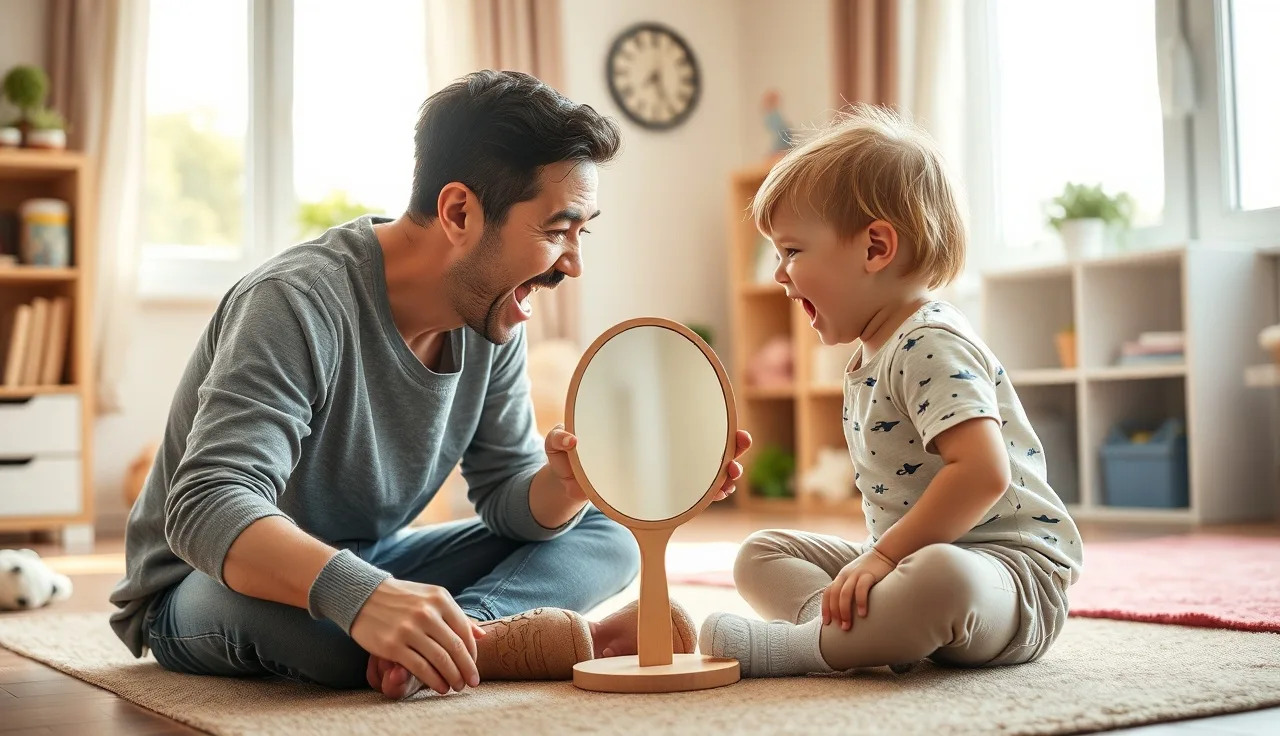
A bottle of bubbles (under $2), a straw, a mirror, and your own face are enough to start. The mirror matters: watching their own mouth move gives kids real-time feedback that's hard to get any other way.
Beyond basics, some tools are genuinely useful:
Chewy tubes and chew necklaces. For kids who chew on clothing or need oral sensory input, these give a safer alternative and can support jaw grading. ARK Therapeutic and Chewy Tubes are common brands. Expect to pay $8 to $20 per item. They're not magic, but they're practical.
Vibrating oral tools. Z-Vibe and similar tools provide tactile feedback for tongue and lip placement. Some SLPs use them actively in therapy. They cost $30 to $60. Useful for sensory-averse kids as a desensitization step, but not necessary for everyone.
Straws of different widths. Narrower straws require more lip tension and breath control. Wide straws are easier. You can grade difficulty by changing straw size. A pack of assorted straws is under $5.
A small mirror. Prop it up at face height during practice so your child can see their own mouth. Floor mirrors work great for toddlers.
Skip the expensive "oral motor kits" sold online with a dozen tools. Pick one or two items your child tolerates and use those consistently. More tools does not mean more progress.
Apps can also support practice at home. Little Words (littlewords.ai) offers AI-guided speech activities designed specifically for neurodivergent kids, including exercises parents can do alongside their child between therapy sessions. It's worth exploring if you want structured guidance without waiting for your next appointment.
How do you make oral motor exercises feel like play, not therapy?
This is the part most clinical guides skip, and it's the part that determines whether you can actually sustain a daily practice.
Game first, exercise second. Blowing cotton balls across a table with a straw is a race. Tongue clicks are a horse galloping across a field. Lip presses are "making your lips disappear." The exercise is the same; the framing changes everything.
Follow your child's sensory preferences. Some kids love the vibration of an oral tool. Others find it intolerable. Some will blow bubbles for 20 minutes. Others find bubbles frustrating because they keep popping. Start where your child is interested, not where a guide says you should start.
Use real-life contexts. Mealtime is an oral motor session in disguise. Offer many food textures, have your child help blow on hot soup, make silly sounds at the table. It all counts.
Model enthusiastically and imperfectly. If you make the same sounds alongside your child and make mistakes, it reduces pressure. Kids are more willing to try when they see adults trying too.
Know when to stop. A child who's melting down or refusing is not a child who's learning. End the activity before that point. A 3-minute session that ends successfully is worth more than a 15-minute session that ends in tears.
When should you stop doing this at home and get a professional involved?
Home practice is a supplement to professional evaluation, not a replacement for it.
The American Academy of Pediatrics recommends developmental screening at the 9-, 18-, and 24- or 30-month well-child visits, with referral for speech-language evaluation if concerns are identified [1]. If your child isn't meeting speech and language milestones and has not had an evaluation, that's where you start.
Specific flags that mean call now, don't wait:
- Your child has no words at 12 months and no babbling.
- Your child loses words they previously had at any age.
- A stranger can't understand more than 50 percent of your 3-year-old's speech.
- Your child is showing frustration, withdrawal, or behavioral changes around communication.
- You've been doing home exercises for 4 to 6 weeks with no change at all.
Early intervention services are available free under the Individuals with Disabilities Education Act (IDEA) for children under age 3 with developmental delays [5]. After age 3, school districts must provide services to eligible children. These are federal rights, not optional extras. See our deeper look at early intervention to understand how to access these services.
For children who need support beyond what local services offer, online speech therapy has expanded fast and is often covered by insurance.
Oral motor exercises at home are useful. They're not sufficient on their own when a real delay is present. The two things work together: professional assessment directs what to practice, and your daily home practice is where a lot of the repetition happens.
Can oral motor exercises help with feeding problems too?
Often yes, and this is an area where the evidence is somewhat stronger than for speech articulation specifically.
Feeding difficulties and speech delays co-occur frequently in children with low muscle tone, sensory processing differences, and neurological conditions. A 2019 systematic review in the Journal of Autism and Developmental Disorders found feeding problems reported in roughly 70 percent of autistic children sampled, many of whom also had communication challenges [6].
Oral motor work that supports jaw grading, lip closure, and tongue lateralization (moving food to the molars) directly supports safer, more efficient chewing and swallowing. Chewy textures at meals, straw drinking, and tongue lateralization practice (moving a cheerio to one side of the mouth) all serve double duty.
If your child has significant feeding refusal, gagging, or choking, that's a feeding and swallowing evaluation, more than a speech therapy issue. An SLP who specializes in feeding (or a team including an occupational therapist) should assess this directly. Don't assume it will resolve with general speech exercises.
What's a realistic home practice routine you can start today?
Here's a simple structure you can actually sustain. Adjust the timing for your child's age and attention.
Morning (2-3 minutes, at breakfast): Offer a couple of textures. Encourage your child to chew on each side. If they'll tolerate it, do "fish face to smile" 5 times while you both look in a mirror or a phone camera. Make it goofy. Narrate what you're eating: "Crunchy toast! What sound does crunchy make? Crunch crunch."
Midday (5 minutes, during play): Blow bubbles together. Try to imitate one speech sound your SLP has targeted, or pick a sound your child is close to saying. Practice it 10 times in real words: 3 words that start with that sound, said slowly and clearly. Let your child try. Celebrate any attempt.
Evening (3-5 minutes, bath or wind-down): Tongue games: who can touch their nose with their tongue? Who can click like a horse? Blow out imaginary birthday candles. Practice one animal sound and name the animal. End with something your child loves, so the association is positive.
Total daily time: 10 to 13 minutes. That's sustainable. That's what actually gets done.
If you want personalized activity guidance based on your child's specific goals, the Little Words app (littlewords.ai/start) offers a short quiz that tailors exercises to your child's age and communication stage. It's designed to work alongside professional therapy, not replace it.
How do you know if the exercises are working?
Progress in speech is slow and nonlinear. Expecting dramatic change in two weeks sets you up for discouragement.
Realistic markers over 4 to 8 weeks of consistent practice:
- Your child is more willing to participate in oral activities (less resistance, more engagement).
- You notice increased babbling, sound experimentation, or imitation attempts.
- A target sound that was completely absent is now attempted, even if not correctly.
- Feeding tolerance improves: your child tries one or two new textures.
Keep a simple log. A note on your phone once a day: what you did, how long, and one observation. This gives you data to share with your SLP and helps you see trends you'd otherwise miss.
If nothing is shifting after 6 to 8 weeks of daily practice, that's important information. It means either the exercises aren't the right fit for your child's specific needs, or there's something driving the delay that needs professional evaluation. Both of those conclusions are useful. They point you toward the next step.
Frequently asked questions
Do oral motor exercises actually work for speech delay?
It depends on the type. Non-speech oral motor exercises (tongue wags, cheek puffing in isolation) have weak evidence for improving articulation. Exercises that directly involve producing speech sounds have stronger support. ASHA notes the evidence base for NSOMEs is limited. Use oral motor work as a warm-up and sensory support, and pair it with actual speech practice for best results.
What are the best oral motor exercises for toddlers with speech delay?
Blowing bubbles, straw drinking, smile-to-pucker alternations, and tongue clicks work well for toddlers because they feel like play. More useful than any isolated exercise is imitating speech sounds together: animal noises, vehicle sounds, and simple consonant-vowel syllables. Keep sessions under 5 minutes and make them fun. Resistance is a sign to stop and try again tomorrow.
At what age should I start oral motor exercises with my child?
Oral sensory exposure (different textures, temperatures, and touch around the mouth) can begin in infancy and is part of normal feeding development. Intentional oral motor exercises targeting speech are generally most applicable from 18 months onward, when you can observe speech sound attempts. If you have concerns before 18 months, a speech-language pathologist can evaluate and guide you.
Can I do oral motor therapy at home without a speech therapist?
You can do supportive activities at home, but a speech-language pathologist's assessment tells you which exercises actually match your child's needs. Without that guidance, you may spend months on exercises that don't address your child's specific issue. Home practice works best as a follow-through to professional direction, not a standalone plan. Early intervention services are free for children under 3 under federal IDEA law.
How long do oral motor exercises take to show results?
Realistic improvement in speech sounds or oral tolerance typically takes 4 to 12 weeks of daily, consistent practice. Motor learning research shows that short, frequent sessions (5 to 10 minutes daily) build new patterns faster than infrequent long sessions. If you see no change at all after 6 to 8 weeks, consult an SLP to reassess whether the exercises match your child's actual needs.
What's the difference between oral motor exercises and speech therapy?
Speech therapy is a professional service delivered by a licensed speech-language pathologist who assesses your child, identifies the root cause of their delay, and designs a targeted treatment plan. Oral motor exercises are specific physical activities targeting mouth muscle function. A speech therapist may use oral motor exercises as one component of treatment, but therapy involves much more: language modeling, phonological work, and parent coaching.
Are oral motor exercises helpful for autistic children?
They can be, particularly for autistic children with oral sensory aversion, low muscle tone, or feeding difficulties. Sensory desensitization work (graded touch around the mouth) often needs to come first. Many autistic children communicate through AAC rather than or alongside oral speech, and oral motor exercises are not a prerequisite for AAC use. Always follow your child's sensory tolerance and work with an SLP familiar with autism.
What tools or materials do I need for oral motor exercises at home?
Very little. A mirror, bubbles, assorted straws, and your own face cover most of the basics for under $10. Chewy tubes ($8 to $20) help kids who need oral sensory input. Vibrating tools like the Z-Vibe ($30 to $60) are useful for sensory-averse kids and for giving tactile placement cues. Skip expensive multi-tool kits; pick one or two items your child actually tolerates.
Can oral motor exercises help with feeding problems and picky eating?
Yes, particularly for jaw grading, lip closure, and tongue lateralization. These skills overlap between feeding and speech. Jaw exercises, chewing varied textures, and straw work all support both areas. A 2019 study in the Journal of Autism and Developmental Disorders found feeding problems in roughly 70 percent of autistic children sampled. Significant feeding refusal or gagging warrants a dedicated feeding evaluation from an SLP or feeding team.
How are oral motor exercises different for childhood apraxia of speech?
Children with apraxia have difficulty with motor planning and sequencing for speech, not primarily muscle weakness. For apraxia, research supports intensive, repetitive practice of real speech sequences with multisensory feedback. Generic NSOMEs (isolated tongue movements, blowing) are less relevant. Speech-specific motor practice is the priority. An SLP diagnosis is essential before designing any apraxia-focused program.
What oral motor exercises can help with tongue placement for speech sounds?
For /l/ and /t/: practice tongue tip touching just behind the front teeth, then immediately produce the sound. For /s/ and /z/: show the "smiling position" with teeth close together, then add airflow. For /k/ and /g/: these are back-of-tongue sounds; a mirror helps show where the tongue lifts. Always pair the placement exercise with real words, more than isolated movement.
Is blowing through a straw a good exercise for speech delay?
Blowing exercises support breath support and lip rounding, both of which matter for certain speech sounds. The direct link between blowing and improved articulation is modest in the research, but blowing is easy to make fun, requires no equipment beyond a straw, and builds oral motor awareness. It works best as one piece of a broader home practice, not as the whole program.
When should I worry that oral motor exercises aren't enough?
If your child has no words at 12 months, loses words at any age, or if a stranger can't understand more than half of your 3-year-old's speech, those are flags for formal evaluation regardless of what home exercises you're doing. Also, if you've been consistent for 6 to 8 weeks with zero change, that's information: something else is likely driving the delay that exercises alone won't address.
Sources
- American Academy of Pediatrics, Developmental Surveillance and Screening Policy: Communication disorders affect roughly 1 in 12 children ages 3-17 in the US; AAP recommends developmental screening at 9-, 18-, and 24- or 30-month well-child visits
- American Speech-Language-Hearing Association (ASHA), Non-Speech Oral Motor Exercises practice portal: ASHA states the theoretical and empirical bases for using NSOMEs to treat speech sound disorders are weak
- Lof GL, Watson MM. A nationwide survey of nonspeech oral motor exercise use: implications for evidence-based practice. Language, Speech, and Hearing Services in Schools. 2008;39(3):392-407.: Nationwide survey found no high-quality evidence that NSOMEs improved speech sound production; 85% of surveyed clinicians used these exercises despite thin evidence
- Maassen B. Motor speech disorders: from basic science to clinical practice. Journal of Speech, Language, and Hearing Research. 2006.: Distributed motor practice (a little each day) outperforms massed practice for building speech motor patterns; structured speech-specific motor practice has clearest support for CAS and dysarthria
- U.S. Department of Education, Individuals with Disabilities Education Act (IDEA): Under IDEA, early intervention services are available free for children under age 3 with developmental delays; after age 3, school districts must provide services to eligible children
- Shefer S et al. Feeding problems in children with autism spectrum disorder: a systematic review. Journal of Autism and Developmental Disorders. 2019.: Feeding problems reported in approximately 70% of autistic children in a 2019 Journal of Autism and Developmental Disorders systematic review; feeding difficulties and speech delays frequently co-occur
- American Speech-Language-Hearing Association (ASHA), Speech Sound Disorders: Articulation and Phonology practice portal: ASHA guidance on evidence-based treatment of speech sound disorders in children, distinguishing motor-based from phonological approaches
- Terband H, Maassen B, Guenther FH, Brumberg J. Computational neural modeling of speech motor control in childhood apraxia of speech (CAS). Journal of Speech, Language, and Hearing Research. 2009;52(6):1595-1609.: For childhood apraxia of speech, intensive repetitive practice of specific speech sequences with multisensory feedback has research support; isolated NSOMEs are less relevant
- Strand EA. Dynamic Temporal and Tactile Cueing (DTTC): A Motor Learning Treatment for Childhood Apraxia of Speech. American Journal of Speech-Language Pathology. 2020;29(1):30-48.: Research supports speech-specific, intensive motor practice for CAS with tactile and multisensory cueing; evidence for non-speech oral motor exercises in CAS is not established
- Centers for Disease Control and Prevention, Learn the Signs. Act Early. Developmental Milestones: CDC milestones include no babbling by 12 months and no words by 16 months as developmental flags warranting evaluation
- National Institute on Deafness and Other Communication Disorders (NIDCD), Speech and Language: NIDCD lists speech and language milestones and notes that children who do not meet milestones should be referred for evaluation by a speech-language pathologist