Last updated 2026-07-11
TL;DR
Oral motor imitation exercises ask toddlers to watch and copy mouth movements: blowing, lip rounding, tongue clicks. Research shows they build the movement awareness that supports early speech, but only when you pair them with real sounds and words. They work as short, playful routines, not isolated drills. Start with big, visible movements. Match the child's attention span, not their birthday.
What are oral motor imitation exercises for toddlers?
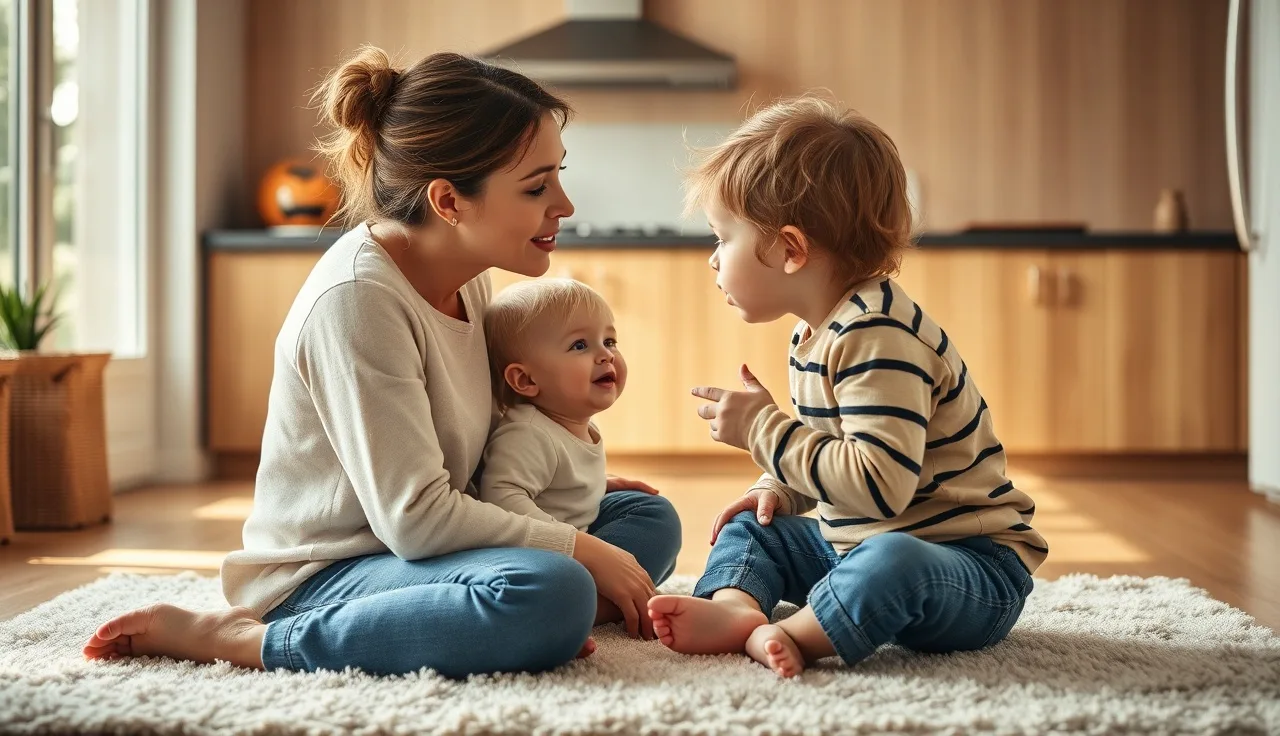
Oral motor imitation exercises are activities where a toddler watches an adult make a mouth movement and tries to copy it. Blowing out a candle. Clicking the tongue. Puffing cheeks, smacking lips, rounding lips into an "ooh" shape. The goal is to build a child's awareness of where their tongue, lips, and jaw sit, and what those parts can do.
Imitation is one of the earliest building blocks of speech. Before babies say a first word, they're already copying facial expressions and mouth shapes from the people around them [1]. When that natural imitation runs late or patchy, as it often does in late talkers and autistic children, targeted practice can help fill the gap.
The phrase "oral motor" makes some parents picture complicated therapy equipment. Most of the exercises below need nothing but your face. A few use everyday objects like straws or bubbles. That's the whole kit.
Here's the honest part up front: oral motor exercises are a support tool, not a cure. They work best as one piece of a larger speech routine, used alongside real words, modeling, and back-and-forth interaction. Nobody has clean data on how much improvement oral motor work produces on its own. The closest systematic review, McCauley and colleagues in 2009 [2], found mixed evidence for non-speech oral motor exercises used in isolation, and stronger results when those movements tied directly to speech sounds. That distinction runs through this entire article.
Why does oral motor imitation matter for speech development?
Speech is a motor skill. Saying "mama" asks the lips to close, open, and close again while the voice switches on and off, all in under a second. Toddlers who can't yet control those precise movements often have words stuck somewhere between their brain and their mouth.
Oral motor imitation helps in three ways. It draws attention to the face, so a child who isn't watching mouths starts picking up the visual information that shows how to position their own lips and tongue. It builds the habit of copying, and copying a caregiver's mouth is a short step from copying a caregiver's words. And it gives a child low-stakes practice with movement patterns they'll need for real sounds.
The American Speech-Language-Hearing Association (ASHA) treats oral motor skills as one component of the larger system behind speech production [3]. ASHA is careful to say exercises need to be relevant to speech movement, not general mouth gymnastics, and the principle of building movement awareness is solid and widely used by practicing speech-language pathologists (SLPs).
For children with childhood apraxia of speech, a motor planning disorder, focused movement practice is often a direct part of therapy. For late talkers without apraxia, it's usually a smaller piece, but still useful when done well.
A 2002 study in the American Journal of Speech-Language Pathology [4] found children who received oral motor intervention alongside traditional articulation therapy made greater gains in speech intelligibility than those who got articulation therapy alone. The sample sizes were small, and the researchers asked for more replication.
At what age should you start these exercises?
You can start simple face-play from infancy. Stick out your tongue, open your mouth wide, make silly lip sounds. Babies as young as 2 months imitate some facial gestures [5]. You're not running formal exercises at that age. You're building the habit of face-to-face imitation, which is worth a lot on its own.
For structured oral motor imitation, most SLPs introduce it on purpose around 18 months to 2 years, when toddlers are expected to be producing 50 or more words and starting to combine them [6]. If a child that age is well behind and not imitating sounds or words readily, oral motor games become a reasonable early move.
Age is a rough guide, though. A nonverbal 3-year-old and a minimally verbal 18-month-old might both benefit from the same foundational level. Let the child's current skill, not their birthday, decide where you begin.
If your child is under 3 and showing speech delays, the first step is an early intervention evaluation. Services through the Individuals with Disabilities Education Act (IDEA) Part C are free for children from birth to 3, and they can include speech therapy from a licensed SLP who will shape exercises around your child specifically [7].
Which oral motor imitation exercises work best for toddlers at home?
Here are exercises grouped by the movement they target. Start with whichever ones your child finds easiest and most fun. Early success keeps them willing to keep going.
Lip exercises
- Kiss face: pucker your lips toward the child and encourage them to copy. A loud "mwah" makes it exciting.
- Fish lips: suck the cheeks in slightly, then open and close the lips. Pair it with a fishy sound.
- Lip pops: press the lips together firmly, then pop them open. Say "pop" as you do it.
- Smile and round: alternate a big smile with an "ooh" lip shape. This pairs the /ee/ and /oo/ movement patterns.
Tongue exercises
- Tongue click: click the tongue against the roof of the mouth. Many toddlers find this one satisfying to copy.
- Lick it: dab a tiny bit of peanut butter, applesauce, or yogurt on your upper lip and stick your tongue up to lick it. Put the same on their lip so they copy the movement.
- Tongue wag: stick the tongue out and move it side to side slowly.
Jaw and cheek exercises
- Big open mouth: open wide like a lion. Roar together.
- Chew chew: exaggerated chewing motion without food, to work the jaw.
- Cheek puffs: puff both cheeks full of air. Then tap one cheek to show how to release air from that side.
Blowing exercises
- Blow out a candle. Pretend works, but real ones motivate toddlers.
- Blow bubbles through a wand. The child has to sustain a slow, steady blow, which builds lip rounding and breath support.
- Blow through a straw to move a cotton ball across a table.
- Blow a pinwheel.
Keep sessions to 3 to 5 minutes. Toddler attention windows are short, and ending while the child is still into it keeps them wanting the next round. Do this once or twice a day rather than one long marathon.
How do you get a toddler to actually copy you?
This is the real challenge. You can know every exercise cold and still get a blank stare, or a child who wanders off to find their truck. Getting imitation going takes a little strategy.
Get face-to-face first. Sit at the child's level, or hold them in your lap facing you. Make your face the most interesting thing in their visual field. Kill the distractions. Turn off any background TV.
Use a mirror. Plenty of toddlers who won't watch an adult's face will happily watch their own reflection. Sit together at a low mirror and do the exercises there. The child sees both faces at once.
Make it absurd. Toddlers copy things that surprise or delight them. A very loud tongue click. A slow, dramatic lip pop. An exaggerated fish face. Boring gets ignored. Go bigger than feels natural.
Pause and wait. After a movement, count silently to five before you try again. The child may need a beat to process and attempt it. Jumping back in too fast fills the space they need.
Reward the attempts, generously. Any rough approximation earns a big smile, a clap, the sound repeated back with real excitement. You're teaching that trying gets a response.
Chain it to play. A lip pop before you push the toy car forward. A tongue click before you drop a block in the bucket. The movement becomes part of the game.
If your child is autistic or struggles with joint attention, these strategies matter even more. You may need to start inside a highly preferred activity and slip face play into a brief moment within something the child already loves, rather than expecting them to sit for a dedicated exercise slot.
What do speech therapists actually say about oral motor exercises?
SLPs are genuinely split on this, and it's better to say so than to pretend there's a settled consensus.
One camp, associated with researchers like Gregory Lof, argues that non-speech oral motor exercises (NSOME) don't transfer to speech because the neural pathways for chewing and blowing differ from the pathways for producing speech sounds [8]. Lof and Watson's 2008 survey in Language, Speech, and Hearing Services in Schools pushed for more rigorous trials before oral motor work became routine practice. That skepticism is legitimate.
The other camp, backed by a large number of practicing clinicians, argues that for children with reduced awareness of their own mouths, some non-speech oral motor practice builds the sensory foundation that makes speech motor learning easier. The key phrase is "sensory foundation," not muscle strength.
Where most SLPs meet: exercises that pair mouth movements directly with speech sounds beat exercises done in isolation. "Blow a bubble" is fine. "Blow a bubble, now say buh buh buh" is better. The movement and the sound need to connect.
ASHA's technical report on oral motor exercises tells clinicians to use "evidence-based decision making" and to keep exercises "functionally relevant" to speech goals [3]. That's not a blanket endorsement or a blanket rejection. It's a call to be deliberate.
The practical takeaway: if your child works with an SLP, trust their individualized judgment. If you're running home practice, pair every oral motor exercise with a speech sound or a word. Skip the mouth gymnastics in a vacuum.
How is oral motor imitation different from regular speech therapy?
Regular speech therapy for toddlers targets actual words, sounds, and communication. The SLP might grow vocabulary, get a child to request things out loud, sharpen specific consonants, or stretch sentence length. That's the main event.
Oral motor imitation is more like a warm-up, a preparatory skill. It teaches a child that mouths are worth watching, that copying is possible, and that specific movements can be controlled on purpose. For children who don't have those building blocks yet, going straight to word work can feel like playing a song before you've learned to hold the instrument.
For some children, especially those with apraxia of speech or significant low muscle tone, oral motor work sits closer to the center of therapy than the warm-up. For late talkers with typical muscle tone who simply haven't started talking yet, it's a smaller component.
Speech therapy also covers the social side of talking: turn-taking, eye contact, making requests, understanding language. Oral motor exercises touch only the physical movement side. You need both.
Parents often find oral motor exercises easier to run at home than other speech activities, because they don't require the child to produce language. That takes the pressure off. The lower barrier is real, and worth using.
Can oral motor exercises help autistic toddlers specifically?
The answer depends heavily on the individual child. For some autistic toddlers these exercises land well. For others they backfire.
Some autistic toddlers have strong oral sensory sensitivities that make focused attention on mouth movements uncomfortable. Pushing exercises in that situation can increase aversion. If a child pulls away, covers their mouth, or shows distress, that's a clear signal to back off and work with an SLP on a gentler sensory approach first.
Other autistic toddlers love repetitive, predictable face-play and dive in with real enthusiasm, especially when the adult keeps things consistent and ritualized. Same spot, same order, same sound effects every time.
For minimally verbal or nonverbal autistic children, oral motor imitation can be one path toward the motor control speech needs, but AAC devices and other communication supports belong on the table at the same time. The research is clear that using AAC does not slow speech development and may support it [9].
A note on autism spectrum speech therapy: SLPs who specialize in autism often use naturalistic developmental behavioral interventions (NDBIs) as their framework. Inside that framework, oral motor activities get embedded into play rather than delivered as formal drills. That approach usually gets better buy-in from autistic toddlers than a sit-down format.
If your child is autistic and has a significant speech delay, an SLP evaluation is the right first step. The exercises here are safe to try at home, but an individualized plan matters more than any general guide.
How often should you practice, and how do you track progress?
Short and frequent beats long and occasional. Two or three sessions a day, 3 to 5 minutes each, built into routines you already have, is realistic and effective for most families. Diaper change. Before a meal. Bath time. Those are natural face-to-face moments.
Don't expect visible progress week to week. Oral motor imitation is a slow-building skill. Watch month to month instead. What can the child copy at the end of four weeks that they couldn't at the start?
Keep a simple log. A note on your phone after each session: what you practiced, whether the child attempted it, roughly how many reps you got. No formal system required. You just need enough to look back and see whether anything is moving.
Signs of progress: the child watches your face more readily, attempts a new movement even if it's messy, makes any sound while copying a movement, and refuses or wanders off less often.
If you've practiced consistently for six to eight weeks and see no engagement at all, consult an SLP. Sensory, motor, or attention factors may need a professional look. The Little Words app includes a structured screening quiz that helps you see where your child sits and whether a formal evaluation makes sense next.
Progress in oral motor imitation often shows up sideways. You may notice new babbling, clearer consonants in words the child already has, or more willingness to make sounds during play. Those are the wins.
What materials and tools make oral motor practice easier?
You don't need much. A few tools do make practice more engaging and easier to keep up.
Mirror (high value, low cost). A large floor mirror or a wall-mounted bathroom mirror. A child seeing their own face is often the difference between engagement and a blank stare.
Bubbles. Cheap and effective for lip rounding and sustained breath control. Kids love them. Get a wand the child can eventually hold.
Pinwheels and party blowers. Same breath principle as bubbles, different shape and sensation. Pinwheels feel especially satisfying because the feedback is instant and visual.
Straws of different widths. Thicker straws are easier to blow through. Narrow straws build more control over time. Use them to blow cotton balls or scraps of tissue across a smooth surface.
Small food dabs. Peanut butter, cream cheese, or yogurt on the upper lip for tongue-up practice. Check for allergies first.
Whistles and harmonica. For older toddlers (2 and up), these give sound feedback paired with lip and breath control. Forget actual music. A honk is a win.
Things you can skip: electric toothbrush vibration tools marketed as oral motor therapy devices get pushed hard in parent groups but have weak evidence for speech outcomes specifically. Chewy tubes can help children with sensory-seeking behaviors or those working on jaw grading, but they're a specialized tool that works best under SLP guidance, not a home essential.
For most families, your face, a mirror, and a bottle of bubbles get you 80 percent of the way there.
When should you see a speech-language pathologist instead of just doing home exercises?
Home exercises supplement professional care. They don't replace an evaluation when there's a real concern. Here's when to stop waiting and make the call.
Call for a formal evaluation if your child is 12 months and not babbling, 16 months with no words, 24 months with fewer than 50 words, or is losing words they had before at any age. Those are pediatric red flags [12]. The American Academy of Pediatrics recommends developmental screening at the 9-, 18-, and 24-month well-child visits [10].
If your child produces sounds but they're very hard to understand, even for you as a parent, that's worth professional attention. Typical intelligibility runs roughly 50 percent understandable to strangers at age 2 and 75 percent at age 3 [6].
If your child shows signs of childhood apraxia of speech specifically, such as limited consonant sounds, inconsistent errors on the same word, or a big gap between how much they understand and how much they can say, oral motor home exercises alone won't be enough. Apraxia needs a specific motor-based speech therapy that looks quite different from general exercises [11].
Speech therapy comes in online formats now, which lowers the barrier for families in rural areas or those short on transportation. Telehealth SLP services have grown a lot since 2020 and can work well for toddlers, best when a caregiver joins the session as a coaching partner.
One more thing. Even if your child doesn't quite hit a red-flag threshold, if your gut says something's off, get the evaluation. Early services through Part C of IDEA (birth to 3) or Part B (3 and up, through the school system) cost families nothing, and earlier beats later every time [7].
Frequently asked questions
Do oral motor exercises actually help toddlers talk?
They can help, especially when paired directly with speech sounds rather than done alone. The research is mixed on non-speech exercises in isolation (McCauley and colleagues, 2009, found inconsistent evidence), but exercises linked to actual sounds and words show better outcomes. Treat them as a way to build awareness and movement habits that make speech practice easier, not as a direct route to new words on their own.
How long does it take to see results from oral motor practice?
Most families notice changes over weeks to months, not days. Look for subtle signs: a child who watches your face more, attempts a new movement, or babbles more. Practice consistently for four to eight weeks before drawing conclusions. If you see no engagement at all after six to eight weeks of daily practice, consult a speech-language pathologist for an individualized assessment.
Can I do oral motor exercises with my toddler at home without a therapist?
Yes. The exercises in this article are safe for caregivers to run at home. Keep sessions short (3 to 5 minutes), make them playful, pair movements with sounds or words, and watch for signs the child enjoys or tolerates it. Home practice works best as a daily supplement alongside professional speech therapy, not as a full replacement when a child has significant delays.
Are there oral motor exercises specifically for kids who don't babble?
Start with sound-paired exercises rather than silent mouth movements. Lip pops with a voiced 'pop,' tongue clicks with a voiced follow-up, blowing with a 'whoo' afterward. The goal is connecting a mouth movement to a sound. For children who don't babble at all, an SLP evaluation matters, since it can point to issues beyond oral motor awareness, including hearing loss or motor planning difficulty.
What's the difference between oral motor exercises and speech exercises?
Oral motor exercises target the physical movements of the mouth (lips, tongue, jaw, cheeks) and build movement awareness and control. Speech exercises target specific sounds, words, or communication skills. Most speech therapists use both, but they do different jobs. Oral motor work is most useful as a foundation or warm-up; actual speech production practice is where most language gains happen.
Are oral motor exercises recommended for children with low muscle tone?
Yes, they're often a specific priority for children with hypotonia (low muscle tone) affecting the face and mouth. Low tone can affect how a child controls their lips, tongue, and jaw for speech. Exercises are typically tailored by an SLP and may include jaw-strengthening work alongside speech sound practice. Get an SLP assessment first, since the type and intensity should match the child's specific profile.
Can blowing exercises like bubbles and straws really improve speech?
Blowing builds lip rounding, breath control, and sustained airflow, all of which feed into sounds like /w/, /oo/, and /b/. The evidence for blowing as a direct path to specific speech sounds is limited, but as a way to make mouth practice fun and pair it with breath control, it's reasonable and widely used. Pair blowing with the relevant speech sound right after to strengthen the connection.
My toddler refuses to copy me. What should I do?
Start by removing the expectation. Sit with a mirror and make faces yourself without asking anything. Let curiosity pull the child in. When they glance at you, exaggerate something silly. Use motivating foods (a small dab on the lip creates a natural tongue lick). Fold oral motor moments into games they already love rather than a separate sit-down activity. Some children need weeks of exposure before attempting anything.
Is it possible to do too many oral motor exercises?
More isn't better. Too many sessions, or sessions that run too long, can create negative associations and make a child avoid face-to-face interaction. Aim for two to three short sessions daily. If a child shows distress, resistance, or shutdown during exercises, stop and try a different approach. Rest is part of motor learning; the brain consolidates new movement patterns between sessions, not only during them.
Should I use oral motor exercises alongside AAC for my nonverbal toddler?
Yes, and the two approaches run in parallel without conflicting. AAC gives a child a functional way to communicate right now. Oral motor and speech work builds toward verbal speech over time. Research consistently shows that using AAC does not reduce a child's motivation to speak and often increases communication overall. Talk to your SLP about how to fit both into a daily routine.
At what age are oral motor exercises no longer useful?
There's no firm upper age limit. These exercises are most common with toddlers and preschoolers (ages 1 to 5), but children with motor speech disorders like apraxia may continue motor-based speech work well into school age. The exercises evolve over time, from simple face play to more precise articulation work. What matters is matching the activities to the child's current skill level and therapy goals.
How do I know if my child needs an oral motor evaluation?
Consider requesting one if your toddler drools heavily past age 3, has consistent trouble chewing or managing food textures, strongly avoids certain textures, has speech that's very hard to understand, or shows limited sound variety in babbling. A speech-language pathologist can assess oral structure, strength, and movement, then decide whether oral motor work belongs in your child's therapy plan.
Are there signs that oral motor exercises are working?
Watch for more willingness to make face-to-face contact during play, attempts at new mouth movements even when imprecise, new sounds in babbling or play, more varied consonant-vowel combinations, and clearer versions of words already in their vocabulary. Progress is gradual. A monthly comparison of what the child can attempt now versus a month ago tells you more than week-to-week checks.
Sources
- Meltzoff & Moore, Science (1977), 'Imitation of facial and manual gestures by human neonates': Babies as young as 2 months imitate facial gestures, including mouth movements, from adults.
- McCauley et al., American Journal of Speech-Language Pathology (2009), 'Evidence-based systematic review: effects of non-speech oral motor exercises on speech': A systematic review found mixed evidence for non-speech oral motor exercises in isolation; stronger results appeared when movements were tied to speech sounds.
- American Speech-Language-Hearing Association (ASHA), Technical Report on Oral Motor Exercises: ASHA states clinicians should use evidence-based decision making and that oral motor exercises must be functionally relevant to speech goals.
- Forrest, American Journal of Speech-Language Pathology (2002), 'Are oral-motor exercises useful in the treatment of phonological/articulatory disorders?': Children who received oral motor intervention alongside articulation therapy showed greater gains in speech intelligibility than those receiving articulation therapy alone, though sample sizes were small.
- Meltzoff & Moore, Developmental Psychology (1994), 'Imitation, memory, and the representation of persons': Facial imitation, including mouth movements, is observed in infants as young as 2 months and is a foundational building block for social and speech development.
- American Speech-Language-Hearing Association (ASHA), Speech and Language Developmental Milestones: By 24 months, toddlers are expected to have 50 or more words; typical intelligibility is roughly 50 percent to strangers at age 2 and 75 percent at age 3.
- U.S. Department of Education, IDEA Part C (Individuals with Disabilities Education Act, 20 U.S.C. § 1431 et seq.): Under IDEA Part C, free early intervention services including speech therapy are available to children from birth to age 3 who have developmental delays.
- Lof & Watson, Language Speech and Hearing Services in Schools (2008), 'A nationwide survey of nonspeech oral motor exercise use: implications for evidence-based practice': Researcher Gregory Lof argues that non-speech oral motor exercises do not transfer to speech production because the neural pathways differ between speech and non-speech movements.
- Millar, Light & Schlosser, American Journal of Speech-Language Pathology (2006), 'The impact of augmentative and alternative communication intervention on the speech production of individuals with developmental disabilities': AAC use does not reduce speech development and may support it; research shows AAC does not decrease a child's motivation to speak.
- American Academy of Pediatrics (AAP), Developmental Surveillance and Screening Policy: The AAP recommends formal developmental screening at the 9-, 18-, and 24-month well-child visits, including assessment of speech and language milestones.
- ASHA, Childhood Apraxia of Speech (Practice Portal): For children with childhood apraxia of speech, motor-based speech therapy targeting movement sequencing is a direct and central part of evidence-based treatment.
- National Institute on Deafness and Other Communication Disorders (NIDCD), Speech and Language Developmental Milestones: NIDCD provides normative data on speech milestones and identifies lack of babbling by 12 months and no words by 16 months as red flags warranting evaluation.