Last updated 2026-07-09
TL;DR
A picture scene is a single illustration showing people, objects, and actions in context. Speech-language pathologists use them to target vocabulary, grammar, narrative, and social communication. You can use them at home with zero training. Research supports scene-based activities for late talkers as young as 18 months. Free and low-cost options work as well as pricey kits.
What are picture scenes in speech therapy?
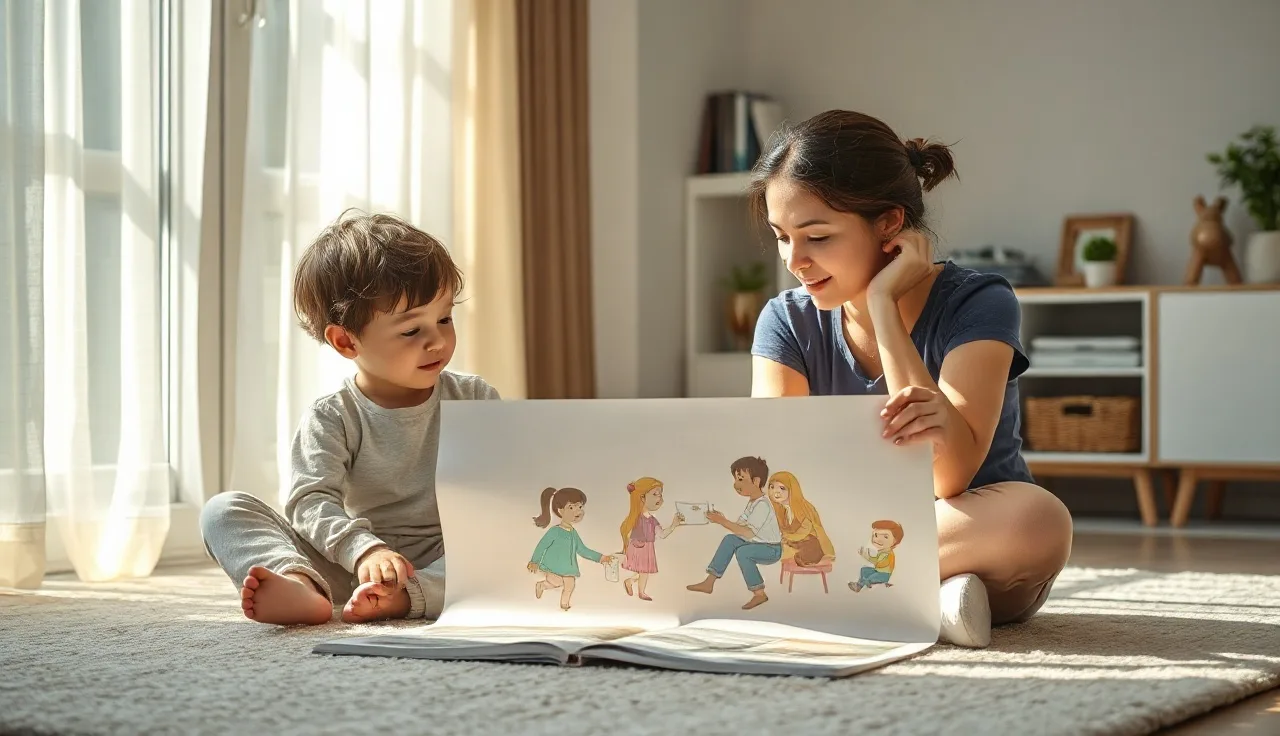
A picture scene is a single illustration or photograph showing a setting full of characters, objects, and ongoing actions. Think a busy playground, a kitchen at breakfast, or a birthday party. The scene has no labels or captions. That blank-slate quality is the point: it gives a child something real to talk about without handing them the words first.
Speech-language pathologists (SLPs) have used scene images since at least the 1970s as what the field calls a "low-structure" elicitation tool. You present the image. The child narrates, labels, asks questions, or describes actions, depending on the goal for that session. The SLP watches and listens for which language forms show up and which are missing.
They are different from flashcards. A flashcard shows one object against a white background, "apple" or "dog." A picture scene shows a dog chasing a ball while a girl laughs and a boy drops his ice cream. That mess mirrors how language actually works in the real world, which is why scenes beat flashcards for verb tenses, prepositions, pronouns, and sentence structure, more than nouns [1].
Action pictures for speech therapy are a close cousin. They zoom in on a single ongoing event, like a woman climbing a ladder or a boy spilling milk, rather than showing a full environment. Both formats have their uses. Action pictures are sharper for verb-specific work. Full scenes are better for narrative, perspective-taking, and social language.
Why do SLPs use picture scenes? What does the research say?
The evidence for scene-based language elicitation is solid, though research on specific commercial products is thinner than research on the technique itself. That gap matters when a company charges you $80 for a box of cards.
A widely cited framework comes from Lahey's 1988 work on language content, form, and use, which established that meaningful context, the kind a scene provides, is necessary for children to generalize new language patterns beyond the therapy room [2]. Later research keeps backing contextually rich stimuli over decontextualized drill.
On narrative specifically, ASHA's guidance on language disorders notes that picture-based story generation tasks are among the most common and clinically useful tools for assessing narrative structure, including sentence length, clause density, and use of mental state verbs [1]. Children who struggle with narrative language carry elevated risk for later reading and academic trouble, so scenes do more than build small talk.
For late talkers, research published in the Journal of Speech, Language, and Hearing Research has found that parent-implemented naturalistic language intervention using picture-supported contexts produces meaningful gains in expressive vocabulary in toddlers 18 to 36 months old [3]. You do not need to be an SLP to make scenes work. You need a good image and a few simple prompting habits, which we cover below.
For children on the autism spectrum, scene images also support social communication goals. A 2019 study in the Journal of Autism and Developmental Disorders found that visual scene displays, a type of AAC that organizes vocabulary inside a meaningful scene image rather than a grid, improved spontaneous communication in minimally verbal children more than traditional grid-based displays did [4]. If your child uses AAC, this one is worth raising with their SLP. Our article on alternative augmentative communication devices for autism covers the options in more depth.
What speech and language goals can picture scenes target?
This is where scenes earn their reputation. One good image can hit half a dozen goals in a single session depending on how you use it.
| Goal area | What you do with the scene | Example prompt |
|---|---|---|
| Expressive vocabulary (nouns) | Point and name objects | "What do you see?" |
| Verbs and action words | Describe what characters are doing | "What is she doing?" |
| Verb tenses (is/was/will) | Talk about what happened vs. what is happening | "What happened to the boy?" |
| Prepositions | Locate objects relative to each other | "Where is the dog?" |
| Pronouns (he/she/they) | Refer to characters | "Who is running?" |
| Sentence structure | Build longer utterances | "Tell me a whole sentence about her." |
| Narrative language | Tell a story about what led to the scene | "What do you think happened first?" |
| Inferencing | Read emotions, predict outcomes | "How does he feel? Why?" |
| Social language | Discuss character intentions and perspectives | "Why did she do that?" |
| AAC vocabulary | Find target words in a scene-based display | Match scene vocabulary to device |
For children with speech delay, the first priority is usually nouns and verbs, so almost any scene with people doing things will work. For older kids with pragmatic language challenges, including many autistic children, the inferencing and social language rows are the ones that earn their keep.
How do you use picture scenes at home without being an SLP?
You do not need a therapy script. You need three things: a scene your child finds interesting, a rough sense of your child's current language level, and patience with silence.
Start with the scene your child picks. Agency matters for kids with language difficulties. If they love dinosaurs, trains, or the grocery store, find a scene in that world. Motivation to talk is the first predictor of whether any activity produces language at all.
For toddlers and early talkers, keep your own language simple. Model one-word or two-word comments instead of firing off questions. "Big dog. Dog running. Oh no, dog!" gives a child something to copy without pressure. Research behind the "It Takes Two to Talk" parent-mediated approach from the Hanen Centre shows that following the child's lead and trading questions for comments increases spontaneous language attempts [5].
For preschoolers targeting sentences, use a technique SLPs call "expansions." If your child says "boy fall," you say "Yes, the boy is falling." You do not correct them. You model the fuller form right after their attempt. ASHA describes this kind of recasting as a core strategy in naturalistic language intervention [1].
For school-age children working on narrative, try the "tell me the story" prompt. After they give a plain description, ask "and then what?" or "how do you think that started?" This is called story generation, and it targets the episodic structure, setting, problem, and resolution, that sits under reading comprehension.
One practical rule: wait five seconds after any question before you fill the silence. Five seconds feels uncomfortably long. It is often exactly the processing time a child with a language delay needs to build a response [6].
What are the best free picture scene resources for speech therapy?
Free is genuinely useful here. You do not need to spend a dime to get started.
Teachers Pay Teachers (teacherspayteachers.com) has hundreds of free speech therapy scene images, many made by working SLPs. Search "WH question scenes" or "describe a scene speech therapy." Quality swings wildly, so look for items with high download counts and recent reviews.
Boards2Life, part of the AAC community, offers free visual scene displays for download. These are built for children who use or might benefit from AAC alongside verbal speech.
Google Image Search with the filter set to "labeled for reuse" pulls usable scene images. A kitchen shot from a cooking blog, a park photo from a city website, a birthday stock image, any of them works the same as a commercially printed card.
The Peabody Picture Vocabulary Test (PPVT) and similar standardized assessments use picture stimuli, but those are not free and should only be given by a licensed SLP. Do not repurpose standardized test materials as informal therapy tools. The norms are only valid under standardized conditions [7].
For parents who want more structure, ASHA's public site (asha.org) has tip sheets on supporting language development at home, including visual supports [1].
What paid picture scene materials are worth buying?
A handful of products keep showing up on SLP recommendation lists, and they have held up under years of clinical use.
The Webber Photo Cards series (Super Duper Publications) includes scene sets for WH questions, actions, and story sequencing. Individual sets run roughly $20 to $35. They photograph cleanly for screen-share, which matters if your child is doing online speech therapy.
Talk About It Scenes (Super Duper) is a set of large-format illustrated boards. It targets describing, comparing, and narrative at an elementary level. Around $25 to $40 depending on the vendor.
Language Builder Picture Cards (Stages Learning Materials) are photo-based, organized by category, and include a scene set. They show up often in ABA programs alongside speech therapy. The full scene set runs $60 to $80.
For AAC users, Snap Core First and TouchChat both include visual scene display options inside their software. Not cheap. If your child already has a device, though, scene displays may already sit under a different menu, so poke around with your SLP before buying anything new.
Honest opinion: for most families, free scene images plus one or two cheap printed sets from Teachers Pay Teachers is plenty to start. The expensive kits are easier to organize and more durable, but the underlying technique is identical. Spend your money on actual speech therapy for kids before you spend it on materials.
What makes a good action picture for speech therapy?
Action pictures are the scene's more targeted cousin. They shine when you need to drill a specific verb or verb tense without a busy environment pulling attention away.
A good action picture has a clear subject doing something with an obvious, nameable action. A woman is running. A child is eating. A dog is jumping. Ambiguous images, where the action could be read two or three ways, sabotage the goal, because you end up teaching the word you had in mind instead of eliciting what the child actually sees.
For verb tense work, you want action pictures in two or three time states: before (the glass is on the table), during (the glass is falling), after (the glass broke). A sequence like this lets you practice "was," "is," and "will be" or "broke" with no abstract explanation.
For kids building early verb vocabulary, ASHA points to high-frequency action words as the place to start: eat, drink, run, fall, give, put, go, come, make, break [1]. These verbs show up in natural conversation most often. Make sure they are well represented in your action pictures before you move to rarer words like "gallop" or "construct."
Photographs work better than cartoons for some children, especially autistic kids who process realistic images more readily than abstract illustration. Test both. Watch which one gets your child talking.
How do picture scenes help kids with autism specifically?
Autistic children often have strong visual processing, and many find visual input easier to engage with than words alone. That makes picture scenes a natural fit, but the real benefits run deeper than a general preference for pictures.
For children who are minimally verbal or use AAC, visual scene displays, illustrated scenes with embedded vocabulary hotspots, have shown better outcomes than traditional grid-based AAC in building spontaneous communication [4]. The scene gives meaningful context that helps a child grasp why a word exists, more than what it sounds like.
For autistic children who are verbal but have social communication differences, picture scenes are one of the best tools for theory of mind and inferencing. Show a scene where a character's face reads one emotion while their situation suggests another (a child smiling while clearly lost) and you create a low-stakes way to talk about mental states, intentions, and predictions. The image holds still. The child can study it as long as they need.
The American Academy of Pediatrics recommends early and intensive speech-language services for autistic children, noting that communication intervention should be individualized and often includes visual supports [8]. If your child has an autism diagnosis, finding an SLP with autism-specific experience is the best next move. Our article on autism spectrum speech therapy covers what to look for in that evaluation.
Parents can do real scene-based work at home. Keep sessions short, five to ten minutes, stop before the child checks out, and never force eye contact with the image. The goal is language, not compliance.
How do picture scenes fit into a broader speech therapy plan?
Picture scenes are a tool, not a curriculum. They work best inside a larger plan an SLP has built from a formal assessment of your child's current language profile.
A standard speech therapy plan for a child with a language delay usually mixes structured drill on a specific target, naturalistic practice inside play or conversation, and a home program for parents [1]. Picture scenes fit all three. They add structure without the fakeness of rote repetition, and they carry over to home practice because any scene image works without specialized training.
If your child is in early intervention speech and language therapy under IDEA Part C (the federal law covering birth through age two), picture-based activities may already sit in their IFSP goals. Under Part B (ages three through twenty-one), they may appear in IEP goals for expressive language, receptive language, or narrative skills.
If you do home practice between sessions, the number one rule is to tell your child's SLP what you are doing. They can say whether your images match the current therapy targets and whether your prompting style matches their in-session work. Home practice that fights in-clinic strategy can slow progress, even when you mean well.
For families without regular access to an SLP, AI-supported tools are filling some of the gap. Little Words (littlewords.ai) is an AI speech companion for neurodivergent kids that uses picture-based prompts and natural conversation to support language practice between therapy sessions. A short quiz at littlewords.ai/start matches the approach to your child's needs. AI tools supplement professional therapy. They do not replace it.
At what age should you start using picture scenes with a child?
Earlier than most parents assume.
By 18 months, typically developing children point at pictures in books and try to name objects. For late talkers this age, scene-based activities can start right away. Keep the scenes simple, a caregiver and baby, a child eating, a dog playing, but the technique holds: comment, pause, follow the child's lead.
The American Academy of Pediatrics recommends developmental surveillance at every well-child visit and formal screening at 9, 18, and 30 months [8]. If a 24-month-old has fewer than 50 words or is not combining two words, that is a flag for a speech-language referral. You do not need a diagnosis to start using pictures at home.
For toddlers 18 to 30 months, action pictures with a single clear subject beat complex multi-character scenes. Add complexity as vocabulary grows. By age 3 to 4, most children can handle a scene with four or five characters and several actions at once.
For school-age children, the scenes get sophisticated. Complex social situations, ambiguous emotions, multi-event narratives. The goal shifts from "name what you see" to "explain what is happening and predict what comes next." That shift matches the language demands of reading comprehension, which turn academically significant around second grade [2].
How are picture scenes different from picture books and what is better?
Picture books win for narrative structure and vocabulary in context. Picture scenes win for elicitation, getting the child to produce language instead of following along. Neither one is better in the abstract. They do different jobs.
When you read a picture book, the story and vocabulary are already fixed. A child gets to hear rich language, but the setup often lets them coast as a passive listener. A picture scene has no built-in script. The child has to generate the language.
For assessment, scenes are irreplaceable. An SLP uses a scene to find out what a child can produce on their own, which is the most honest read of functional language. A book read-aloud tells you about receptive language and imitation, both important but different skills.
In practice, good home programs use both. Read picture books for shared book reading, which has its own strong evidence base for vocabulary and print awareness [9]. Use picture scenes for the parts of your routine where you want the child talking, not listening.
One underused trick: pause a video your child loves and use that frozen frame as an impromptu scene. A paused moment from a show they watch every day already has motivation baked in. "What is he doing right now?" or "What do you think happens next?" can produce more language in thirty seconds than a formal activity in ten minutes.
If you are looking at ways to widen your child's communication support, our overview of pediatric speech therapy lays out what evidence-based intervention looks like for kids under twelve.
Frequently asked questions
Can I make my own picture scenes for speech therapy at home?
Yes, and homemade scenes often beat commercial ones because they show environments your child already knows. Take a photo of your kitchen, your backyard, or a recent birthday party. Familiar settings lower anxiety and raise motivation to talk. Print the photo or show it on a tablet. The technique is the same as any store-bought scene: comment on what you see, pause, and follow your child's lead.
How long should a picture scene activity last for a toddler?
Five minutes or less. Toddlers with language delays have short attention spans for structured tasks, and stopping before they lose interest keeps the whole thing positive. Two or three short scene activities spread across the day produce more language than one long slog. If your child is disengaging, stop. Forcing participation teaches avoidance, not language.
What is a visual scene display and how is it different from a regular picture scene?
A visual scene display (VSD) is a picture scene with interactive hotspots built into it. Tap a hotspot and the device speaks a word or phrase tied to that part of the image. VSDs are an AAC format, more than a therapy activity. Research in the Journal of Autism and Developmental Disorders found VSDs improved spontaneous communication in minimally verbal children more than traditional grid AAC did [4]. A regular scene image has no interactive vocabulary links.
Are picture scenes useful for children who are nonverbal or minimally verbal?
Yes, especially in the VSD format above. For minimally verbal children, the goal may be pointing, eye gaze toward the image, or activating an AAC device rather than spoken words. The scene provides shared attention and a concrete referent, which are the building blocks of communication even before speech shows up. Always work with an SLP on AAC-specific goals. A scene image alone is not a replacement for a full AAC evaluation.
Which picture scenes work best for WH questions (who, what, where, when, why)?
Complex multi-character scenes work best because they answer all five question types inside a single image. A playground scene answers "who" (the children), "what" (they are playing), "where" (outside, on swings), "when" (daytime), and "why" (because it is recess). Super Duper Publications' Webber Photo Cards for WH questions are a common pick, and free scene images from Teachers Pay Teachers cover this goal too.
How do I know if picture scene activities are actually helping my child's speech?
Track one narrow target. If you are working on verbs, count how many different verbs your child uses on their own during a five-minute scene activity each week. Progress shows up faster when you measure one thing at a time. Your child's SLP should also track progress data at each session and adjust targets from it. If you see no change after four to six weeks of steady practice, bring it up with the SLP.
Can picture scenes help with grammar and verb tenses specifically?
Yes, this is one of their strongest uses. A scene showing an action in progress targets present progressive ("she is running"). A before-and-after pair of images targets past tense ("she ran" or "she fell"). A scene with an obvious next step targets future tense ("he is going to eat"). This visual scaffolding makes abstract grammar concrete without asking a child to understand grammatical rules on purpose.
Do picture scenes work for older children, more than toddlers?
They work well through elementary school and beyond. For older children, the goals shift toward narrative language, inferencing, perspective-taking, and social problem-solving. Complex scenes showing ambiguous social situations turn up in therapy for children with pragmatic language disorder and social communication differences well into middle school. The format is the same. The cognitive and linguistic demands of the prompts scale up.
How many picture scenes should I have available at home?
Ten to fifteen varied scenes is enough to start. You want enough variety that your child generates language instead of memorizing the "right" answers. Rotate scenes every few weeks. Adding one or two new scenes a month keeps things fresh. If your child has a very narrow range of interests, it is fine to skew most scenes toward that theme. Motivation outweighs variety.
Are there apps that use picture scenes for speech therapy?
Several apps run scene-based activities. Proloquo2Go and Snap Core First include visual scene display features for AAC users. Articulation Station and similar apps focus more on sounds than scenes. Little Words (littlewords.ai) uses picture-based natural prompts for late talkers and neurodivergent children. No app replaces evaluation and direct therapy from a licensed SLP, but apps can give meaningful practice between sessions.
What is the difference between picture scenes used for speech therapy versus occupational therapy?
In speech therapy, picture scenes elicit language: vocabulary, grammar, narrative, and social communication. In occupational therapy, illustrated scenes may show up in visual perceptual tasks, like finding hidden objects or spotting differences between two images. Some scenes get used in both disciplines for different goals. If your child sees an SLP and an OT, the two may use similar materials but read what they see very differently.
How do picture scenes relate to early intervention under IDEA?
Under IDEA Part C (birth to age two) and Part B (ages three to twenty-one), speech-language services must be evidence-based and individualized. Picture-based language activities are a recognized evidence-based strategy and commonly appear in IFSP or IEP goals. Parents can ask that scene-based home activities be written into their child's plan so home practice matches school or clinic goals. See our article on early intervention speech and language therapy.
Are real photographs better than illustrations for speech therapy scenes?
It depends on the child. Photographs are more realistic, which can help word-to-world mapping for children learning vocabulary. Illustrations cut visual clutter and highlight the target elements. Autistic children sometimes process photographs more readily; others find the detail overwhelming and do better with clean illustrations. Test both with your child. Your SLP can tell you which format produces more spontaneous language from session data.
Sources
- American Speech-Language-Hearing Association (ASHA), Practice Portal: Spoken Language Disorders: ASHA describes recasting and naturalistic language intervention strategies including picture-based elicitation as core approaches for language disorders in children.
- Lahey, M. (1988). Language Disorders and Language Development. Macmillan. Framework of language content, form, and use.: Lahey's framework established that meaningful context is necessary for children to generalize new language patterns, supporting scene-based over decontextualized stimuli.
- Journal of Speech, Language, and Hearing Research (ASHA journals), parent-implemented naturalistic language intervention for late talkers: Parent-implemented naturalistic language intervention using picture-supported contexts produces meaningful gains in expressive vocabulary in toddlers 18 to 36 months old.
- Journal of Autism and Developmental Disorders (Springer), Visual Scene Displays vs. Grid AAC in minimally verbal children (2019): Visual scene displays improved spontaneous communication in minimally verbal children with autism more than traditional grid-based AAC displays.
- The Hanen Centre, It Takes Two to Talk program: Following the child's lead and reducing questions in favor of comments increases spontaneous language attempts in toddlers with language delays.
- Rowe, M. L. (2012). A longitudinal investigation of the role of quantity and quality of child-directed speech in vocabulary development. Child Development, 83(5), 1762-1774.: Wait time after a question, allowing roughly five seconds of processing time, is associated with increased language responses from children with language delays.
- Pearson Assessments, Peabody Picture Vocabulary Test, Fourth Edition (Dunn & Dunn, 2007): Standardized assessments like the PPVT should only be administered by licensed SLPs; norms are only valid under standardized conditions.
- American Academy of Pediatrics, Pediatrics journal, developmental surveillance and screening guidance: The AAP recommends developmental surveillance at every well-child visit and formal screening at 9, 18, and 30 months, and early intensive speech-language services for children with autism.
- National Institute for Literacy, Report of the National Early Literacy Panel (2008): Shared picture book reading has a strong evidence base for vocabulary development and print awareness in young children.
- ASHA, IDEA Part C and Part B and Speech-Language Services: Under IDEA Part C (birth to age 2) and Part B (ages 3 to 21), speech-language services must be evidence-based and individualized; picture-based language activities are a recognized evidence-based strategy.
- U.S. Department of Education, IDEA (Individuals with Disabilities Education Act): IDEA Part C covers early intervention services for children birth through age two; Part B covers ages three through twenty-one, including IEP-based speech-language services.