Last updated 2026-07-10
TL;DR
Proloquo2Go is an AAC (augmentative and alternative communication) app for iPad and iPhone that costs $249.99 as a one-time purchase. It uses symbol-based communication to help nonspeaking and minimally speaking children and adults express themselves. It requires an Apple device, works best with SLP guidance, and is covered by some insurance plans and Medicaid waivers.
What is Proloquo2Go and how does it work?
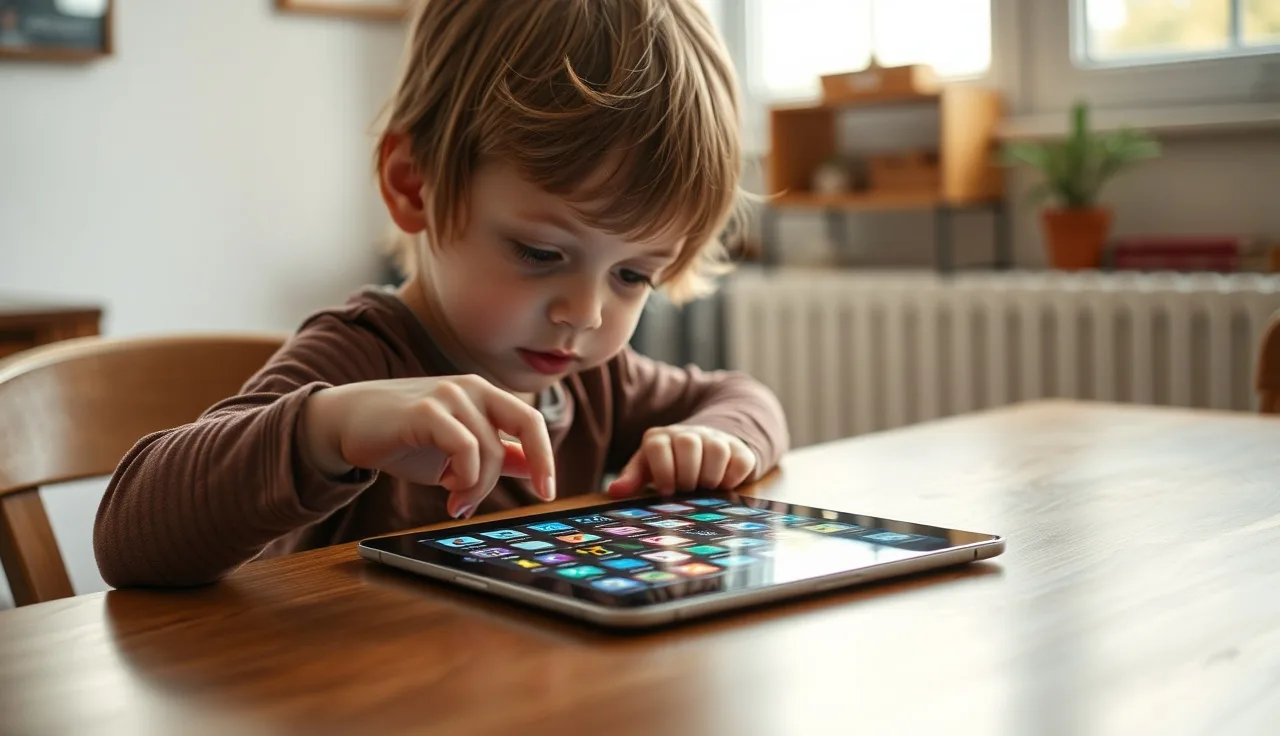
Proloquo2Go is an AAC app made by AssistiveWare, a Dutch company that has been building communication software since 2000. It runs exclusively on Apple devices: iPhone, iPad, and iPod Touch. The app turns a standard consumer tablet into a voice-output communication device, meaning your child touches a symbol or word and the app speaks it aloud through the device speaker or headphones.
The core logic is symbol-based communication. The default symbol set is called SymbolStix, though the app also supports PCS (Picture Communication Symbols) from Tobii Dynavox. Symbols are organized into vocabulary pages, and the app ships with two built-in vocabulary options: Crescendo, which is designed for children building language from scratch, and BasicCommunication, a simpler layout for users who need high-frequency phrases fast. Both are fully customizable.
Where Proloquo2Go differs from simpler picture boards is motor planning. The app uses a system called Aided Language Stimulation combined with consistent vocabulary placement, so a symbol always lives in the same spot regardless of which page you're on. Over time, a child's hands learn where to reach before their eyes confirm it. That matters because motor memory can support communication even on hard days when cognitive load is high.
The app also has a built-in word prediction engine and supports access methods beyond touch: switch scanning, head tracking, and eye gaze when paired with compatible hardware. That range of access options is why speech-language pathologists (SLPs) frequently recommend it for children with apraxia of speech, autism, cerebral palsy, and other complex communication needs [1].
Who is Proloquo2Go designed for?
AssistiveWare markets Proloquo2Go to anyone who has difficulty speaking clearly enough to be understood, from toddlers who are late talkers with suspected motor speech disorders to adults with ALS. In clinical practice, the most common users are children diagnosed with autism spectrum disorder, childhood apraxia of speech, cerebral palsy, Down syndrome, Angelman syndrome, and Rett syndrome.
The American Speech-Language-Hearing Association's position on AAC is clear: there is no prerequisite cognitive or language level required before introducing AAC [2]. That used to be debated, but the research now consistently shows that offering AAC early does not suppress speech development and frequently supports it. A 2014 systematic review in the American Journal of Speech-Language Pathology found that AAC interventions did not impede natural speech and often increased it in children with autism [3].
Age range is wide. Proloquo2Go has vocabulary sets designed for children as young as two, and the system scales up through adult use without requiring a different app. For very young children, a parent or SLP typically sets up a small, simple board of 9 to 16 symbols and models its use repeatedly before expecting the child to initiate independently. That modeling process, called Aided Language Stimulation, is the most evidence-supported way to introduce any symbol-based AAC system [2].
If your child is a late talker without a clear diagnosis, an SLP evaluation is the right first step before committing to any specific AAC system. Early intervention services, available free through IDEA Part C for children under three, can include AAC assessment as part of the process [4].
How much does Proloquo2Go cost, and is it covered by insurance?
Proloquo2Go costs $249.99 as a one-time purchase from the Apple App Store, as of mid-2025. There is no subscription. AssistiveWare does offer a free 14-day trial through its website, which is genuinely useful for trialing the interface before paying.
The device itself, meaning the iPad, is a separate cost. A new entry-level iPad runs $329 to $499 at retail. A refurbished or older iPad can work with older versions of the app, but AssistiveWare regularly updates iOS requirements, so check compatibility before buying used hardware.
Insurance coverage varies a lot. Here is the honest picture:
| Coverage path | Typical outcome | Notes |
|---|---|---|
| Medicaid (state AAC waiver) | Often covers app + device | Requires SLP documentation and prior authorization |
| Private insurance (ABA/habilitation benefit) | Inconsistent, 30-60% approval rates | Denial is common; appeals succeed frequently |
| IDEA Part B (school, age 3-21) | School provides device for school use | Device stays at school, not sent home |
| Vocational Rehabilitation | Available for adults/teens | Must demonstrate work-related need |
| AssistiveWare funding help | Free app trial; funding guides available | Does not cover device cost directly |
Medicaid is the most reliable route for families who qualify. Most state Medicaid programs cover AAC as durable medical equipment when an SLP writes a letter of medical necessity documenting that the child has a communication impairment that affects daily function [5]. The Assistive Technology Act of 1998 (Public Law 105-394) also established state AT programs that provide loans, demonstrations, and sometimes funding assistance for devices [6].
Private insurance denials are common but not final. The appeals process works often enough that it's worth doing, especially with a well-written SLP letter and documentation of the child's functional communication needs. Many SLPs have templates for this.
Proloquo2Go vs other AAC apps: how does it compare?
Proloquo2Go is the market leader in iOS-based AAC apps, but it's not the only option. The main competitors are Snap Core First (Tobii Dynavox), TouchChat, and LAMP Words for Life.
| App | Platform | Price | Symbol set | Motor planning focus |
|---|---|---|---|---|
| Proloquo2Go | iOS only | $249.99 | SymbolStix, PCS | Yes (consistent locations) |
| Snap Core First | iOS + Android | $299.99/year | PCS | Moderate |
| TouchChat | iOS + Android | $149.99-$299.99 | Multiple | Optional add-on |
| LAMP Words for Life | iOS + Android | $299.99 | SymbolStix | Yes (core focus) |
| Cboard | Web/Android/iOS | Free | Open symbols | No |
LAMP Words for Life deserves a specific mention because it uses a different motor planning approach called Language Acquisition through Motor Planning, developed by Lois Brady and the Children's Hospital of Philadelphia. Some SLPs prefer it for children with apraxia of speech because the motor patterns are even more tightly organized. Neither LAMP nor Proloquo2Go is universally better. The right one depends on the child and their SLP's clinical judgment.
Proloquo2Go's biggest practical limitation is that it only runs on Apple hardware. If your family uses Android devices, you're looking at a separate iPad purchase just for the app. LAMP Words for Life and Snap Core First both have Android versions, which changes the device math significantly.
For minimally verbal children, especially those who also show echolalia, a full vocabulary-based system like Proloquo2Go tends to be a better long-term investment than simple phrase-board apps. Echolalic speech and AAC can coexist, and the research increasingly shows that supporting intentional communication alongside echolalia produces better outcomes than trying to eliminate echolalia first [3].
How do you set up Proloquo2Go for a child?
Setup is genuinely complex, and I'd be doing you a disservice if I said otherwise. Out of the box, the app opens to a full vocabulary with hundreds of symbols. Without customization and clinical guidance, most children will be overwhelmed and the family will give up inside two weeks.
The practical setup path that works:
Start with a small core vocabulary board of 9 to 16 symbols, not the full default layout. Core vocabulary means high-frequency words like "more," "stop," "want," "go," "help," "no," and "yes." These words appear in most communication and work across contexts. AssistiveWare's own research and ASHA guidance both support starting with core [2].
Then model, model, model. Every SLP who works with AAC will tell you the same thing: you have to use the device yourself, pointing to symbols as you talk to your child, for weeks before expecting them to use it independently. This is called Aided Language Stimulation (ALS) and it's not optional. It's how the child learns what the system is for.
The app's Partner-Assisted Scanning mode lets you set up the device for a child who can't touch a screen reliably. If your child uses a switch or eye gaze device, an AT specialist or SLP certified in AAC should configure that access method. This is not a DIY job.
AssistiveWare has a free online resource called AAC Learning Journey (learn.assistiveware.com) with videos and guides organized by communication stage. It's genuinely good. The company also publishes a free vocabulary planning tool. Neither replaces an SLP, but both help parents stay consistent between therapy sessions.
For families working with a school district, ask for an AAC team that includes an SLP, an AT specialist, and ideally an educator trained in AAC. Under IDEA, if the IEP team determines a child needs AAC to access their education, the district must provide it [4].
Does Proloquo2Go work for autism specifically?
Yes, and it's probably the most common diagnosis in Proloquo2Go's user base. The app is frequently recommended by SLPs working with autistic children who are nonspeaking or minimally speaking, a group estimated to be around 25 to 30 percent of people on the autism spectrum, though that figure has wide confidence intervals depending on how you define minimally speaking [7].
For autism specifically, a few features matter more than others. The consistent symbol placement supports the predictability and routine that many autistic children rely on. The customizable visual layout means you can minimize visual clutter for children who are easily overwhelmed by too many symbols. And the text-to-speech output gives the child a consistent voice that doesn't vary in tone the way human speech does.
The evidence base for AAC in autism is solid enough to be included in ASHA's Practice Portal on AAC. The organization states that "AAC does not hinder speech development and may support it" specifically in the context of autism [2]. A randomized controlled study published in the Journal of Autism and Developmental Disorders in 2019 found that children with autism who received PECS (a picture exchange system, not an app) showed more spontaneous communication after intervention, a finding that the broader AAC research community considers relevant to symbol-based apps like Proloquo2Go as well, though direct RCT data on the app itself is limited.
For families navigating autism spectrum speech therapy, the key is that AAC is not a last resort. The AAP's autism clinical report explicitly supports early introduction of AAC for children who are not meeting speech milestones [8]. Waiting until a child has "tried everything else" costs developmental time.
One honest caveat: the app works best when it's used consistently across all environments, more than in therapy. That means parents, teachers, and caregivers all modeling the same vocabulary on the same device. Inconsistent use across settings is the most common reason AAC stalls.
What device do you need for Proloquo2Go?
Proloquo2Go requires iOS 16 or later, which means it works on iPhone models from around 2018 onward and iPad models from 2019 or later. The most common choice for children is an iPad, specifically the standard iPad (not the Mini) because the larger 10.9-inch screen is easier to touch accurately, especially for younger children with limited motor precision.
For durability, most families buy a protective case immediately. Griffin Survivor and Otterbox Defender are the most commonly recommended by SLPs. Both are thick, drop-resistant, and have screen covers. A mounting system (to attach the iPad to a wheelchair, stroller, or table) costs an additional $50 to $200 depending on the setup.
You do not need a cellular-capable iPad. Proloquo2Go works offline once downloaded. Wi-Fi only is fine for most users.
One thing parents frequently ask: can the child use the same iPad for games and videos? Technically yes, but in practice it creates problems. The device becomes a contested object, and children may get confused about its communication function. Many families and SLPs recommend a dedicated device with communication apps prominent on the home screen and entertainment apps either removed or placed in a locked folder.
If cost is the limiting factor, refurbished iPads from Apple's certified refurbished store carry a one-year warranty and cost $100 to $200 less than new. That's a real option worth considering.
How does Proloquo2Go support language development over time?
One of the better-designed features of Proloquo2Go is that it's built to grow with the child rather than requiring a switch to a different system as vocabulary expands. The Crescendo vocabulary starts with a small set of core words and fringe vocabulary, and new words and pages can be added as the child's communication grows.
For children in the early stages, the goal is requesting and commenting with single symbols: "more," "want," "finished." For children who have mastered single-symbol communication, the SLP will typically expand to two-word combinations, then three, building toward phrase and sentence construction. Proloquo2Go supports all of these stages in the same interface.
The app includes a data-logging feature called "Usage Data" that tracks which symbols a child uses and how often. This is genuinely useful for SLPs and parents monitoring progress, though the data is most meaningful when an SLP interprets it alongside direct observation.
What Proloquo2Go does not do is teach language. It's a communication tool, not a curriculum. The language learning happens through modeling, interaction, and consistent use across environments. An AAC device is only as good as the communication partnership around it.
For children who are also receiving speech therapy, Proloquo2Go typically becomes part of an overall communication plan rather than a replacement for oral speech goals. SLPs often work on both simultaneously, using the app to support communication while also targeting speech sounds, oral motor skills, or other areas depending on the child's profile.
AssistiveWare reports that users are active in over 80 countries and that the app supports 22 languages, though the English vocabulary is the most fully developed.
Can a child use Proloquo2Go at school?
Yes, and under IDEA, if the IEP team determines that AAC is necessary for a child to receive a free appropriate public education (FAPE), the school district is required to provide it at no cost to the family [4]. That means the district could provide an iPad with Proloquo2Go, or an alternative AAC system, depending on the child's assessed needs.
The catch is that school-provided devices typically stay at school. If you want the child to communicate at home, you either need a second device or you need to negotiate a home use provision in the IEP. Home use provisions are legally allowable under IDEA and worth asking for in writing.
For the IEP meeting, bring documentation from your private SLP if you have one, along with any trial data from Proloquo2Go. The more concrete evidence you have about the child's communication needs, the stronger the case for including AAC in the IEP.
School SLPs vary widely in their AAC experience. If your district's SLP has limited AAC training, you can request an independent AAC evaluation at district expense, though this is a negotiation and schools sometimes push back. The school is required to consider outside evaluations under IDEA, even if they don't have to follow them.
For older teens and young adults transitioning out of school, speech therapy for adults through Medicaid or private insurance can continue AAC support post-graduation.
What are the real limitations of Proloquo2Go?
Honesty here matters. Proloquo2Go is a strong app, but it has real limitations that I'd want a friend to know before spending $250 plus the cost of a new iPad.
First, it only runs on Apple. If your family doesn't own Apple devices, you're adding $329 to $499 for an iPad before you even buy the app. That's a meaningful barrier.
Second, the learning curve for parents and caregivers is steep. The app is powerful precisely because it's complex. Without training or SLP support, many families set it up, hand it to their child, and then wonder why it isn't working. It requires adult modeling for weeks or months before most children use it spontaneously.
Third, the app hasn't changed its core interface dramatically in several years. Some SLPs feel the default vocabulary organization is more complex than it needs to be for young beginners, and competitors like LAMP Words for Life have taken a more deliberate approach to motor planning from the start. Neither criticism is disqualifying, but they're worth knowing.
Fourth, the built-in voices. The default voices are text-to-speech and sound somewhat synthetic. AssistiveWare supports the use of Acapela voices (purchased separately) and more recently has integrated natural-sounding options, but getting a fully natural-sounding voice still costs extra.
Fifth, there's no truly good solution for when the iPad dies mid-day, gets broken, or is forgotten at home. AAC users need a low-tech backup, usually a printed symbol board, for exactly these situations. Building that backup into the plan from day one is something many families don't think about until it's already a crisis.
If you're still in the exploratory phase and want a lower-cost entry point, apps like Cboard (free, open-source) or LetMeTalk (free, Android) can be useful for trialing symbol-based AAC before committing to Proloquo2Go.
How does the Little Words app fit alongside Proloquo2Go?
Proloquo2Go is a full AAC communication system designed for children who need a primary voice output device. Little Words (littlewords.ai) is an AI speech companion designed to give parents guided, at-home activities between therapy sessions, and works best for children who are late talkers or in the earlier stages of speech development rather than children who are nonspeaking.
The two serve different needs. If your child's SLP has recommended a full AAC system like Proloquo2Go, that recommendation should drive the device decision. If you're earlier in the process and looking for structured speech support at home while you wait for evaluation or between sessions, Little Words is worth exploring. You can start with their quiz to see which approach fits your child's current communication stage.
For most families dealing with complex communication needs, the right answer is a combination: a full AAC system for primary communication, SLP-directed therapy, and supplemental home practice tools. None of these replace the others.
Where can you get training and support for Proloquo2Go?
AssistiveWare offers the most accessible free training through its AAC Learning Journey site (learn.assistiveware.com), which organizes video tutorials and guides by communication stage. It's genuinely well-organized and free.
For more structured training, ASHA's Practice Portal on AAC has clinical guidance that SLPs use, and reading it as a parent gives you a realistic sense of the clinical framework [2]. The United States Society for Augmentative and Alternative Communication (USSAAC) is the national organization for AAC users and professionals and maintains a list of AAC specialists by region.
Funding and device support is available through state Assistive Technology programs established under the AT Act. Every state has one. The ATA (Association of Assistive Technology Act Programs) maintains a directory at ataporg.org.
Facebook groups for Proloquo2Go users (search "Proloquo2Go Parents" or "AAC Parents") are active and often where families share customized vocabulary sets, troubleshooting tips, and funding letters that worked. These are peer communities, not clinical guidance, but the practical knowledge shared there is often excellent.
For online therapy that includes AAC support, online speech therapy has expanded significantly since 2020 and many telepractice SLPs now specialize in AAC. ASHA supports telepractice as an appropriate service delivery model for AAC [2].
If you're early in the process of understanding your options, the broader AAC devices landscape is worth reviewing before settling on any single system. Proloquo2Go is excellent, but the right system depends on your child's specific motor, cognitive, and communication profile.
Frequently asked questions
Is Proloquo2Go a one-time purchase or subscription?
Proloquo2Go is a one-time purchase of $249.99 through the Apple App Store, as of 2025. There is no annual subscription fee. App updates are included with the purchase. AssistiveWare offers a free 14-day trial through its website before you buy, which is worth using to confirm the interface works for your child.
What age can a child start using Proloquo2Go?
There is no minimum age. Children as young as 18 to 24 months have been introduced to symbol-based AAC, and ASHA's position is that there are no prerequisite skills required before starting AAC. In practice, most children start with a very small vocabulary of 9 to 16 core words, and parents model use before expecting the child to initiate. Earlier introduction generally produces better outcomes.
Does Proloquo2Go work on Android?
No. Proloquo2Go only runs on Apple iOS devices: iPad, iPhone, and iPod Touch. If you need an Android-compatible AAC app, LAMP Words for Life, Snap Core First, and TouchChat all have Android versions. The device requirement is a real cost consideration if your family doesn't already own an iPad.
Will using Proloquo2Go stop my child from learning to talk?
No. This concern is common but not supported by research. ASHA's Practice Portal on AAC states clearly that AAC does not impede speech development and often supports it. A 2014 systematic review in the American Journal of Speech-Language Pathology found that AAC interventions did not reduce natural speech in children with autism and frequently increased communication overall. AAC and spoken language goals can be worked on simultaneously.
Can Proloquo2Go be used with eye gaze or switch scanning?
Yes. Proloquo2Go supports multiple access methods beyond direct touch, including switch scanning and, when paired with compatible eye gaze hardware, eye tracking. Setting up alternative access requires an AT specialist or AAC-trained SLP. It's not a simple configuration and should not be attempted without professional guidance, especially for children with significant motor impairments.
How long does it take for a child to start using Proloquo2Go independently?
This varies enormously by child, diagnosis, and how consistently adults model the app. Some children begin attempting to use it within weeks; others take six months to a year of consistent modeling before initiating independently. The research on AAC adoption consistently shows that adult modeling frequency is the strongest predictor of child uptake. There is no timeline that applies universally.
Does insurance cover Proloquo2Go?
Sometimes. Medicaid is the most reliable coverage path and often covers the app plus the iPad as durable medical equipment when an SLP writes a letter of medical necessity. Private insurance coverage is inconsistent but worth pursuing with a thorough denial appeal. IDEA requires school districts to provide AAC if the IEP team determines it's necessary, but school devices typically stay at school.
What is the difference between Proloquo2Go and Proloquo4Text?
Proloquo2Go uses symbols and pictures combined with text, making it appropriate for children who aren't yet reading. Proloquo4Text is a text-based AAC app for literate users who type their messages. They are separate products from AssistiveWare. Most children start with Proloquo2Go and some transition to text-based AAC as literacy develops, though many users continue with symbol-based systems throughout life.
Can parents customize Proloquo2Go without an SLP?
Parents can and do customize the app, but it works much better with SLP guidance, especially at the start. Common mistakes include adding too many vocabulary pages too quickly, not organizing core vocabulary consistently, and skipping the modeling phase. AssistiveWare's free AAC Learning Journey tutorials at learn.assistiveware.com give parents a solid foundation, but an SLP familiar with AAC is worth seeking out.
Is Proloquo2Go good for kids with childhood apraxia of speech?
Yes, and it's frequently recommended for CAS. Children with apraxia have motor speech difficulties that make oral expression unreliable, and AAC gives them a consistent communication method while they work on speech. The consistent symbol placement in Proloquo2Go supports motor planning. Some SLPs prefer LAMP Words for Life for CAS specifically because its motor planning design is more central to the app's architecture, so it's worth discussing both options with your child's SLP.
How do I get a free trial of Proloquo2Go?
AssistiveWare offers a 14-day free trial through its website at assistiveware.com. The trial gives full access to the app's features on an iPad or iPhone. This is the right way to test the interface with your child before committing $249.99. The Apple App Store itself does not offer a free trial period for the app.
What vocabulary system does Proloquo2Go use?
Proloquo2Go ships with two built-in vocabulary systems: Crescendo, designed for language learners building from core vocabulary up, and BasicCommunication, a simpler layout for users who need quick access to high-frequency phrases. The default symbol set is SymbolStix. PCS (Picture Communication Symbols) from Tobii Dynavox is also available. All vocabulary is customizable, and custom symbols including photos can be imported.
Does Proloquo2Go work offline?
Yes. Once the app and vocabulary are downloaded, Proloquo2Go works fully offline. You don't need Wi-Fi or cellular data for the communication features. Internet access is only needed for downloading updates, adding new voices, or accessing cloud backup features. This makes it reliable in schools, outdoors, and in areas with poor connectivity.
What is Aided Language Stimulation and why does it matter for Proloquo2Go?
Aided Language Stimulation (ALS) is the practice of an adult pointing to symbols on the AAC device while speaking to the child, modeling how the system is used before expecting the child to use it independently. It's the most evidence-supported introduction strategy for any symbol-based AAC system. Without consistent ALS from parents and caregivers, Proloquo2Go adoption stalls. ASHA includes ALS in its AAC clinical guidance as a core implementation strategy.
Sources
- ASHA Practice Portal: Augmentative and Alternative Communication: AAC is recommended for individuals with a range of diagnoses including autism, cerebral palsy, and apraxia of speech, with no prerequisite cognitive level required
- ASHA Practice Portal: Augmentative and Alternative Communication: AAC does not hinder speech development and may support it; Aided Language Stimulation is a supported implementation strategy
- Schlosser & Wendt (2008), American Journal of Speech-Language Pathology: Does the use of augmentative and alternative communication (AAC) influence the speech production of children with autism spectrum disorders?: Systematic review found AAC interventions did not impede natural speech and often increased it in children with autism
- U.S. Department of Education: IDEA Individuals with Disabilities Education Act: Under IDEA, school districts must provide AAC as part of a free appropriate public education if the IEP team determines it is necessary; early intervention services under Part C are available at no cost for children under three
- CMS Centers for Medicare and Medicaid Services: Speech Generating Devices: Medicaid covers AAC devices as durable medical equipment when an SLP documents medical necessity related to a communication impairment
- Tager-Flusberg & Kasari (2013), Autism Research: Solving the minimally verbal puzzle in autism spectrum disorder: Approximately 25 to 30 percent of individuals with autism spectrum disorder are nonspeaking or minimally speaking, though estimates vary by definition
- American Academy of Pediatrics: Identification, Evaluation, and Management of Children With Autism Spectrum Disorder (2020 clinical report): AAP autism clinical guidance supports early introduction of AAC for children not meeting speech milestones; AAC is not a last resort
- AssistiveWare: Proloquo2Go product page: Proloquo2Go costs $249.99 as a one-time purchase, supports iOS 16 or later, and includes SymbolStix and PCS symbol sets with Crescendo and BasicCommunication vocabulary options
- Ganz et al. (2012), Journal of Autism and Developmental Disorders: A Meta-Analysis of Single Case Research Studies on AAC Interventions for Individuals with Autism Spectrum Disorders: Meta-analysis of single-case research found positive outcomes for AAC interventions including symbol-based systems in individuals with autism spectrum disorder
- Association of Assistive Technology Act Programs (ATAP): State AT Programs Directory: Every U.S. state has an Assistive Technology program established under the AT Act providing device loans, demonstrations, and funding navigation
- AssistiveWare: AAC Learning Journey: AssistiveWare provides free video tutorials and implementation guides organized by communication stage at learn.assistiveware.com
