Last updated 2026-07-11
TL;DR
Noise sensitivity is common in autistic kids and late talkers. When the auditory system is overwhelmed, the brain has fewer resources left for language and speech. This isn't defiance. It's a real neurological bottleneck. Somewhere between 50% and 70% of autistic people report sound sensitivity. Reducing sensory load, not pushing through it, is what speech research consistently supports.
What is auditory sensory sensitivity, exactly?
Auditory sensory sensitivity means the nervous system processes sound differently, often more intensely, than it does in people who don't have it. The term you'll see in occupational therapy literature is auditory hypersensitivity, and it sits under the broader heading of sensory processing differences. The American Occupational Therapy Association describes sensory processing as how the nervous system receives, organizes, and responds to input from the environment [1].
For some kids, a sound that barely registers for you arrives at full volume with no built-in filter. A refrigerator hum. A crowded cafeteria. The fluorescent light buzzing overhead. Marco and colleagues, writing in Pediatric Research in 2011, described atypical neural filtering of irrelevant auditory stimuli in autism, meaning the brain doesn't automatically suppress background noise the way a typical brain does [2].
That last detail matters. The brain normally runs a suppression process called sensory gating, which decides what sounds are important and quiets the rest. When sensory gating is reduced or inconsistent, every sound competes for attention at roughly the same volume. Picture trying to follow one conversation while tracking twelve others at equal loudness. That's the daily experience for many kids with auditory hypersensitivity.
This is not hearing loss. A standard audiogram can come back completely normal, and the child still finds noise unbearable. The difference lives at the level of processing, not detection.
How does noise sensitivity actually interfere with speech and language?
Language and sensory processing draw from the same cognitive bandwidth. When a loud or unpredictable environment is using most of that bandwidth just to manage the incoming flood of sound, less is left for finding words, retrieving vocabulary, monitoring your own output, and responding in real time. Researchers call this cognitive load, and it's well documented in both typical development and neurodivergent populations [3].
This is the question parents ask most often, and it has a clearer answer than most people expect.
For a child who is already working hard to produce speech, because of autism, apraxia, a late-talking profile, or some combination, that extra tax can cross a threshold and shut down output almost entirely. From the outside it looks like the child "refusing" to talk or "acting out." It's neither. It's a system at capacity.
Three specific mechanisms are worth knowing.
Signal-to-noise ratio problems. A child with auditory hypersensitivity may struggle to pull the speech signal (your voice) out of the background. Typical listeners need a signal-to-noise ratio of around +6 dB to understand speech well; children with auditory processing difficulty often need +10 to +20 dB [4]. A busy classroom or a loud restaurant doesn't come close.
Fight-or-flight interference. Overwhelming noise can set off a stress response. Once cortisol and adrenaline spike, the prefrontal cortex, where language planning lives, goes offline to some degree. You literally think less clearly. That's why a child might go nonverbal at a birthday party full of shrieking and popping balloons.
Attention fragmentation. Even below the threshold of a full stress response, unpredictable noise breaks sustained attention. Sustained attention is what conversation runs on. You need it for following multi-step directions and for auditory memory, holding the start of a sentence in mind long enough to answer the end of it.
For kids using AAC devices or working through speech therapy goals, a noisy environment can wipe out days of progress in a single session if the sensory setup isn't handled first.
Which kids are most likely to have noise sensitivity?
Autistic children are the group most consistently documented to have auditory hypersensitivity. Prevalence estimates run wide, somewhere between 50% and 70% of autistic people report sound sensitivity, and the exact figure depends on how it's measured and who's asking [5]. The DSM-5 lists "hyper- or hyporeactivity to sensory input" as a diagnostic criterion for autism spectrum disorder, so sensory differences are part of the diagnosis itself, more than a footnote to it [6].
Autism is far from the only context, though. Noise sensitivity also shows up at meaningful rates in:
- Children with ADHD, where attention fragmentation from noise hits especially hard
- Kids with a history of recurrent ear infections, even after the infections clear
- Children with auditory processing disorder (APD), which is a separate diagnosis from autism
- Some late talkers with no other diagnosis
- Children with anxiety disorders
A 2019 systematic review in the Journal of Autism and Developmental Disorders found sensory features present in 69% to 93% of autistic children, depending on the measure used [5]. That's a wide band, and part of it comes from the fact that sensory processing isn't assessed the same way from clinic to clinic.
If your child covers their ears often, melts down in specific loud settings, or goes quiet where it's noisy, those behaviors are worth raising with your pediatrician and your speech-language pathologist, even before any formal diagnosis.
What does noise-related communication shutdown actually look like?
Parents describe the same cluster of behaviors over and over, and those behaviors get confused or dismissed at first because they don't look like a sensory problem on the surface.
The child who talks freely at home but says almost nothing at school. The toddler with 30 words in a quiet playroom who seems to lose them at a family gathering. The kid who follows instructions one-on-one but falls apart in a group lesson with music playing underneath. These aren't inconsistencies in the child's ability. They're consistent responses to inconsistent environments.
Specific behaviors to watch for:
- Sudden silence or a sharp drop in word attempts in noisy settings
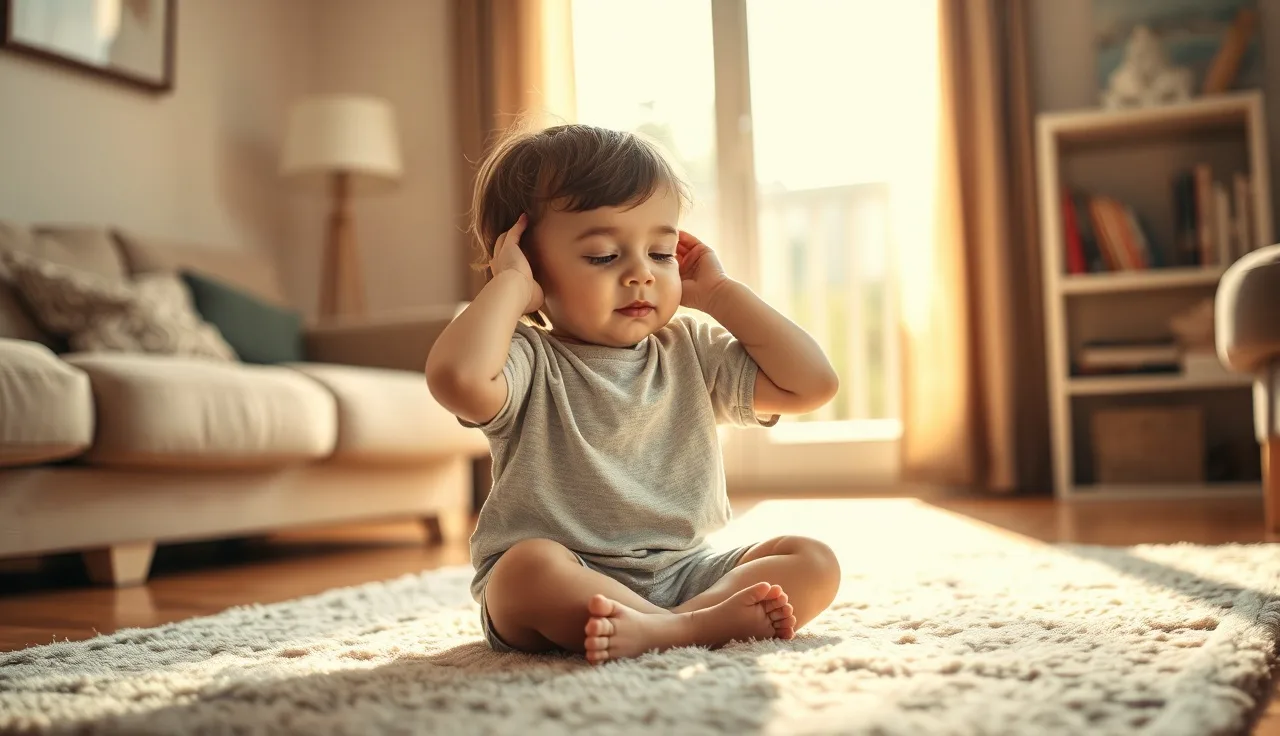
- Covering ears, humming, or making their own noise to block outside sound
- Increased echolalia in loud settings (repeating phrases rather than generating new ones, a more automatic and protective speech mode)
- Heightened rigidity or meltdowns tied to specific sound environments
- Asking for things to be repeated far more in noise than in quiet
- A long lag between when you speak and when the child responds, since processing time stretches under load
The echolalia point deserves a pause. Under sensory stress, many kids fall back on more automatic speech. Echolalia meaning in this context isn't regression. It's the brain reaching for its most practiced, lowest-effort route to communicate when resources run thin.
Is noise sensitivity connected to auditory processing disorder?
These two overlap, but they aren't the same thing. Auditory processing disorder is about decoding speech in hard listening conditions. Auditory hypersensitivity is about how intensely sound registers and the reaction to that intensity. A child can have one, the other, or both.
Auditory Processing Disorder (APD) describes difficulty understanding speech even when hearing is normal, specifically in challenging conditions like background noise or a degraded signal. An audiologist diagnoses APD using specific tests, not a speech-language pathologist or a psychologist.
Auditory hypersensitivity is the sensory piece: sound feeling too loud, too sharp, sometimes physically painful, and the emotional or behavioral response that follows.
The American Speech-Language-Hearing Association's technical report on APD separates it from more general sensory processing concerns [4]. The practical read for parents: if your child's trouble is specifically about understanding speech in noise, mishearing words, saying "what?" constantly, losing spoken directions in a group, an audiologist referral for APD testing makes sense. If the trouble is more that sound feels overwhelming or painful and sets off big emotional reactions, an occupational therapist with sensory integration training is the right first stop.
Plenty of kids need both conversations. Timing helps too. Early intervention before age five, when neuroplasticity is highest, gives the best odds of meaningful functional change.
How does noise sensitivity affect a child's ability to use AAC?
This gets overlooked, and it shapes AAC use in concrete ways. Every AAC method asks the child to attend, locate, and select, and each of those steps costs cognitive resources that noise is already draining.
AAC systems, whether dedicated speech-generating devices, tablet apps, or low-tech picture boards, all require that attend-locate-select sequence. In a noisy environment, a child who's already swamped by incoming sound has less attention for the device, less patience for the motor steps, and less ability to hold a communication intent in working memory long enough to carry it out.
On top of that, many AAC apps and devices produce synthesized speech. In a loud room, that output is harder for the partner to hear and harder for the child to hear and self-monitor. Some dedicated devices amplify better than others, and this rarely comes up in AAC evaluations, which it should.
Accommodations that actually help:
- Practice in quiet first, then add background noise gradually
- Pair AAC use with the noise reduction strategies in the next section
- Keep a low-tech backup (a core vocabulary board or a few high-priority cards) for noisy, high-demand moments when the full device is harder to use
- Ask your SLP to practice "noisy environment" scenarios on purpose, not only in the quiet therapy room
For families exploring autism spectrum speech therapy, bring up your child's specific sensory environment at the very first session.
What environmental changes actually reduce the communication impact of noise?
Environmental modification works, and most of it costs nothing. Change the room before you change the child.
Acoustics in the room. Hard surfaces (tile, bare walls, wood floors) bounce sound and raise reverberation, which makes speech harder to follow and the whole space harder to tolerate. Soft surfaces absorb it. Rugs, fabric wall panels, curtains, and upholstered furniture bring the noise floor down. Schools that ran acoustic retrofits have shown measurable gains in speech intelligibility for students with hearing and processing difficulties [4].
Seating position. In a group, the closer the child sits to the speaker, the better the signal-to-noise ratio. Moving a child from the back of the classroom to the front, or nearer the teacher at circle time, is free and immediate.
Background noise reduction. Fans, HVAC, and above all a TV running in the background add real load even when nobody's watching. Turning off background media during communication-heavy times (meals, homework, therapy practice at home) changes things fast.
Noise-canceling headphones or ear defenders. These help many kids in places where they don't need to hear speech: grocery stores, assemblies, airplanes. They aren't right for every moment, since they also cut the child off from speech, but used well they lower the sensory load that piles up across a day.
Warning before loud sounds. Predictability blunts the startle response. "I'm about to turn on the blender" gives the nervous system a second to brace. This sounds trivial. For a kid with auditory hypersensitivity, it isn't.
Visual supports. When sound is unreliable or overwhelming, visual supports (picture schedules, written cues, gestures) carry more of the load. This isn't giving up on speech. It keeps communication moving even when the auditory channel is jammed.
What does speech therapy look like when noise sensitivity is part of the picture?
A speech-language pathologist who understands sensory processing does two things a purely language-focused approach tends to miss.
First, they assess communication in more than one environment, not only the quiet therapy room. A child who produces 50 words one-on-one and 10 in a noisy playgroup has a very different functional profile than the vocabulary count alone suggests, and the plan should say so.
Second, they coordinate with an OT when sensory processing is clearly affecting daily communication. SLPs and OTs working the problem together is the standard of care, not a luxury. The American Speech-Language-Hearing Association's practice portal on autism addresses interprofessional collaboration on sensory and communication goals directly [7].
Techniques that show up in evidence-based practice for this population:
- Graduated exposure to noise, starting at the child's comfortable threshold and widening slowly, with the child in control
- Sensory regulation before communication demands (heavy work, deep pressure, a calm-down routine, guided by an OT or taught to parents)
- Working communication goals in slightly noisier conditions on purpose, so the skill generalizes
- Self-advocacy, so older kids can ask for quiet, ask for a repeat, or signal when they're overwhelmed
For families who can't get to regular in-person therapy, online speech therapy has expanded a lot, and some SLPs now target functional goals across a child's actual home environments, which is genuinely useful for noise-related barriers.
Little Words, an AI speech companion app, gives structured language practice you can do in a controlled, quiet home setting, useful for building on therapy goals between sessions. Take a short quiz at littlewords.ai/start to see if it fits your child's profile.
Can sensory processing therapy actually improve communication?
Here honesty matters, because the research is messier than either the fans or the skeptics admit. The short version: sensory integration therapy has decent evidence for sensory gains, thin evidence for speech gains directly, and reducing environmental noise has the clearest link to better communication.
Sensory Integration Therapy (SIT), the OT approach developed by A. Jean Ayres, has a mixed evidence base. A 2012 randomized controlled trial by Pfeiffer and colleagues in the American Journal of Occupational Therapy found children receiving SIT made significantly greater gains on sensory and motor measures than a fine motor control group [8]. Turning sensory gains into communication gains takes more steps, and the research linking SIT directly to speech is thinner.
What the evidence supports more directly: reducing sensory load in the environment goes with better communication performance. That's less about "fixing" sensory processing and more about meeting the child where the nervous system actually is. You don't need a study to prove a quieter room helps. You can test it at home this afternoon and watch what happens.
For kids with apraxia of speech, noise is especially disruptive, because speech motor planning needs focused attention and precise auditory feedback. A child drilling speech motor sequences in a loud room works at a real disadvantage, and most childhood apraxia of speech protocols quietly assume a quiet room without ever saying so to families.
The takeaway: sensory processing therapy is most defensible when it's goal-directed, measurable, and paired with communication therapy, not offered as a standalone fix.
How do you talk to a school about noise accommodations for your child?
Schools carry legal obligations here, and knowing the framework changes the conversation. Under the Individuals with Disabilities Education Act (IDEA, 20 U.S.C. § 1400 et seq.), children who qualify for special education are entitled to a Free Appropriate Public Education in the Least Restrictive Environment [9].
An IEP (Individualized Education Program) can and should include sensory accommodations when sensory differences affect educational performance, and if noise is shutting down communication, they clearly do.
Section 504 of the Rehabilitation Act covers students who don't qualify for an IEP but have a disability that substantially limits a major life activity. Communication is a major life activity. Sensory hypersensitivity that limits communication at school qualifies. A 504 plan can include preferential seating, noise-reducing headphones during non-communication tasks, and access to a quieter space for high-demand communication work.
Language that works with a school team:
- "My child's communication performance is significantly different across quiet and noisy environments." (Bring examples and, if you can, data.)
- "I'd like the IEP to include an assessment of how the sensory environment affects communication goals."
- "Can we discuss acoustic accommodations or preferential seating as part of the plan?"
You don't need a diagnosis to request an evaluation. Under IDEA you can submit a written request for a special education evaluation, and states set the response timeline (many use a 60-day window from consent, though it varies by state). Get everything in writing.
What can parents do at home right now, before any assessment?
Plenty. You don't have to wait for an OT referral or an IEP meeting to make your child's communication environment better today.
Track the pattern first. For one week, note when your child communicates easily and when they go quiet or shut down, and write down what the noise was like each time. A pattern usually shows up faster than you'd guess, and that record earns its keep in appointments.
Cut background noise during your highest-communication moments. Meals, transitions, bedtime routines, those are when kids talk most. Turn off the TV. Step away from the kitchen fan. Sit in the quieter room.
Give more processing time. In a noisy setting, add a few extra seconds after a question or request. Research on wait time in speech therapy shows that extending the pause from about 3 seconds to 5 to 7 seconds raises the rate of child verbal response [7]. It feels awkward. Do it anyway.
Build a "communication corner" at home, a quiet, visually calm spot for language-rich time together: reading aloud, simple verbal games, practicing new words. It's not a therapy room. It's just a place where the noise floor is low enough that your child's brain has room to work.
Honor the shutdown. When a child goes nonverbal in noise, pushing for words usually makes it worse. Move somewhere quieter, let the nervous system settle, then try again. That's not permissiveness. It's basic neuroscience.
Frequently asked questions
Why does my child talk fine at home but barely speaks at school or in public?
The most common explanation is the noise gap between environments. Home is usually quieter and more predictable; school and public spaces layer in background noise, unpredictable sounds, and competing voices. For a child with auditory sensitivity, that extra noise eats the cognitive resources needed for speech. This isn't shyness or defiance. Ask the school team to look at acoustic conditions and where your child sits during communication-heavy activities.
Can noise sensitivity cause a child to go completely nonverbal?
Yes, temporarily. When sensory overwhelm triggers a stress response, the prefrontal cortex goes offline to some degree, and speech production can stop. This is sometimes called situational mutism or stress-related shutdown, and it's different from selective mutism (an anxiety diagnosis), though the two can overlap. The response is neurologically driven, not a choice. Moving to a quieter space and letting the nervous system settle is the most reliable first step.
How is auditory processing disorder different from sensory sensitivity to noise?
APD is specifically about the brain's difficulty decoding speech signals in challenging listening conditions, diagnosed by an audiologist with specific tests. Auditory hypersensitivity is about how intensely sound registers emotionally and physically. A child with APD struggles to understand what they hear in noise. A child with hypersensitivity may understand fine but be overwhelmed by the intensity. Some kids have both, which compounds the communication difficulty significantly.
What percentage of autistic children have noise sensitivity?
Estimates range from roughly 50% to 70% of autistic individuals, depending on how sensitivity is measured and the age of the population studied. A 2019 systematic review in the Journal of Autism and Developmental Disorders found sensory features broadly present in 69% to 93% of autistic children across different measurement tools. Auditory sensitivity is among the most commonly reported sensory differences in autism, alongside tactile sensitivity.
Are noise-canceling headphones a good idea for a child with sound sensitivity?
They can help a lot in places where the child doesn't need to hear speech: stores, waiting rooms, assemblies, car rides. The main limit is that wearing them during communication-heavy activities cuts off auditory input, which isn't always what you want. Most OTs recommend strategic use: on during overwhelming non-communication settings, off when communication is the goal, with a gradual tolerance-building plan for the noisy places that matter most.
Should I tell my child's speech therapist about the noise sensitivity?
Absolutely, and early in the relationship. A speech-language pathologist who knows about noise sensitivity will assess communication across environments, not only in the quiet therapy room. They can adjust session structure, coordinate with an OT if needed, and set goals that will actually generalize to the real, noisy environments your child lives in. Leaving it out means the SLP works with an incomplete picture of your child's communication.
Can schools be required to provide noise accommodations?
Yes. Under IDEA and Section 504 of the Rehabilitation Act, schools must provide accommodations that let a child with a disability access their education. If sensory sensitivity is affecting communication and learning, that qualifies. Accommodations can include preferential seating, noise-reducing headphones during non-communication tasks, access to quieter spaces, and acoustic improvements in the classroom. Submit a written request for evaluation or accommodations to create a paper trail.
Does sensory processing therapy improve speech outcomes?
The evidence for Sensory Integration Therapy improving sensory measures is moderate and positive. The evidence connecting it directly to speech outcomes is thinner and less consistent. What the research supports clearly is that reducing environmental noise improves communication performance in real time. For speech outcomes, the best-supported approach pairs a sensory-friendly environment with targeted speech-language therapy, ideally with an SLP and OT working together rather than in separate silos.
My child uses AAC. Does noise sensitivity affect how they use their device?
It does, in several ways. Noisy environments cut the attention and working memory available for device navigation. The device's synthesized speech output can be harder to hear. And if the child is in sensory overwhelm, the motor steps of using an AAC system get harder to execute. Practicing in quiet first, then adding noise gradually, helps. A low-tech backup board is worth having for high-noise settings where the full device is harder to use well.
How long does it take for a child to calm down after noise overwhelm?
There's no universal answer, and it varies by child and by how strong the trigger was. Physiologically, a stress response (elevated cortisol, elevated heart rate) can take 20 to 45 minutes to fully subside in children, sometimes longer. Rushing back to communication demands before the nervous system resettles often drags out the difficulty. Most families find, through observation, that their child has a fairly consistent recovery window worth learning and planning around.
What is sensory gating and why does it matter for speech?
Sensory gating is the brain's process of filtering out irrelevant input so you can focus on what matters. In typical development it mostly runs automatically: background noise gets suppressed, the relevant speech signal gets amplified. Research shows autistic individuals often have atypical sensory gating, so background sounds don't get filtered as efficiently. The auditory system stays busy processing everything, which leaves fewer cognitive resources for language production and comprehension.
Is noise sensitivity something kids grow out of?
Some do. Sensory sensitivities can shift over time, and early support for both sensory and communication needs seems to improve outcomes. But for many autistic individuals, some degree of auditory sensitivity carries into adulthood, often becoming something they manage strategically rather than something that resolves. Treating it as a lifelong trait to accommodate and work with, rather than a problem to cure, tends to lead to better functional outcomes and stronger self-advocacy.
Can background TV noise affect a toddler's language development even without sensory sensitivity?
Yes, and it's well documented. A 2019 study in JAMA Pediatrics found that background TV significantly reduces the quantity and quality of parent-child verbal interactions, which are the primary driver of early language development. Even children with no sensory differences show reduced babbling and fewer conversational turns with background TV on. For children who also have auditory sensitivity, the impact stacks.
Sources
- American Occupational Therapy Association, Sensory Integration and Processing: Sensory processing is how the nervous system receives, organizes, and responds to sensory input from the environment
- Marco et al., 'Sensory Processing in Autism: A Review of Neurophysiologic Findings', Pediatric Research, 2011: Autistic individuals often have atypical neural filtering of irrelevant auditory stimuli, reducing the brain's ability to suppress background noise
- Baddeley, 'Working Memory, Thought, and Action', Oxford University Press; cognitive load effect on language: Language processing and sensory processing share cognitive bandwidth; high sensory load reduces resources available for language formulation
- American Speech-Language-Hearing Association, Auditory Processing Disorder Technical Report: Children with auditory processing difficulty often require +10 to +20 dB signal-to-noise ratio for adequate speech understanding, compared to +6 dB for typical listeners
- Baranek et al., sensory features in autism systematic review, Journal of Autism and Developmental Disorders, 2019: Sensory features were present in 69% to 93% of autistic children depending on the measure used; auditory sensitivity among the most commonly reported
- American Psychiatric Association, DSM-5-TR Diagnostic Criteria for Autism Spectrum Disorder: DSM-5 lists hyper- or hyporeactivity to sensory input as a diagnostic criterion for autism spectrum disorder
- American Speech-Language-Hearing Association, Practice Portal: Autism Spectrum Disorder: ASHA practice guidance on autism addresses interprofessional collaboration between SLPs and OTs on sensory and communication goals, and the value of extended wait time in eliciting child verbal responses
- U.S. Department of Education, Individuals with Disabilities Education Act (IDEA), 20 U.S.C. § 1400: Under IDEA, children with disabilities are entitled to a Free Appropriate Public Education including IEP accommodations for sensory needs affecting educational performance
- Dahl et al., background television and the home language environment, JAMA Pediatrics, 2019: Background television significantly reduces the quantity and quality of parent-child verbal interactions, which are the primary driver of early language development
- American Academy of Pediatrics, Council on Children with Disabilities, Sensory Integration Therapies for Children with Developmental and Behavioral Disorders, Pediatrics 2012: AAP review notes that sensory processing differences are common in developmental and behavioral disorders and encourages individualized, evidence-informed assessment and intervention