Last updated 2026-07-09
TL;DR
A speech-language pathologist (SLP) evaluates and treats communication disorders across all ages. For children, that covers late talking, articulation problems, language delays, stuttering, and autism-related communication differences. In the US, pediatric speech therapy costs roughly $100 to $350 per session out of pocket, though early intervention services for kids under three are often free through IDEA Part C.
What does a speech therapist actually do?
Speech-language pathologists (the formal name the field uses, shortened to SLP) assess, diagnose, and treat disorders involving speech, language, voice, fluency, and swallowing. That's a wider scope than most parents expect. An SLP working with a three-year-old might spend one session coaxing consonant sounds and the next session teaching a child to use a picture-based communication system.
The American Speech-Language-Hearing Association (ASHA) defines the SLP's scope of practice to include speech sound disorders, language disorders, augmentative and alternative communication (AAC), cognitive-communication disorders, voice disorders, fluency disorders like stuttering, and feeding and swallowing [1]. In pediatric practice, the most common referrals are for late talking, articulation errors, language delays, and autism spectrum communication differences.
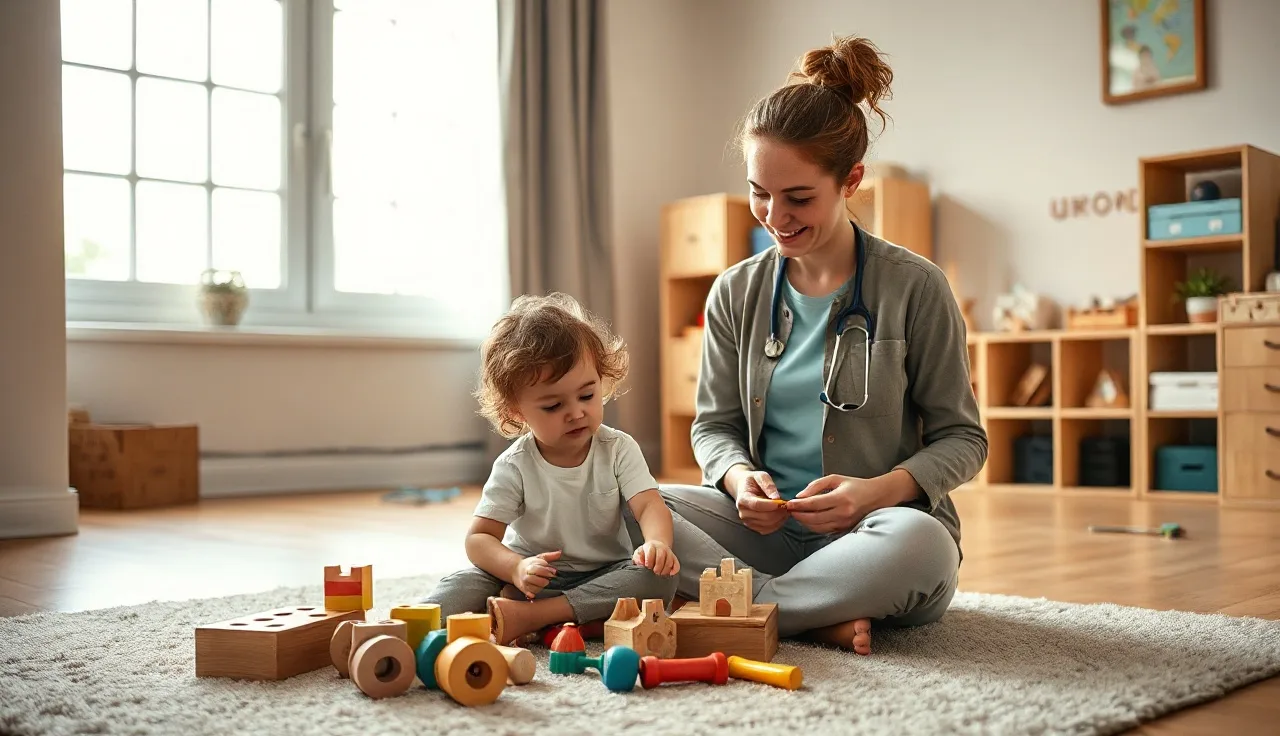
Day-to-day, a session usually looks like play. A skilled pediatric SLP structures activity so that the child gets dozens of communication opportunities without sitting at a table drilling sounds. That's on purpose. Child-directed, naturalistic therapy has more evidence behind it for young children than drill-based approaches, according to a 2015 review published in the Journal of Speech, Language, and Hearing Research [2].
SLPs also do something parents often underestimate: they coach the adults in the child's life. Teaching a parent how to use expansion, recasting, or aided language stimulation at home can triple the number of practice opportunities a child gets each week. Therapy twice a week with an SLP is maybe two hours. The other 100-plus waking hours belong to you.
What are the different types of speech therapy?
There's no single method called 'speech therapy.' What an SLP does depends heavily on what the child needs.
Articulation therapy targets specific speech sounds a child mispronounces or can't produce. A child who says 'wabbit' for 'rabbit' or drops final consonants gets a different program than one who can't form the /s/ blend.
Language therapy works on vocabulary, grammar, understanding directions, and using language to communicate ideas. This is the category most late talkers fall into.
Fluency therapy addresses stuttering and cluttering. Approaches for children are different from those for adults; many young children who stutter recover without intervention, but an SLP can help families decide when to wait and when to act.
AAC (augmentative and alternative communication) covers any system, low-tech picture boards or high-tech speech-generating devices, that supplements or replaces spoken speech. This is increasingly common for autistic children and kids with apraxia. You can read more about specific devices in our guide to alternative augmentative communication devices for autism.
Social communication therapy focuses on the pragmatic side of language: taking turns, reading facial expressions, staying on topic, understanding figurative language. Autistic kids often need this alongside other supports. See our deeper look at autism spectrum speech therapy for more on this.
Feeding therapy handles oral motor problems that make eating or drinking difficult, which frequently overlaps with speech motor development in young children.
Many children need more than one of these at once. A child with autism might get language therapy, AAC support, and social communication work in the same session.
How do you know if your child needs a speech therapist?
Pediatricians screen for communication milestones at well-child visits, and the American Academy of Pediatrics recommends developmental surveillance at every well-child visit plus formal developmental screening at 9, 18, and 30 months [3]. But parents often notice something is off before any appointment.
Here are the benchmarks that, if missed, are generally worth a referral. These come from ASHA's published milestones [1]:
| Age | Expected milestone |
|---|---|
| 12 months | Uses a few words (mama, dada, uh-oh); waves; points |
| 18 months | Uses 10 or more words; follows simple one-step directions |
| 24 months | Uses at least 50 words; combines two words (more milk, daddy go) |
| 36 months | Strangers can understand about 75% of what child says; uses short sentences |
| 4 years | Speech mostly clear to strangers; tells simple stories |
If your child isn't meeting a milestone, that's a reason to ask for a referral, not to wait and see on your own. The evidence on early intervention is clear enough that most SLPs will tell you the same thing: an evaluation is low-risk, and waiting can cost time you won't get back. You can read more in our article on early intervention speech and language therapy.
One thing parents rarely hear: you don't need a doctor's referral to contact an SLP directly in most states. You can self-refer to a private practice or a university clinic.
For children under three in the US, early intervention speech and language therapy is available through your state's Part C IDEA program. You request an evaluation through your state's early intervention office, not through a private SLP. If your child qualifies, services are provided in the natural environment (usually your home) at low or no cost depending on your state's rules [4].
What credentials should a speech therapist have?
In the US, the baseline credential for a licensed SLP is a master's degree plus a clinical fellowship year. ASHA's Certificate of Clinical Competence in Speech-Language Pathology (CCC-SLP) is the national credential. It requires a graduate degree from an accredited program, 400 clinical hours, a nine-month supervised fellowship, and passage of the Praxis exam [1].
Licensure is separate and state-regulated. Every state requires licensure to practice, though exact requirements vary slightly. You can check whether an SLP is licensed through your state's licensing board website, or verify ASHA certification directly through ASHA's online directory at asha.org.
Beyond the core credential, some SLPs hold specialized certifications. Board Recognized Specialists in Child Language (BRS-CL) have advanced training in pediatric language disorders. Some SLPs complete extra training in PROMPT (a tactile-kinesthetic approach for motor speech disorders), PECS (Picture Exchange Communication System), or Hanen programs. These aren't required, but they tell you the therapist has gone beyond the minimum.
For school-based SLPs, the credential structure is slightly different. They typically need a state education department certification, which may or may not require ASHA's CCC. School SLPs are employees of the district and work under IDEA [4].
One thing to watch out for: 'speech coach' or 'communication specialist' are not regulated titles. Anyone can use them. If you're paying for therapy, make sure the person holds a state license and ideally the CCC-SLP.
How much does speech therapy cost, and does insurance cover it?
Out-of-pocket costs for private pediatric speech therapy in the US typically run $100 to $350 per session, with 30- and 45-minute sessions most common for young children [5]. Rates vary by region; sessions in major metro areas often hit the top of that range. University training clinics usually charge $30 to $80 per session, sometimes less, because sessions are supervised student clinicians.
Insurance coverage is genuinely complicated. The Affordable Care Act requires that individual and small-group plans cover habilitative services (therapy to develop skills a child never had) and rehabilitative services (to restore lost skills), but it doesn't specify how many sessions [6]. In practice, many plans impose session limits, require prior authorization, or use narrow networks that don't include your preferred SLP.
Autism-specific mandates now exist in all 50 states and DC, though the scope of what's covered varies a lot by state. Some mandate medically necessary speech therapy specifically; others are broader.
For children under three, IDEA Part C requires states to provide early intervention services at no cost to families except where state law permits sliding-scale fees [4]. After age three, IDEA Part B covers speech therapy through the school district if the child qualifies for an IEP. School-based therapy is free but may be less frequent than private therapy, and the goals are educationally focused rather than clinically complete.
Medicaid covers speech therapy for children under 21 under EPSDT (Early and Periodic Screening, Diagnostic and Treatment) provisions, which are more generous than standard Medicaid adult benefits [7].
If you're paying privately, a few things can bring the cost down: ask about sliding-scale fees (many private practices offer them), look into community college or university clinic programs, and ask your SLP to write a letter of medical necessity to support your insurance appeal if a claim is denied.
How often does a child need speech therapy, and how long does it take?
There's no universal answer, and anyone who gives you one without evaluating your child is guessing. That said, common practice for young children with mild-to-moderate delays is one or two sessions per week, each 30 to 45 minutes.
Duration depends on what's being treated. A child with a single articulation error (say, a /r/ sound) might need three to six months of therapy. A child with a significant expressive language delay might need a year or more. Autism-related communication work is often long-term and ongoing rather than time-limited.
A 2019 study in the International Journal of Language and Communication Disorders looked at children with developmental language disorder and found that higher intensity (more sessions per week) produced faster gains, but children who got lower-intensity therapy over longer periods reached similar outcomes eventually [8]. So there isn't a single 'best' schedule. It depends on the family's capacity, the child's tolerance, and what the goals are.
Progress should be measurable. If your SLP can't tell you what goals you're working on, how progress is measured, and what criteria you'd use to decide therapy is complete or needs adjustment, ask those questions directly. Therapy without clear goals drifts.
For families working through the school system, IEP goals are reviewed annually, and you can request a review sooner if you think progress isn't happening or your child's needs have changed.
What happens during a speech therapy evaluation?
An evaluation is separate from therapy and usually takes one to two hours. The SLP will review developmental history, often through a parent interview or questionnaire, and then do direct testing with your child.
Standardized tests compare your child's performance to same-age peers. Common ones include the Preschool Language Scales (PLS-5), the Clinical Evaluation of Language Fundamentals (CELF), and the Goldman-Fristoe Test of Articulation (GFTA-3). Scores are reported as standard scores or percentile ranks; a score below the 10th percentile or more than 1.25 to 1.5 standard deviations below the mean typically indicates a disorder, though the cutoffs vary by test and setting.
Beyond standardized tests, a good SLP also does informal observation, watching how your child communicates in natural play rather than just on structured tasks. For young children or those who don't respond well to testing, informal assessment can tell you more than scores.
At the end of the evaluation, you get a written report with scores, a diagnosis if one is warranted (SLPs diagnose speech and language disorders; they don't diagnose autism or other medical conditions), and recommendations for frequency and type of therapy.
If the evaluation is through early intervention or a school district, the process involves a team and results in either an IFSP (Individualized Family Service Plan, for under-three) or an IEP (Individualized Education Program, for school age). Parents are full members of those teams and must give informed consent before services start [4].
What's the difference between a school SLP and a private SLP?
Both are licensed professionals doing the same work, but the context shapes what they can and can't do.
A school SLP's job is to address communication needs that affect a child's ability to access education. That's the legal standard under IDEA [4]. If your child has a language delay that doesn't affect classroom performance, the school may legitimately decline to provide therapy. The goals in an IEP are written around educational access, not clinical best practice for maximizing communication potential.
A private SLP isn't bound by that educational standard. They can work on any communication goal the family and SLP agree on, meet as often as warranted clinically, and use methods that aren't available in schools. The downside is cost.
Many families use both: school-based therapy for consistency and IEP compliance, and private therapy for added frequency or specialized approaches. If you go that route, it helps a lot if the two SLPs talk to each other.
For children who need speech therapy for toddlers before school age, early intervention is the school-system equivalent (through the Part C IDEA program), and it's provided in the home or daycare rather than a clinic.
Can parents do speech therapy at home?
Yes, and good SLPs will expect it. Home practice isn't a replacement for professional evaluation and treatment. It's how you consolidate gains from sessions.
The most evidence-supported thing parents can do is increase the quantity and quality of communication opportunities throughout the day. That means responding to all communication attempts (including gestures, sounds, and AAC), narrating daily routines, following the child's lead in play, and using techniques like expansion (adding one word to what the child said) and recasting (restating what the child said in a corrected form).
Hanen's 'It Takes Two to Talk' program is probably the most widely studied parent-implemented intervention for late talkers. A randomized controlled trial published in the Journal of Speech, Language, and Hearing Research found that children whose parents completed the program showed significantly greater gains in expressive vocabulary than controls [9].
There are also apps built to support communication development between therapy sessions. Little Words, for example, is an AI speech companion made for neurodivergent kids, designed to give families structured, language-rich interaction they can use at home alongside professional therapy. Tools like this work best when they line up with what your SLP is already targeting, not as a substitute for one.
For families with limited access to in-person SLPs, online speech therapy has become a real option. Telehealth SLP services grew fast after 2020, and research has shown outcomes comparable to in-person therapy for many language goals, particularly for school-age children [10].
You can also find guided home practice strategies in our broader article on speech therapy for kids.
How do you find and choose a speech therapist?
ASHA's ProFind directory at asha.org is the most reliable starting point. It lists certified SLPs by zip code and lets you filter by age range served, disorders treated, and languages spoken. Your pediatrician can also refer you, though the referral network any one doctor knows is limited.
Once you have a few names, here's what actually matters when you choose.
Experience with your child's specific issue. An SLP who mostly sees adults with stroke-related aphasia is not the right fit for a toddler with autism. Ask directly how many children with similar profiles they currently see.
Approach to parent coaching. If an SLP plans to see your child alone in a room with zero parent involvement, that's a red flag for pediatric therapy. You should be in or observing sessions and getting specific strategies to use at home.
Communication about goals and progress. Ask before you commit: how will you measure whether therapy is working, and how will you communicate that to me? A good SLP will have a clear answer.
Wait times are a real problem in the US. In many areas, waits for pediatric SLPs run three to six months or longer. If you're waiting, ask whether the practice has a cancellation list, look into university training clinics as a faster option, and ask your pediatrician whether an early intervention referral can run in parallel.
For a child with autism or significant communication needs, also look for SLPs who are AAC-friendly, meaning they actively support augmentative communication rather than treating it as a last resort. There's no evidence that using AAC slows speech development; most research shows the opposite.
Does speech therapy work? What does the evidence say?
For most speech and language disorders, yes. The evidence base varies by disorder type, but it's stronger than people often expect.
For speech sound disorders (articulation), intervention is consistently effective. A 2018 Cochrane review found strong evidence that speech-language therapy produces better outcomes than no treatment for children with developmental speech sound disorders [11].
For developmental language disorder (DLD, formerly called SLI), a 2017 systematic review and meta-analysis in the Journal of Speech, Language, and Hearing Research found a moderate-to-large effect size for language interventions, with parent-implemented programs showing effects comparable to clinician-delivered therapy [2].
For autism-related communication differences, the evidence is more mixed because autism is heterogeneous. Naturalistic developmental behavioral interventions (NDBIs) like JASPER and ESDM have randomized controlled trial support for improving communication outcomes. AAC does not delay speech and in many studies speeds it up [12].
For stuttering in young children (under six), the Lidcombe Program has the strongest RCT evidence; direct intervention significantly reduces stuttering compared to watchful waiting in that age group.
The honest caveat: effect sizes in speech-language research are usually measured in group averages, and individual children vary enormously. An SLP who promises a specific outcome timeline is overpromising. A good SLP will tell you what the research suggests for a profile like your child's, and be honest about what's uncertain.
If you want more on how speech therapy fits into broader support for a specific population, our article on pediatric speech therapy goes deeper on intervention approaches by diagnosis.
What if my child refuses speech therapy or sessions aren't going well?
This happens more than parents expect, and it's usually fixable.
Young children, especially autistic kids or kids with sensory sensitivities, often struggle with the move to a new person and a new environment. A few rough sessions at the start is normal. But if your child is consistently dysregulated, refusing to engage, or appears distressed week after week, that's information.
First, talk to the SLP. A good clinician will change approach, setting, or pacing before giving up. Sometimes the answer is shorter sessions. Sometimes it's moving where sessions happen (home-based vs. clinic). Sometimes it's a completely different activity structure.
If sessions keep going poorly after genuine adjustment attempts, consider whether the fit between your child and this particular SLP is the issue. The therapeutic relationship matters. An SLP experienced with autistic and sensory-sensitive children uses different techniques than one who mostly treats articulation disorders.
For kids who genuinely can't access in-person therapy right now, online speech therapy sometimes removes enough of the sensory load to make engagement possible. Home-based early intervention is another route for children under three.
Separate 'my child doesn't like therapy' from 'my child isn't making progress.' Some kids resist and still make gains. Others appear to participate but plateau. Check goals and data with your SLP, more than your gut sense of how sessions feel.
One more thing: if your child uses AAC or is a speech delay case where communication is already stressful, reducing demand and giving more child-led communication opportunities at home can sometimes break a logjam that's blocking progress in sessions.
Frequently asked questions
At what age should a child start speech therapy?
There's no minimum age. Early intervention services under IDEA Part C serve children from birth through age two, and states can start services as early as diagnosis or concern warrants. Research consistently shows that earlier intervention produces better outcomes for language delays. If you have a concern at 15 months, it's appropriate to request an evaluation then, not at age three.
What's the difference between a speech therapist and a speech-language pathologist?
'Speech therapist' is the common name people use. 'Speech-language pathologist' (SLP) is the formal professional title. They mean the same person. ASHA uses 'speech-language pathologist' in all official materials. You may also see 'SLP' or 'speech-language therapist' used interchangeably in practice, though SLP is the standard US credential designation.
Does my child need a doctor's referral to see a speech therapist?
In most US states, no. You can contact a private speech therapy practice directly and self-refer. Some insurance plans require a physician referral for coverage purposes, so check your policy before booking. For early intervention services through IDEA Part C (children under three), you refer through your state's early intervention program, not through a private SLP.
How long does it take to see results from speech therapy?
It depends heavily on what's being treated and how often therapy happens. For single-sound articulation errors in a typically developing child, families often see clear progress in three to six months. For language delays or autism-related communication differences, therapy is usually measured in years, not months. Your SLP should track measurable goals and share data with you regularly so you can see whether progress is happening.
Can speech therapy help a child who doesn't speak at all (nonverbal)?
Yes, and this is exactly when AAC becomes central. A child who doesn't use spoken words still has communication potential through gesture, vocalization, picture systems, or speech-generating devices. SLPs trained in AAC work with minimally verbal and nonverbal children to build functional communication. Research shows AAC use does not prevent speech development and often supports it.
Is online speech therapy as effective as in-person therapy?
For many goals and age groups, research suggests telehealth produces outcomes comparable to in-person therapy. A 2017 systematic review found teletherapy effective for articulation and language disorders in children. It works best when a parent or caregiver is present to support the session. Some children with significant sensory or attention differences do better in person; this varies by child.
What is an IEP, and how does speech therapy fit into it?
An Individualized Education Program is a legal document created under IDEA for school-age children (three and up) who qualify for special education services, which includes speech-language services. Speech therapy goals in an IEP must be educationally relevant. Parents are part of the IEP team and must consent to the plan. Services are provided free by the school district if the child qualifies.
What should I do if I suspect my toddler has a speech delay but my pediatrician says to wait?
You can request an early intervention evaluation directly through your state's Part C program without a doctor's referral. IDEA gives you that right regardless of your pediatrician's recommendation. The evaluation is free and carries no obligation to receive services. If you prefer, you can also contact a private SLP for an independent evaluation. Waiting without evaluation is the one path the evidence doesn't support.
How much does a speech therapy evaluation cost?
Private evaluations typically cost $200 to $500 out of pocket, though some practices charge more in high-cost areas. Insurance may cover it if you have a diagnosis code and referral. University clinic evaluations are often $50 to $150. Early intervention evaluations (for children under three) through your state's IDEA Part C program are free by federal law.
What's the difference between a speech delay and a language disorder?
A speech delay means a child is developing speech on the expected trajectory but more slowly than peers. A language disorder (or developmental language disorder) means the underlying language system isn't developing typically, which affects comprehension and expression beyond just timing. The distinction matters for treatment: the approaches overlap but aren't identical. A full evaluation by an SLP is the right way to tell them apart.
Does bilingualism cause speech or language delays?
No. Bilingualism does not cause speech or language disorders. Bilingual children may have a slightly different vocabulary distribution across their two languages, but their total vocabulary across both languages is comparable to monolingual peers. An SLP evaluating a bilingual child should assess in both languages. Recommending a family drop one language to improve speech is not evidence-based.
What is apraxia of speech and how is it treated?
Childhood apraxia of speech (CAS) is a motor speech disorder where the brain has difficulty planning and coordinating the movements needed for speech. It's not caused by muscle weakness. Treatment is intensive and motor-focused; approaches like DTTC (Dynamic Temporal and Tactile Cueing) and the Nuffield Dyspraxia Programme have the most evidence. Children with CAS typically need more frequent therapy than children with other speech disorders.
Can a speech therapist help with reading and literacy?
Yes. Language and literacy are deeply connected. SLPs are trained in phonological awareness, a key predictor of reading success, and often work on literacy-related skills alongside oral language. ASHA's position is that SLPs have a direct role in reading and writing intervention. This is especially relevant for children with language disorders, who have elevated risk for reading difficulties.
What's the difference between speech therapy for kids and speech therapy for adults?
The goals and methods differ substantially. Pediatric speech therapy focuses on development: building skills that haven't emerged yet, usually through play-based methods. Adult speech therapy more often addresses rehabilitation after injury (stroke, brain injury, laryngeal cancer) or long-standing disorders like stuttering. The underlying science overlaps, but a clinician who specializes in one population is not automatically expert in the other.
Sources
- ASHA (American Speech-Language-Hearing Association), Scope of Practice in Speech-Language Pathology: ASHA defines the SLP scope of practice and publishes developmental milestone benchmarks for communication across ages.
- Law J et al. (2017), 'Interventions for children with developmental language disorder,' Journal of Speech, Language, and Hearing Research: Systematic review and meta-analysis found moderate-to-large effect sizes for language interventions, including parent-implemented programs.
- American Academy of Pediatrics, Developmental Surveillance and Screening Policy: AAP recommends developmental surveillance at every well-child visit and formal screening at 9, 18, and 30 months.
- US Department of Education, IDEA (Individuals with Disabilities Education Act) Parts B and C: IDEA Part C requires free early intervention for eligible children birth to three; Part B covers school-age services through IEPs.
- American Speech-Language-Hearing Association, Health Care Economics and Funding Resources: Private speech therapy sessions in the US typically range $100 to $350 per session depending on region and setting.
- HealthCare.gov, Essential Health Benefits (habilitative and rehabilitative services): The ACA requires individual and small-group plans to cover habilitative and rehabilitative services, but does not set a session count.
- Medicaid.gov, Early and Periodic Screening, Diagnostic, and Treatment (EPSDT): Medicaid EPSDT provisions require coverage of medically necessary speech therapy for children under 21, more broadly than standard adult Medicaid.
- Ebbels SM et al. (2019), 'Effectiveness of 1:1 speech and language therapy for older children with (developmental) language disorder,' International Journal of Language and Communication Disorders: Children with developmental language disorder receiving higher-intensity therapy showed faster gains; lower-intensity therapy over longer periods reached similar long-term outcomes.
- Girolametto L, Pearce PS, Weitzman E (1996), Hanen 'It Takes Two to Talk' RCT, Journal of Speech, Language, and Hearing Research: Children whose parents completed the Hanen It Takes Two to Talk program showed significantly greater gains in expressive vocabulary than controls.
- Wales D et al. (2017), 'Teletherapy for children with language impairment,' Developmental Neurorehabilitation: Systematic review found telehealth speech-language therapy produced outcomes comparable to in-person therapy for articulation and language goals in children.
- Bavin EL, Bretherton L (2018), Cochrane Review, 'Speech and language therapy interventions for children with primary speech and/or language disorders': Cochrane review found strong evidence that speech-language therapy produces better outcomes than no treatment for developmental speech sound disorders.
- Ganz JB et al. (2012), 'A meta-analysis of single case research studies on aided augmentative and alternative communication systems with individuals with autism spectrum disorders,' Journal of Autism and Developmental Disorders: Meta-analysis found AAC use supports communication development in autism and does not delay speech acquisition.