Last updated 2026-07-09
TL;DR
The speech therapy tools that help kids talk are simpler and cheaper than most parents expect: a mirror, picture cards, wordless books, and your own voice. Mid-tech options like AAC apps ($180-$250) earn their price for some kids. Research backs pairing an SLP's plan with 15-20 minutes of daily home practice using tools your child already likes.
What do speech therapists actually use in sessions?
Walk into a pediatric speech clinic and the toolkit looks almost embarrassingly plain. Bubbles. A mirror. Laminated pictures. A tablet propped against a bin of toys. The most researched, most reliable tools tend to be the cheapest ones, which is genuinely good news for a parent trying to recreate some of that work at home.
The American Speech-Language-Hearing Association (ASHA) defines speech-language pathology across several areas: articulation, language, fluency, voice, and social communication [1]. Which tool an SLP grabs depends entirely on what she's targeting that day. A 3-year-old who isn't talking yet needs nothing like what a 6-year-old chasing the /r/ sound needs.
Tools sort into four buckets: low-tech (no battery), mid-tech (simple electronic devices), high-tech (AAC systems, apps, software), and technique-based tools where the parent's voice and body are the instrument. Each earns a place. None of them work without a plan behind them.
Ask your SLP one blunt question: "What are you using in session, and what should I use at home between visits?" That single question does more for carryover than any purchase. If you don't have a therapist yet, speech therapy and speech therapists is where to start.
What are the best low-tech tools for speech therapy at home?
Low-tech tools cost close to nothing and carry decades of evidence. These are the ones that keep showing up, both in the research and on the floors of real clinics.
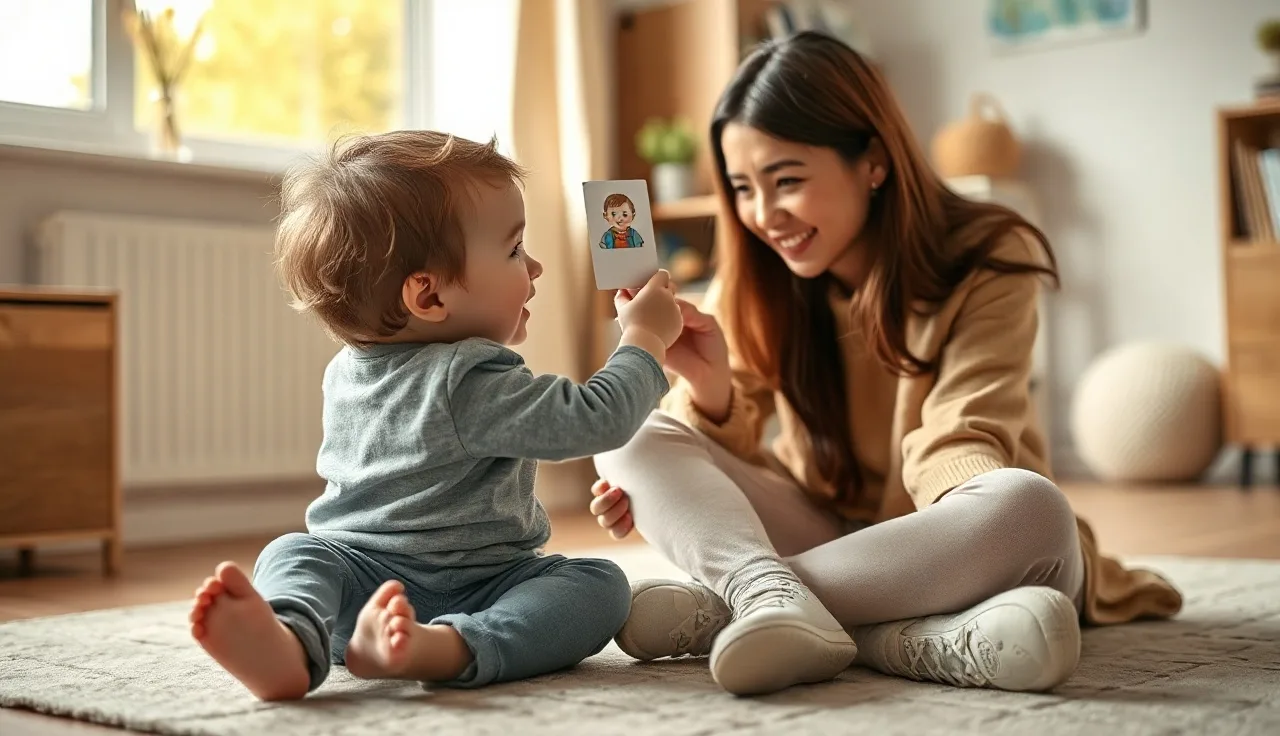
Picture cards and visual supports. PECS (Picture Exchange Communication System) is a structured protocol with several published randomized controlled trials behind it for children with autism [2]. You don't need the certified PECS training kit (which runs north of $200) to use picture-based communication at home. Free printable cards or Boardmaker-style images do fine for informal practice. The part that matters is the exchange itself: the child picks up the picture and hands it to you, rather than just pointing.
A simple mirror. Watching their own mouth while they make a sound helps kids with articulation errors and with apraxia of speech map the movements they're chasing. A dollar-store handheld mirror does the job. Sit side by side so your child can see both mouths in the same frame.
Wordless picture books. Mercer Mayer's illustrated books, or any book heavy on pictures and light on text, pull language out instead of forcing decoding. You narrate, the child comments, and vocabulary lands with no right-or-wrong reading pressure. Wordless books are a standard piece of the naturalistic developmental behavioral interventions (NDBIs) ASHA recommends for young autistic children [3].
Puppets and small figurines. Kids talk to a puppet when they won't talk to an adult. Therapists lean on this constantly. A cheap hand puppet lets you model target words and ask questions through a play partner the child doesn't feel graded by.
Bubbles and balloons. Oral motor claims get overblown online (more on that below), but bubbles earn their keep. Blowing takes sustained breath support, and few things motivate a toddler like a jar of bubbles. They also hand you natural chances to model "more," "pop," and "blow."
Which mid-tech and high-tech tools are worth the money?
This is where the price tags jump, so straight comparisons matter more than marketing.
| Tool | Typical cost | Best for | Evidence level |
|---|---|---|---|
| Single-message voice output device (e.g., BIGmack) | $50-$100 | First step into AAC, very young kids | Moderate |
| Step-by-step communicator (e.g., Step-by-Step) | $90-$130 | Sequencing, early requesting | Moderate |
| Dedicated AAC device (e.g., Tobii Dynavox) | $2,000-$10,000 | Complex communication needs | Strong |
| AAC app on a tablet (e.g., Proloquo2Go, TouchChat) | $180-$250 app + $300-$500 tablet | Most families, portable | Strong |
| Articulation apps (e.g., Articulation Station) | $10-$40 | School-age kids working on sounds | Moderate |
| Speech feedback software (e.g., recording/playback apps) | Free-$40/mo | Older kids and teens, self-monitoring | Low-moderate |
AAC apps on regular tablets are where most families land, and that's a defensible choice. Proloquo2Go, made by AssistiveWare, has peer-reviewed research behind it for vocabulary growth and spontaneous communication in minimally verbal autistic children [4]. The app runs about $180-$250 depending on platform, and it's a one-time purchase. A dedicated device holds up better to being thrown and mounts more securely, but insurance covers dedicated devices far more readily than apps (details in the FAQs).
For AAC devices specifically, the evidence is settled enough that ASHA states plainly AAC does not hold back speech. It usually helps it along [1].
Articulation apps are legitimately useful once a child is already in therapy for specific sounds. Articulation Station (by Little Bee Speech) sorts practice by phoneme and gives parents a clean drill format. The free version covers a handful of sounds; the full version runs about $38. It won't replace an SLP, but it's an honest carryover tool.
One category I'd skip: "speech delay" gadgets sold straight to parents with no published data. If the product page cites zero research and the thing costs $150 or more, that money buys more real progress as SLP sessions.
What tools work best for late talkers specifically?
"Late talker" means something specific: a child between 18 and 30 months with fewer words than expected and no other developmental red flags [5]. Roughly 70 to 80 percent of late talkers catch up on their own by some estimates, but you can't tell early which ones won't, and that's exactly why monitoring and home strategies pull their weight.
The tools that help late talkers target input, not output. You're flooding the child's world with rich, simplified language so word learning speeds up.
Self-talk and parallel talk. These are techniques rather than objects, but they work like tools. Self-talk narrates what you're doing: "I'm washing the cup. Now I'm drying it." Parallel talk narrates what the child is doing: "You're pushing the truck. The truck goes fast." Both show up in naturalistic language intervention research as ways to build receptive vocabulary before spoken words arrive [3].
Focused stimulation. Pick 5 to 10 words your child actually cares about. Use each one 20 to 30 times a day across normal routines. That's the engine behind the Hanen "It Takes Two to Talk" program, which has published efficacy data and costs about $20 for the parent book [6].
Stacking and cause-and-effect toys. Their value is bigger than play. They build in natural moments to request and comment. A child who wants the next block says or signs "more." Anyone who's read about early intervention will spot this as the core of communication temptation strategies.
When a late talker also shows differences in social attention, repetitive behaviors, or sensory responses, autism spectrum speech therapy tools come into play and the evaluation picture gets more layered.
Do oral motor tools like chew tubes and vibrating toys actually work?
Here parent enthusiasm and the research sit miles apart, and you deserve the blunt version.
Non-speech oral motor exercises (NSOMEs), meaning chewing on tubes, blowing through straws, vibrating facial muscles, and the like, are not supported as a way to improve speech sound production. ASHA's technical report says flatly there is "no strong scientific evidence" that NSOMEs improve speech intelligibility [7]. The intuition ("strengthen the mouth muscles") sounds airtight and simply hasn't held up in studies.
That said, some kids with sensory differences do benefit from oral input for regulation. That's a different goal than speech. Chew necklaces and chew tubes have a real place as sensory tools. The claim to push back on is that they'll make a child talk better.
Vibrating "oral motor speech tools" sit in the same box. If your SLP recommends them inside a broader sensory plan and not as a direct speech treatment, that's a different conversation than buying them off Amazon because a blog told you to.
So: if a product's marketing promises better speech by exercising mouth muscles, doubt it. Ask your SLP to point you to one published study. That question sorts a therapy tool from a wellness product in about ten seconds.
What tools support echolalia and help move kids toward functional communication?
Echolalia, repeating words or phrases heard elsewhere, is common in autistic children and in some late talkers. It isn't noise. Work by Barry Prizant and others established that echolalia is often communicative, an early language strategy you can shape into functional speech rather than stamp out [8].
The tools that help honor the echoed language and add function to it.
Visual sentence strips. A strip showing "I want + [item]" helps a child shift from echoing a whole TV phrase to producing a short, useful request. You're not killing the echolalia. You're giving it a frame.
Scripts and script fading. This is a documented intervention: a child learns a short written or spoken script for a social moment, then the script fades bit by bit until spontaneous language fills the gap. Work by Patricia Krantz and Lynn McClannahan at the Princeton Child Development Institute supports it for autistic children [8].
Low-demand language modeling. Commenting instead of questioning drops the pressure that pushes kids toward scripted answers. Instead of "What do you want?" you say, "You want the red one." It's a technique, and it pairs cleanly with visual supports.
For more on what echolalia means and why it happens, echolalia and echolalia meaning go further.
When a child's main way of communicating is lines from a favorite show, that context shapes which tool to reach for, and it's telling you more than it looks.
What tools are SLPs using for childhood apraxia of speech?
Childhood apraxia of speech (CAS) is a motor speech disorder, so the tools that work are chosen for motor learning, not sound drill. Apraxia Kids (formerly CASANA) and ASHA both stress that CAS needs frequent, intensive, individualized therapy using approaches like DTTC (Dynamic Temporal and Tactile Cueing) or the Nuffield Dyspraxia Programme [9].
Home tools for CAS have to match what the SLP is doing in session, not run off on their own.
Mirror work. Same idea as before, tighter execution. The child watches their articulators produce the exact sequence the SLP is targeting.
Printed syllable and word cards with motor cues. Some SLPs hand families cards with small tactile cue reminders (a symbol for tongue placement, a mark for voicing). These are highly individual and should come from your therapist, not a generic pack off a shelf.
Apps built for CAS. VAST (Video Assisted Speech Technology) and Apraxia Therapy (by Tactus Therapy) are both built with clinical input and used by SLPs working on CAS. Tactus Therapy's apps run $15 to $35 each. They don't replace direct therapy, but they're real home practice tools.
Recording and playback. Your phone's voice recorder is underrated. Record a target word, let the child hear it, record their attempt, play it back. That loop gives immediate self-monitoring feedback, and motor learning research consistently supports augmented feedback as a way to speed motor skill learning.
For how CAS works and how therapy gets structured, childhood apraxia of speech goes deep.
How do you build a speech therapy toolkit at home on a tight budget?
The honest math: you can run an effective home program for about $30 to $50 if you're smart about it. Here's a starter kit.
Free: a smartphone camera for recording, a dollar-store mirror, and your own voice. Those three cover visual feedback, motor modeling, and language input, which are the mechanisms behind most speech interventions anyway.
Under $20: a wordless picture book (the library costs nothing), a dollar-store hand puppet, and a printed set of core vocabulary symbols. The LAMP Words for Life core vocabulary poster downloads free from AAC Learning Corner.
$20 to $50 range: the Hanen "It Takes Two to Talk" parent guidebook (about $20), one articulation app if your child is school-age and working on specific sounds ($10 to $40), and laminating pouches if you want homemade picture cards that survive a toddler.
The one thing worth spending real money on: actual SLP sessions. A single solid evaluation, even one session with an SLP who sends you home with a program, multiplies the value of every tool you buy after. An SLP tells you which $150 app fits your kid and which one would sit dead on the tablet. Without that guidance, expensive tools mostly gather dust.
If you're in Ohio and wondering about the at-home speech therapy Cleveland families can reach, plenty of practices there run hybrid models: an SLP does one in-clinic session a month and coaches home practice over telehealth between. Online speech therapy turned into a real evidence-based option after 2020, with ASHA formally recognizing telepractice as appropriate for SLP services [1].
What role can AI and apps play in at-home speech practice?
This space moves fast, and the honest read is this: apps and AI tools are useful supplements, not therapists.
The research on app-based practice still trails the marketplace. A 2021 systematic review in the American Journal of Speech-Language Pathology found that while AAC apps had strong evidence for communication outcomes, most other speech apps had limited or preliminary evidence [10]. That's not a reason to skip them. It's a reason to use them as carryover tools guided by an SLP, not as standalone treatment.
What apps do well: repetitive, low-pressure practice, immediate visual or auditory feedback, and holding a kid's attention longer than a stack of flashcards. What they do badly: catch compensatory errors, adjust to a child's specific motor or phonological pattern, or notice when a strategy has stopped working.
AI-assisted tools like Little Words are built to sit inside a guided home practice model, giving a speech companion that adjusts to a child's level and telling parents what language to model next. To see whether that kind of approach fits your child, the start quiz at Little Words runs a quick intake.
For families who can't get to a weekly SLP (a real access gap, especially in rural areas), structured app use with periodic SLP check-ins beats no practice at all by a wide margin.
How do you know if a speech therapy tool is backed by real evidence?
The speech tool market is packed with products that sound scientific and aren't. Here are the filters I'd use.
Check ASHA's Evidence Maps (at asha.org). These are living systematic reviews of treatments by disorder type. If an approach isn't there, treat that as a data point.
Ask for the study. Any legitimate clinical tool has at least one peer-reviewed publication behind it. "Research-based" in ad copy means nothing. A citation to a named journal article means something.
Check who paid for the research. A single study funded by the product's own maker is weak evidence. Independent replication is stronger.
Be wary of before-and-after testimonials on a product's own website. Those aren't clinical evidence. Kids' language often takes off between ages 2 and 4 no matter what product is on the table, which makes it easy to hand a tool credit for ordinary development.
Ask your SLP straight out. A good one will tell you if something's worth a try and knows the evidence. If a therapist pushes an expensive product she happens to sell, get a second opinion.
The AAP's developmental guidance says families should get "evidence-based information" about communication interventions and warns against "facilitated communication" and similar approaches that have been disconfirmed again and again [11]. Same skepticism applies to tools.
Can the right tools help enough, or does my child need formal therapy?
This is the question sitting under the whole article, and the honest answer: it depends on what's driving the delay, and you often can't know that without a professional evaluation.
The AAP recommends developmental surveillance at every well-child visit and formal screening at 9, 18, and 24 or 30 months using validated tools like the M-CHAT-R/F for autism or the ASQ for general development [11]. If a child fails a screen, or a parent worries between screens, the next move is a referral to early intervention (under age 3) or a school district evaluation (age 3 and up). Not more tools.
For kids already in therapy, home tools add on top. The research on parent-implemented intervention is strong: a Cochrane review of parent-mediated interventions for autism found real benefits for parent responsiveness and child communication initiations when parents were coached in specific techniques [12]. Tools support those techniques.
For kids on a waitlist (and SLP evaluation waits in much of the U.S. run 3 to 6 months or longer), home tools make a reasonable bridge. Lean on input-focused strategies: reading aloud, self-talk, following the child's lead, easing off communication pressure. Those carry the best safety profile and a solid evidence base.
If your child is under 3 and you haven't touched early intervention yet, that's the highest-value move you have. Early intervention under IDEA Part C is federally mandated and free. The statute states services under IDEA are provided "at no cost to the parents" in the natural environment [13].
For working through evaluation and next steps, speech therapy and speech therapists covers how to find someone, what an evaluation involves, and how to read the report.
Frequently asked questions
What speech therapy tools can I use at home with a toddler?
Start with the simplest: a mirror, bubbles, cause-and-effect toys, and picture books. Use self-talk and parallel talk through daily routines: bath, meals, and play. Free printable picture cards work well for early requesting. For toddlers under 3 with fewer than 50 words, call your state's early intervention program. Those services are free and happen in your home.
What is the best AAC app for a nonspeaking child?
Proloquo2Go and TouchChat are the two most widely used AAC apps with published peer-reviewed support. Both run $180-$250 and work on iOS. Snap Core First is a strong Android option. The right app depends on your child's motor skills, vision, and how your SLP plans to teach vocabulary. Get SLP input before you buy; many apps offer trial periods.
Does insurance cover speech therapy tools and AAC devices?
Dedicated AAC devices (from makers like Tobii Dynavox or PRC-Saltillo) are often covered by Medicaid and many private insurers as durable medical equipment with an SLP's documentation. AAC apps on consumer tablets rarely are. Therapy sessions are usually covered with a diagnosis. Call your insurer and ask specifically about CPT code 92597 for AAC evaluation and 92605 for non-speech-generating device fitting.
Are vibrating oral motor tools helpful for speech delays?
Probably not for speech itself. ASHA's technical report finds no strong evidence that non-speech oral motor exercises improve intelligibility. Vibrating tools may help some children with sensory regulation, but that's a separate goal from improving speech sounds. If an SLP recommends these for articulation, ask them to share one supporting study.
How many minutes a day should I practice speech therapy tools with my child?
Most clinician guidance points to 15-20 minutes of focused practice daily, which beats one long weekly session. Short, frequent exposures fit how motor and language learning actually work in the brain. Consistency matters more than duration. Even 10 minutes folded into a daily routine like meals or bath counts, especially for toddlers with short attention spans.
What tools help with articulation errors like lisps or /r/ problems?
A mirror for visual feedback, an articulation app (Articulation Station runs about $38 for the full version), and printed word lists for the specific phoneme. The /r/ sound is notoriously hard to fix without in-person help since it has many variants. Most SLPs don't start formal /r/ therapy until age 7-8 because earlier errors are developmentally typical.
Is at-home speech therapy in Cleveland different from anywhere else?
The tools and techniques are the same everywhere. Access is what varies. Cleveland has several pediatric hospital systems and university programs (including Case Western Reserve) with speech-language pathology clinics, some with sliding-scale fees. Ohio's early intervention program, Help Me Grow, covers children under 3 at no cost. For school-age kids, Cleveland Metropolitan School District provides free evaluations under IDEA.
What speech therapy tools are best for autism?
For autistic children, the most evidence-backed tools are AAC systems (when speech is limited), visual supports and schedules, and tools that support naturalistic developmental behavioral interventions (NDBIs) like JASPER or PRT. ASHA's evidence maps rate AAC, NDBI, and PECS as having strong or moderate evidence for autism communication outcomes. The specific tool matters less than how consistently and naturally you embed it into daily life.
Can a child become dependent on AAC and stop trying to talk?
This is one of the most common worries families raise, and the evidence is reassuring. Multiple studies and ASHA's own guidance confirm that AAC does not suppress speech development and in many cases supports it. Children who use AAC often develop more spoken words over time, not fewer. Withholding AAC from a child who needs it delays communication, which carries its own developmental costs.
What is the Hanen program and is it worth it for late talkers?
Hanen is a Canadian non-profit that trains SLPs and parents in naturalistic language intervention. Its "It Takes Two to Talk" program targets parents of late talkers. Published studies support parent outcomes and some child language gains. The parent guidebook costs about $20. Full parent groups run by a Hanen-certified SLP cost more (often $300-$600 for a series) but coach you on your specific child.
What free speech therapy tools are actually useful?
Your voice and daily routines are free and powerful. Beyond that: free printable core vocabulary boards from sources like LAMP Words for Life, wordless picture books from any library, the Hanen Centre's parent coaching videos on YouTube, and your phone's voice recorder for motor practice feedback. The AAC app Cboard is also free and open-source for basic symbol-based communication.
How do I know if my child needs a tool or just more time?
If your child is missing multiple language milestones (fewer than 50 words by 24 months, no two-word combinations by 24-30 months, losing words they used to have), a formal evaluation is warranted no matter what tools you're using. Tools help children already getting or ready for targeted support. Waiting to see if a child catches up is reasonable for mild delays, but it should mean monitoring, not doing nothing.
Are there speech therapy tools specifically for school-age kids?
Yes. School-age kids working on articulation benefit from phoneme-specific apps and structured word lists. Those working on language (grammar, vocabulary, narrative) benefit from story retelling tools, comic strip conversation visuals (developed by Carol Gray), and structured literacy materials. Social communication tools like Zones of Regulation visuals and social scripts help kids working on pragmatic language at school.
Does telehealth speech therapy work as well as in-person?
For many goals, yes. A 2021 study in the American Journal of Speech-Language Pathology found no significant difference in articulation therapy outcomes between in-person and telepractice delivery for school-age children. Telehealth works less well for very young toddlers who won't attend to a screen, and for kids needing tactile cueing for apraxia. ASHA formally endorses telepractice as appropriate for SLP services when done properly.
Sources
- ASHA (American Speech-Language-Hearing Association), Scope of Practice in Speech-Language Pathology: ASHA defines SLP practice domains and formally endorses telepractice as appropriate for speech-language pathology services; AAC does not inhibit speech development
- Bondy & Frost, Journal of Applied Behavior Analysis, PECS overview and outcome data: PECS has multiple published randomized controlled trials supporting its effectiveness for children with autism
- ASHA, Evidence Map for Autism Spectrum Disorder, Naturalistic Developmental Behavioral Interventions: ASHA rates NDBIs as having strong evidence for autism communication outcomes; wordless books and self-talk are components of naturalistic intervention approaches
- Schlosser & Wendt, American Journal of Speech-Language Pathology, AAC and speech production in autism: Proloquo2Go and similar AAC apps have peer-reviewed research supporting vocabulary growth and spontaneous communication in minimally verbal children with autism
- Rescorla, L., Journal of Speech Language and Hearing Research, late talker definition and outcomes: Late talker is defined as a child 18-30 months with fewer words than expected but no other developmental concerns; approximately 70-80% catch up by school age
- Hanen Centre, It Takes Two to Talk program research summary: Hanen's It Takes Two to Talk program has published efficacy data on parent responsiveness and child language gains for late talkers
- ASHA Technical Report, Non-Speech Oral Motor Exercises: ASHA's technical report states there is no strong scientific evidence that non-speech oral motor exercises improve speech intelligibility
- Prizant B.M. et al., Autism and the Search for Meaning; Krantz & McClannahan, Journal of Applied Behavior Analysis, script fading for autism: Echolalia is communicative and can be shaped toward functional speech; script fading has documented effectiveness for increasing spontaneous language in autism
- Apraxia Kids (CASANA), Treatment Approaches for Childhood Apraxia of Speech: CAS requires frequent, intensive, individualized therapy using motor learning approaches like DTTC; Apraxia Kids and ASHA both specify these evidence-based approaches
- Furlong et al., American Journal of Speech-Language Pathology, systematic review of speech apps 2021: A 2021 systematic review found AAC apps have strong evidence for communication outcomes; most other speech apps had limited or preliminary evidence
- American Academy of Pediatrics, Developmental Surveillance and Screening Policy Statement: AAP recommends developmental screening at 9, 18, and 24 or 30 months using validated tools; families should receive evidence-based information about communication interventions
- Oono I.P. et al., Cochrane Database of Systematic Reviews, parent-mediated early intervention for autism: A Cochrane review found significant benefits for parent responsiveness and child communication initiations from parent-coached intervention approaches for autism
- IDEA (Individuals with Disabilities Education Act), 20 U.S.C. § 1432, Part C Early Intervention: IDEA Part C mandates early intervention services for children under 3 at no cost to parents in the natural environment