Last updated 2026-07-09
TL;DR
Spelling to communicate (S2C) is a method where nonspeaking or minimally speaking autistic people point to letters on a letterboard to express themselves. It has passionate advocates, including many autistic self-advocates. It also has a serious evidence problem: ASHA and peer-reviewed researchers have raised concerns about message authorship. Parents deserve both sides before deciding.
What is spelling to communicate (S2C) and how does it work?
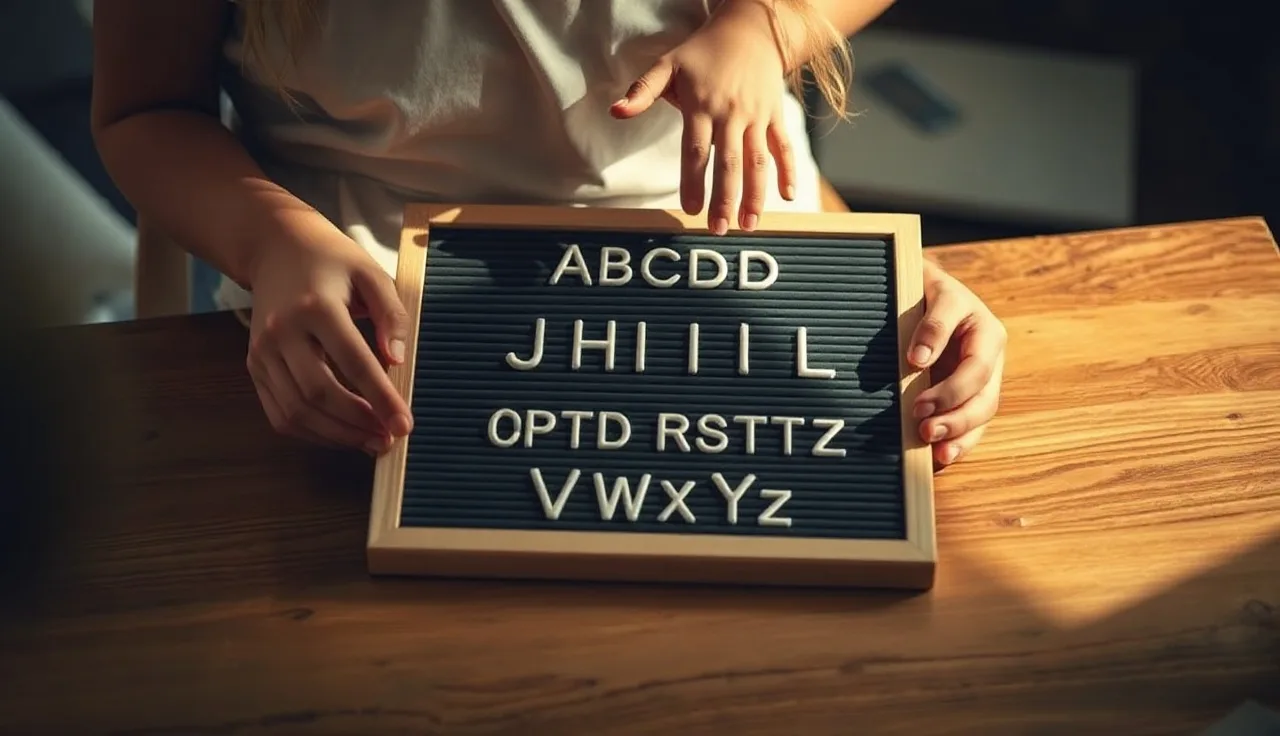
Spelling to communicate is a method developed by Elizabeth Vosseller, a speech-language pathologist, in the early 2010s. A nonspeaking or minimally speaking person points to letters on a laminated letterboard, stencil, or keyboard to spell out words and sentences. The communication partner holds the board and moves it away after each letter selection, which is meant to prevent perseveration and help the person isolate intentional movements.
The theory underneath it is simple to state. Many autistic people, particularly those diagnosed with apraxia or other motor-planning differences, may have far more language comprehension than their speech output suggests. Supporters call this the "presumption of competence" framework: assume the person understands everything, give them a reliable motor pathway out, and language follows.
S2C differs from facilitated communication (FC), at least in how practitioners describe it. In FC, the facilitator physically supports the person's hand or arm. In S2C, the person moves their own hand to the board, and the partner holds and moves the board rather than guiding the hand. In practice, the line between these two has been argued over for years in the research literature [1][2].
The method has grown fast. The International Association for Spelling as Communication (I-ASC) reported training hundreds of practitioners across multiple countries as of the early 2020s. It is not a fringe idea anymore, and dismissing it without engaging the real questions it raises does families a disservice.
Who uses spelling to communicate? Which kids is it aimed at?
S2C is used mostly with nonspeaking and minimally speaking autistic people. Some practitioners also use it with people who have cerebral palsy, Rett syndrome, or other conditions that affect speech motor control. Age range in practice runs from young children (some practitioners start around age 5 or 6) to adults.
The most commonly cited profile is a child or adult who:
- Has limited or no functional speech
- Shows signs of motor-planning difficulty (sometimes diagnosed as childhood apraxia of speech or apraxia of speech)
- Demonstrates understanding of spoken language through behavior but cannot produce speech reliably
- Has not made strong gains with other communication supports
Some nonspeaking autistic adults, including several high-profile self-advocates, credit S2C with giving them their first reliable communication channel. Their accounts are powerful and should not be casually dismissed. The honest tension is this: personal testimony, however moving, cannot by itself tell us whether the messages started with the communicator or were nudged into being by the partner [2].
S2C is not usually recommended as a first communication tool for late talkers with mild-to-moderate delays. For those kids, early intervention services and speech therapy approaches with a stronger evidence base are the normal starting point.
What does the research actually say about spelling to communicate?
This is the part where you have to sit with real discomfort, because the evidence is genuinely mixed and the stakes are high.
On one side: there are multiple published case reports and small studies showing that some nonspeaking autistic people produce novel, contextually appropriate messages through S2C-style methods. A 2019 study by Jaswal, Wayne, and Golino published in Scientific Reports found that some participants showed eye gaze patterns consistent with reading the words they were spelling, which suggests at least partial authorship [3].
On the other side: the core scientific concern with any facilitated or partner-assisted pointing method is ideomotor influence, the same unconscious mechanism that makes a Ouija board planchette move. The facilitator does not have to be consciously guiding the person's hand for subtle cues to steer where the hand goes. Controlled studies, where the partner and communicator have access to different information, have repeatedly shown message breakdown in FC conditions. The open question for S2C is whether its physical setup is different enough to avoid this [1][2].
The American Speech-Language-Hearing Association (ASHA) reviewed the evidence and in 2018 issued a position statement classifying facilitated communication as a "discredited" technique. The statement says "the evidence is overwhelming that FC messages are authored by the facilitators." ASHA placed RPM (Rapid Prompting Method, a closely related technique) in the same category [1]. I-ASC and many practitioners push back on applying that label to S2C, arguing the physical setup is meaningfully different. ASHA has not issued a separate classification for S2C specifically as of 2024, but its guidance covers the broader category.
The Autism Science Foundation and the Association for Science in Autism Treatment hold similar positions. That is a lot of heavyweight institutional skepticism.
What is missing from both camps is a well-controlled randomized study specifically testing S2C with message-passing (different information given to communicator and partner). Nobody has good data on this yet. The closest work is the Jaswal et al. eye-tracking study [3], which is suggestive but not a controlled test of message authorship.
Parents sitting with this need to hold two things at once. The institutional skepticism is based on real science. And the absence of a definitive controlled study means the question is not fully closed. That is an uncomfortable place to be. It is also the honest one.
What does ASHA say about S2C and facilitated communication?
ASHA's 2018 position statement on facilitated communication is the most cited official guidance in this area. The statement reads, in part: "The American Speech-Language-Hearing Association (ASHA) maintains that facilitated communication is a discredited technique that should not be used." [1] ASHA extends this concern to RPM and similar partner-dependent pointing methods.
Here is the practical consequence. A licensed SLP who uses S2C with your child may be working outside ASHA's recommended practice guidelines. Some SLPs do use it anyway, especially those who specialize in nonspeaking autism. Others refuse to touch it precisely because of the ASHA position. You will get different answers from different clinicians, and those answers reflect a real, unresolved professional debate, more than individual preference.
ASHA does not regulate licensure directly. State licensing boards do. A few states have taken action against practitioners for using FC-family methods, but most have not. The legal and professional landscape is patchy.
The American Academy of Pediatrics (AAP) has aligned with the scientific consensus against FC-family methods in its autism communication guidance, recommending instead AAC approaches with established evidence [4]. For a broader look at AAC options, AAC devices and autism spectrum speech therapy cover those alternatives in detail.
How is S2C different from facilitated communication and RPM?
The three methods share a family resemblance but differ in physical setup and underlying theory.
| Method | Physical setup | Who moves the board/device | Evidence status (per ASHA) |
|---|---|---|---|
| Facilitated Communication (FC) | Facilitator holds/supports hand or arm | Both facilitator and communicator | Discredited [1] |
| Rapid Prompting Method (RPM) | Practitioner holds letterboard; may touch or stabilize | Practitioner holds, person points | Same concerns as FC [1] |
| Spelling to Communicate (S2C) | Partner holds and moves board; person points independently | Partner moves board, person points | No separate ASHA classification as of 2024; covered under broader guidance |
S2C practitioners argue the key distinction is that the communicator's hand is not touched or supported, which makes ideomotor influence harder. Critics argue that a partner controlling the position and movement of the board still has several channels for unintentional influence: anticipatory movements, small hesitations, and the timing of when they pull the board away.
The distinction matters legally and professionally, because "facilitated communication" carries specific regulatory weight in some states. Whether S2C is a different thing entirely or a variant of the same family is genuinely contested.
Can spelling to communicate be used alongside other AAC methods?
Yes, and many families do exactly this. A child or adult can use an SGD (speech-generating device), PECS, or a high-tech AAC app for everyday functional communication, and also explore letterboard methods separately. These approaches are not mutually exclusive.
The practical worry with using S2C as a primary or sole communication method is partner dependency. Functional communication has to work across environments and with multiple people, including teachers, strangers, and emergency responders who have never been trained in S2C. A high-tech AAC device works anywhere. A letterboard session needs a trained partner in the room.
Some SLPs who work in this space suggest using S2C as a language exploration tool while building independent AAC skills in parallel. The communicator is not stuck choosing one or the other. What you want to avoid is a setup where S2C becomes the only outlet because it produces the most elaborate output, while independent communication skills stall.
If your child also shows patterns that look like echolalia, understanding what that behavior communicates is part of the same broader picture of how they process and express language.
What should parents ask before starting spelling to communicate?
If you are weighing S2C for your child, here are the questions that actually matter.
First: has your child had a thorough motor assessment? Specifically, has a qualified SLP evaluated them for childhood apraxia of speech? The theoretical basis for S2C rests heavily on motor-planning deficits as the barrier to speech. If your child has not been assessed for apraxia, you are missing a foundational piece of the picture.
Second: what independent communication does your child have right now? S2C works best, if it works, as an addition to a communication system, not a replacement for building one. Ask what the practitioner's plan is for generalization and independence.
Third: will the practitioner run message-passing checks? This is a blinded test where the communicator has access to information the partner does not, or the reverse. If the practitioner refuses or says it is not necessary, that is a significant red flag. It is the most basic way to test message authorship, and any practitioner confident in their method should welcome it.
Fourth: what does your child's current speech therapist think? If you are working with an SLP who does not use S2C, ask them directly. You want their clinical reasoning, more than a position statement.
Fifth: what is the cost and time commitment? S2C sessions are not usually covered by insurance when they fall outside evidence-based SLP practice. Families often pay out of pocket. Costs vary widely by region and practitioner, but private therapy sessions in the US typically run $100 to $250 per hour, and intensive S2C training programs can cost considerably more. I could not find a published national average specific to S2C.
What do nonspeaking autistic people say about spelling to communicate?
This part of the conversation gets flattened too fast in both directions.
Many nonspeaking autistic self-advocates who use or have used S2C report that it gave them access to communication they did not have before. Their accounts describe frustration with being presumed to have intellectual disability, relief at being understood, and strong opinions about their own lives. These are not trivial experiences to wave off.
The scientific community's response to this is not "these people are lying." It is "we cannot tell from testimony alone whether the messages are fully self-authored, partially influenced, or primarily facilitated, and the history of FC shows we have been wrong before." That is a distinction worth keeping clear.
The Autistic Self Advocacy Network (ASAN) has taken a careful position, supporting presumption of competence while also calling for more rigorous research. Some autistic researchers and advocates are themselves skeptical of FC-family methods. The nonspeaking autistic community does not speak with one voice on this.
What families can take from it: listen to the experiences of nonspeaking autistic adults, take their accounts seriously, and hold that alongside the open scientific questions. Both things can be true at once.
How does S2C compare to high-tech AAC for nonspeaking autistic kids?
High-tech augmentative and alternative communication (AAC), meaning speech-generating devices and symbol-based apps, has a much larger evidence base than S2C. Systematic reviews and decades of research support AAC as effective for nonspeaking autistic people across many ages and skill levels [4][5].
The practical differences matter for daily life:
| Factor | S2C / Letterboard | High-tech AAC (SGD or app) |
|---|---|---|
| Partner required | Yes, trained partner for every session | No; independent use is the goal |
| Evidence base | Limited, contested | Strong, peer-reviewed [5] |
| Insurance coverage | Usually not covered | Often covered under IDEA and Medicaid [6] |
| Use in emergency | Requires trained partner present | Device works anywhere |
| Message complexity | Can produce long sentences | Ranges from single symbols to full sentences depending on system |
This does not mean high-tech AAC is right for every child, or that S2C has nothing to offer. It means that if you are deciding where to put your time and money, the evidence heavily favors building independent AAC skills first.
For families exploring what a tech-supported approach looks like day to day, the Little Words app is one tool built to support speech practice for neurodivergent kids at home, with a focus on building independent communication habits. Take their start quiz to see if it fits your child's current needs.
Is spelling to communicate covered by insurance or IDEA?
Generally, no. Insurance coverage for speech therapy depends on whether the specific method counts as evidence-based under the insurer's clinical criteria. Most major insurers follow guidelines from ASHA or similar bodies. Because S2C does not have a strong peer-reviewed evidence base and sits in a contested regulatory space, coverage is unlikely under standard health plans.
Under IDEA (Individuals with Disabilities Education Act), school districts have to provide communication supports that are educationally necessary and evidence-based. Several districts have specifically excluded FC-family methods from IEP-funded services based on ASHA's guidance [6]. Parents who request S2C as part of an IEP may hit resistance, and the district's position will usually rest on the ASHA statement.
Medicaid waiver programs (which vary by state) sometimes cover AAC evaluations and devices with more flexibility, but coverage is still more reliable for methods with established evidence.
If cost is a constraint and you want professional communication support, online speech therapy has widened access to SLPs who specialize in nonspeaking autism, often at lower cost than in-person care, and usually using methods with clearer insurance pathways.
What are the risks of using spelling to communicate?
The risks break into two buckets: direct harms and opportunity costs.
Direct harms documented in the FC literature include cases where facilitated messages led to false accusations of abuse, wrong medical decisions, and educational placements based on assumed abilities that were not independently verifiable [2]. These are not hypothetical. The FC record includes documented legal cases and real harm to families and caregivers. Whether S2C carries the same risk depends on whether the physical differences actually reduce facilitator influence, which is the unresolved empirical question.
Opportunity cost is the quieter risk. Every hour spent on S2C is an hour not spent on speech therapy approaches with more evidence behind them, on building independent AAC skills, or on early intervention services. For young children, time matters. The window where motor and language plasticity is highest does not stay open forever.
There is also a psychological risk for families. If a child's S2C messages are later found to be heavily influenced by the partner, the emotional hit to both the family and the communicator can be severe. Parents invest enormously in believing their child's voice is coming through. Raising that possibility is not cruel. It is honest.
None of this means S2C is certainly harmful or certainly useless. It means the risk-benefit math is genuinely uncertain, and you should do it with full information.
What should I do if I want to try spelling to communicate with my child?
If you decide to explore S2C despite the evidence questions, here is a practical approach that most clinicians on any side of this debate would call reasonable.
Keep it parallel, not primary. Do not stop building independent communication skills. Run S2C alongside evidence-based AAC and speech therapy, not instead of them.
Find a licensed SLP. Even practitioners who use S2C vary widely in training and rigor. Working with someone who holds an ASHA CCC-SLP credential means they are accountable to a professional body, even if the method itself is contested.
Build in message-passing checks from the start. Before drawing strong conclusions about what your child is communicating, test authorship. Have a different partner work with your child, or set up situations where the partner genuinely does not know the answer your child is supposed to give. Write down what happens.
Talk to your child's whole team. Your child's school SLP, behavioral therapist, and pediatrician should know you are trying this. Decisions made off letterboard messages, including educational placements, medical choices, and abuse allegations, carry consequences that reach well beyond the S2C session.
For teens and adults who want to explore S2C on their own, speech therapy for adults outlines how to find specialists who work with acquired or developmental communication differences.
And if your child has significant motor-planning challenges that seem to be blocking speech, a dedicated evaluation for apraxia of speech is worth pursuing no matter what you decide about S2C. Motor-based speech interventions with strong evidence, like DTTC and Nuffield, address the same underlying mechanism S2C is theorized to work around, but through the speech system rather than around it.
Frequently asked questions
Is spelling to communicate the same as facilitated communication?
Not exactly, but they are closely related. In facilitated communication, the facilitator physically supports the person's hand or arm. In S2C, the person points independently while the partner holds and moves the board. Critics argue the physical difference does not eliminate partner influence; supporters argue it does. ASHA's 2018 position statement covers FC and RPM explicitly; S2C sits in a contested adjacent category.
What age can a child start spelling to communicate?
Practitioners vary, but most who use S2C start around age 5 to 7, once a child can show letter recognition and intentional pointing. Some start earlier with pre-literacy letterboard work. There is no published developmental age threshold based on controlled research. Starting very young raises added authorship concerns, because young children's intentional motor control is still developing.
Can spelling to communicate help a child who has some speech but is hard to understand?
S2C is designed mainly for nonspeaking or minimally speaking individuals. For children who have speech but struggle with intelligibility, the usual clinical path is a motor-speech evaluation to rule out childhood apraxia or dysarthria, followed by targeted speech therapy. A letterboard is unlikely to be the first recommendation from an evidence-based clinician for a child with functional speech.
Has spelling to communicate been proven to work?
No, not by the standards of controlled research. There are case reports, qualitative accounts, and one eye-tracking study (Jaswal et al., 2019, Scientific Reports) showing some communicators gaze at letters before pointing. What does not yet exist is a well-controlled message-passing study specific to S2C. The evidence base is thin, and major bodies including ASHA and AAP have not endorsed it.
Why do some schools refuse to use spelling to communicate for IEPs?
IDEA requires schools to use evidence-based interventions. Because ASHA classifies facilitated communication as discredited and has raised similar concerns about RPM and related methods, many school districts follow that guidance and decline to fund S2C as part of a child's IEP. Parents can request an independent educational evaluation or dispute the classification through due process, but the district's position generally has professional backing.
What is the 'presumption of competence' and does S2C require it?
Presumption of competence means assuming a nonspeaking person understands language and has opinions and preferences, even without evidence from standardized tests. It is a broadly accepted and ethical starting point in AAC and autism support. S2C practitioners use it as a philosophical foundation. You can and should presume competence while also requiring message-passing verification before making major decisions based on letterboard output.
Are there alternatives to S2C for nonspeaking autistic kids?
Yes. High-tech AAC devices and apps (like Proloquo2Go or TouchChat) have strong peer-reviewed evidence and allow independent communication. PECS (Picture Exchange Communication System) has an established evidence base for early communicators. For kids with motor-speech profiles, DTTC and Nuffield approaches target apraxia directly. None of these require a trained partner to be present for every communication attempt.
What is I-ASC and who runs spelling to communicate training?
I-ASC stands for the International Association for Spelling as Communication. It is the main professional body that trains and certifies S2C practitioners and was cofounded by Elizabeth Vosseller, the SLP who developed the method. As of the early 2020s, it reported training hundreds of practitioners across multiple countries. I-ASC is a private organization, not a government or ASHA-affiliated body.
Can adults with autism start spelling to communicate later in life?
Yes. S2C is used with adults, including people who have been nonspeaking for decades. Some adult nonspeaking autistic people report starting letterboard communication as adults and finding it transformative. The same authorship verification questions apply regardless of age. Adults have full autonomy to explore any communication method they choose; the evidence concerns are about what conclusions others should draw from the output.
How do I find a spelling to communicate practitioner?
I-ASC maintains a practitioner directory on its website. Because S2C sits outside ASHA's endorsed methods, practitioners may or may not be licensed SLPs. Always verify licensure independently through your state's licensing board. Working with a licensed SLP matters for accountability, even if the specific method is contested.
Does spelling to communicate work for kids with autism and intellectual disability?
This is one of the most contested questions in the field. S2C theory holds that many people diagnosed with intellectual disability alongside autism are actually capable of sophisticated thought that cannot get out through standard motor channels. Critics say this claim has not been independently verified and that assuming high cognition based on facilitated output could lead to inappropriate placements. Objective cognitive assessment by a qualified neuropsychologist matters alongside any communication method.
What is a message-passing test and why does it matter for S2C?
A message-passing test is a controlled check where the communicator and the communication partner have access to different information, then a third party asks the communicator to share what they know. If messages reflect the communicator's unique information, authorship is supported. If messages reflect the partner's information instead, facilitation is likely. This test is the gold standard for evaluating any partner-assisted communication method and should be a routine part of any S2C practice.
Sources
- ASHA, Position Statement: Facilitated Communication (2018): ASHA classifies facilitated communication as a discredited technique and extends concerns to RPM; states 'the evidence is overwhelming that FC messages are authored by the facilitators'
- Mostert, M.P. (2001). Facilitated Communication Since 1995: A Review of Published Studies. Journal of Autism and Developmental Disorders.: Systematic review of FC controlled studies documenting message authorship failures and documented harms including false abuse allegations
- Jaswal, V.K., Wayne, A., & Golino, H. (2019). Eye-tracking reveals agency in assisted autistic communication. Scientific Reports.: Eye-tracking study finding some nonspeaking autistic participants gazed at letters before pointing, suggesting partial authorship
- American Academy of Pediatrics, Autism Spectrum Disorder Communication Guidance: AAP aligns with scientific consensus against FC-family methods and recommends evidence-based AAC approaches for nonspeaking autistic children
- Ganz, J.B. et al. (2012). Meta-analysis of single-case research studies on AAC for individuals with ASD. Journal of Autism and Developmental Disorders.: Meta-analysis supporting effectiveness of high-tech AAC for nonspeaking autistic individuals across age ranges
- U.S. Department of Education, IDEA Statute and Regulations: IDEA requires that school-funded interventions including communication supports be evidence-based; basis for school districts excluding FC-family methods from IEPs
- Association for Science in Autism Treatment, Facilitated Communication summary: ASAT maintains position that facilitated communication and related methods lack scientific support and carry documented risks
- Autism Science Foundation, Position on Facilitated Communication: Autism Science Foundation opposes FC-family methods based on controlled research evidence
- ASHA, Augmentative and Alternative Communication (AAC) Practice Portal: ASHA practice portal documents evidence base for AAC approaches as alternatives for nonspeaking individuals
- Schlosser, R.W. & Wendt, O. (2008). Effects of AAC on natural speech in children with ASD. American Journal of Speech-Language Pathology.: Research showing AAC does not inhibit speech development and often supports it in nonspeaking autistic children
- Individuals with Disabilities Education Act, 20 U.S.C. § 1400: Federal statute establishing rights to free appropriate public education including communication services for children with disabilities