Last updated 2026-07-11
TL;DR
Switch access lets children who can't reliably point or tap operate an AAC device using one or two simple buttons. The device highlights choices in sequence (scanning) and the child hits a switch to select. With the right switch position and a good vocabulary system, many kids with motor differences become functional communicators. Start with a joint evaluation by a speech-language pathologist and an occupational therapist.
What is switch access AAC and who is it for?
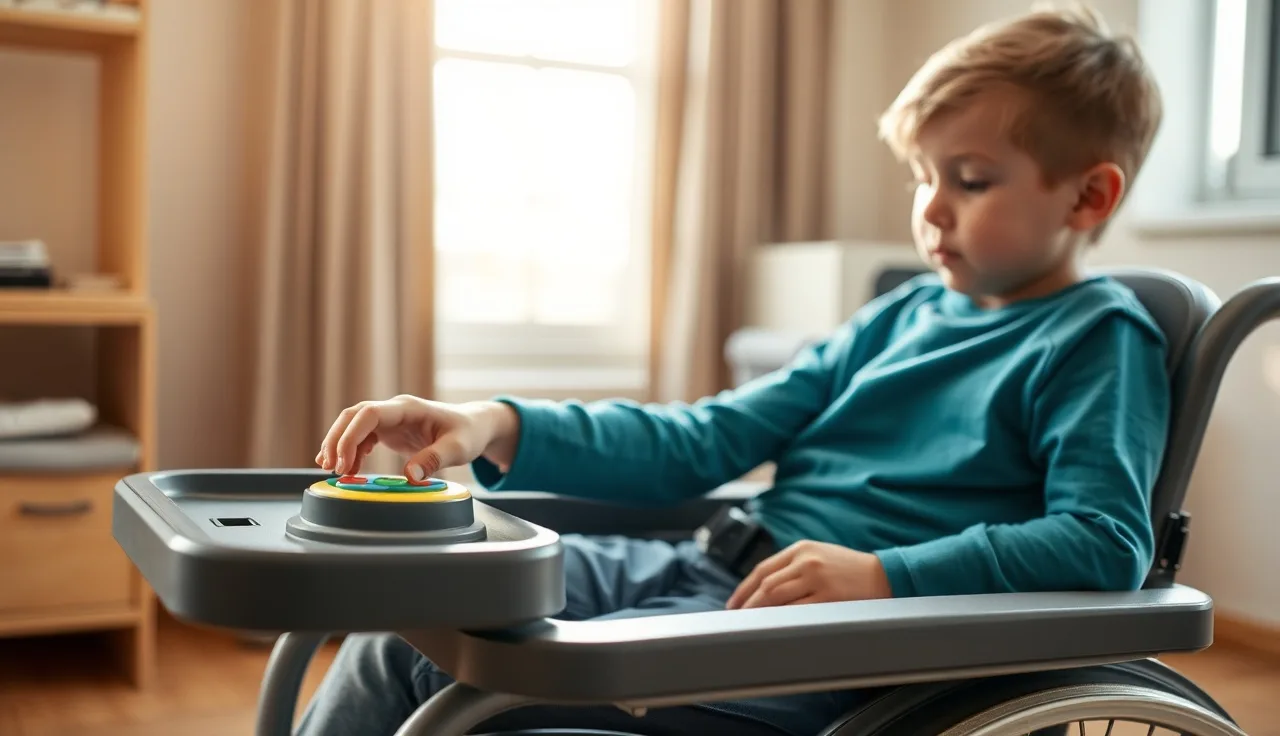
Switch access is a way to control an augmentative and alternative communication (AAC) device, or any computer, without touching a screen or keyboard directly. Instead of tapping a symbol, the child activates a physical switch, a button that gets pressed, squeezed, puffed into, or nudged, and the device responds.
The child does not need functional hand use. The switch can go anywhere the child has reliable, repeatable movement: a thumb, a knee, the side of the head, a foot, a cheek. That one controllable movement becomes their voice.
Switch access AAC is used by children with cerebral palsy, spinal muscular atrophy (SMA), muscular dystrophy, spina bifida, traumatic brain injury, degenerative conditions, and any diagnosis that heavily limits upper limb or fine motor control. It is sometimes the right path for children with childhood apraxia of speech who have co-occurring motor involvement, and for some children on the autism spectrum who have reliable movement in only one body site. Age is not the barrier many parents assume. Children as young as 12 to 18 months have been taught cause-and-effect switch use as a stepping stone toward communication [1].
The American Speech-Language-Hearing Association (ASHA) classifies switches as "indirect selection" access methods and treats them as one of the access options that must be considered in any thorough AAC evaluation [2].
How does scanning work in switch AAC?
Scanning is the navigation method that turns one button into a way to choose from many options. The device moves a highlight (or reads items aloud) through the possible choices in a predictable pattern. When the highlight lands on what the child wants, they hit their switch and the device selects it.
There are three main scanning patterns.
Automatic scanning moves the highlight on its own at a set speed. The child waits and hits the switch to select. Beginners usually start here.
Step scanning makes the child activate the switch once to move the highlight to the next item, then hold or activate again to select. More control, more motor effort.
Directed scanning uses two switches: one to move, one to select. It is faster for children who can manage two access points reliably.
Within these patterns, the highlight can travel in different arrangements. Linear scanning goes item by item across the whole screen. Row-column scanning (also called group-item scanning) highlights an entire row first; one switch hit accepts that row, then the highlight moves through individual items inside it. Row-column is generally faster for larger vocabulary grids because it cuts the number of switch hits needed [3].
Scan rate (how fast the highlight moves) is adjustable, usually in increments of 0.1 to 0.5 seconds. Most children learning to scan start at 2 to 4 seconds per item and speed up as their timing gets reliable. The right rate is not about what looks fast to a parent. It is the rate at which the child is accurate.
All the major AAC software systems (Snap Core First, TouchChat, Proloquo2Go, LAMP Words for Life, Grid 3) include built-in scanning and switch-access settings. Grid 3 by Sensory Software gets cited by AAC specialists as especially flexible for switch configuration [3].
What types of switches are available and how do you choose?
A switch is basically any sensor that sends an activation signal when the child makes the target movement. The variety is wide.
| Switch type | Activation | Best suited for |
|---|---|---|
| Jellybean / big button | Press (direct pressure) | Reliable hand, fist, or elbow push |
| Pillow / plate switch | Press (low force) | Very low muscle strength |
| Sip-and-puff | Inhale or exhale through a straw | Minimal limb movement, adequate breath control |
| Head switch | Head tilt or side movement | Children with better head control than limb control |
| Proximity (infrared) | Moving into a beam without touching | Very low force, sensitive to small movements |
| Eye-gaze system | Eye movement (technically not a "switch" but often grouped here) | Extremely limited motor function; requires clear ocular control |
| Foot switch | Foot press | Children with better lower limb movement |
| Wobble / Grasp switch | Squeeze or tilt | Variable grip strength |
Choosing the switch is not a parent decision, and it is not purely a speech therapist decision either. It takes an occupational therapist (OT) to evaluate motor control, fatigue patterns, positioning, and spasticity, working alongside the SLP who is designing the communication system. ASHA's guidance on AAC evaluation explicitly calls for this interdisciplinary team approach [2].
Prices vary a lot. A basic jellybean-style button switch (like those from AbleNet) usually costs $60 to $120. Specialty switches such as sip-and-puff or proximity sensors run $150 to $500. Eye-gaze systems that act as the AAC access method are a separate category and can cost $8,000 to $20,000 for a dedicated device, though insurance coverage increasingly applies under the durable medical equipment (DME) benefit of Medicaid and many private plans [4].
Want to experiment before you commit? Many state assistive technology programs run device lending libraries with free short-term loans. The AT3 Center (funded by the Administration for Community Living) keeps a directory of these programs in every state [5].
The switch connects to the AAC device through a standard 3.5mm audio jack in most cases, or via Bluetooth for wireless options. That standardization means most switches work with most devices.
How do you find the best switch position for your child?
Position matters more than switch type. A child may look like they have no reliable movement until an OT finds that a consistent, isolated head movement exists on one side, or that a toe extends the same way every time.
The evaluation usually includes a motor access assessment, sometimes called a seating and mobility evaluation, done with the child in their usual supported seating or wheelchair. The OT maps out which body sites produce the most consistent, least tiring, and most isolated movements. "Isolated" matters because accidental activations wreck communication. If a child's arm spasms every time they breathe, that arm is a bad switch site.
A few principles come out of good assessments.
Fatigue changes everything. A site that works for 10 minutes at 9 a.m. may fail at 3 p.m. after a school day. Build in observation at different times.
Positioning before access. If a child is not seated with their trunk well supported, limb control degrades. The seating system is part of the AAC system.
Start with a single switch. Two-switch access is faster eventually, but learning two sites at once overloads most beginning communicators. Master one first.
The joint SLP and OT assessment should happen before the family buys any device, because the access method drives which device and which software make sense. Retrofitting a scanning setup onto a device bought without this assessment is a common and expensive mistake.
Some children with heavy motor involvement also qualify for early intervention services from birth to age three, where this kind of interdisciplinary AT assessment is available at no cost to the family under the Individuals with Disabilities Education Act (IDEA Part C) [6].
What does a good vocabulary system look like for switch users?
The vocabulary on the device has to work with the scanning method, not against it. A few principles hold up well in AAC research.
Smaller grids scan faster. A 4-location grid needs far fewer switch hits per selection than an 84-location grid. Most switch AAC learners begin with 4 to 9 locations and grow the grid as scanning speed and accuracy improve.
Core vocabulary first. Core words ("more," "stop," "go," "want," "help," "no," "yes," "I," "it") make up roughly 80% of what people say in daily communication, according to research on typical language use summarized by Beukelman and Mirenda [7]. Putting core words where they scan quickly (top row, or first item in a frequent category) gives the child more communication per switch hit.
Frequency-based layout. Some AAC apps let you reorder items by how often they get used. For a switch user, putting the eight most-used items in the first row of a row-column grid cuts scan time in a way you can feel.
Modeling matters as much for switch users as for anyone. The same "aided language input" strategy that SLPs recommend for all AAC learners applies here: the communication partner points to or activates symbols on the device while talking, even when the child is not using it. A 2016 systematic review in the American Journal of Speech-Language Pathology found that modeling intervention consistently increased symbol use across AAC populations [8].
For children with apraxia of speech who also have motor access limits, motor learning principles still apply to the speaking output the device produces. Some families use apps that pair AAC with speech sound practice. Little Words is built for neurodivergent kids and includes guided communication activities that complement what a therapist is already doing at home, though it is not a substitute for a dedicated switch-access AAC device for children with significant motor limitations.
Stay away from vocabulary systems that bury common words five screens deep. For a child taking 2 seconds per scan step with row-column navigation, reaching a word 10 selections away takes 20 seconds minimum. That is long enough that most communication partners have already moved on.
How do you teach a child to use a switch for the first time?
Teaching switch use happens in stages. Jump straight to communicating words before the child understands what the switch does, and you get frustration all around.
Stage 1: Cause and effect. The child learns that hitting the switch makes something happen, anything enjoyable: a fan turns on, music plays, a toy activates. This has nothing to do with communication yet. It builds the idea that "I have control." Battery-operated toy adapters (AbleNet makes them; about $20 to $30) let you plug almost any toy into a switch without modifying the toy [5].
Stage 2: Switch to start and stop. The child learns to activate the switch to start a preferred activity and activate again to stop or request more. This is the earliest communicative switch use: "I want this" and "I want more."
Stage 3: Simple scanning. Present a two-location choice. Highlight Option A, then Option B. The child hits the switch when the thing they want is highlighted. Keep scan time slow. Celebrate every accurate selection.
Stage 4: Growing the grid and speed. Add locations as accuracy holds above 80%. Cut scan time as the child's timing gets consistent.
This progression mirrors the research on switch training in children with physical disabilities [1]. Progress is not linear. A child sick for a week may need to step back a stage for a while.
One thing helps enormously: a consistent scan schedule. Use the switch AAC setup for the same routines every day, snack time, book time, free choice, so the child knows when to expect it and communication partners know how to support it. Inconsistent access is the single most common barrier to switch AAC progress, more common even than the wrong switch or the wrong vocabulary.
How does insurance and funding work for switch AAC devices?
The device and the switch hardware are both potentially fundable. Here is what actually applies.
Medicaid covers AAC devices as durable medical equipment (DME) in all 50 states. Federal Medicaid rules under 42 CFR Part 440 do not let states categorically exclude DME for children, and the EPSDT (Early and Periodic Screening, Diagnostic and Treatment) benefit for children under 21 requires coverage of medically necessary services, which ASHA has consistently argued includes AAC [2][4]. In practice, approvals need a letter of medical necessity (LMN) written by the evaluating SLP, documentation of the disability, and often evidence the device was trialed.
Private insurance coverage has improved a lot since the autism insurance reform laws that most states now have on the books, though those laws vary by state. As of 2023, 49 states plus D.C. had some form of autism insurance mandate, but the scope differs, and AAC coverage is not always spelled out [9].
IDEA school-based coverage: if a child has an IEP (Individualized Education Program) and the team decides a switch AAC device is necessary for access to education, the school district has to provide it under IDEA. The legal standard is "free appropriate public education" (FAPE). The device the school provides stays at school; the family may need separate funding for a home device, though some districts let devices travel.
Vocational Rehabilitation (VR) funds assistive technology for transition-age youth (16 and up under IDEA, sometimes younger through state programs).
Nonprofit grants are a real option. Groups like United Cerebral Palsy, the Muscular Dystrophy Association, and the Epilepsy Foundation run equipment grant programs. Dollar amounts and eligibility shift year to year, so check directly with each organization.
A fully configured switch AAC system (device, software, switch hardware, mounting arm) can range from about $500 for a shared iPad setup with donated or loaned switch hardware to $15,000 or more for a dedicated SGD (speech-generating device) with eye-gaze access [4]. Know the funding pathway before choosing the device, because some dedicated SGDs are only covered when specific criteria are met.
What role does the school team play in switch AAC?
For school-age children with an IEP, the school team is often the primary provider of switch AAC services, and knowing how that works saves families a lot of confusion.
The IEP team, which includes the SLP, OT, special education teacher, parents, and in some cases the child, is responsible for AT consideration. IDEA requires teams to consider whether a child needs assistive technology to receive FAPE [6]. "Consider" does not mean "automatically provide," so parents need to formally request an AT evaluation if it has not happened.
The AT evaluation at school ideally mirrors what a private AT clinic would do: the SLP assesses communication needs and vocabulary, the OT assesses motor access, and they trial devices together. Many districts have AT specialists or can reach regional AT centers.
The IEP has to document AAC goals with enough specificity to measure progress. A goal like "will use switch AAC to make requests" is weak. A stronger goal names the scanning method, the grid size, the expected accuracy rate, and the contexts. Parents can and should ask for measurable, time-bound goals.
Carryover between school and home is one of the weakest links in school-based AAC. Research consistently shows AAC use drops sharply when the device is only available in therapy sessions [8]. Push for the device to be used throughout the school day, across settings, with all communication partners trained.
If your child is not yet school age, the early intervention system (IDEA Part C) covers children from birth to three. The service coordinator is your point of contact. After three, IDEA Part B covers preschool through age 21. Transitions between these systems take planning, because services are delivered differently.
Families working through school-based AAC disputes have rights under IDEA procedural safeguards, including the right to an independent educational evaluation (IEE) at public expense if they disagree with the school's evaluation [6].
How long does it take for a child to become a functional switch AAC communicator?
Every parent asks this, and honestly there is no single answer. What the research can give us is rough shape.
For children who begin with no switch experience, the cause-and-effect stage usually takes a few weeks to a few months, depending on cognitive status, motivation, and how often they practice. Studies of children with severe physical disabilities have found functional switch-activated communication emerging in some children within 3 to 6 months of consistent intervention, and in others over 1 to 2 years [1].
Age at start matters, but not in the way people fear. Earlier is generally better because language exposure time matters, yet there is no upper age cutoff. Adults with acquired conditions learn switch AAC. The drive to communicate holds up across a wide age range.
Motor learning responds to volume of practice. A child who uses their switch AAC setup for 30 minutes a day across multiple settings will move faster than one who uses it twice a week in therapy. That is why caregiver training carries so much weight, arguably more than the therapy hour itself.
A realistic expectation: a young child (2 to 5 years old) starting cause-and-effect training today might be making reliable two-choice switches within 6 months, expanding to a 9-location scanning grid within 12 to 18 months, and communicating in short functional phrases within 2 to 3 years of good, consistent therapy and home practice. Some children move faster. Some need longer. Neither outcome is a failure.
Families who want to support communication at home alongside formal speech therapy can use tools like Little Words to build language exposure and interaction habits in daily routines, as a supplement to the AAC work the therapy team is leading.
The single best predictor of outcome in AAC research is not device type or diagnosis. It is communication partner training and consistent, motivated use [8].
Are there AAC apps that work with switch access on an iPad or Android?
Yes, and this area has improved a lot in the past decade. The iPad (iOS) has a built-in switch feature called Switch Control, tucked into Settings under Accessibility. It supports one or two switches over Bluetooth and lets you scan any app on the device, including AAC apps [10].
Android has a comparable feature called Switch Access, also in Accessibility settings, with similar capabilities. Both operating systems let you set scan speed, visual highlighting style, and switch behavior without buying any extra software.
The most widely used AAC apps with good built-in switch scanning include the following.
Proloquo2Go (AssistiveWare): works with iOS Switch Control; common in school settings; one-time purchase roughly $220 as of 2024 [11].
Snap Core First (Tobii Dynavox): subscription model, about $35 a month or $350 a year; integrates with dedicated Tobii hardware or iPad [3].
TouchChat HD: one-time purchase, around $150; solid scanning support on iOS.
Grid 3 (Sensory Software): primarily PC and dedicated device; regarded by many AT specialists as the most flexible for complex scanning setups; licensed per device, roughly $650 to $950 depending on version [3].
LAMP Words for Life (PRC-Saltillo): built on motor learning principles; available as an app ($300) or on dedicated PRC devices; switch access supported.
For children just learning cause-and-effect or early scanning, there are lower-cost or free apps that work as practice environments: Inclusive TechTools (Inclusive Technology) and the Switch Progression Road Map app are resources some SLPs recommend for structured switch skill building.
A quick caution: the AAC app is not the intervention. The research is clear that the vocabulary system, communication partner behavior, and consistent access drive outcomes far more than which specific app is installed [8].
How do you talk to your child's doctor about getting a switch AAC evaluation?
Pediatricians are often the first point of contact, and they are frequently underprepared for this referral pathway. Here is what actually moves things forward.
Ask for a referral to a speech-language pathologist with AAC and AT experience, specifically. Not every SLP has this training. If your pediatrician's practice does not have that SLP on staff, ask for a referral to a children's hospital AAC clinic or a regional AT center. Many children's hospitals run dedicated AAC programs.
Ask for a concurrent OT referral for motor and seating assessment. Frame it as part of the same evaluation. Some insurers require a physician order for this, so get it at the same appointment.
Document your child's motor limitations in the referral request. The more specific you are ("my child cannot isolate individual finger movements reliably and has significant spasticity in both hands"), the more likely the referral gets routed correctly.
If your child is under three, contact your state's early intervention program directly. You do not need a physician referral to request an EI evaluation; any parent can initiate one [6]. The child must be evaluated within 45 days of the referral under IDEA Part C.
The American Academy of Pediatrics (AAP) recommends developmental surveillance at every well-child visit and formal screening at 9, 18, and 30 months, with immediate referral if motor or communication concerns come up [12]. If your pediatrician has not started that process and your child has known motor limitations, bring it up and ask that it be written in the visit note.
For children already receiving autism spectrum speech therapy or other ongoing therapy, the treating SLP may be the most direct route to an AT referral, skipping the general pediatrician entirely.
Frequently asked questions
Can a child use switch access AAC if they can only move one body part?
Yes. Single-switch access is a standard configuration. The child uses one repeatable movement, a thumb press, a head turn, a toe push, to scan through options and select. One reliable movement is enough to support functional communication. The OT and SLP figure out which body site works best based on a motor assessment.
What is the difference between switch access and eye gaze AAC?
Switch access needs a physical movement to activate a button or sensor. Eye gaze uses a camera to track where the child is looking and selects symbols with no physical press. Eye gaze is generally faster and less tiring, but requires consistent ocular control and costs far more, often $8,000 to $20,000 for a dedicated system. Switch access fits when a child has reliable motor movement but limited hand function.
How many switch hits does it take to say something with scanning AAC?
It depends on the scanning pattern and vocabulary layout. With row-column scanning on a 4-row, 8-column grid, reaching an item takes an average of about 3 to 5 switch activations. A frequency-based layout, where the most-used words sit in the first row, drops the average noticeably. Larger grids and linear scanning need more hits per word.
At what age can a child start learning switch access?
There is no minimum age. Some intervention programs begin cause-and-effect switch training with infants at 12 to 18 months when motor limitations show up early. Early access to the idea that "I can control my environment" supports both communication and cognitive development. Early intervention services under IDEA Part C are available from birth and can include AT assessment.
Does using switch AAC prevent a child from developing natural speech?
No. Research does not support the idea that AAC use suppresses speech. A 2006 systematic review in the journal Augmentative and Alternative Communication found AAC did not inhibit speech and in many cases supported it. For children with motor-based limits on natural speech, AAC gives a communication channel that reduces frustration and increases language exposure, both of which help overall communication development.
What is the best switch for a child with cerebral palsy?
There is no single best switch for cerebral palsy, because CP presents very differently across individuals. Some children have reliable head movement and do well with a head-activated switch. Others have functional breath control and use sip-and-puff. An OT with seating and AT experience needs to assess the specific child's motor profile. The motor access evaluation should happen before any switch is purchased.
Can switch AAC be used in school?
Yes, and if the IEP team decides it is necessary for the child to access education, the school must provide it under IDEA. That includes the device, the switch hardware, and training for school staff. Parents should request an AT evaluation through the IEP process if it has not started. The school-provided device usually stays at school; a separate home device may need independent insurance or Medicaid funding.
How much does a switch for AAC cost?
Basic mechanical switches like a jellybean or pillow button usually cost $60 to $120. More specialized switches such as proximity sensors or sip-and-puff systems run $150 to $500. Most switches connect to a device through a standard 3.5mm audio jack. State AT lending libraries offer free short-term loans, a good way to trial different switches before buying. The AT3 Center directory lists state programs.
Will Medicaid pay for a switch AAC device?
Medicaid covers AAC devices as durable medical equipment for children in all 50 states. The EPSDT benefit for children under 21 requires coverage of medically necessary services. You need a letter of medical necessity from the SLP, documentation of the diagnosis and prior trials, and often a prescription. Private insurance coverage varies by state and plan. An AAC-specialist SLP can help prepare the funding documentation.
What vocabulary should I put on a switch AAC device for a young child?
Core vocabulary first: words like "more," "stop," "help," "want," "go," "no," "yes." These high-frequency words cover most of everyday communication. Add fringe vocabulary (specific nouns) tied to the child's daily life. Start with a small grid, 4 to 9 items, so scanning is fast and successful. Placement matters: put the most-used words in the first scan row to cut switch hits per selection.
How do I train family members to support switch AAC at home?
Ask the treating SLP for a home training session, in person or by telehealth. The key skills for partners are: wait after the child activates the switch (resist filling the silence), model using the device yourself during conversations, keep the device accessible and charged, and follow the child's lead on topic. Consistent partner behavior matters more than the device itself, according to AAC communication partner research.
What is the difference between dedicated AAC devices and an iPad with a switch?
Dedicated speech-generating devices (SGDs) are built only for AAC, often more durable, with louder speakers, and easier to fund through Medicaid DME pathways. An iPad with an AAC app and Apple Switch Control costs less upfront and feels familiar, but it is more fragile and sometimes harder to get funded as a standalone communication device. Both can support switch access. The right choice depends on the child's needs, environment, and funding situation.
Can switch AAC users eventually move to direct touch or eye gaze?
Some can. A child whose motor control improves with therapy, growth, or changed positioning might gain reliable enough touch to use direct selection. Eye gaze is sometimes introduced when hand function is absent but ocular control is good. The access method should be reassessed regularly, not locked in for good. Annual AT re-evaluations are reasonable practice for children with changing motor profiles.
What does a speech therapist who specializes in AAC actually do differently?
An AAC specialist has training beyond the standard SLP degree in feature matching (pairing device capabilities to the child's specific needs), vocabulary selection, aided language modeling, and funding documentation. They work directly with AT-trained OTs. Not all SLPs have this background, so ask a therapist directly about their AAC caseload and training before starting an evaluation. ASHA maintains a directory of certified SLPs at asha.org.
Sources
- Lancioni et al., Developmental Neurorehabilitation, 2008, Switch use training in children with multiple disabilities: Children as young as 12 to 18 months have been taught cause-and-effect switch use; functional switch communication has emerged in some children with severe physical disabilities within 3 to 6 months of consistent intervention.
- ASHA, Augmentative and Alternative Communication (AAC) Practice Portal: ASHA classifies switches as indirect selection access methods and requires interdisciplinary team evaluation including SLP and OT for AAC assessment.
- Sensory Software, Grid 3 AAC Software: Grid 3 is cited by AT specialists for flexible switch configuration; Snap Core First (Tobii Dynavox) subscriptions are approximately $350/year.
- CMS, Medicaid Durable Medical Equipment Coverage: AAC devices are covered as DME under Medicaid; eye-gaze dedicated devices can cost $8,000 to $20,000 and are increasingly covered under DME and EPSDT benefits.
- AT3 Center, Assistive Technology Act Programs (ACL-funded): The AT3 Center maintains a directory of state AT programs that offer free device lending libraries; AbleNet toy adapters cost approximately $20 to $30.
- U.S. Department of Education, IDEA Individuals with Disabilities Education Act: IDEA Part C covers early intervention from birth to age 3; IDEA requires IEP teams to consider whether a child needs assistive technology for FAPE; Part C evaluations must occur within 45 days of referral.
- Beukelman & Mirenda, Augmentative and Alternative Communication, 4th ed. (Paul H. Brookes Publishing): Core vocabulary words account for roughly 80% of everyday communication; frequency-based vocabulary layout reduces switch hits per word selection.
- Sennott, Light & McNaughton, AAC Modeling Intervention Research Review, American Journal of Speech-Language Pathology, 2016: A systematic review found that aided language modeling consistently increased AAC symbol use; communication partner training and consistent access are stronger outcome predictors than device type.
- National Conference of State Legislatures, Autism and Insurance Coverage State Laws: As of 2023, 49 states plus D.C. had some form of autism insurance mandate, though AAC coverage specifics vary by state.
- Apple, Switch Control Accessibility Feature (iOS): iOS Switch Control supports one or two switches via Bluetooth and allows scanning of any app including AAC apps, configurable via Settings > Accessibility.
- AssistiveWare, Proloquo2Go AAC App: Proloquo2Go is available as a one-time purchase approximately $220 and supports iOS Switch Control for scanning access.
- American Academy of Pediatrics, Developmental Surveillance and Screening Policy: AAP recommends developmental surveillance at every well-child visit and formal screening at 9, 18, and 30 months with referral when concerns emerge.