Last updated 2026-07-09
TL;DR
Talker Buddy is a dedicated AAC talker device marketed to children with limited speech, autism, or apraxia. It runs symbol-based communication software on locked-down hardware, priced between $150 and $250. It works best as a starter device. Most children who need a full-featured, long-term system will eventually outgrow it, but Talker Buddy can bridge the gap affordably while you get an evaluation.
What is the Talker Buddy AAC device?
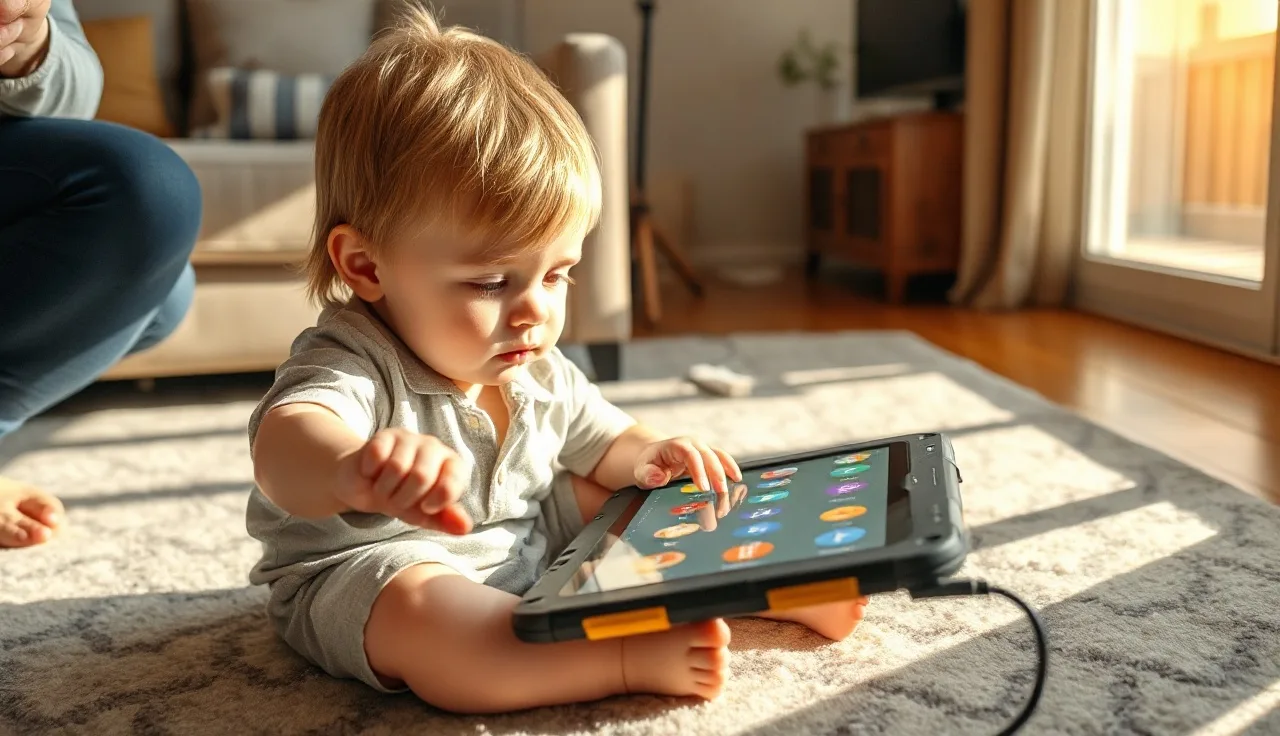
Talker Buddy is a purpose-built AAC (augmentative and alternative communication) device aimed at children and adults who have little or no functional speech. The hardware is essentially a rugged Android tablet preloaded with symbol-based communication software and locked so the child cannot accidentally close the app or wander into YouTube. That locked-home-screen design is the main thing that separates it from just buying a cheap tablet and downloading a communication app yourself.
The device uses a grid of picture symbols. The child taps a symbol, the device speaks the word or phrase aloud. Grids can start very small, say four large buttons, and grow as the child's vocabulary expands. That progression from simple to complex is what the research literature calls full-featured or generative AAC, and it matters: the American Speech-Language-Hearing Association (ASHA) states that AAC systems should be capable of growing with the user's communication needs [1].
Talker Buddy is not a medical device under FDA classification, so it is sold directly to families without a prescription. That makes it accessible. It also means insurance reimbursement is inconsistent, which we will cover later.
The device targets a real gap in the market. High-end dedicated AAC devices from companies like Prentke Romich, Tobii Dynavox, or Saltillo cost $5,000 to $10,000 or more before insurance [2]. A mainstream iPad with a full-featured AAC app runs $500 to $1,000 in hardware alone, plus $300 to $500 for the software license. Talker Buddy tries to get a working solution into a family's hands for under $250.
Who is a Talker Buddy designed for?
The device targets minimally verbal and nonverbal children, roughly ages 2 and up, and adults who need a low-barrier entry to AAC. The profiles families describe most often:
- Children with autism who are not yet using words functionally
- Children with childhood apraxia of speech whose motor planning difficulties make consistent speech very hard
- Late talkers whose team is exploring AAC while continuing speech therapy
- Children with Down syndrome, cerebral palsy, or other conditions affecting speech motor control
Be skeptical of the "and adults" claim. The vocabulary sets and symbol styles lean young. An adult who needs a professional-looking device or vocabulary suited to work and community life will find a better fit elsewhere.
One thing the research is clear on: AAC does not reduce a child's motivation to develop speech. A well-cited 2012 systematic review in the American Journal of Speech-Language Pathology found no evidence that AAC hinders natural speech development, and some evidence it supports it [3]. So if you are worried that handing your child a talker device will make them "give up" on talking, that fear is not supported by the literature.
The early intervention window matters here. Children under three who receive AAC supports as part of an IDEA Part C plan have federally guaranteed access to services. A device like Talker Buddy can be part of that plan, though your early intervention provider can also recommend and fund a higher-tier device if warranted.
How much does a Talker Buddy cost, and does insurance cover it?
Talker Buddy devices have been listed in the $150 to $250 range through their direct website and third-party resellers as of early 2025. That price includes the hardware and the preloaded software. There are no confirmed subscription fees for the base vocabulary, though some configuration or expansion packs may carry separate costs. Verify current pricing with the vendor before you buy.
Insurance is the complicated part. Dedicated AAC devices are covered under Medicare and most state Medicaid programs when prescribed by a physician and evaluated by a speech-language pathologist (SLP). But the device has to be classified as durable medical equipment (DME) and meet medical necessity criteria. Talker Buddy's low price and direct-to-consumer sales model mean most insurers have no established billing code for it. Practically, most families pay out of pocket.
Medicaid's AAC coverage requirements vary by state, but the federal floor is set by the Early Periodic Screening, Diagnostic, and Treatment (EPSDT) benefit, which requires states to cover any medically necessary service for children under 21 [4]. If a child's SLP documents medical necessity and recommends an AAC device, a state Medicaid program generally cannot flatly deny it. Families have used this to fund high-end devices. It takes persistence.
For children with an IEP, the Individuals with Disabilities Education Act (IDEA) requires schools to provide assistive technology, including AAC devices, when needed to receive a free appropriate public education [5]. The school district funds the device in that case, not the family. The catch: the school owns it, so it may stay at school.
Some families use FSA or HSA funds to buy Talker Buddy. That is generally allowed because AAC devices qualify as medical expenses under IRS Publication 502 [6].
How does Talker Buddy compare to other AAC talker devices?
Here is a straight comparison of Talker Buddy against the main alternatives a family is likely to consider.
| Device / Option | Approx. cost | Software included | Insurance path | Best for |
|---|---|---|---|---|
| Talker Buddy | $150, $250 | Yes, preloaded | Usually OOP | Starter, budget-constrained |
| iPad + Proloquo2Go | $500, $1,000 hardware + $300, $500 app | No (separate purchase) | App rarely covered | Families already owning iPad |
| iPad + Snap Core First | $500, $1,000 + $499/yr | No | Rarely covered | Familiar Boardmaker symbols |
| Tobii Dynavox TD Snap | $4,500, $8,000+ | Yes | Strong insurance path | Long-term, full-featured users |
| Prentke Romich LAMP WFL | $8,000, $10,000+ | Yes | Strong insurance path | Motor learning approach, apraxia |
| Android tablet (DIY) | $150, $300 + free apps | Partial (free apps vary) | No | Tech-savvy families, interim use |
The main tradeoff with Talker Buddy is ceiling height. A child who starts on Talker Buddy and grows into a complex communicator will need to transition to a more capable system. That is not a knock on the device. It is an honest statement about vocabulary depth, language representation systems, and motor planning features. High-end devices like those from Prentke Romich use motor-learning-based symbol placement that stays consistent at every vocabulary level, which matters for children with apraxia of speech.
If your child is minimally verbal at age 2 and you need something in their hands this week while you wait for an SLP evaluation, Talker Buddy makes sense. If your child is 5, has a confirmed AAC need, and has a diagnosis that qualifies them for Medicaid or an IEP, push hard for a funded evaluation for a full-featured device. The evaluation itself is the point: ASHA guidance says AAC device selection should involve a team evaluation, not a parent purchase decision alone [1].
What vocabulary system does Talker Buddy use?
Most Talker Buddy configurations use a symbol-plus-text grid, where picture symbols (typically from a standard AAC symbol library) sit alongside printed words. The child taps a symbol and the device produces synthesized speech.
The vocabulary organization matters more than most parents realize. Two broad approaches exist in the AAC field. Activity-based vocabulary organizes buttons around specific situations like "bath time" or "snack." Core vocabulary anchors the system with a small set of high-frequency words: go, more, want, stop, help, that. Research favors core-word approaches for building generative language. The 50 most common words in English account for roughly 40 to 50 percent of everything typically developing children say [7]. A device that leads with core vocabulary teaches language, more than requesting.
Where Talker Buddy lands on this spectrum depends on the configuration version. Some setups lean toward core vocabulary grids. Others are more activity-based. Before you buy, ask the vendor whether the default setup includes a core vocabulary home page and whether you can customize the layout. If you cannot customize it, that is a real limitation.
Customization is also where parent training comes in. An AAC device sitting on a shelf because caregivers are unsure how to model it is a common, documented problem. A 2016 study in Augmentative and Alternative Communication found that caregiver-implemented aided language input (pointing to symbols while speaking) significantly increased children's symbol use [8]. Buy the device and commit to using it yourself. That modeling matters more than the hardware choice.
Does Talker Buddy work for children with autism?
Yes, and AAC broadly has strong evidence for autistic children. The question is not whether AAC works for autism. It is which system fits a particular child.
Autistic children with limited speech are a population where AAC has some of its strongest research support. A 2014 meta-analysis published in Research in Autism Spectrum Disorders found that AAC interventions produced positive communication outcomes across multiple studies for minimally verbal autistic children [9]. The American Academy of Pediatrics (AAP) endorses AAC as part of a full approach to autism treatment [10].
For autism spectrum speech therapy, the key is getting the right SLP involved early. A device alone, Talker Buddy included, does little without someone teaching the child to use it and teaching caregivers to model it. The SLP also needs to watch for echolalia, which is very common in autistic children and interacts with AAC in specific ways. A child who echoes phrases may use the device differently than a child with no functional speech at all. Read more about what echolalia actually means at the echolalia meaning article.
If your child has autism and uses some words but not reliably, they may still benefit from an AAC system. AAC is not only for completely nonverbal children. Many autistic children use AAC to bridge communication breakdowns when spoken words are unavailable, like during stress or sensory overload.
How do I set up and use a Talker Buddy at home?
Out of the box, Talker Buddy should be ready to use with a default vocabulary set. The setup varies by model generation, but the general steps:
1. Charge the device fully before first use. 2. Power on and confirm the communication app launches automatically to the locked home screen. 3. Explore the default vocabulary grid. Check whether a core vocabulary page is reachable from the home screen. 4. Adjust the voice output. Most devices offer a choice of synthesized voices. Some families prefer a child-like voice, others a clearer adult voice. Neither is wrong. 5. If the software allows customization (check the settings menu), add vocabulary that reflects your child's life: family names, preferred foods, favorite activities.
The single most useful thing you can do at home is model. Pick up the device and tap the symbols yourself while you talk. If you say "more juice," tap "more" and "juice" on the device. This is called aided language stimulation (ALS) or aided language input, and it has the best evidence base for teaching AAC use [8]. Do not ask your child to use the device. Just model. Children need to watch a symbol used many times before they use it on their own.
Keep the device within reach at all times. Putting it away between sessions is the most common mistake. It has to be available in the moment communication happens.
If you want guided support while you wait for an SLP appointment, an app like Little Words offers caregiver coaching on modeling techniques, though it does not replace a dedicated AAC device for children who need one. You can take a short quiz at littlewords.ai/start to see if that kind of support fits your situation.
For deeper guidance on working with a therapist, see our article on speech therapy at home with a speech therapist.
What are the limitations of Talker Buddy compared to high-end AAC devices?
Being honest here matters more than making a sale. Talker Buddy has real limits, and you should know them going in.
Vocabulary depth is the biggest one. High-end systems hold thousands of programmed words and phrases with a consistent motor pathway regardless of page level. Talker Buddy's ceiling is lower, and the navigation logic may not follow a consistent motor-based layout. For children who will become power communicators, that creates a relearning burden when they eventually switch devices.
Speech output quality is another gap. Premium devices use high-quality natural-sounding voices from companies like Acapela or NeoSpeech. Talker Buddy's synthesized voice is functional but not comparable. For a child whose device voice is their primary way of speaking, voice quality is not cosmetic.
Durability is worth checking. Dedicated clinical AAC devices are built to survive drops, drool, and years of daily use, with warranties designed around clinical use. Talker Buddy's warranty and build quality fall closer to consumer electronics.
Eye-gaze access is missing. Children with limited motor control who need eye-gaze access need a device built for it, which means a higher-tier system.
Support and training run deep for high-end devices. Tobii Dynavox and Prentke Romich have large communities of trained SLPs, extensive online training, and dedicated support teams. Talker Buddy's support infrastructure is leaner.
None of this means the device is wrong for your family. It means you should go in with clear expectations and a plan for what happens if your child grows beyond it. Online speech therapy can help bridge the gap while you sort out next steps.
Can a school or IEP team fund an AAC device instead of Talker Buddy?
Yes, and for many families this is the better path.
IDEA requires that IEP teams consider assistive technology for any child with a disability. The question "does this child need an assistive technology device or service to receive a free appropriate public education?" must be answered at every IEP meeting [5]. If the answer is yes, the school district pays.
The practical process: request an assistive technology evaluation in writing. That triggers the district's obligation to evaluate within its standard timeline (often 60 days, though state timelines vary). The evaluation team, which should include an SLP with AAC experience, assesses the child's communication needs and recommends a device. The district then funds it.
School-funded devices usually stay at school unless the IEP specifically says the device goes home. Fight for home access. A child who uses AAC only at school cannot communicate with their family in the same language, which limits how well the skill generalizes.
If the district recommends a low-feature device when your child's needs are higher, you have the right to request an independent educational evaluation (IEE) at district expense [5]. That IEE can include an independent AAC evaluation from an SLP not employed by the district.
For children under 3, the IDEA Part C early intervention system has its own assistive technology provisions. Your early intervention coordinator can start an AT evaluation as part of the IFSP process.
What does the research say about AAC outcomes for late talkers and nonverbal children?
The research base for AAC is genuinely strong, with a few nuances worth knowing.
For minimally verbal autistic children, a 2014 meta-analysis found AAC interventions improved communication outcomes in the majority of included studies [9]. A widely cited 2012 review in the American Journal of Speech-Language Pathology concluded that "the weight of evidence supports the position that AAC does not impede the acquisition of natural speech and may, in fact, facilitate it" [3]. That sentence is quotable straight from the study and worth sharing with skeptical family members.
For children with apraxia, motor-learning-based AAC systems show promise. The vocabulary organization on high-end devices like LAMP (Language Acquisition through Motor Planning) was designed specifically around motor learning principles. See our article on childhood apraxia of speech for more on how that condition interacts with AAC.
For late talkers without a specific diagnosis, the evidence is thinner, partly because "late talker" covers a heterogeneous group. Some late talkers catch up without intervention by age 3 or 4. Others do not. The AAP recommends developmental surveillance at every well-child visit and referral for speech-language evaluation if there are concerns, rather than a wait-and-see approach [10]. If an SLP recommends AAC for a late talker, that reflects clinical judgment that the child needs it now, not a prediction that they will never talk.
Nobody has perfectly clean data on outcomes for budget AAC devices versus high-end systems. The closest research compares different language representation systems (core vocabulary vs. activity-based, motor-learning vs. categorical) rather than price tiers. What the evidence supports: any AAC access paired with caregiver modeling beats no AAC access.
When should I consider upgrading from Talker Buddy to a more capable system?
A few signs your child is ready for a more capable AAC device:
They are hitting the vocabulary ceiling. If your child keeps asking for symbols or combinations the device cannot produce, they have outgrown it. That is a good sign, even when it is inconvenient.
They are using the device for longer phrases or multi-step conversations. A child stringing three or four symbols together to communicate a complex thought needs a system built for generative language.
They are starting school and will need a device an SLP-trained team can program and maintain.
The speech output voice is embarrassing them. Older children and teenagers become aware that their communication device represents them socially. A low-quality voice can become a barrier to using it.
The device is not durable enough for their physical environment. If the hardware is breaking down under daily use, it is not doing its job.
Upgrading does not have to mean paying out of pocket. By the time a child has used Talker Buddy for a year or more, you should have documentation of their AAC use to support a medical necessity argument for insurance or a school-based AT evaluation. That documentation is worth building from day one.
The transition process also matters. An SLP familiar with both systems should ideally manage vocabulary transfer and help the child learn the new motor patterns. Do not cold-switch a child to a new device without support.
Frequently asked questions
Is Talker Buddy a good AAC device for a 2-year-old?
It can work as a starter device for toddlers who need immediate AAC access. The grid can be set to a few large buttons. The bigger issue is whether a 2-year-old has had an SLP evaluation. An early intervention evaluation is free under IDEA Part C for children under 3, and it may lead to a better-funded device. Use Talker Buddy as a bridge, not a permanent solution, and pair it with a therapist.
Does Talker Buddy work offline?
Yes. Talker Buddy, like most dedicated AAC devices, stores its vocabulary and speech output locally. It does not need an internet connection to work as a communication device. That matters for school, outdoor use, and travel. Check the specific model you are buying to confirm, since this can vary between hardware generations.
Can Talker Buddy be used for adults with autism or ALS?
Adults with autism can use it, though the vocabulary and symbol style lean toward children. For ALS or progressive conditions, Talker Buddy lacks eye-gaze access and the high-quality voice banking options premium devices offer. Adults with degenerative conditions are almost always better served by a full AAC evaluation through an SLP, and Medicare Part B covers high-feature speech generating devices when medically documented.
What is the difference between Talker Buddy and an iPad with Proloquo2Go?
Talker Buddy is dedicated hardware locked to one app, lower cost, and simpler to manage. An iPad with Proloquo2Go costs more upfront, has a far deeper vocabulary and customization ceiling, and works for other purposes too. The vocabulary depth and SLP community support around Proloquo2Go are much greater. If your child is likely to be a long-term AAC user, the iPad route often makes more sense once you factor in total cost.
Will using an AAC device stop my child from learning to talk?
No. This is one of the most persistent myths in the field. A 2012 review in the American Journal of Speech-Language Pathology found no evidence that AAC inhibits speech development, and some evidence it supports it. Giving a child an effective way to communicate reduces frustration and creates more communication opportunities, both of which support speech development. ASHA's position supports AAC use alongside speech therapy.
How do I teach my child to use an AAC talker device at home?
Model, model, model. Pick up the device and tap symbols yourself while you talk naturally throughout the day. This is called aided language stimulation. Do not drill or prompt your child to use it. Just show them what it does across many daily routines. Research shows caregivers need to model a symbol dozens of times before most children use it independently. Keep the device within reach at all times.
Can I get Talker Buddy funded through my child's IEP?
Possibly, but IEP teams usually fund devices through their own assistive technology evaluation process, which can lead to a better device than Talker Buddy. Request an AT evaluation in writing. The district must consider AT for every child with a disability. If they fund a device, it typically stays at school unless the IEP says otherwise. Push for home access in writing.
Does Talker Buddy have a core vocabulary system?
Some configurations include a core vocabulary home page. Others are more activity-based. Ask the vendor directly before you buy whether the default layout includes a core vocabulary grid and whether it is customizable. Core vocabulary approaches, built around high-frequency words like go, want, more, and stop, have stronger research support for building generative language than activity-based setups.
What is the return policy and warranty on Talker Buddy?
Return and warranty terms vary by vendor and model version. Verify directly with the seller before buying, especially through a third-party retailer. Dedicated clinical AAC devices from major manufacturers typically carry one to three year warranties with clinical-use terms. Consumer-grade devices, which Talker Buddy more closely resembles, often have shorter or more limited coverage.
How is Talker Buddy different from a speech-generating device (SGD) that insurance covers?
Insurance-covered speech generating devices are typically prescribed after an SLP evaluation documents medical necessity, and they are classified as durable medical equipment. High-end SGDs from Tobii Dynavox, Prentke Romich, or Saltillo have established insurance billing codes. Talker Buddy is sold directly to consumers without a prescription and lacks established billing pathways, so coverage is rare. Cost is $150 to $250 out of pocket versus potentially $0 for an insured SGD.
At what age should a child start using AAC?
There is no minimum age. AAC can be introduced as early as 12 to 18 months when communication delays are apparent. ASHA supports early AAC introduction, and the evidence base includes children as young as 18 months. Earlier access gives children more time to develop language with a reliable system. Waiting until a child is older or has "failed" at speaking first is not supported by research.
Is there a Talker Buddy app version, or is it hardware only?
Talker Buddy is primarily sold as dedicated hardware. Some AAC software companies offer app versions of their platforms separately, but as of early 2025, Talker Buddy is not widely available as a standalone app on standard app stores the way Proloquo2Go or Snap Core First are. Verify with the vendor whether a software-only option exists for your tablet.
What should I look for when comparing any AAC talker device?
Five things matter most: vocabulary depth and whether it can grow with your child, whether it uses a core vocabulary approach, voice output quality, customization options for your child's specific life and vocabulary, and whether your SLP has experience programming and supporting that system. Hardware durability and access method, touch versus eye gaze versus switch, matter too. Price matters, but it should be the last filter, not the first.
Sources
- ASHA, Augmentative and Alternative Communication overview: ASHA states AAC systems should grow with the user's communication needs and that device selection should involve a team evaluation
- Tobii Dynavox, AAC device pricing information: High-end dedicated AAC devices from major manufacturers cost $5,000 to $10,000 or more before insurance
- Millar, Light, Schlosser (2006), American Journal of Speech-Language Pathology, 'The impact of augmentative and alternative communication intervention on the speech production of individuals with developmental disabilities': The weight of evidence supports that AAC does not impede speech acquisition and may facilitate it
- Medicaid.gov, EPSDT Early and Periodic Screening Diagnostic and Treatment: EPSDT requires states to cover any medically necessary service for children under 21 enrolled in Medicaid
- U.S. Department of Education, IDEA Individuals with Disabilities Education Act: IDEA requires schools to provide assistive technology including AAC devices when needed for a free appropriate public education, and guarantees the right to an independent educational evaluation
- IRS Publication 502, Medical and Dental Expenses: AAC devices qualify as medical expenses eligible for FSA and HSA reimbursement under IRS Publication 502
- Beukelman & Mirenda, Augmentative and Alternative Communication (AAC textbook), core vocabulary research: The 50 most common words in English account for roughly 40 to 50 percent of what typically developing children say, supporting core vocabulary AAC approaches
- Sennott, Light, McNaughton (2016), Augmentative and Alternative Communication, caregiver-implemented aided language input: Caregiver-implemented aided language input significantly increased children's symbol use in AAC
- Ganz et al. (2014), Research in Autism Spectrum Disorders, meta-analysis of AAC for minimally verbal autistic children: AAC interventions produced positive communication outcomes across multiple studies for minimally verbal autistic children
- American Academy of Pediatrics, Autism Spectrum Disorder policy and guidance: The AAP endorses AAC as part of comprehensive autism treatment and recommends developmental surveillance at every well-child visit with referral for concerns rather than wait-and-see