Speech Activities by Age

10-Minute Speech Practice That Doesn't Require Sitting Still

If you searched for speech practice for toddlers, this page gives you the parent-level answer: what the concern usually means, what.

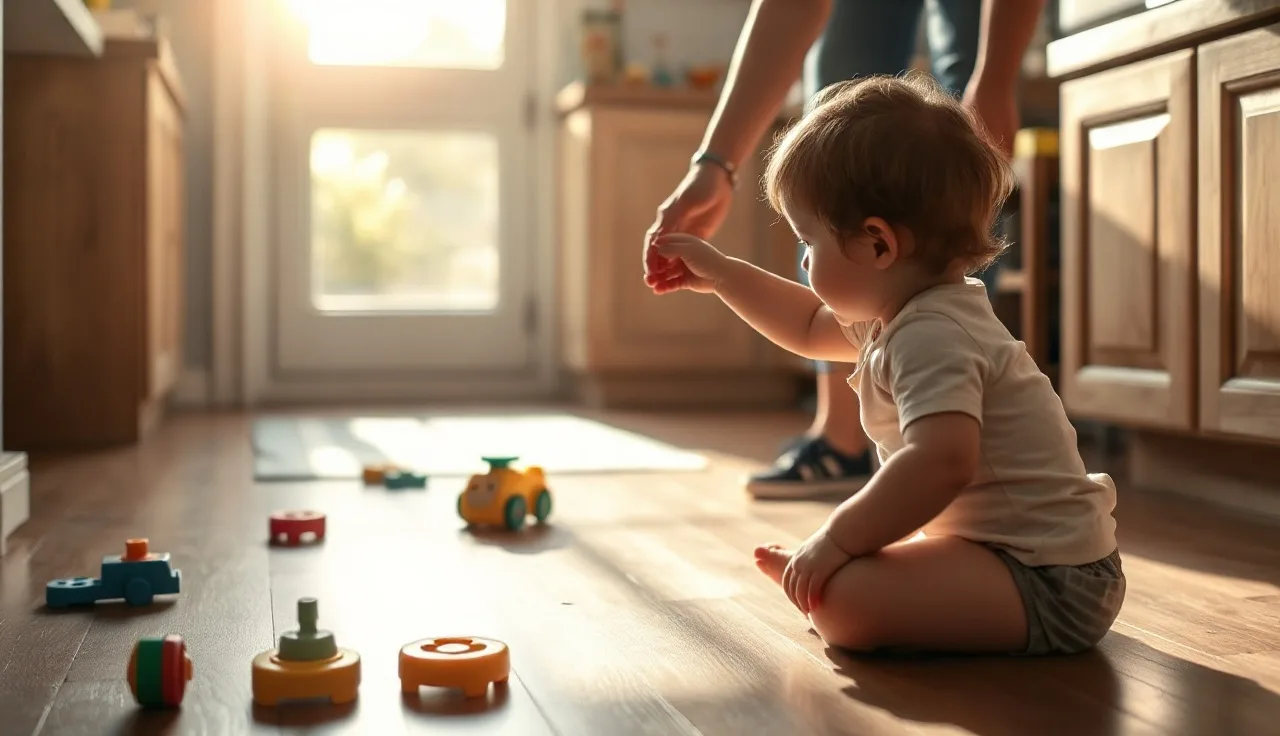
Toddler reaching toward parent on a kitchen floor, grunting to communicate

Last updated 2026-07-10

TL;DR

Grunting is normal communication in babies and young toddlers. But if your child is past 12 months and mostly grunting instead of talking, with few or no words by 16 months and no two-word phrases by 24 months, those are real red flags. Most causes are treatable, especially with early intervention. Get an evaluation sooner rather than later.

Is it normal for a toddler to grunt instead of talking?

Yes, up to a point. Grunting is one of the earliest forms of intentional communication. Babies grunt to signal effort, discomfort, or a want. In the first year, it's completely expected and actually a good sign that your child is trying to communicate something.

The issue is when grunting stays as the primary tool well past the age when words should be arriving. The American Academy of Pediatrics sets clear language milestones: most children say their first word around 12 months, have at least six to ten words by 18 months, and are putting two words together by 24 months [1]. A toddler who is mostly grunting and pointing at 18 or 20 months, with little interest in attempting words, is behind those benchmarks in a way that warrants attention.

Normal covers a lot of ground, and no two kids follow the exact same schedule. Some late talkers catch up entirely on their own. The problem is that you can't reliably predict in advance which children will catch up and which ones won't, which is exactly why the research consistently supports early evaluation rather than a "wait and see" approach [2].

Why is my toddler grunting and not talking?

There are several reasons a toddler might grunt rather than attempt words, and they range from completely benign to clinically significant. Here are the most common ones.

Grunting is working for them. If pointing and grunting gets your child exactly what they want every single time, there's less pressure on them to try words. This isn't laziness. It's a child using the most efficient tool available. The solution here is relatively simple: gently withhold the response until there's a communication attempt that moves toward language, even just a vocalization with a different sound.

Hearing loss. This is the first thing a pediatrician or speech-language pathologist should rule out. A child who can't hear clearly has a much harder time learning to reproduce the sounds they're hearing. Ear infections, fluid in the middle ear, and congenital hearing differences can all reduce hearing clarity without making a child completely deaf. An audiological evaluation is typically the first step before any other assessment [3].

Motor speech difficulties. Some children have the words stored in their brain but struggle to coordinate the muscle movements needed to produce them. Childhood apraxia of speech is one such condition, and it's often characterized by inconsistent sound errors and a child who seems frustrated when they can't get words out. Grunting can become a fallback when speech attempts repeatedly fail.

Autism spectrum differences. Reduced verbal communication, preference for non-verbal signaling like grunting or pointing, and limited interest in back-and-forth conversation are all features that can appear in autistic children. This doesn't mean every grunting toddler is autistic. But if you're also noticing reduced eye contact, repetitive behaviors, limited joint attention (pointing to share interest rather than just to request), or very focused play patterns, those are worth discussing with your pediatrician. You can read more about communication patterns in autism spectrum speech therapy.

Oral-motor weakness or structural differences. Things like low muscle tone in the mouth and jaw, or structural differences like a tongue tie, can make producing speech sounds harder and less rewarding.

Expressive language delay. Some children understand a great deal but struggle specifically with producing spoken language. This is called an expressive language delay, and it's one of the most common diagnoses in toddlers. Understanding typically develops ahead of expression, so a child can follow two-step directions but still produce very few words.

Temperament and environment. Some children are simply quieter and more observant by nature. Multilingual households can also create a slight delay in one language while total language ability is age-appropriate. These factors are worth knowing, but they shouldn't be used to explain away a real delay.

What are the speech and language milestones for toddlers?

These are the benchmarks used by the American Speech-Language-Hearing Association (ASHA) and the AAP. Missing one doesn't automatically mean something is wrong, but consistently missing several is a signal to act [1][4].

AgeTypical communication milestone
6 monthsBabbling with consonant sounds (ba, ma, da)
9 monthsImitates sounds, uses gestures like waving
12 monthsFirst words; uses gestures to communicate
15 months3 to 5 words; points to request things
18 monthsAt least 10 words; points to show you things
24 months50+ words; combines two words ("more milk", "daddy go")
36 months200+ words; strangers understand most of what child says

The 24-month mark is one of the most important clinical checkpoints. Research published in the journal Pediatrics found that children who had fewer than 50 words and no word combinations at age 2 were significantly more likely to continue showing language delays at school age [2]. That doesn't mean every child in that category will have ongoing difficulties, but it's a strong signal to stop waiting.

Grunting is not a word. Pointing paired with a vocalization is a step toward communication but not a substitute for words. If grunting and pointing are the dominant communication tools at 18 months or beyond, that's worth bringing up at the next well-child visit, and worth requesting a referral to a speech-language pathologist.

Typical language milestones: expected words by age Number of words most children produce at each age; persistent grunting without words signals a gap 12 months: 1-3 words 2 15 months: 3-5 words 4 18 months: 10+ words 10 24 months: 50+ words 50 36 months: 200+ words 200 Source: American Academy of Pediatrics, Developmental Milestones (2024)

What are the red flags that mean I should get help now?

Certain signs shouldn't wait for the next scheduled pediatric appointment. Contact your child's doctor or your state's early intervention program directly if you see any of the following [1][4].

No babbling by 12 months. No gestures (pointing, waving, showing) by 12 months. No words at all by 16 months. No two-word combinations by 24 months. Any loss of previously acquired language or social skills at any age.

That last one is the most urgent. A child who used to say words and has stopped is more than behind on milestones. Regression in language or social communication should prompt a pediatric evaluation quickly.

Beyond the milestone gaps, there are behavioral patterns that pair with grunting and warrant evaluation: not responding to their name consistently by 12 months, not pointing to share interest in something (as opposed to just pointing to get something), reduced eye contact compared to what you'd expect, and very limited interest in imitating sounds or actions.

You don't need a pediatrician's referral to access early intervention services in the US if your child is under 3. Under the Individuals with Disabilities Education Act (IDEA) Part C, every state is required to provide free evaluations and, if eligible, free services for children from birth to age 3 [5]. You can self-refer directly. No gatekeeping required.

What does early intervention actually involve for a toddler who grunts?

Early intervention for a toddler with a language delay starts with an evaluation by a speech-language pathologist (SLP). The SLP will look at your child's understanding of language (receptive skills), their verbal output (expressive skills), their use of gestures and non-verbal communication, their oral-motor function, and their social communication patterns.

Based on that, a therapy plan gets built. For a toddler who is grunting instead of talking, therapy usually focuses on a few key things.

Increasing communicative intent. The therapist works to ensure the child understands that communicating gets results, and that they have reasons to communicate. This sounds basic but it's a foundational step for children who have mostly relied on grunting.

Expanding the sound repertoire. If a child is only producing grunt sounds, therapy will work on getting more varied vocalizations first, then moving toward approximations of words.

Parent coaching. This is genuinely one of the most effective parts of early speech therapy. Research from Northwestern University and elsewhere consistently shows that coaching parents in how to respond to and expand their child's communication is as effective as clinic-based therapy alone for many toddlers [6]. You are with your child far more hours than any therapist is.

If a motor speech component is suspected, the approach shifts toward techniques used for childhood apraxia of speech specifically, which requires more intensive and specialized work.

For children where verbal speech is extremely limited, an SLP may introduce some form of AAC (augmentative and alternative communication) alongside speech work. AAC does not replace speech. The research is clear that AAC use does not reduce verbal speech development and often supports it [7].

How can I help my toddler talk more at home?

There is a lot you can do between therapy sessions, and even before you get an evaluation. These strategies come from the evidence base in parent-implemented language intervention research [6][8].

Follow their lead. Talk about what your child is paying attention to, not what you think they should pay attention to. If they're staring at the dog, say "dog" and "the dog is running," not "look at the ball."

Don't rush to interpret. When your child grunts and reaches, wait a moment before you respond. Give them a beat to attempt a sound or word. You're not withholding help. You're creating a tiny window for communication growth.

Model, don't test. Instead of asking "what's that?" over and over, just say the word. "That's a cup. Cup. You want the cup?" Questions put a child on the spot. Models give them something to borrow.

Use a slow, clear speech rate. Not baby talk. Real words, real sentences, but slightly slower and with natural pauses.

Narrate your day. Not in a performative way, but in a real way. "I'm washing the dishes. Water is cold. Splash splash." This is called self-talk and it builds vocabulary exposure.

Expand on what they do communicate. If your child grunts and points at a bird, say "bird! A little brown bird." You're adding one step above where they are.

Reduce background noise during play and meals. TV on in the background significantly reduces the amount of meaningful speech input children receive. A 2020 study in JASA found that TV noise reduced child-directed speech by measurable amounts in naturalistic home settings [9].

If you want a structured way to do this consistently, Little Words (littlewords.ai) has a guided activity tool built specifically to help parents practice these techniques with their child between therapy sessions. It's not a replacement for an SLP but it gives you something concrete to do every day.

One more thing worth knowing: reading aloud, even to a child who squirms and doesn't sit still, builds vocabulary exposure. The words don't need to be absorbed in one sitting. They accumulate.

My toddler understands everything but won't talk. What does that mean?

This pattern, strong receptive language with weak expressive language, is actually quite common and usually a good sign in terms of prognosis. A child who follows directions, responds to their name, understands questions, and laughs at the right moments is clearly processing language. The bottleneck is on the output side.

For these kids, an expressive language delay is the most likely diagnosis. The gap between understanding and speaking can be frustrating for both parent and child. Some children in this group grunt and point precisely because they know what they want but can't yet produce the word.

Expressive-only delays respond well to speech therapy. The ASHA evidence maps suggest that children with expressive delays who receive intervention earlier show better outcomes than those who wait, especially if the delay persists past 24 months [4].

One thing to watch: even if your child seems to understand everything, it's worth having an SLP assess receptive language formally. Toddlers are remarkably good at using context, routine, and non-verbal cues to appear like they understand more than they do. A proper evaluation in a less familiar setting can sometimes reveal that receptive skills aren't as strong as they look at home.

Could my toddler just not be interested in talking?

This is one of the most common things parents say, and it makes sense because some toddlers genuinely do seem indifferent to words. But "not interested in talking" is a description of behavior, not an explanation for it.

A child who is truly not interested in verbal communication is actually showing you something clinically useful. Reduced interest in verbal interaction, preferring non-verbal solutions like grunting and leading adults by the hand, and limited back-and-forth vocalization are features that speech-language pathologists and developmental pediatricians take seriously as potential markers for underlying differences.

For some children, the disinterest is related to motor difficulty. If speech attempts have been largely unsuccessful, they stop trying. For others, there may be social communication differences, like those seen in autism, where the typical drive to verbally communicate with others is less intense. For a smaller group, there are sensory or oral-motor differences that make speech feel effortful or uncomfortable.

"Toddler not interested in talking" is not a personality quirk to shrug off. It's data. Bring it to your pediatrician exactly that way: "My child doesn't seem interested in talking or attempting words. They mostly grunt and point." That framing tends to get taken more seriously than "they're just behind."

An important note: some toddlers are quiet and observant in public or with unfamiliar people but chatty at home. If your child talks at home but shuts down elsewhere, that's different information than a child who is quiet everywhere.

What is the evaluation process for a toddler who isn't talking?

Getting an evaluation is less complicated than most parents expect. Here's how it generally works in the US.

Step 1: Pediatrician check-in. Raise your concerns at the next well-child visit or call to request an earlier appointment. The AAP recommends formal developmental screening at 9, 18, and 24 or 30 months, and surveillance at every visit [1]. If your child is missing milestones, ask for a referral to an SLP and an audiologist.

Step 2: Hearing test. An audiologist will check your child's hearing. This is non-invasive and can be done even for infants. Ruling out hearing differences is always step one.

Step 3: Speech-language evaluation. An SLP will do a formal assessment that typically takes one to two sessions. They'll observe your child communicating, use standardized tools, and talk with you about your child's communication at home.

For children under 3: Contact your state's early intervention program directly. You don't need a referral. Under IDEA Part C, the evaluation is free and the state is required to complete it within 45 days of your referral [5]. If your child qualifies, services are provided at no cost or on a sliding fee scale.

For children 3 and older: The school district takes over under IDEA Part B. Contact your local school district's special education office to request an evaluation. Again, it's free.

If you prefer to go private, many SLPs take insurance and the wait times are often shorter than early intervention programs. Online speech therapy is also now well-established and can be a good option if local providers have long waitlists.

The evaluation will not label your child unnecessarily. It will tell you what's actually happening so you can help them more effectively.

What conditions are most often behind toddler grunting and not talking?

No article can diagnose your child, and you should never rely on a checklist to replace a clinical evaluation. That said, parents deserve to know what the evaluation is looking for. Here are the conditions most commonly identified when a toddler grunts instead of talking.

Expressive language delay. The most common. Receptive language is roughly age-appropriate, expressive language is lagging. Good prognosis with intervention.

Global language delay. Both receptive and expressive language are delayed. May have multiple contributing factors.

Childhood apraxia of speech (CAS). A motor speech disorder where the brain has difficulty planning and programming the movements for speech. Children with CAS often have few consonants, inconsistent errors, and can be very hard to understand. Read more about apraxia of speech.

Autism spectrum disorder (ASD). Communication differences in autism vary a lot from child to child. Some autistic children are grunting and minimally verbal at 2 and become highly verbal by school age. Others develop echolalia, repeating phrases without functional communication. Others remain minimally verbal and benefit significantly from AAC.

Hearing loss. Affects approximately 1 to 3 per 1,000 newborns in the US according to the CDC, but mild to moderate hearing loss can be missed by newborn screens and develop later [10].

Intellectual disability. Language delay is often one of the first signs that prompts referral and eventually this diagnosis.

Selective mutism. Less common in toddlers, but worth knowing about. A child who speaks freely in some contexts but not others may have an anxiety-based communication difference.

Many children who grunt instead of talking don't have a diagnosable condition at all. They're late talkers who, with a combination of parent strategies and a few months of speech therapy, start talking and close the gap. The honest answer is that you need an evaluation to know which situation you're in.

When do late talkers catch up on their own?

About 70-80% of children identified as late talkers at age 2 (50 or fewer words, no word combinations) do eventually catch up to peers without formal intervention, based on longitudinal research [2]. That sounds reassuring until you think about the 20-30% who don't, because there's currently no reliable way to predict from a two-year-old which group they'll fall into.

Factors associated with better spontaneous catch-up rates include: a larger receptive vocabulary (understanding more than they say), use of gestures, some consonant variety in their vocalizations, and a family history of late talking with eventual typical development.

Factors associated with persistent delays include: limited receptive language, very few consonant sounds, limited use of gestures, and late talkers who are also showing social communication differences.

The research by Rescorla and colleagues, published in the Journal of Speech, Language, and Hearing Research, followed late talkers into adolescence and found that even children who appeared to "catch up" by age 5 sometimes showed more subtle language differences on formal testing at age 13 [11]. This doesn't mean late talking always has long-term consequences. It means that early support is rarely wasted even when a child catches up on their own.

Pediatricians sometimes genuinely recommend watchful waiting for a child who is 18 months and has a handful of words. That can be reasonable for a short window. It becomes a problem when waiting stretches to 24, 30, or 36 months.

What can I do right now while I wait for an evaluation?

Evaluation waitlists can be frustrating, sometimes running 4 to 12 weeks for private SLPs and even longer for some early intervention programs. Here's what you can do in the meantime.

Start the parent-implemented strategies described in the earlier section on home strategies. They're research-backed and they work. You're not waiting to be told what to do.

Self-refer to your state's early intervention program today. The sooner the referral is in, the sooner the clock starts on that 45-day evaluation window [5].

Keep a simple communication log. Note what sounds your child makes, what they do to communicate (pointing, pulling your hand, handing you objects), and what they seem to understand. This information is useful to any evaluator.

Read aloud every day. Short books, repeated books, the same three board books for the fifteenth time. Repetition builds word learning.

Turn off background TV during active play and meals. This single change increases the quality of your child's language input immediately.

If your child has a well-child visit coming up, write down your specific concerns before you go. "My child mostly grunts and points. They have two words at 20 months and don't seem interested in trying words" is more actionable for a pediatrician than "I'm worried about their speech."

Little Words (littlewords.ai) also offers a quiz that helps identify where your child is communicating and what strategies match their current level. It's a practical way to get structured guidance while you're waiting for that first appointment.

Frequently asked questions

At what age should a toddler stop grunting and start talking?

Grunting as the primary communication tool should be giving way to words well before 18 months. Most children say their first words around 12 months and have at least 10 words by 18 months according to AAP guidelines. Grunting combined with pointing is a communication step, but if it's still the main strategy at 18 to 20 months without real words emerging, that's worth an evaluation.

My 18-month-old only grunts. Is that a speech delay?

Quite likely, yes. ASHA and the AAP consider 10 or more words by 18 months a standard milestone. A child with no or very few words who is primarily grunting at this age is behind that benchmark. That doesn't mean something is seriously wrong, but it does mean an evaluation from a speech-language pathologist is a good next step rather than waiting another few months.

Why does my toddler grunt instead of asking for things?

Usually because grunting works. If pointing and grunting reliably gets the juice or the toy, there's little pressure to try words. This can become a self-reinforcing loop. The fix isn't to ignore your child but to pause briefly before responding, giving them a moment to attempt a sound or word. An SLP can show you exactly how to do this without creating frustration.

Can a toddler grunt because of autism?

Yes, reduced verbal communication and reliance on grunting or leading adults by the hand can be features of autism. Other signs to look for include limited joint attention (pointing to share interest, more than to get things), inconsistent response to their name, and repetitive behaviors. Grunting alone doesn't indicate autism, but paired with those other features it warrants a developmental evaluation.

Is my child grunting because of hearing problems?

Possibly. Hearing loss is one of the first things clinicians rule out in a non-talking toddler because children who can't hear clearly have a much harder time learning to produce speech sounds. Mild to moderate hearing loss can easily be missed by parents and even by routine newborn screens if it develops or worsens later. Ask your pediatrician for a formal audiology referral.

How do I get a free speech evaluation for my toddler?

If your child is under 3, you can self-refer to your state's early intervention program at no cost. Under the Individuals with Disabilities Education Act Part C, every state must provide a free evaluation within 45 days of referral and free or low-cost services if your child qualifies. You do not need a pediatrician's referral to start this process. Find your state's program through the IDEA website.

My toddler understands everything I say but won't talk. Should I be worried?

Understanding more than they speak is typical to some degree, but a large gap is still worth addressing. Strong receptive language is a good sign and usually predicts better outcomes from intervention. That said, children who have 50-plus words of understanding but very few expressive words at 24 months still benefit from speech therapy. An SLP can assess whether the gap is in the normal range or needs support.

Does ignoring my toddler's grunts actually help them talk more?

Not exactly ignoring, but creating a brief wait before responding is a research-backed strategy. The idea is to pause one to three seconds after your child communicates non-verbally, giving them a window to attempt a sound or word. Then respond warmly whether they try a word or not. This is called expectant waiting and it's one of the most recommended parent strategies in early language intervention.

What is the difference between a late talker and a speech delay?

"Late talker" typically refers to a child who has limited vocabulary but otherwise typical development in other areas, and who may catch up on their own. "Speech delay" is a broader clinical term covering any child whose speech or language skills fall meaningfully below age expectations, including those who won't catch up without help. Both groups benefit from evaluation; the intervention just looks different.

Can bilingual toddlers grunt instead of talking because of language confusion?

Bilingual children sometimes have smaller vocabularies in each individual language, but their total vocabulary across both languages is usually age-appropriate. True language confusion that causes grunting rather than words is not well-supported by research. If a bilingual child is grunting more than talking in both languages, the same evaluation process applies. Bilingualism alone doesn't cause a communication delay.

Should I use sign language if my toddler is grunting and not talking?

Yes, and the evidence supports it. Teaching a few core signs (more, eat, drink, help, all done) gives your child a way to communicate clearly while speech develops. For most children, signing alongside speech does not reduce verbal speech attempts. Many SLPs actually recommend it for toddlers with expressive delays. If signing becomes the only tool for years, that's a different situation to discuss with an SLP.

My toddler used to say a few words and has stopped talking. What should I do?

Call your pediatrician today. Language regression, where a child loses words they had, is always a flag that needs prompt medical attention. It can be related to several causes including autism, hearing changes, or neurological factors. Don't wait for the next scheduled visit. Regression is different from a child who just never built much vocabulary and is one of the clearest action signals in child development.

Is it true that some late talkers don't need therapy and just catch up?

It's true that roughly 70 to 80 percent of late talkers identified at age 2 do appear to catch up by school age. But there's no reliable way to predict which child is in that group, and some research suggests subtle language differences can persist even when children seem caught up. Early intervention has very few downsides. Waiting has real costs if your child turns out to be in the 20 to 30 percent who don't catch up on their own.

Sources

  1. American Academy of Pediatrics, Developmental Milestones: AAP milestone benchmarks: first words around 12 months, 10 words by 18 months, two-word combinations by 24 months
  2. Pediatrics (AAP Journal), 'Late Talking Toddlers: Outcomes in the Second Year' (Rescorla et al.): Children with fewer than 50 words and no word combinations at age 2 are significantly more likely to show continuing language delays at school age
  3. American Speech-Language-Hearing Association, Hearing and Balance: Hearing loss is a primary factor to rule out in non-talking toddlers; audiological evaluation is typically the first clinical step
  4. American Speech-Language-Hearing Association, Evidence Maps: Late Language Emergence: Children with expressive delays who receive intervention earlier show better outcomes than those who wait, especially past 24 months
  5. U.S. Department of Education, IDEA Part C Early Intervention Program: Under IDEA Part C, every state must provide free evaluations within 45 days of referral and free or low-cost services for children birth to age 3
  6. Northwestern University / Roberts & Kaiser (2011), Journal of Speech Language and Hearing Research, Parent-implemented language intervention: Parent-implemented language intervention is as effective as clinic-based therapy alone for many toddlers with language delays
  7. American Speech-Language-Hearing Association, Augmentative and Alternative Communication: AAC use does not reduce verbal speech development and often supports it
  8. ASHA, Tips for Parents: Encouraging Language Development: Strategies including self-talk, following the child's lead, and expansions are recommended for parents of late-talking toddlers
  9. Journal of the Acoustical Society of America (JASA), background TV and child-directed speech (2020): Background TV noise significantly reduces the amount of meaningful child-directed speech children receive at home
  10. CDC, Hearing Loss in Children: Data and Statistics: Approximately 1 to 3 per 1,000 newborns in the US have hearing loss; mild to moderate loss can be missed by newborn screens and develop later
  11. Journal of Speech, Language, and Hearing Research, Rescorla (2009): Age 13 outcomes of late talkers: Late talkers who appeared to catch up by age 5 sometimes showed subtle language differences on formal testing at age 13
Little Words is a talk-with-Buddy app built for kids like yours.

Buddy is a voice-first speech companion your child actually talks to, made for late talkers and neurodivergent kids. It is free to download on the App Store.

Download on the App Store