Last updated 2026-07-11
TL;DR
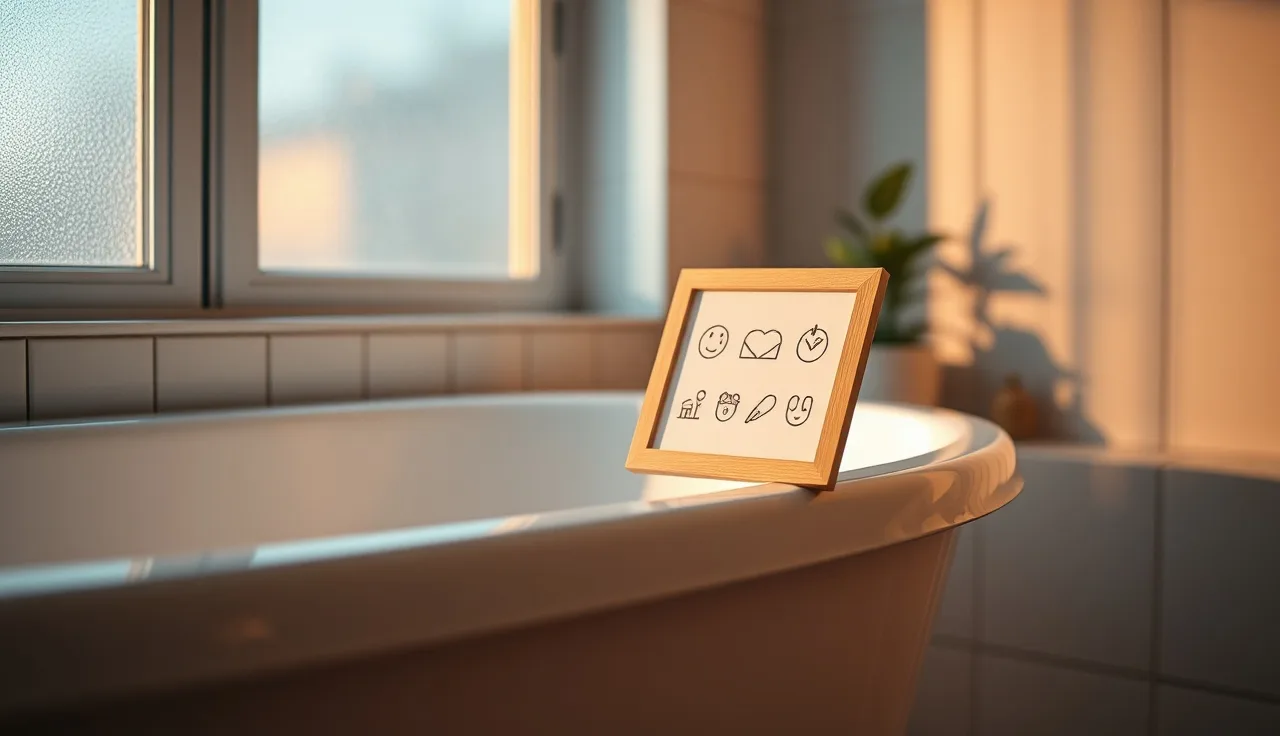
Waterproof communication boards are low-tech AAC tools printed or drawn on water-resistant material so kids can make requests, express feelings, and practice language during bath time. Laminated cardstock, PVC foam, or dedicated waterproof paper all work. Most parents spend $5 to $30 making one at home. Commercial options exist but are rarely necessary.
Why does bath time communication matter so much?
Bath time is one of the most language-rich routines in a young child's day, and it's also one of the most stressful for kids who struggle to communicate. There's water in the eyes, unfamiliar sensory input, no toys to hide behind, and an adult who needs clear signals about temperature, soap, and whether something hurts. For a late talker or a child using AAC, that combination can turn a nightly routine into a meltdown.
The American Speech-Language-Hearing Association (ASHA) describes AAC as any method that supplements or replaces speech, including low-tech tools like picture boards [1]. A bath-time board is exactly that: a small set of pictures or words a child can point to when they can't or won't speak. It doesn't replace the work your child's speech-language pathologist is doing. It extends it into a context where communication is genuinely needed.
Routines matter for language learning. Research on naturalistic language intervention consistently finds that embedding communication opportunities into predictable daily routines, like bath time, meals, and bedtime, produces more generalization than clinic-only practice [2]. Bath time happens every day or close to it. That's a lot of reps.
The catch is that ordinary paper communication boards dissolve. Even laminated boards can delaminate or warp after a few weeks of steam and splashing. So the material choice isn't a cosmetic detail. It's what makes the tool actually usable.
What materials actually hold up in water?
This is where most DIY guides go wrong. They say "laminate it" and call it a day. Regular lamination pouches with heat-sealed edges work fine for a few months if the edges are sealed with clear packing tape, but water eventually gets in at corners and the paper inside bubbles. Here's what genuinely lasts:
Waterproof inkjet paper (also called synthetic paper or Rite in the Rain paper): This is a polypropylene-based sheet that goes through a standard inkjet printer. The paper itself is waterproof even without lamination. Brands like Rite in the Rain sell it in letter-size sheets. Expect to spend about $15 to $25 for a 25-sheet pack. The surface can smear while wet if you use dye-based inks, so use a pigment-based inkjet printer or let it cure for 24 hours before the first use.
PVC foam board (foam core with a vinyl skin): Available at craft stores and sign shops, this material is fully waterproof, doesn't warp, and can be written on with a Sharpie. Cut it to size with scissors or a craft knife. A single 12x18 inch sheet runs about $2 to $5. This is probably the most durable option for a board that lives permanently in the bathroom.
Dry-erase lamination pouches with sealed edges: These are thicker than standard lamination film and designed to be written on and wiped clean. Seal all four edges with clear silicone sealant or 100% silicone bathroom caulk (the kind rated for wet areas) rather than tape. This takes an extra day to cure but creates a genuinely waterproof seal.
Commercial waterproof boards: A few AAC suppliers, including Boardmaker materials printed on Tyvek or PVC, exist. Tyvek is the same material used in FedEx envelopes and house wrap. It doesn't tear, survives full submersion, and accepts most inkjet printing reasonably well. You can order blank Tyvek sheets online.
| Material | Cost per board | Survives submersion | Printable | Reusable |
|---|---|---|---|---|
| Laminated cardstock (sealed edges) | $0.50-$2 | Weeks to months | Yes | No |
| Waterproof synthetic paper | $0.60-$1/sheet | Indefinitely | Yes | No |
| PVC foam board | $2-$5 | Indefinitely | With transfer | Yes |
| Tyvek | $1-$3/sheet | Indefinitely | Yes (inkjet) | No |
| Commercial PVC-printed boards | $15-$60 | Indefinitely | N/A | Yes |
For most families, waterproof synthetic paper or PVC foam is the sweet spot. Both survive real use, cost almost nothing, and can be remade quickly when your child's vocabulary grows.
What should you put on a bath-time communication board?
Less is more, especially at first. A board with 40 symbols overwhelming a 3-year-old is decoration, not communication. The right vocabulary for a bath-time board comes from one question: what does your child actually need to say during this routine?
ASHA's guidance on core and fringe vocabulary is useful here [1]. Core vocabulary is the small set of high-frequency words that work across contexts: more, stop, help, no, want, done, again, like. Fringe vocabulary is the specific stuff tied to one context: water, soap, shampoo, too hot, too cold, bubbles, rinse, towel. A good bath board has both.
For a starting board, most speech-language pathologists suggest 8 to 16 symbols for young children or new AAC users. That fits on a quarter-sheet or half-sheet of paper. Consider including:
- Sensory/safety signals: too hot, too cold, hurts, stop
- Requests: more (water/bubbles), all done, help
- Body parts: head, ears, eyes (for directing where to wash or where to keep water away)
- Emotions: happy, scared, mad, good
- Bath items: soap, shampoo, towel, bubbles
If your child already uses an AAC device or app, the symbols on the board should match what they see there. Consistency across tools reduces confusion and builds recognition faster. Your child's SLP can help you pull the right symbol set, and many use the PCS (Picture Communication Symbols) library, which has recognizable icons most families recognize [1].
Don't forget a way to mount the board. Suction cups work on tile. A small mesh bath caddy can hold a rigid board upright. Velcro-backed boards can stick to a rubber bath mat. The board has to be where the child can reach and see it without having to ask for it.
How do you make a DIY waterproof bath board at home?
You don't need to be crafty. Here's a straightforward process that most parents finish in under two hours.
Step 1: Pick your symbols. Free symbol sets are available through Boardmaker's free trial, the Mulberry Symbol Set (open-source), or simply Google Images for simple line drawings. Your child's SLP may be able to export a symbol set directly. Print your symbols on regular paper first to confirm sizing before moving to waterproof material.
Step 2: Choose your material. For most people, waterproof synthetic paper is the easiest starting point. It prints like normal paper and requires no extra sealing.
Step 3: Print. Use a pigment-based inkjet printer if you have one. Laser printers also work and are arguably more water-resistant since the toner is heat-fused. Let the sheet dry fully before cutting.
Step 4: Laminate (optional but helpful for structure). If you're using synthetic paper, lamination is optional. If you used regular paper, laminate now and seal the edges with clear silicone caulk, not tape. Tape fails in humidity.
Step 5: Round the corners. Sharp corners on a rigid board are a safety hazard in a bathtub. A $5 corner punch from a craft store handles this in seconds.
Step 6: Mount it. Suction cup hooks rated for wet areas (the kind meant for shower caddies) can hold a rigid board to tile or the side of a plastic tub. For a soft Tyvek board, tie two small grommets into the corners and hang it from a suction cup hook.
Total cost: $5 to $20 for materials, depending on what you already have. Total time: roughly 45 minutes to two hours, including drying time.
Are there commercial waterproof communication boards worth buying?
Some exist, and they're not a waste of money if you want something durable and professional-looking without the DIY time. But you should know what you're getting.
Boardmaker (by Tobii Dynavox) is the industry-standard symbol creation software. The symbols themselves are not sold as pre-made bath boards, but many SLPs use the software to create them and then print on waterproof materials [1]. If your SLP uses Boardmaker, ask whether they can print a bath-specific board for you.
Some Etsy sellers and small AAC accessory businesses sell pre-made laminated bath boards, typically for $10 to $30. Quality varies enormously. Before buying, ask specifically what material was used and whether the edges are sealed. A laminated cardstock board with taped edges will survive a few months at most.
A handful of companies sell PVC-printed boards similar to what you'd see in a restaurant menu. These are genuinely waterproof and last for years. They tend to run $30 to $60 and usually require customization for your child's specific vocabulary, which means a longer lead time.
For most families, the DIY route is better: it's faster, cheaper, and produces a board that's actually calibrated to your child's current vocabulary. You can update it in an hour when their communication needs change, which they will.
How does a bath board fit into a broader AAC strategy?
A bath board is a low-tech, single-context communication tool. It's useful. It's not a complete AAC system.
If your child is using a speech-generating device or an AAC app, the bath board is a backup and an extension, not a replacement. High-tech AAC devices generally can't go in the bathroom (water damage risk is real, and even waterproof-rated devices are usually rated for brief splashing, not a toddler's bath). The bath board fills that gap.
For kids who are just starting with AAC, a bath board is also a great on-ramp. Low-tech tools require no charging, no troubleshooting, and no screen time. The American Academy of Pediatrics supports AAC use even for very young children, noting that AAC does not impede natural speech development [3]. Starting with a picture board in the bath is a reasonable, low-barrier way to introduce the concept.
Your child's speech-language pathologist should know about the bath board so they can make sure the vocabulary matches broader goals. If you don't yet have an SLP working with your child, early intervention services for children under 3 are available in every U.S. state at no cost under Part C of IDEA [4]. For children 3 and older, school districts are required to evaluate and provide services under Part B [4].
The bath board is also a good topic to bring up if you're exploring AAC devices or working on autism spectrum speech therapy strategies with your child's team. The more contexts where your child has a way to communicate, the more chances they have to practice.
What if my child won't use the board in the bath?
This is the most common practical problem, and it's not a sign the board is wrong. It usually means the setup needs adjustment.
First, check placement. If a child has to reach across the tub or turn away from you to see the board, they won't use it. The board needs to be at eye level and within arm's reach, mounted on the wall they naturally face.
Second, model first. Point to the symbols yourself while narrating what you're doing. "I'm going to wash your hair. See? Shampoo." Point to the shampoo symbol. Do this for several baths before expecting your child to point independently. Modeling without expectation is a technique SLPs call aided language stimulation or aided language input [2].
Third, simplify. If the board has too many symbols, cover half of them with a piece of tape or just make a smaller board. Two or three symbols your child actually uses are more useful than 16 symbols they ignore.
Fourth, check whether the bath itself is the problem. For many sensory-sensitive kids, the bath is already a highly dysregulated environment. A child who is overwhelmed by the sensory experience of bathing isn't going to have cognitive bandwidth left to use a communication tool. In that case, address the sensory piece first (different temperature, less water, different soap) and introduce the board once the routine is less stressful.
Fifth, don't give up after two tries. It typically takes multiple exposures to a new routine before a child integrates it. Most SLPs would say give it two to four weeks of consistent use before reassessing.
Can a bath board help with specific speech challenges like apraxia?
Yes, with some caveats. A bath board doesn't treat apraxia, but it provides communication support during a time when verbal output is especially hard.
Childhood apraxia of speech is a motor speech disorder where the brain has difficulty planning the movements needed for speech [5]. Kids with apraxia often have a significant gap between what they understand and what they can say. A low-tech board in the bath gives them a way to communicate during that gap, which reduces frustration and keeps them engaged in the routine.
The same logic applies to kids with apraxia of speech more broadly, late talkers, and children on the autism spectrum. The board isn't doing the speech therapy work. It's making the communication environment less frustrating so the child stays regulated and connected.
For kids who produce some speech, you can use the board alongside verbal attempts rather than instead of them. Point to the symbol together while saying the word. This is consistent with principles from PROMPT therapy and other motor-speech approaches that pair visual support with motor output.
One thing to avoid: using the board as a way to skip verbal attempts entirely if your child's SLP wants them practicing speech sounds. Check in with the SLP about when to encourage pointing versus when to create a moment for a verbal attempt.
How is a bath board different from a full AAC device?
A bath board is a low-tech, static display. It shows a fixed set of symbols that can't change unless you physically swap the board. A full AAC device or app is dynamic: it can hold hundreds or thousands of vocabulary items, produce synthesized speech, and be updated remotely.
The bath board wins on cost, simplicity, and durability in wet environments. The AAC device wins on vocabulary depth and voice output. Most families with kids using high-tech AAC use both: the device in most contexts, the board in the bath and other wet or high-risk situations.
ASHA notes that AAC systems often combine multiple components, and low-tech tools remain appropriate and effective even when high-tech options are available [1]. A waterproof bath board isn't a lesser version of an AAC device. It's a different tool for a different context.
If you're newer to this world and wondering about the full landscape of options, the article on AAC devices goes into much more depth on the device side. And if your child's communication delays are part of a broader picture, the overview of speech therapy explains how different interventions fit together.
Tools like the Little Words app can also support language practice in everyday routines by helping parents model vocabulary in context, which is the same principle behind using a bath board. The approach holds whether the tool is analog or digital.
What does the research say about low-tech AAC in daily routines?
The evidence base for low-tech AAC in naturalistic routines is solid, if not enormous. The most relevant research comes from the field of naturalistic developmental behavioral interventions (NDBIs), which embed communication targets into everyday activities.
A 2014 systematic review published in the American Journal of Speech-Language Pathology found that aided AAC interventions produced positive communication outcomes across participants with autism spectrum disorder, with the strongest effects seen when AAC was used consistently across multiple environments [6]. Bath time is exactly that kind of naturalistic environment.
ASHA's 2005 position statement on AAC for individuals with autism spectrum disorders explicitly supports low-tech AAC tools as part of a multimodal communication approach, noting that "the goal of AAC intervention is not to replace speech" but to provide functional communication [7].
The AAP's 2009 policy statement on AAC stated that "AAC use does not inhibit speech development" and encouraged early introduction across all contexts, including daily routines [3]. This is directly relevant to the concern many parents have about whether introducing a picture board during bath time will reduce their child's motivation to speak.
Nobody has good data specifically on bath-time communication boards as a standalone intervention. The evidence is extrapolated from broader research on low-tech AAC in daily routines, which is a reasonable extrapolation but worth naming honestly.
What about bath time and sensory processing: does that affect how you design the board?
It does, practically speaking.
Kids with significant sensory sensitivities during bath time are often in a state of high arousal. Their window of tolerance for cognitive tasks, including looking at and pointing to symbols, is narrower. This means the board needs to be even simpler for these kids, not more detailed.
For a child who is very dysregulated in the bath, start with two or three high-priority symbols: stop, too hot, and help. That's it. Add more symbols only once the bath itself is a less activating experience.
High contrast visuals help when a child is overwhelmed. Black symbols on a white background, or white on black, are easier to process than full-color photographs when sensory load is high. Keep the board away from water spray so it's not moving or dripping when the child looks at it.
Some families find that introducing the board outside the bath first, at a calm moment, reduces resistance. Show the child the board during playtime. Use it to request things they want. Then bring it into the bath only after it's already familiar.
If sensory processing challenges are significant, an occupational therapist who specializes in sensory integration is worth consulting alongside your SLP. The communication and sensory pieces interact closely, and separating them into different treatment boxes doesn't always serve the child.
Frequently asked questions
Can I just use regular lamination for a bath communication board?
Regular lamination works for a few weeks to a couple of months if you seal all four edges with silicone caulk, not tape. Tape fails in humidity and steam. Without sealing, water gets under the lamination film at the corners and the paper inside warps or molds. For anything meant to last longer than a season, waterproof synthetic paper or PVC foam is a better choice.
Where do I find free symbols to put on a bath board?
The Mulberry Symbol Set is open-source and free to download and use. Boardmaker offers a free trial that includes access to PCS symbols. Your child's SLP may already have a symbol library they can export from. For simple images, searching for line-art pictures of bath-related items on Google Images and printing them in black and white also works, especially for younger children who respond well to simple visuals.
How many symbols should a beginner bath board have?
Start with 8 to 12 symbols for most children. For kids who are very new to AAC or very young, 4 to 6 high-priority symbols is often better. The goal is a board the child can actually scan and use, not a board that covers every possible topic. You can always add more symbols as your child's recognition and use grows. Speech-language pathologists often recommend starting smaller than feels right.
Are there waterproof AAC apps or devices that can go in the bath?
Most speech-generating devices are not rated for wet environments beyond brief splashing. Some iPads are water-resistant under IP67 or IP68 ratings, meaning they can survive brief submersion in shallow water, but prolonged steam and splash exposure from a bath is a different situation. A physical waterproof board remains the safer and more practical choice for the bath itself, with the device available immediately before and after.
Will using a picture board stop my child from trying to talk?
No. The American Academy of Pediatrics reviewed the evidence and concluded that AAC does not inhibit speech development and can support it by reducing frustration [3]. Children who have a reliable way to communicate are often more motivated to attempt verbal communication, not less. Your child's SLP can advise on how to balance board use with verbal practice opportunities during the bath routine specifically.
How do I mount a communication board in the bathtub safely?
Suction cup hooks rated for wet surfaces (the same type used for shower caddies) attach to tile or the smooth side of a plastic tub. For a rigid board, drill or punch two holes in the top corners and hang it from the hooks. For a flexible Tyvek or laminated board, add small grommets and hang it the same way. Make sure the board is at your child's eye level and within arm's reach without them having to stand.
My child is 18 months old. Is a bath board appropriate at that age?
Yes. Low-tech AAC tools including picture boards are used with children well under age 2. ASHA and the AAP both support early introduction of AAC, including for children who are not yet speaking. At 18 months, a board with 2 to 4 symbols, more (water), all done, and help, is entirely appropriate. Keep it simple and model using it yourself before expecting your child to point independently.
How often should I update the vocabulary on the bath board?
Update it whenever your child's communication needs change significantly, roughly every 2 to 4 months for younger children whose vocabulary is expanding quickly. Signs that it needs updating: your child consistently points to symbols that aren't there, your child's SLP adds new target words that aren't represented, or your child seems bored with or dismissive of the current board. The DIY nature of a waterproof board makes updates quick and cheap.
Should the symbols on the bath board match the ones on my child's AAC device or app?
Yes, as much as possible. Symbol consistency across tools reduces the cognitive load of switching between them. If your child uses PCS symbols on their device, use PCS on the bath board. If they use a custom photograph-based system, use photographs. Consistency helps children generalize recognition and doesn't require them to learn two separate visual languages for the same concept.
What is aided language stimulation and why does it matter for a bath board?
Aided language stimulation, sometimes called aided language input, is the practice of an adult pointing to AAC symbols while speaking, to model how the system works. Research supports it as an effective way to introduce and build AAC use [2]. For a bath board, this means you point to the 'soap' symbol when you pick up the soap, to 'too hot' when you test the water, and to 'all done' when the bath ends. Model consistently for several weeks before expecting independent use.
Can a bath board help a child with echolalia communicate better?
A bath board gives a child an alternative channel for communication that doesn't rely on producing spontaneous speech. For kids with echolalia who repeat phrases but struggle with intentional communication, pointing to a symbol is a different and sometimes easier act. The board doesn't address the echolalia itself, but it can reduce frustration during a high-demand routine. For more on echolalia, see our article on echolalia.
How much does a commercial waterproof bath communication board cost?
Pre-made commercial boards sold through Etsy or AAC supply vendors typically cost $10 to $30 for laminated versions and $30 to $60 for fully waterproof PVC-printed versions. DIY options using waterproof synthetic paper run $5 to $20 for materials. Most families find the DIY route produces a better outcome because the vocabulary is customized rather than generic, and it can be updated easily as needs change.
Do I need a prescription or therapist referral to get a communication board for bath time?
No. Low-tech communication boards are not medical devices and require no prescription or referral. Any parent can make or buy one. That said, your child's speech-language pathologist can help you select the right vocabulary and symbol set, which meaningfully improves the board's usefulness. If you don't yet have an SLP, children under 3 can be referred for free evaluation through state early intervention programs under IDEA Part C [4].
Sources
- ASHA, Augmentative and Alternative Communication (AAC) overview: ASHA defines AAC as any method that supplements or replaces speech, including low-tech picture boards; supports multimodal AAC use in naturalistic contexts
- Romski & Sevcik (2005), AAC and language development, American Journal of Speech-Language Pathology: Naturalistic language intervention embedding communication in daily routines produces stronger generalization than clinic-only practice; aided language input is supported as an AAC modeling strategy
- American Academy of Pediatrics, policy statement on AAC and autism: AAP states AAC does not inhibit speech development and encourages early introduction across all contexts including daily routines
- U.S. Department of Education, IDEA Part C and Part B overview: Under Part C of IDEA, children under 3 are eligible for free early intervention services in every U.S. state; Part B requires school districts to evaluate and serve children 3 and older
- ASHA, Childhood Apraxia of Speech practice portal: Childhood apraxia of speech is a motor speech disorder where the brain has difficulty planning movements needed for speech, often creating a gap between comprehension and verbal output
- Ganz et al. (2014), systematic review of AAC for autism spectrum disorder, American Journal of Speech-Language Pathology: Aided AAC interventions produced positive communication outcomes for individuals with ASD; effects were strongest when AAC was used consistently across multiple environments
- ASHA, AAC for individuals with autism spectrum disorders position statement: ASHA states 'the goal of AAC intervention is not to replace speech' and supports low-tech tools as part of multimodal communication approaches
- Mulberry Symbol Set, open-source AAC symbols: The Mulberry Symbol Set is a free, open-source symbol library appropriate for AAC boards including low-tech printed formats
- CDC, Developmental Milestones and Early Intervention: CDC encourages early identification and intervention for developmental delays including speech and language; free resources available for families