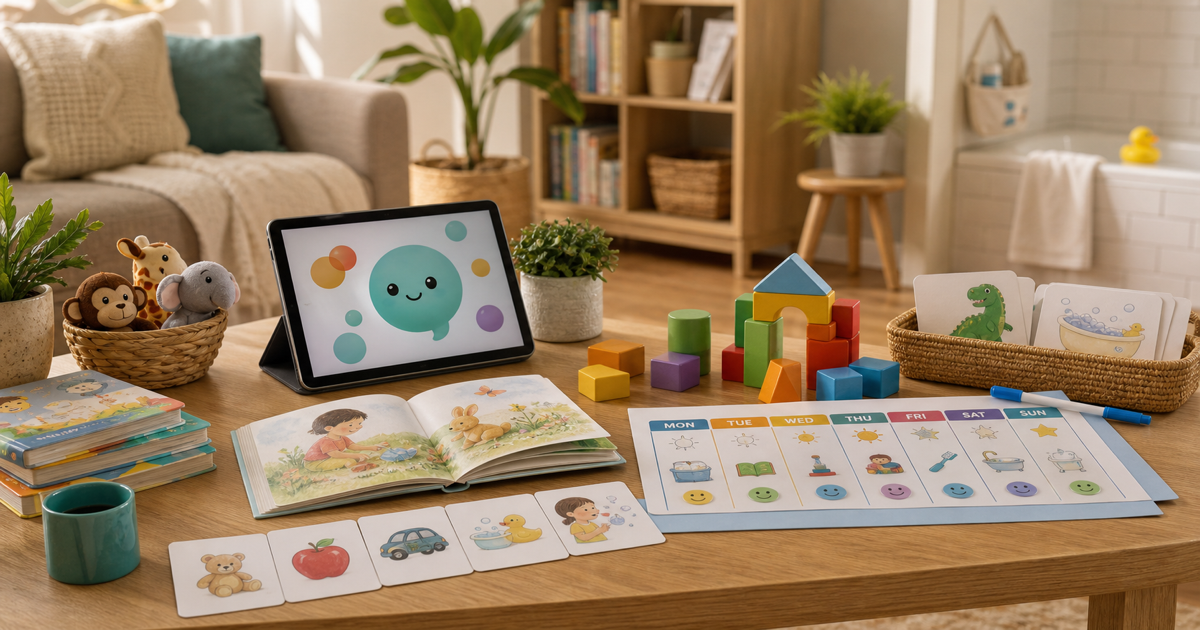
If you've been searching for ways to practice speech at home, here's the short version: watch how your child communicates across everyday moments, not just one rough afternoon, and try weaving in small language models during routines you already do together. If the pattern of concern sticks around, loop in an SLP, pediatrician, early intervention team, or school team.
The more useful question isn't "how do I get my child talking right now?" It's what your child is already communicating, and what kind of modeling or access would make the next step a little easier. That reframing matters because it protects your relationship with your child, and it also gives any professional you talk to better information to work with.
Rather than judging one difficult afternoon, watch for patterns over several days. Pay attention to gestures, pointing, and how your child responds to their name, along with pretend play, frustration, scripts, AAC use, sound attempts, and whether they seem to understand more than they can say out loud. A single moment doesn't tell you much. A pattern across routines does.
For this week, pick one routine that already happens daily, bath time, snack time, car rides, whatever's reliable, and model one useful word, phrase, AAC button, or gesture inside it. Pause afterward long enough to let your child respond in whatever form that takes. An approximation, a sign, a point, a scripted phrase, or a tap on a device all count as communication. And if the moment starts turning into a battle, stop. That's not the goal.
Will's daily routine with his daughter is worth looking at here too: what worked, and what didn't.
If speech practice at home feels like one piece of a bigger pattern, it's worth asking for help sooner rather than later. That might mean a hearing check, an early intervention evaluation, a private SLP evaluation, a school-based evaluation, or a broader developmental assessment. Getting evaluated early doesn't mean you're overreacting. It means giving your child access to the communication support they're entitled to.
For more on this, the Speech Therapy at Home hub covers the topic in full, and there's a wider set of parent guides if you want to read further. Related reading includes pieces on ADHD and speech delay, autism and anxiety in toddlers, autism and apraxia together, and autism and sensory processing, along with guidance on finding the best approach for an autistic child, for a bilingual child with speech delay, for a child with ADHD, or for a child with apraxia.
Little Words is meant as educational support for practicing at home. It's not a medical device, not a replacement for AAC, and not a substitute for a licensed speech-language pathologist, pediatrician, early intervention program, school team, or formal developmental evaluation.