Last updated 2026-07-10
TL;DR
A speech therapy session for a 2-year-old runs 30 to 60 minutes and looks almost entirely like play. The therapist gets on the floor, follows the child's lead, and uses toys and books to prompt communication while coaching the parent in real time. There's rarely a desk or flashcard in sight. Goals target first words, gestures, imitation, and back-and-forth interaction.
What actually happens in a toddler speech therapy session?
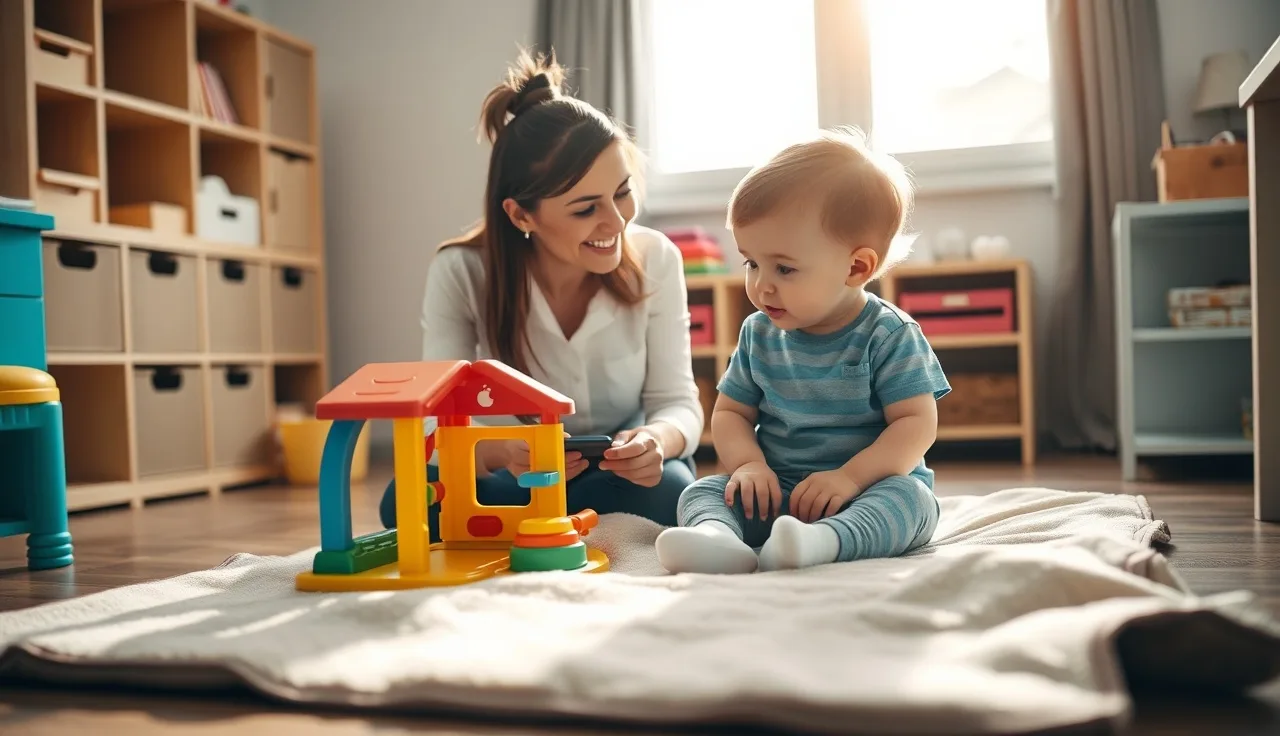
A toddler speech therapy session looks like a playdate on the floor. The room is small and stocked with toys: blocks, bubbles, cause-and-effect gadgets, maybe a toy barn. Your two-year-old walks in and starts playing. The therapist gets down on the floor with them.
That's not a warm-up. That is the session.
Speech-language pathologists (SLPs) who work with toddlers use naturalistic developmental behavioral interventions, a research-supported family of approaches that build language targets into play and daily routines rather than structured drills [1]. The American Speech-Language-Hearing Association treats this as appropriate for early childhood because toddlers learn language through interaction, not instruction [2].
Here's the sequence you'll typically see:
1. The therapist watches what the child is drawn to, then sits nearby and waits. The waiting is deliberate. A toddler who reaches for the bubble wand has just made a communication opportunity. 2. The therapist models the target word or gesture. "Bubbles. Want bubbles? Bubbles!" They blow one. They wait again. 3. If the child makes any attempt, verbal or not, the therapist responds right away and adds a little more. The child says "buh" and gets bubbles plus a slightly bigger model: "More bubbles!" 4. That loop repeats across different toys for most of the session.
Parents usually sit in and watch, or jump in directly. Most toddler SLPs spend 10 to 20 minutes of each session coaching the parent, because carryover at home is where the real progress happens [3].
How long is a speech therapy session for a 2 year old?
Most toddler sessions run 30 to 60 minutes. Thirty minutes suits very young or easily tired children. Sixty minutes usually leaves room for real parent coaching.
Frequency matters more than most parents expect. One session a week is the common starting point. For children with bigger delays, twice a week is often recommended, and there's some evidence that higher-intensity intervention produces faster early vocabulary gains [4]. The Early Start Denver Model, one well-studied approach for toddlers on the autism spectrum, was first delivered at 20 or more hours per week across multiple settings, though shorter clinic-based versions are the practical reality for most families [5].
If your child gets services through early intervention, the team sets session frequency in the Individualized Family Service Plan (IFSP). Federal law under IDEA Part C requires services in the child's natural environment, which often means the therapist comes to your home [6].
One 30-minute session a week is not enough on its own. The real intervention is what parents do the other 167 hours of the week. That's exactly why coaching is baked into most toddler therapy models.
What are the goals in a speech therapy session for a toddler?
Goals for a toddler speech session come out of the evaluation, but for a typical two-year-old with a speech or language delay they cluster into a handful of areas. The list below is what those goals look like on the floor and why each one earns its place.
| Goal area | What it looks like in session | Why it matters |
|---|---|---|
| Joint attention | Child and therapist both look at the same toy or book | Foundation for all word learning |
| Imitation | Child copies motor actions, sounds, or words | Comes before word production |
| First words / word combinations | Producing 50+ words, then two-word phrases | AAP milestone at 24 months: 50 words [7] |
| Requesting | Child communicates "want" through words, signs, or pointing | Most motivating reason to communicate |
| Turn-taking | Child waits, then responds | Core of conversation |
| Play skills | Functional play, then pretend play | Language and play develop together |
The American Academy of Pediatrics puts the marker at 50 words and the start of two-word combinations by 24 months [7]. A two-year-old well below that is the classic referral point.
If a child has very little verbal output, the SLP might add simple sign language or a picture-based system alongside speech, never instead of it. Research keeps showing that augmentative and alternative communication supports speech development rather than suppressing it [2]. Our overview of aac devices covers those tools in depth.
Goals are always written to be measurable. Something like: "Child will spontaneously request a desired object using a one-word verbal approximation in 4 out of 5 opportunities across three consecutive sessions." Vague goals are a warning sign.
What techniques does the therapist use with a 2 year old?
A handful of techniques come up in almost every toddler session, and it pays to know them by name so you can copy them at home. These are the same strategies described in standard SLP training texts [10].
Modeling and recasting. The therapist says the target word clearly, without demanding the child repeat it. If the child says something close, the therapist recasts it with the correct form. Child: "dat." Therapist: "Ball! You want the ball."
Expectant waiting. The therapist sets up a situation where the child needs something, then waits with an expectant face, sometimes for a full 5 to 10 seconds. The silence is the prompt.
Sabotage. The therapist hands over a puzzle with a piece missing, or blows one bubble and screws the lid back on. Mild frustration, managed gently, gives the child a reason to communicate.
Expansion. Whatever the child says, the therapist bounces it back one step bigger. One word becomes two. Two words become three.
Parallel talk. The therapist narrates what the child is doing in simple language. "You're stacking. Stack, stack, stack. It fell!"
Imitation games. Pure back-and-forth: therapist bangs the table, child bangs the table, therapist bangs differently. This builds the turn-taking scaffold that conversation runs on.
Some children, especially those showing early signs of apraxia of speech, need more direct motor-based work where the SLP targets exactly how the mouth moves to make sounds. That's a related but different path. Childhood apraxia has its own framework, laid out in our childhood apraxia of speech article.
If you notice repetitive or echoed speech during a session, flag it. Echolalia in toddlers can be a communicative stage, not a deficit, and a good SLP will have a clear plan for working with it rather than against it.
How much do parents participate in a toddler speech therapy session?
A lot. Or at least you should. In evidence-based toddler therapy, the parent is close to being the primary intervention [3].
Roberts and Kaiser's 2011 meta-analysis in the American Journal of Speech-Language Pathology found that parent-implemented language intervention produced meaningful gains in children's language, and that coaching parents alongside children outperformed child-only therapy on several measures [3].
In most sessions, the therapist will at some point hand you a toy and step back. They watch you interact, then give you specific, behavioral feedback. "Did you notice he reached for it just before you gave it to him? Next time, pause right there and see if he'll vocalize." That coaching is not criticism. It's the actual service you're paying for.
If you attend sessions and the therapist never talks to you, never explains what they're doing, never hands you strategies to use at home, raise it. Directly. Ask: "What should I be doing this week between sessions?"
For families who can't get to in-person therapy consistently, online speech therapy has real evidence behind it for toddlers, especially the parent-coaching models where the parent is the main agent of change.
How is a first speech therapy session different from later ones?
The first session, or the first couple, is mostly evaluation. The therapist is measuring where your child is before targeting anything.
The SLP will likely use a standardized assessment tool. Common ones for toddlers include the Preschool Language Scales (PLS-5) and the Receptive-Expressive Emergent Language Test (REEL-4), plus informal observation. They're looking at receptive language (what the child understands) and expressive language (what the child produces).
They'll ask you a pile of questions. How many words does your child say? Do they point? Do they respond to their name? Do they imitate? What does a meltdown look like? What does a good day look like? This history carries as much weight as any test score.
After the evaluation, the SLP writes a report and proposes goals. You should get that report in writing. It states the child's current scores or observations, the goals, and the recommended frequency.
Once therapy starts for real, sessions stack on each other. The SLP tracks data every session, often a simple tally of how many times the child produced a target. Progress that isn't being tracked isn't really being measured.
Most toddlers take a few sessions to warm up to a new person and a new room. Some kids shut down completely the first two or three times. That's normal. Don't read a rough first session as proof therapy won't work.
What should I look for in a good speech therapist for a 2 year old?
Credentials first. In the United States, a licensed SLP holds a master's degree or clinical doctorate and either the Certificate of Clinical Competence from ASHA (the CCC-SLP) or is in a supervised clinical fellowship working toward it [9]. You can verify credentials through ASHA's online member directory.
Beyond credentials, specialization matters. Not every SLP works with toddlers. Ask straight out: "What percentage of your caseload is under three?" Someone who mostly treats adults or school-age kids for articulation may not have deep training in early language development or autism-specific approaches.
Good signs in a session:
- The therapist gets on the floor.
- They follow the child's lead instead of forcing activities.
- They explain what they're doing and why.
- They give you take-home strategies.
- They track data and share it with you.
Warning signs:
- The therapist spends most of the session talking to you while the child plays alone.
- Sessions feel like drills or flash cards.
- Goals are vague ("improve communication skills").
- You're never coached on what to do at home.
- Progress is only described in words, never measured.
If your child is on or suspected to be on the autism spectrum, look for someone trained in autism spectrum speech therapy approaches like ESDM, JASPER, or PRT. These have published outcome data. They aren't proprietary programs with marketing budgets.
How much does speech therapy cost for a toddler?
It varies a lot, and that's not a hedge. Cost depends on where you live, who provides it, and how you pay.
For children under three, early intervention services are free or low-cost under IDEA Part C. Federal law requires states to provide these services at no cost to families or on a sliding scale based on income [6][11]. If your child is under three and hasn't been evaluated through your state's early intervention program, that's your first call.
For children at or approaching age three who no longer qualify for early intervention, the school district takes over under IDEA Part B if the child qualifies for special education. That's also free.
Private therapy, paid out of pocket or through insurance, runs roughly $100 to $350 per session depending on the provider's credentials, the region, and whether it's individual or group. Insurance coverage is uneven. Many states have autism insurance mandates that require coverage of speech therapy for an autism diagnosis, but coverage for a plain language delay without a diagnosis swings widely by plan.
Telehealth sessions tend to cost a bit less, often $80 to $200 per session, and can be a practical fix for families stuck on long waitlists.
Waitlists are a real problem. In many parts of the country, families wait three to six months or longer for an initial evaluation from a private SLP. That's time a young brain can't get back, which is why early intervention enrollment, school district referrals, and parent-implemented strategies at home carry so much weight [4].
What can I do at home between speech therapy sessions?
Plenty. What you do at home almost certainly matters more than the 30 minutes a week in a clinic.
The strategies therapists use in sessions are the same ones you can use during bath time, meals, and play. You don't need special equipment.
A few high-yield moves:
Follow their gaze. When your child looks at something, name it. Simply. One word or two.
Narrate simply. Talk about what you're both doing in short phrases. "Washing hands. Water's warm. Soap!"
Make them ask. Put a favorite snack where your child can see it but can't reach it. Wait. Don't fill in the blank before they've had a shot at trying.
Answer every attempt. A gesture, a vocalization, a point, a reach. They all count. Responding every time teaches your child that communication works.
Read together. Label pictures instead of reading every word. Let the child point. Ask "what's that?" and take any attempt.
Ask fewer questions. Constant "say the word" pressure can backfire. Model more than you quiz.
For families who want structured support between sessions, some app-based tools coach parents through these techniques. Little Words, for example, gives parent coaching guided by speech pathology principles and adapts to your child's communication profile. Take a quick quiz at littlewords.ai/start to see if it fits your situation. It won't replace a therapist, but it can make the hours between sessions more intentional.
The research on parent-implemented intervention is strong enough that even without a therapist, a well-coached parent can move the needle [3].
How do I know if speech therapy is working for my 2 year old?
This is the question parents are often scared to ask out loud. Ask it anyway.
Progress in toddlers is real but slow-looking at the start. Early gains usually show up in understanding before production. Your child might start following two-step directions, or pointing more, before new words arrive. That's progress.
Your SLP should be taking session data and sharing it with you regularly, ideally every few sessions or at monthly reviews. If the documented data shows no change after two to three months of consistent therapy, that warrants a conversation. Not an accusation, just: "What does the data show? Do we need to adjust the approach?"
Red flags that therapy might not be the right fit:
- Your child is actively distressed every session and the therapist isn't adapting.
- Goals haven't been updated in months.
- You're not being coached on home strategies.
- The SLP can't explain why they're using a particular approach.
Green lights:
- The data is moving in the right direction, even slowly.
- Your child is getting more comfortable in sessions.
- You're picking up strategies you can actually use.
- The SLP is honest about what's working and what isn't.
Some children need a change in approach, a different therapist, or an added evaluation for something like childhood apraxia of speech or an autism spectrum profile before their trajectory shifts. A second opinion from another SLP is completely reasonable, and a good therapist will support you getting one.
When should a 2 year old start speech therapy?
The short answer: as soon as there's a concern. Earlier beats later, and a parent's worry counts as a reason.
The American Academy of Pediatrics recommends developmental surveillance at every well-child visit and formal developmental screening at 9, 18, and 24 to 30 months [7]. If a two-year-old has fewer than 50 words, isn't combining words, has lost skills they used to have, or is hard for familiar people to understand, a speech-language evaluation is appropriate. The CDC lists using at least 50 words and pointing to show things of interest among the markers for this age, and flags loss of previously acquired skills as a reason to seek help [8].
Many pediatricians take a "wait and see" approach. That's sometimes fine for children who are very close to milestones and show strong comprehension and social engagement. For children well below milestones, or any child whose parent is genuinely worried, waiting spends time that the brain's early plasticity window doesn't hand back.
IDEA Part C entitles children under three to a free evaluation through the state's early intervention system, regardless of diagnosis or income, usually within 45 days of referral [6]. That's the fastest route to a free, qualified evaluation for most families.
The timing science is not subtle. Sandbank and colleagues, writing in the Journal of Autism and Developmental Disorders in 2021, tied earlier intervention to significantly larger language gains than later starts [4]. Our early intervention article walks through the referral process for families just getting going.
Frequently asked questions
Will my 2 year old cry or refuse to participate in speech therapy?
Many toddlers resist the first session or two, and some take a full month to warm up. A skilled toddler SLP expects this and adapts: early sessions might be nothing but playing near the child without demands, building trust before targeting language. If a child stays consistently distressed past the four or five session mark and the therapist hasn't adjusted, raise it directly.
Do speech therapists use flashcards or drills with toddlers?
Not usually, and the ones who lean hard on flashcards with two-year-olds are behind the evidence. Research backs naturalistic, play-based approaches for toddlers over drill-based instruction. Drills can fit older children or specific targets like motor speech in apraxia, but for a two-year-old building a first vocabulary, play is the method.
Should I stay in the room during my child's speech therapy session?
Yes, especially at this age. Parent participation is standard in evidence-based toddler therapy. If a therapist routinely asks you to wait outside and never coaches you on strategies, ask why. Most modern toddler SLP models treat parent coaching as a core part of the session, not an optional add-on.
What is the difference between a speech delay and a language delay in a 2 year old?
Speech is the physical production of sounds. Language is understanding and using words to communicate, including gestures and comprehension. A child can have a speech delay (unclear words but lots of them), a language delay (few words but clear sounds), or both. The distinction shapes which goals a therapist targets and which evaluation tools they pick.
How many words should a 2 year old have before starting speech therapy?
The American Academy of Pediatrics cites 50 words as a typical milestone at 24 months, along with the start of two-word combinations. Children well below that, especially those with fewer than 20 to 25 words at 24 months, are good candidates for referral. A parent's concern is itself a valid reason to seek evaluation, whatever the word count.
Can speech therapy be done at home for a 2 year old?
Yes, and for children under three, IDEA Part C actually requires services in the child's natural environment, which usually means home. Home-based early intervention is common and often effective because the therapist works with real toys, routines, and family members. Telehealth is also a legitimate option with solid parent-coaching evidence behind it.
What is PROMPT therapy and is it right for my 2 year old?
PROMPT (Prompts for Restructuring Oral Muscular Phonetic Targets) is a tactile-kinesthetic approach where the SLP uses gentle physical cues on the face and jaw to guide speech movement. It's one approach for motor speech disorders like childhood apraxia of speech. It's not a first-line approach for a simple language delay; it's more relevant when the evaluation points to motor planning difficulties.
How do I get a speech therapy referral for my toddler?
Ask your pediatrician directly at any well-child visit. You can also self-refer to your state's early intervention program without a physician referral; each state runs a toll-free intake line. ASHA keeps a directory of licensed SLPs at asha.org. If your child is close to three, contacting your local school district's special education office is the parallel route for evaluation under IDEA Part B.
Is group speech therapy or individual therapy better for a 2 year old?
Individual therapy is more common at this age because goals are highly specific and sessions need close attention to the child's communication attempts. Small group therapy can help once a child has some baseline skills and benefits from peers. For very young or easily overwhelmed toddlers, one-on-one is usually the right starting point.
What should I bring to my child's first speech therapy appointment?
Bring your child's favorite toy or comfort object, any prior evaluation reports or medical records tied to their development, insurance cards, and a list of words your child says now (approximate is fine). Some clinics send a developmental questionnaire ahead of time; fill it out as accurately as you can. Bring snacks. Hungry toddlers do not cooperate.
How long will my 2 year old need speech therapy?
Nobody can give you an honest answer upfront. Duration depends on the severity of the delay, the underlying cause, the child's rate of progress, and how consistently strategies happen at home. Some children make fast gains in three to six months. Others need support into the preschool years. The SLP should revisit goals and duration estimates at regular intervals, not treat therapy as open-ended without review.
Does insurance cover speech therapy for a 2 year old?
Coverage varies a lot by plan and diagnosis. Under IDEA Part C, early intervention for children under three is provided at no cost or on a sliding scale, with federal and state funding covering most of it. Private insurance may cover speech therapy with a diagnosis, but coverage for developmental delay without a specific diagnosis is inconsistent. Check your plan's benefits and ask the SLP's billing staff before assuming coverage.
Sources
- Schreibman et al., Journal of Clinical Child and Adolescent Psychology, 2015, Naturalistic Developmental Behavioral Interventions review: Naturalistic developmental behavioral interventions build language targets into play and daily routines rather than structured drills and are research-supported for early childhood
- American Speech-Language-Hearing Association, Early Intervention practice portal: ASHA identifies naturalistic, play-based approaches as appropriate for early childhood language intervention; AAC supports rather than suppresses speech development
- Roberts & Kaiser, American Journal of Speech-Language Pathology, 2011, meta-analysis of parent-implemented language intervention: Parent-implemented language intervention produced meaningful gains in children's language outcomes; coaching parents alongside children outperformed child-only therapy on several measures
- Sandbank et al., Journal of Autism and Developmental Disorders, 2021, intervention meta-analysis: Intervention before age three was associated with significantly larger language gains than later-starting intervention; higher-intensity intervention produced faster gains in early vocabulary
- Dawson et al., Pediatrics, 2010, Early Start Denver Model RCT: The Early Start Denver Model was originally delivered at 20 or more hours per week and produced significant gains in language and adaptive behavior for toddlers with autism
- U.S. Department of Education, IDEA Part C Early Intervention program overview: IDEA Part C requires states to provide early intervention services in the child's natural environment at no cost or on a sliding scale; children are entitled to evaluation within 45 days of referral
- American Academy of Pediatrics, Developmental Milestones: AAP cites 50 words and the beginning of two-word combinations as typical milestones at 24 months; formal developmental screening is recommended at 9, 18, and 24 to 30 months
- CDC, Learn the Signs. Act Early. Developmental Milestones: CDC milestone data indicates two-year-olds should use at least 50 words and point to show things of interest; loss of previously acquired skills is a flag for referral
- ASHA, Certification standards and SLP credentialing: A licensed SLP in the US holds a master's degree or clinical doctorate and either the CCC-SLP credential or is in a supervised clinical fellowship
- Paul & Norbury, Language Disorders from Infancy Through Adolescence, 4th ed., clinical textbook widely cited in SLP training: Expectant waiting, modeling, expansion, and recasting are core naturalistic techniques for toddler language intervention described in standard SLP clinical training
- HRSA Maternal and Child Health, Early intervention and IDEA Part C program requirements: States receive federal IDEA Part C grants to provide early intervention; services are free or low-cost regardless of family income for children under three