Last updated 2026-07-11
TL;DR
A good AAC evaluation assesses every way your child communicates right now, more than speech. It should include a speech-language pathologist with AAC experience, structured trials with multiple device types, input from family and teachers, and a clear report with device recommendations, funding codes, and a therapy plan. The whole process typically takes two to four sessions.
What is an AAC evaluation, exactly?
An AAC evaluation figures out which augmentative and alternative communication tools and strategies fit your child best. It's not a pass-fail judgment about whether your child "qualifies" for AAC. It's a matching process: take your child's current communication profile and find the systems most likely to help.
AAC covers a huge range. Low-tech picture boards, speech-generating devices (SGDs), tablet apps, eye-gaze systems, and everything between. A proper evaluation looks at all of them and rules each in or out based on your child's motor skills, cognition, vision, hearing, and existing communication. The American Speech-Language-Hearing Association defines AAC as "all forms of communication other than oral speech that are used to express thoughts, needs, wants, and ideas" [1].
The evaluation produces a written report. That report is what schools, insurance companies, and Medicaid programs need to approve devices and services. Without a solid one, families get stuck in funding limbo for months. Quality matters, and knowing what to look for beforehand saves a lot of frustration.
Who should conduct the AAC evaluation?
The lead evaluator must be a licensed speech-language pathologist (SLP) with documented AAC experience. That last part is not a formality. AAC is a specialty within speech-language pathology, and general clinical training in an SLP program is often thin. A 2019 survey found that fewer than half of SLP graduate programs required a dedicated AAC course [2]. You want someone who pursued AAC training beyond their degree.
ASHA recommends a team approach. In practice the SLP coordinates with some mix of the following: an occupational therapist (for motor access and positioning), a physical therapist (for seating and mobility), a vision specialist (if vision is a factor), an assistive technology specialist, and the people who know your child best, meaning you and any teachers or aides [9].
What to ask the evaluator before you book:
- How many AAC evaluations do you conduct per month?
- What device companies have you worked with?
- Do you have experience with [your child's diagnosis]?
- Will you write the report in a format insurers accept for funding?
If they can't answer those questions comfortably, keep looking. Speech therapy directories through ASHA and your state's assistive technology program (every state has one under the Assistive Technology Act) can help you find specialists.
What does a thorough AAC evaluation actually cover?
A quality AAC evaluation has several distinct parts. Skip any of them and the recommendation usually won't hold up.
Communication profile. The SLP documents every way your child currently communicates: vocalizations, words, gestures, pointing, eye contact, facial expression, behavior. This baseline matters because AAC should build on existing strengths, not replace them. Research consistently shows AAC does not reduce speech development and often supports it [3].
Receptive and expressive language. Standardized and informal measures assess what your child understands versus what they can express. These two numbers can be very different, especially in autism and childhood apraxia of speech.
Motor access assessment. How does your child best interact physically with a device? Direct touch with a finger? A stylus? A head switch? Eye gaze? The OT and SLP map access methods together so the device recommendation actually works for your child's body.
Sensory and cognitive considerations. Vision, hearing, attention span, memory, and learning style all shape which system will work. An eye-gaze device is useless if your child has cortical visual impairment that hasn't been addressed.
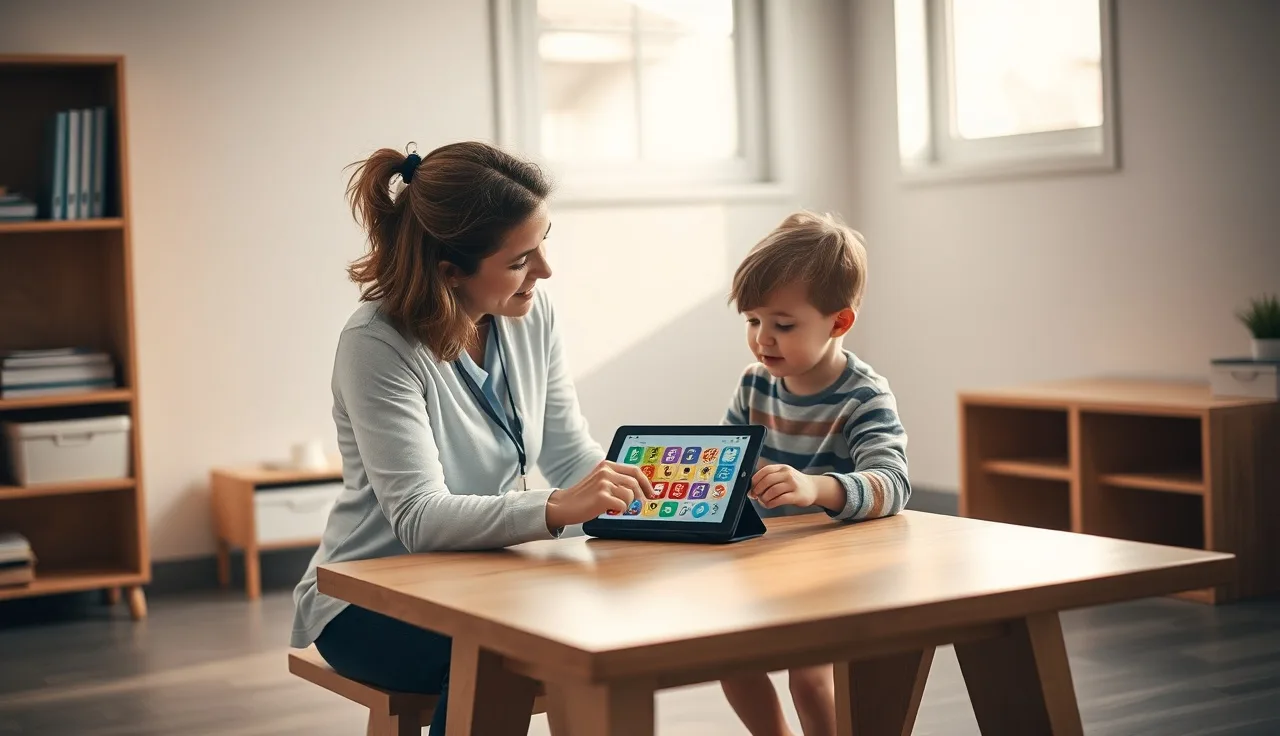
Trial of multiple systems. This is non-negotiable. A real evaluation includes hands-on trials with different AAC options during the session, more than a demonstration. Trials should happen across more than one session when possible, because kids perform differently on different days.
Environmental inventory. Where does your child spend their time? What communication demands exist at home, school, therapy, and in the community? The report should address every context, more than a clinic table.
Family and team interview. You know things the evaluator doesn't. A good SLP builds structured parent and teacher questionnaires into the process, not as an afterthought.
What AAC device types might be considered during the evaluation?
The evaluator should introduce your child to options across the full range, then narrow based on trials. Here's a quick look at the main categories and typical price ranges.
| System type | Examples | Approximate cost | Best when... |
|---|---|---|---|
| No-tech (PECS, picture boards) | Laminated boards, binders | $0 to $200 | Starting point, backup, or primary system for some learners |
| Low-tech with voice output | GoTalk, BIGmack | $30 to $500 | Simple messages, early communicators |
| Mid-tech SGD | Nova Chat, Accent | $1,000 to $3,500 | More vocabulary, portable |
| High-tech dedicated SGD | Tobii Dynavox, PRC-Saltillo | $6,000 to $15,000 | Full language access, complex needs |
| Tablet with AAC app | Proloquo2Go, TouchChat, LAMP WFL | $250 to $900 (device + app) | Flexible, socially less stigmatizing for some |
| Eye-gaze system | Tobii I-Series, Eyegaze Edge | $12,000 to $20,000+ | Motor access limitations, ALS, severe CP |
Prices are approximate ranges as of 2025; actual costs vary by vendor and configuration. Insurance, Medicaid, and school funding can cover high-end SGDs when documentation is correct [4].
A good evaluator won't walk in with one device already in mind. If they hand your child a single tablet app and call that an evaluation, push back.
What questions should parents ask during the evaluation?
Come prepared. You're more than a bystander here. Bring notes. These are the questions worth raising.
About the process:
- How many sessions will this take?
- Who else will be part of the team?
- Will my child's teacher receive any input?
About the recommendation:
- Why this device over others you trialed?
- What access method are you recommending and why?
- Which vocabulary system does this device use, and how will we learn it?
About funding:
- What diagnosis and procedure codes will you use in the report?
- Does your report include the letter of medical necessity?
- Have you gotten prior authorization through our insurance before?
About next steps:
- What therapy will support implementation after we get the device?
- What happens if the device doesn't work well once we're home?
The funding questions feel uncomfortable to ask. Ask them anyway. They decide whether the recommendation becomes a device your child actually holds or just a line in a report.
How long does an AAC evaluation take?
Realistically, two to four sessions of 60 to 90 minutes each. Some evaluations compress into a single long session (two to three hours), but that's rarely ideal for young children or kids who fatigue quickly.
After sessions end, the SLP writes the report. That can take two to six weeks depending on their caseload. The report then goes to your insurance or Medicaid program, which runs on its own clock. Under the Individuals with Disabilities Education Act, an IEP team must convene within 30 days of a parent's written request, though school-based AAC evaluations often follow separate timelines set by your district [5].
For private insurance, prior authorization timelines swing widely. Medicaid SGD approvals under the durable medical equipment benefit can take 30 to 90 days. Getting funding right the first time (solid report, correct codes, complete documentation) is almost always faster than appealing a denial.
If your child is under three, early intervention services under Part C of IDEA must begin within 45 days of referral, and AAC should be part of that conversation from the start [10].
What should the evaluation report include?
The written report is the deliverable everything else depends on. A report missing key sections gets denied by insurance or challenged at an IEP meeting. Here's what belongs in it.
Background and history. Medical diagnoses, previous assessments, current therapies, and relevant developmental history.
Current communication profile. What your child does right now across modalities, with specific observations from the evaluation sessions.
Assessment results. Standardized scores (when available), informal findings, and the reasoning behind which tools were trialed.
Trial results. What was tried, how your child responded, what worked, and what didn't. This section is what makes the recommendation credible.
Specific AAC recommendation. Device name, model, vocabulary system, access method, and mount or case if relevant. A vague line like "a high-tech SGD" is not enough.
Letter of medical necessity. For insurance, this is a separate section or document explaining the medical rationale. Many SLPs fold it into the report; some write it separately. Make sure it's there.
Funding and coding information. HCPCS codes for the device (usually E2500 through E2599 for SGDs), ICD-10 diagnosis codes, and the treating physician's NPI number if the payer requires it [4].
Implementation plan. Who trains whom, how often, in what settings. Without this, devices end up in closets.
Goals. Measurable, time-bound communication goals that can drop straight into an IEP or therapy plan.
If the report you receive is missing funding codes, trial data, or a clear recommendation, go back to the evaluator before submitting it anywhere.
Can schools provide AAC evaluations, or do you need a private one?
Schools can and must provide AAC evaluations if the child's team determines one is needed for a free appropriate public education (FAPE) under IDEA [5]. You request this in writing, and the district must respond within the timeline your state sets (usually 60 days from consent to evaluation).
School-based evaluations are free to families. The catch is that the school's interest is meeting educational needs, not medical necessity. A school-based report rarely includes the letter of medical necessity or insurance codes your family needs to get a personal device through Medicaid or private insurance. Schools also fund devices through educational money, which means the device may belong to the school, not your child.
For most families, the fullest path is both: a school-based evaluation for IEP purposes and a private or clinic-based evaluation for a personal device through insurance. That's redundant but common, and it gives your child a device at home, which is where language learning largely happens.
If you can only afford one, private tends to produce the more actionable funding documentation. Ask the SLP upfront whether their report format has worked for your specific insurer or state Medicaid program.
What red flags should I watch for in an AAC evaluator or report?
Some evaluations are genuinely poor, and the warning signs are easy to spot once you know them.
Device bias. An evaluator tied to one AAC vendor, or one who recommends the same device no matter the child's profile, has a conflict of interest. Some vendor-affiliated SLPs still do quality work, but the good ones tell you upfront about any relationship.
No device trials. If the recommendation rests only on observation and interview, without your child actually using anything, it's guesswork.
"Your child isn't ready for AAC." There is no evidence-based readiness threshold for AAC. ASHA's position is that AAC should be considered for anyone whose natural speech does not meet their communication needs [1]. Age, cognitive level, and language ability do not disqualify a child. If an evaluator tells you to wait, get a second opinion.
Ignoring the family. A report that doesn't reflect what you told them about your child's daily life and home communication is incomplete.
No implementation plan. Getting a device is step one. A report that ends with a recommendation and says nothing about training, therapy frequency, or generalization sets your family up to struggle.
Generic goals. A goal like "will use AAC to communicate" is too vague to drive therapy or satisfy an IEP team. Look for measurable targets with a timeframe and a baseline.
Does AAC work for kids with autism or apraxia?
Yes, with good support. The evidence base for AAC in autism is deep. A 2012 meta-analysis of 24 studies found that SGDs produced reliable communication gains for individuals with autism spectrum disorders, and that the devices did not suppress speech development [3]. For kids who have some speech, AAC tends to support rather than replace it.
Apraxia of speech is a motor speech disorder where the brain struggles to plan the movements for speech. AAC gives kids with childhood apraxia of speech a reliable output channel while they work on speech production, cutting frustration and supporting language growth at the same time. Some kids who use AAC for years eventually develop functional speech and lean on the device less. Some don't, and that's okay too.
For kids who use echolalia as their main way to communicate, AAC evaluations should specifically address how to build on echolalic patterns rather than ignore them. A good evaluator asks about your child's echolalia profile and factors it into the vocabulary and system design. You can read more about how echolalia functions communicatively in our piece on echolalia meaning.
AAC evaluation and intervention look somewhat different across diagnoses, but the core framework holds: assess the whole communicator, trial real options, and build a system that grows with the child.
How is an AAC evaluation different from a standard speech evaluation?
A standard speech-language evaluation focuses on your child's speech and language skills: articulation, phonology, receptive language, expressive language, and pragmatics. It produces a profile and guides therapy. An AAC evaluation takes that profile and asks a different question. Given where this child is right now, which communication tools will help them communicate most effectively while their underlying skills develop?
The two often overlap. Many children get an AAC evaluation as part of a broader speech-language evaluation, especially if the referring team already suspects AAC is needed. But they can happen separately, and the AAC piece requires extra equipment (actual devices to trial), more team members (OT, AT specialist), and a report with entirely different documentation requirements (funding codes, medical necessity, vendor quotes).
If your child already has an IEP with speech therapy and the team hasn't raised AAC, you can request an AAC-specific evaluation in writing. You don't need a separate diagnosis to ask for one.
How can parents support AAC use at home after the evaluation?
The evaluation is the beginning, not the end. Implementation is where families either see real gains or watch an expensive piece of technology gather dust.
The single most useful thing you can do is model. This is called aided language stimulation or AAC modeling, and it means an adult uses the device throughout the day to communicate with the child, more than prompting the child to use it. Studies show children learn AAC symbols faster when caregivers model consistently [6].
Build it into routines rather than treating it as a therapy activity. Snack time, bath time, play, and transitions are all openings. The goal is that the device is always present and always working, more than pulled out for practice.
Ask your SLP to train you directly on the device before you leave the clinic with it. Too many families walk out with a device and minimal training, then struggle for months on avoidable problems. A good implementation plan includes at least one parent training session and check-ins at 30, 60, and 90 days.
If you want daily support between therapy sessions, tools like Little Words help parents practice AAC modeling and communication strategies at home. It's not a replacement for evaluation and therapy, but it's a useful daily companion.
For kids being seen for autism spectrum communication specifically, home carry-over matters even more, because generalizing across environments is often the hardest part.
How much does a private AAC evaluation cost, and is it covered by insurance?
Private AAC evaluations typically cost between $500 and $2,500 depending on location, the number of sessions, and the specialists involved. A single-SLP evaluation runs cheaper. A full interdisciplinary evaluation (SLP, OT, AT specialist) costs more.
Coverage varies. Private insurance plans differ enormously on whether they cover evaluations versus devices. Medicaid in most states covers both the evaluation and, if the recommendation is approved, the device under the durable medical equipment benefit. The Centers for Medicare and Medicaid Services covers SGDs when they're determined medically necessary [4].
For children under 21 on Medicaid, the Early and Periodic Screening, Diagnostic, and Treatment (EPSDT) benefit requires coverage for any medically necessary service, including AAC devices and evaluations [7]. That's a powerful lever if you're fighting denials.
School-based evaluations are free. If your child has an IEP, request the evaluation in writing so it's on the record.
One overlooked option: state assistive technology programs. Every state has an AT program funded by the Assistive Technology Act of 1998 (29 U.S.C. § 3001 et seq.) that offers free device demonstrations and loans, and some offer funding help for low-income families [8].
For families doing this for the first time, the early intervention system (for children under three) and online speech therapy options can both help bridge the gap while you work through evaluation and funding timelines.
Frequently asked questions
At what age can a child have an AAC evaluation?
There's no minimum age. AAC evaluations can happen in infancy if there's reason to believe natural speech development will be significantly delayed or absent. For children under three, the early intervention system under Part C of IDEA is the pathway. Research and ASHA guidance both reject the idea that children need to reach a developmental milestone before AAC is appropriate.
Will using AAC stop my child from learning to talk?
The evidence says no. Multiple studies, including a widely cited 2012 meta-analysis published in the American Journal of Speech-Language Pathology, found that AAC does not suppress speech development and often supports it. Many children who begin with AAC go on to develop spoken language. AAC is a communication tool, not a ceiling.
How do I find an SLP who specializes in AAC?
ASHA's ProFind directory lets you filter by specialty including AAC. Your state's assistive technology program (searchable at AT3Center.net) also keeps provider lists. University speech-language clinics often run AAC programs. Ask any candidate how many AAC evaluations they complete per month and which device companies they have experience with before committing.
What's the difference between an AAC evaluation and an assistive technology evaluation?
An assistive technology (AT) evaluation is broader and covers all tools that support functioning: communication, mobility, learning, and self-care. An AAC evaluation focuses specifically on communication tools. In practice they often overlap, especially for children with complex needs. The lead for AAC is the SLP; the AT specialist supports the team on device access and technology configuration.
Can my child's school deny an AAC evaluation if I request one?
Schools can only deny an evaluation if they put the refusal in writing with a specific reason, and you have the right to dispute that decision through your state's dispute resolution process under IDEA. If the school refuses and you believe your child needs AAC, you can request an independent educational evaluation at the school's expense. Document every communication in writing.
How many AAC devices should be trialed during the evaluation?
There's no magic number, but a minimum of two or three meaningfully different options is a reasonable expectation. Trials should include at least one low-tech option and one or more speech-generating systems that differ in vocabulary layout, access method, or output type. The point is to gather real data on how your child responds, not to demonstrate a device already chosen.
Does a child need a specific diagnosis to qualify for AAC?
No specific diagnosis is required. AAC is considered for anyone whose natural speech doesn't meet their communication needs, regardless of the underlying cause. Children with autism, cerebral palsy, Down syndrome, apraxia, intellectual disability, traumatic brain injury, and other conditions all use AAC. The evaluation determines fit; the diagnosis is just one piece of context.
What is a letter of medical necessity and why does it matter?
A letter of medical necessity (LMN) is a document, usually written by the SLP and co-signed by a physician, that explains why the recommended AAC device is medically required for the patient. Insurance companies and Medicaid require it to approve funding for speech-generating devices. Without a clear, well-documented LMN, prior authorization requests are routinely denied.
How often should AAC evaluations be repeated?
Most children benefit from a re-evaluation every one to three years, or sooner if their communication needs change significantly, they outgrow the current system's vocabulary, their motor access changes, or the device no longer meets their daily demands. An IEP review is a natural checkpoint to ask whether the current AAC system still fits. There's no fixed rule; let your child's progress guide the timing.
What vocabulary system should the AAC device use?
That depends on your child's profile. Core vocabulary systems (words used across many situations) are the most common foundation for full language access. LAMP (Language Acquisition through Motor Planning) is designed specifically for motor learning and is widely used with apraxia and autism. Feature matching in the evaluation should connect your child's cognitive, motor, and language profile to the vocabulary layout. Ask the evaluator to explain their reasoning.
Can a telehealth SLP do an AAC evaluation?
Partly. A telehealth SLP can conduct portions of the evaluation, including background history, parent interview, language assessment, and review of videos you send. Hands-on device trials are harder to run remotely, though some clinics mail loaner devices for families to trial at home during the evaluation process. A fully remote AAC evaluation is possible but less common; ask specifically how device trials will be handled.
What happens if the recommended AAC device doesn't work for my child?
Ask for a device trial or loan period before purchase or insurance submission whenever possible. Many vendors and state AT lending libraries offer short-term loans. If a device is already in the home and isn't working, contact the SLP promptly. Sometimes it's a vocabulary customization or mounting issue that's fixable. Sometimes a different system is needed, and revisiting the evaluation is the right call.
Sources
- ASHA, Augmentative and Alternative Communication (AAC) overview: ASHA defines AAC as 'all forms of communication other than oral speech that are used to express thoughts, needs, wants, and ideas' and states there is no readiness threshold for AAC candidacy.
- Ratcliff, A. et al. (2019), American Journal of Speech-Language Pathology, AAC coursework in graduate programs: Fewer than half of SLP graduate programs required a dedicated AAC course as of 2019 survey data reported in AJSLP.
- Ganz, J. et al. (2012), American Journal of Speech-Language Pathology, SGDs and autism meta-analysis: A 2012 meta-analysis of 24 studies found SGDs produced reliable communication gains for individuals with autism and did not suppress speech development.
- Centers for Medicare and Medicaid Services, Speech Generating Devices coverage policy: CMS covers SGDs (HCPCS codes E2500-E2599) as durable medical equipment when determined medically necessary.
- U.S. Department of Education, Individuals with Disabilities Education Act (IDEA) overview: Under IDEA, schools must provide AAC evaluations when the IEP team determines one is needed for FAPE, and must convene within 30 days of a written parent request.
- Sennott, S. et al. (2016), Augmentative and Alternative Communication journal, aided language stimulation: Studies show children learn AAC symbols faster when caregivers model consistently, a strategy called aided language stimulation or AAC modeling.
- Medicaid.gov, Early and Periodic Screening, Diagnostic, and Treatment (EPSDT) benefit: EPSDT requires Medicaid coverage for any medically necessary service for children under 21, including AAC devices and evaluations.
- AT3 Center, State Assistive Technology Programs directory (funded under Assistive Technology Act, 29 U.S.C. § 3001): Every state has an AT program funded by the Assistive Technology Act offering free device demonstrations, loans, and some funding assistance for low-income families.
- ASHA, Roles and Responsibilities of Speech-Language Pathologists in AAC: ASHA recommends a team approach to AAC evaluation including SLP, OT, PT, vision specialist, AT specialist, and family members.
- U.S. Department of Education, IDEA Part C Early Intervention: Under IDEA Part C, early intervention services for children under three must be initiated within 45 days of referral.