Last updated 2026-07-11
TL;DR
Joint attention, the ability to share focus on the same thing with another person, predicts language development more reliably than how many words a child already says. Children who point, follow a gaze, and share interest before 18 months are far more likely to catch up, even when they aren't talking yet. Building this skill is the smartest use of a late talker's early intervention window.
What is joint attention, exactly?
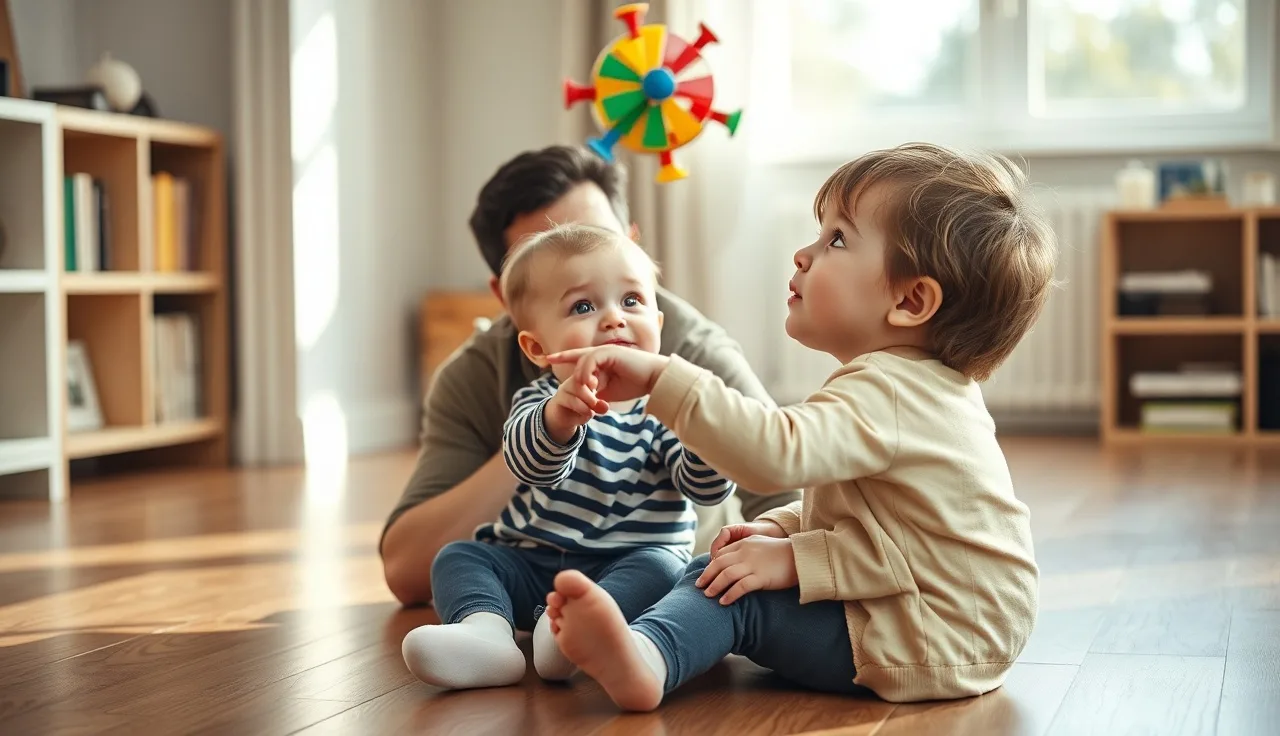
Joint attention is what happens when two people focus on the same object or event and both know they're doing it together. Your child looks at a dog, looks back at you, then looks at the dog again. That three-point triangle, child to object to you and back, is joint attention. It sounds simple. It is one of the most cognitively sophisticated things a toddler does.
There are two forms. Responding to joint attention (RJA) is when your child follows your pointing finger or your gaze to find what you're looking at. Initiating joint attention (IJA) is when your child starts it, pointing at a bird, holding up a toy to show you, or looking back at your face to make sure you noticed something cool. IJA is the stronger predictor of later vocabulary [1].
Joint attention is not the same as shared physical space. A child can sit next to a parent and play with blocks without a single moment of joint attention passing between them. The ingredient that counts is mutual awareness, both people knowing they're in it together.
Why does joint attention predict language better than word count does?
Words are the output. Joint attention is the engine that makes them.
When a child and caregiver share attention on an object, the caregiver naturally names it. The child's brain is already primed to take that label because their attention is locked onto the right thing. A 1998 study by Carpenter, Nagell, and Tomasello found that time spent in joint engagement at 12 months predicted vocabulary size at 18 months more strongly than the raw amount of language parents directed at children [2]. The mechanism is word mapping. A child who is looking where you're looking when you say "balloon" knows exactly what "balloon" means. A child who isn't sharing your gaze is just hearing a sound.
Word count is also a lagging indicator. By the time a 24-month-old is well behind on words, the processing that should have fed those words has already been underperforming for months. Joint attention problems show up earlier, often between 9 and 12 months, which is why researchers use it as a screening signal instead of waiting for the vocabulary gap to widen [3].
The American Speech-Language-Hearing Association (ASHA) describes joint attention as a prelinguistic communication skill that is foundational to language, placing it before intentional communication and symbolic play in the developmental order [4].
What does the research actually say about joint attention and late talkers?
The evidence here is unusually consistent for a field that argues about almost everything else.
A widely cited 1998 study by Mundy and Gomes found that IJA at 13 months predicted expressive language at 20 months with a correlation of roughly 0.50, a strong effect by developmental psychology standards [1]. A 2003 review by Charman in the journal Autism concluded that "joint attention is one of the strongest concurrent and predictive correlates of language ability in autism spectrum conditions" [5]. The relationship holds in late talkers without autism too.
Research by Rescorla and colleagues found that late talkers with strong gestural communication, including pointing and showing, were far more likely to catch up by age 3 than those who relied on vocalization attempts without the social engagement behind them [6]. Pointing and showing are proxies for IJA.
Nobody has clean data on exactly what joint attention "score" guarantees catch-up. The field doesn't have that kind of threshold. What the studies keep showing is a dose-response pattern. More joint attention episodes at 12 to 18 months correlate with faster vocabulary growth at 24 to 36 months, no matter how many words the child started with.
| Joint attention behavior | Typical age of emergence | Link to language outcomes |
|---|---|---|
| Following gaze (RJA) | 9 to 12 months | Predicts receptive vocabulary [2] |
| Pointing to request | 10 to 12 months | Predicts expressive vocabulary [2] |
| Pointing to share interest (IJA) | 11 to 14 months | Strongest predictor of later word learning [1] |
| Showing objects to caregiver | 12 to 15 months | Linked to symbolic play and vocabulary [6] |
| Alternating gaze during play | Throughout toddlerhood | Predicts conversational turn-taking [4] |
Is joint attention the same issue in autism and in late talkers without autism?
Related, but not identical. Worth separating clearly.
In autism, joint attention difficulty is one of the core early signs, partly because the drive to share an experience can be reduced. The Autism Diagnostic Observation Schedule (ADOS-2) measures IJA and RJA as part of its assessment [7]. Children with autism often respond to joint attention bids less consistently and initiate them less often than neurotypical peers, and that gap tends to be wider than in late talkers without autism.
In late talkers without autism, joint attention is usually there but may be less frequent or less developed. A child might point and make eye contact but not hold the shared moment long enough to hear and map words. The issue is more about efficiency than motivation.
This matters for parents because the strategies overlap a lot, but the intensity and structure differ. A child with autism may need more explicit, repeated chances and more adult scaffolding. A late talker without autism may respond fast to a parent slowing down, getting on the floor, and following the child's lead. If you're unsure which picture fits your child, that's a question for a speech-language pathologist (SLP), not something to diagnose from a checklist. See more on early intervention and autism spectrum speech therapy.
How do you know if your child has a joint attention problem?
You're watching for the triangle. Child to object, back to you, back to object.
The American Academy of Pediatrics (AAP) developmental surveillance guidelines flag several behaviors as reasons to refer, not to diagnose: not pointing by 12 months, not following a point by 12 months, and not showing objects to caregivers by 12 months [3]. All three are joint attention behaviors. The M-CHAT-R/F (Modified Checklist for Autism in Toddlers, Revised with Follow-Up), recommended by the AAP for screening at 18 and 24 months, weights joint attention items heavily [8].
At home, try this. Put a toy on the table, make an excited face, and look at a spot across the room saying "oh, look at that!" Does your child follow your gaze and then look back at you? That's RJA. Now sit quietly while your child plays. Does your child hold something up to show you, or point at something just to share it, not to get it? That's IJA.
If pointing is absent at 12 months, or if your child gets what they want by dragging your hand to things instead of pointing and looking at your face, bring that to a pediatrician now, not at the next well-visit. Bring a short video if you can. Pediatricians see children for 15 minutes. A video of everyday play tells them far more than an office observation.
What can parents do at home to build joint attention?
This is where parents have more power than they realize. Joint attention is not wired to a therapy room.
The most evidence-supported home strategy is Responsive Interaction (RI), sometimes called "follow the child's lead." The core move is simple. Get physically at the child's level, wait for them to show interest in something, and then join that interest instead of redirecting. If your child looks at a ceiling fan, you look at the ceiling fan and talk about it. Don't swap in a toy you picked. It sounds almost too easy, but a randomized controlled trial by Yoder and Stone (2006) found that Responsive Interaction increased joint attention episodes in toddlers with autism more than a structured, requesting-focused approach [9].
Other concrete techniques:
Animated commenting without demand. Narrate what your child is doing in short phrases. "Red ball. The ball rolled. Oh, it stopped!" You're not quizzing them. You're joining their attention and adding language to the shared moment.
Sabotage routines slightly. Put a toy just out of reach, open a jar they can't, or pause a familiar song mid-verse. These make moments where the child has to look at you, which is an RJA bid.
Point and wait. Point to something interesting, say nothing for three to five seconds, and see if your child follows the point and then looks back at you. Celebrate any version of that look-back, even a quick one.
Turn-taking games. Rolling a ball back and forth, taking turns stacking blocks, or plain peek-a-boo all build the rhythm of shared attention without needing words. They teach the child to expect mutual engagement.
Reduce screen time during joint play windows. This isn't a moral judgment. It's a practical one. Joint attention needs two faces and real timing. Screens don't initiate or respond to a child's gaze, so screen time never practices this skill. The AAP recommends limiting screen use to video chatting only before 18 months (excluding children with specific documented needs) [3].
If you want structured support between therapy sessions, the Little Words app was built to guide parents through these interaction routines, with prompts tailored to where each child is developmentally.
Does joint attention training actually increase language in late talkers?
Yes, with real effect sizes, though the research has limits worth being honest about.
The JASPER intervention (Joint Attention, Symbolic Play, Engagement, and Regulation), developed at UCLA by Kasari and colleagues, is the most studied structured joint attention program. A 2008 randomized controlled trial by Kasari, Paparella, Freeman, and Jahromi showed that toddlers with autism who received JASPER increased both joint attention and functional play, and those gains fed language growth at follow-up [10]. A 2014 trial by Kasari and colleagues extended this to minimally verbal school-age children with autism, finding that combining JASPER with augmentative and alternative communication (AAC) produced more spontaneous communication acts than either approach alone [10].
For late talkers without autism, the evidence base is thinner but still positive. The Hanen Program's "It Takes Two to Talk," a parent coaching model, has several trials showing gains in joint engagement and later language [9]. The effect sizes are modest to moderate, and not every child responds the same. Nobody should promise you a timeline.
One honest caveat. Most joint attention intervention studies are small, run under 12 months of follow-up, and often focus on children with autism. Applying the exact numbers to a 20-month-old late talker without an autism diagnosis calls for some caution. The mechanism is the same. The dose needed may differ.
What role does a speech-language pathologist play in joint attention work?
An SLP who specializes in early language does two things a parent alone can't easily do: assessment and individualized strategy calibration.
On assessment. An SLP can formally evaluate joint attention using measures like the Early Social Communication Scales (ESCS) or structured observation, giving you a baseline against developmental norms. That matters, because "he points sometimes" is a different thing from "he initiates joint attention 4 times per 10-minute play session versus an expected 8 to 12 times."
On strategy. An SLP watches your child interact, spots which near-misses of joint attention keep slipping by, and coaches the parent in real time on adjustments. That feedback loop is hard to copy from a book or an article, including this one.
ASHA recommends early intervention services for children who show communication delays, and lists joint attention deficits as an indicator for referral [4]. In the US, children under 3 may qualify for free or low-cost services through Part C of the Individuals with Disabilities Education Act (IDEA), which covers evaluation and therapy when eligibility criteria are met [11].
You don't need a diagnosis to request a Part C evaluation. Call your state's early intervention program and say your child is not meeting communication milestones. The evaluation is free by law. See more about speech therapy and early intervention for what to expect.
How does joint attention connect to gestures, pointing, and other pre-verbal skills?
Joint attention doesn't stand alone. It's the hub of a pre-verbal communication cluster that also includes gestures, gaze, vocalization, and imitation. These skills grow together and prop each other up.
Gestures matter a lot. A 2005 study by Iverson and Goldin-Meadow published in Science found that gesture production at 14 months predicted vocabulary size at 42 months, independent of socioeconomic status and early language input [12]. The gesture-to-word progression is fairly predictable. Children first pair a gesture with a vocalization, then eventually the vocalization alone becomes the word. Pointing is the most studied gesture, and declarative pointing (pointing to share interest, not to request) is the strongest predictor.
Imitation is the other companion skill. Children who readily imitate actions and sounds are practicing the same circuitry involved in joint attention: watching another person's intention, predicting their behavior, and syncing with it. If a child is not imitating gestures or sounds by 12 to 15 months, that's another signal worth flagging.
For parents of children who aren't pointing or gesturing yet, the home strategies for joint attention and gesture building overlap almost completely. You model the gesture, you wait, you celebrate any approximation. The same responsive interaction that builds joint attention builds the whole pre-verbal cluster.
Should parents worry about joint attention or focus on getting their child to say more words?
Both matter. But if you have to pick one in the 12-to-24 month window, joint attention is the better bet. Here's the reasoning.
A parent who spends their energy drilling words, "say ball, say ball, say BALL," is working the output side of the equation. The child may push out the word under pressure without really mapping it. That kind of word learning doesn't transfer well. The same parent who spends those minutes getting on the floor, following the child's gaze to the ball, rolling it back and forth, looking excited, and commenting now and then is building the input side that makes word learning stick.
This is not an argument against modeling words. Model constantly. Name everything you're both looking at. The point is that the joint attention framework tells you when and how to deliver those words so they actually land.
If your child already shows clear joint attention (pointing, showing, following your gaze) and just has fewer words than peers, that's a different situation from a child with limited joint attention and limited words. The first child often fits the "expressive late talker" profile and may well catch up. The second child needs more urgency and more support. A 2011 review by Rescorla in the Journal of Child Psychology and Psychiatry found that roughly 70 to 80 percent of late talkers with good receptive language and good nonverbal communication (including joint attention) caught up by school age without intensive intervention, while those with weaker nonverbal skills had worse outcomes [6].
That 70 to 80 percent figure is real and reassuring. It's also an average across a mixed group. It is not a reason to wait and see if your child's joint attention is also lagging. Late words plus limited joint attention, together, are a stronger signal than either one alone.
What if my child uses AAC, has echolalia, or has apraxia: does joint attention still apply?
Yes, in all three cases. In some ways it matters even more.
For children who use AAC devices, the JASPER research specifically includes AAC as part of the intervention, and joint attention predicts how well children learn to use the device to communicate rather than only to request. A child with good joint attention naturally starts using their device to comment and share, not only to get things. That shift from requesting to commenting is one of the milestones SLPs watch for in AAC users.
For children with echolalia, immediate or delayed, the echoing often fills the "saying words" column while joint attention is still developing. Knowing where a child's joint attention sits gives a clearer read on their communicative intent than counting echoed utterances. An echoing child who makes strong eye contact and uses echoes to start interaction is in a different place than one who echoes with little social reference.
For children with apraxia of speech, the motor planning difficulty means words come out hard even when the child fully intends to communicate. Joint attention skills are usually intact. Supporting joint attention here means giving them a pre-verbal way to communicate while the motor work moves along, because the social drive is present even when the words aren't.
The Little Words app includes activities built for children at the joint attention stage, whether they're using words, gestures, or AAC. Take the quiz to see which activities match where your child is right now.
For more on related communication differences, see echolalia meaning and childhood apraxia of speech.
Frequently asked questions
At what age should a child develop joint attention?
Responding to joint attention (following a point) typically emerges between 9 and 12 months. Initiating joint attention, pointing to share interest rather than to request, usually appears between 11 and 14 months. If a child is not following points or pointing to share by 12 months, that warrants a conversation with the pediatrician and possibly a referral for early intervention evaluation.
Can joint attention problems be fixed at home without a therapist?
Parent-implemented strategies like following the child's lead, animated commenting, and turn-taking games have real research support. They can meaningfully increase joint attention episodes. But a speech-language pathologist can assess how significant the gap is, watch your interaction in real time, and calibrate the approach for your specific child. Home work and therapy work best together. Neither fully replaces the other.
My child points to request things but doesn't point to show. Is that a problem?
Yes, this distinction matters. Pointing to request ("I want that") is called protoimperative pointing. Pointing to share interest ("look at that!") is called protodeclarative pointing. Protodeclarative pointing is the stronger predictor of language development and is one of the items screened on the M-CHAT-R. A child who only requests but doesn't share is worth monitoring closely and discussing with an SLP.
How is joint attention different from eye contact?
Eye contact is one component of joint attention but not the whole thing. Joint attention requires a three-way triangle: child, caregiver, and shared object or event, with the child alternating gaze between the two. A child can make eye contact without ever completing that triangle. Conversely, some children with reduced eye contact still engage in joint attention through other cues like pointing and reaching. The triangle is the defining feature.
Does watching TV or video count as joint attention practice?
No. Joint attention requires a responsive partner who follows the child's gaze and reacts to their bids in real time. Screens don't do that. The AAP recommends avoiding solo screen media before 18 months (other than video chatting) partly because passive screen time doesn't build the interactive skills that support language development. Co-viewing with a parent who comments and interacts is better but still not equivalent to live face-to-face play.
Can a late talker have good joint attention? What does that mean for their prognosis?
Yes, and it's generally a good sign. A child with limited words but strong joint attention (good pointing, follows gaze, shows objects, makes eye contact during interaction) fits the profile of an "expressive late talker." Research by Rescorla found roughly 70 to 80 percent of late talkers with good nonverbal communication caught up by school age. That's a meaningful positive signal, though not a guarantee, and monitoring by an SLP still makes sense.
Is poor joint attention always a sign of autism?
No. Joint attention difficulties are a core early feature of autism, but they also appear in children with language delays, hearing loss, developmental delays, and some children who are simply slower to develop social engagement. Poor joint attention is a signal that warrants evaluation, not a diagnosis in itself. A proper evaluation by a developmental pediatrician or a team including an SLP can tease apart the contributing factors.
What is the JASPER intervention and is it available outside of research settings?
JASPER (Joint Attention, Symbolic Play, Engagement, and Regulation) was developed at UCLA and has strong randomized trial evidence for toddlers and school-age children with autism. It is available through trained SLPs and some early intervention programs, beyond research settings. Ask your early intervention coordinator or your SLP specifically whether they are JASPER trained. Parent coaching components can be learned through training programs as well.
My child is 2 and doesn't point at all. Is it too late to catch up?
Two is not too late. Age 2 is solidly within the early intervention window, and joint attention can be built with targeted support. That said, the absence of pointing at 24 months is a meaningful delay, not something to wait on. Contact your state's Part C early intervention program for a free evaluation. If you're in a state with waitlists, ask your pediatrician for a parallel private SLP referral while you wait.
How long does it take to see improvement in joint attention with intervention?
The Kasari JASPER trials saw measurable gains in joint attention frequency within 8 to 10 weeks of 30-minute sessions. Parent-implemented programs like Hanen's "It Takes Two to Talk" typically run about 12 weeks of group sessions plus coaching. That said, joint attention gains vary a lot by child, by intensity of practice, and by how far below the developmental norm the child started. Consistent daily interaction practice at home accelerates progress.
Does bilingual or multilingual exposure affect joint attention development?
No. Joint attention is a preverbal social-cognitive skill that develops the same way regardless of language environment. Bilingual children may have slightly different word counts in each language, but their joint attention trajectories are the same as monolingual peers. If a bilingual child has joint attention difficulties, that's not due to the bilingualism and should be evaluated just as it would be in any other child.
What should I tell my pediatrician if I'm worried about joint attention?
Be specific. Say: "My child is not pointing to share things with me" or "my child doesn't follow when I point to something across the room." Bring a short phone video of a typical play session at home if you can. Ask specifically for a referral to a speech-language pathologist and, if you're in the US, ask about your state's Part C early intervention evaluation, which is free and does not require a diagnosis to access.
Can online speech therapy address joint attention?
Yes, with some caveats. Telehealth SLP sessions can effectively coach parents in joint attention strategies, and parent coaching is a large part of early intervention anyway. Direct therapist-to-child joint attention work is harder to replicate on a screen, especially with very young children. A hybrid model, telehealth parent coaching plus occasional in-person sessions, is often the most practical approach. See more at online speech therapy.
Sources
- Mundy & Gomes (1998), Mental Retardation and Developmental Disabilities Research Reviews, 'Individual Differences in Joint Attention Skill Development in the Second Year': Initiating joint attention at 13 months predicted expressive language at 20 months with a correlation of approximately 0.50
- Carpenter, Nagell & Tomasello (1998), Monographs of the Society for Research in Child Development, 'Social Cognition, Joint Attention, and Communicative Competence from 9 to 15 Months of Age': Time spent in joint engagement at 12 months predicted vocabulary size at 18 months more strongly than raw parental language quantity; pointing to request emerges 10-12 months, declarative pointing 11-14 months
- American Academy of Pediatrics, Developmental Surveillance and Screening Policy: AAP flags absence of pointing by 12 months and not following a point by 12 months as developmental red flags; recommends limiting screen media before 18 months except video chatting
- American Speech-Language-Hearing Association (ASHA), Prelinguistic Communication Skills: ASHA describes joint attention as a foundational prelinguistic communication skill and lists it as an indicator for early intervention referral
- Charman (2003), Autism journal, 'Why is joint attention a pivotal skill in autism?': Charman's review concluded that 'joint attention is one of the strongest concurrent and predictive correlates of language ability in autism spectrum conditions'
- Rescorla (2011), Journal of Child Psychology and Psychiatry, 'Late Talkers: Do Good Predictors of Outcome Exist?': Approximately 70-80 percent of late talkers with good receptive language and strong nonverbal communication (including joint attention) caught up by school age; those with weaker nonverbal skills had worse outcomes
- Lord et al., Autism Diagnostic Observation Schedule Second Edition (ADOS-2), Western Psychological Services: The ADOS-2 specifically measures initiating and responding to joint attention as part of its diagnostic assessment battery
- Robins et al., M-CHAT-R/F (Modified Checklist for Autism in Toddlers, Revised with Follow-Up): The M-CHAT-R/F, recommended by AAP at 18 and 24 months, heavily weights joint attention items including pointing and gaze following
- Yoder & Stone (2006), Journal of Autism and Developmental Disorders, 'Randomized Comparison of Two Communication Interventions for Preschoolers with Autism Spectrum Disorders': Responsive Interaction significantly increased joint attention episodes in toddlers with autism compared to a more structured PECS-based approach
- Kasari et al. (2008, 2014), Journal of Child Psychology and Psychiatry and Journal of Autism and Developmental Disorders, JASPER randomized trials: JASPER toddler RCT showed joint attention gains mediated language growth at follow-up; 2014 school-age RCT found JASPER plus AAC produced significantly more spontaneous communication acts than either approach alone
- U.S. Department of Education, IDEA Part C Early Intervention Program: Part C of IDEA provides free evaluation and early intervention services for eligible children under age 3; no diagnosis is required to request an evaluation
- Iverson & Goldin-Meadow (2005), Science, 'Gesture Paves the Way for Language Development': Gesture production at 14 months predicted vocabulary size at 42 months independently of socioeconomic status and early language input