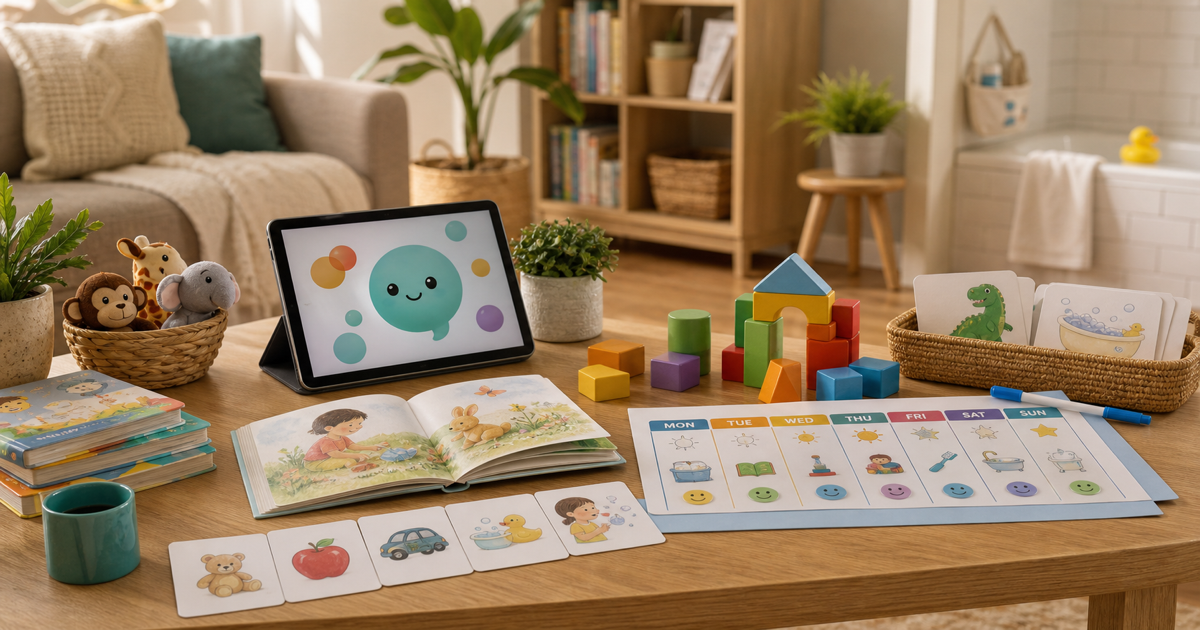
Bath time is one of the easiest places to sneak in language practice, because it happens every day and your child is already a captive audience. If you're wondering whether this counts as a real concern or just wondering how to make the most of it, here's the short version: notice what your child is already communicating, offer one small model of the next step, and loop in a professional if the pattern shows up everywhere, not just in the tub.
The more useful question isn't "how do I get my child talking right now." It's "what is my child already telling me, and what would make the next step a little easier for them." That shift keeps bath time from turning into a test, and it also gives you better information to bring to an SLP, pediatrician, early intervention team, or school team if you ever need one.
Watch across several bath times, not just one rough night. Pay attention to gestures, sound attempts, and whether your child seems to understand more than they can say back to you. A single tough evening doesn't tell you much. A pattern across a couple of weeks does.
To actually try something: pick the routine you already do every night (pouring water, washing hair, whatever). Model one useful word or phrase or gesture right in that moment: "pour," "more," "all done." Then pause and give your child real time to respond, in whatever form that takes: a word, a sign, a point, a sound. Accept it as communication and stop before it turns into a struggle. Tired-parent energy is real, and bath time doesn't need to become a lesson. Simple additions like naming body parts while washing, making sound effects during water play, or narrating action words ("splash," "pour," "scrub") tend to work better than anything more structured.
If what you're seeing at bath time is part of a bigger pattern, don't wait to ask for help. A hearing check, an early intervention evaluation, a private SLP evaluation, or a school-based evaluation are all reasonable next steps. Asking early isn't overreacting. It just means your child gets access to support sooner rather than later.
For more on this topic, the Best Speech Therapy Apps hub is a good starting point, and you'll find more ideas in Parent Guides. Related reads worth a look include 10-Minute Speech Practice for Toddlers Who Won't Sit Still, Cause-and-Effect Toys That Get Kids Talking, Language Activities for Preschoolers: A Year-Long Plan, and Pretend Play and Speech: Why It's the Most Important Activity. If snack time is more your challenge right now, Snack-Time Speech: How a Bowl of Goldfish Can Build Language covers similar ground, and there's also Speech Activities for 2-Year-Olds: 12 That Don't Feel Like, Speech Activities for Nonverbal Kids: Where to Actually Start, and Speech Therapy Activities for 3-Year-Olds at Home.
Little Words is meant as educational support for practice at home. It isn't a medical device, an AAC replacement, or a substitute for a licensed speech-language pathologist, pediatrician, early intervention program, school team, or developmental evaluation.