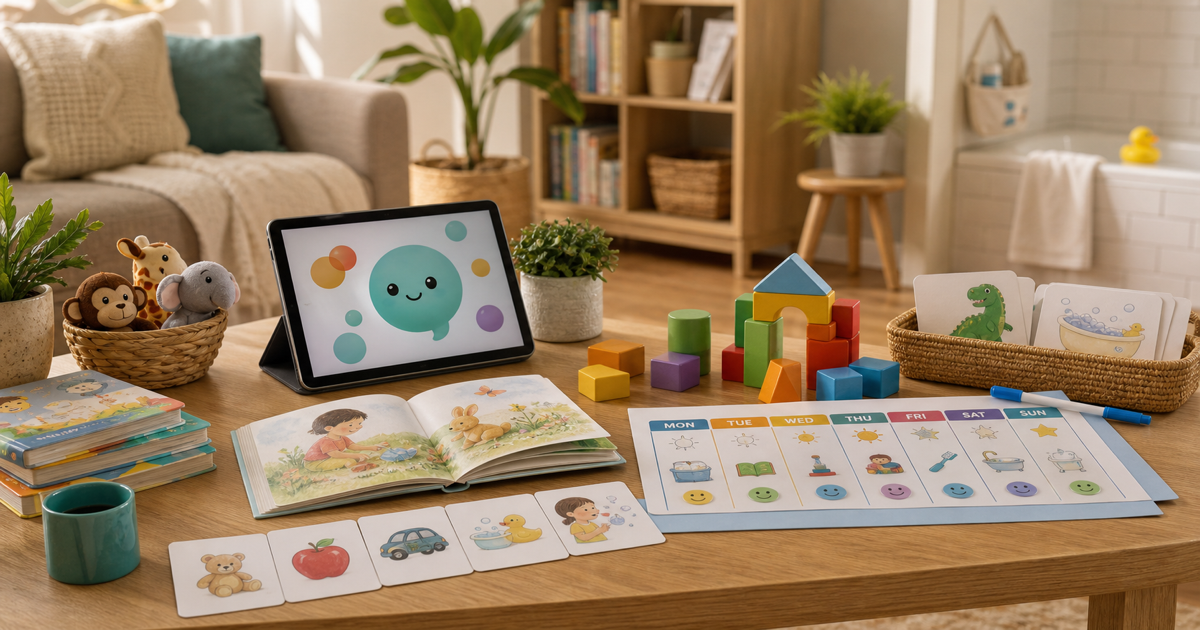
If you've noticed your child pretending less than expected, or wondering whether it connects to how their talking is coming along, here's the short version: pretend play and language development are genuinely linked, and it's worth paying attention to, but one quiet afternoon doesn't mean anything is wrong.
The real question isn't how to get your child talking right this minute. It's what your child is already communicating, and what kind of modeling or access would make the next step a little easier for them. That framing keeps things relaxed between you two, and it also gives you better information to bring to an SLP, pediatrician, or early intervention team if you end up needing one.
Watch across several days rather than judging one rough afternoon. Pay attention to how your child imitates you, whether they engage in pretend play at all, how they respond to their name, and whether they seem to understand more than they can actually say out loud. A pattern across routines tells you far more than any single moment does.
For this week, pick one routine your family already does every day, bath time, snack time, whatever's reliable, and model one useful word, phrase, or gesture inside it. Then pause and give your child real room to respond, in whatever form that takes: a sound, a sign, a point, a script from a favorite show. Accept that as communication. And if the moment starts sliding toward a battle, let it go.
A few things worth understanding in more depth: why pretend play tends to predict later language skills, how to begin with kids who don't pretend on their own yet, and how scaffolding looks different for autistic kids who pretend in their own way.
If this feels like part of a bigger pattern rather than a one-off, it's reasonable to ask for help sooner rather than later, whether that's a hearing check, an early intervention evaluation, a private SLP evaluation, or a school-based assessment. Getting that support in place early just means your child gets access to communication help sooner, nothing more dramatic than that.
For more structured ideas, the Best Speech Therapy Apps hub is a good starting point, and our parent guides cover a wide range of related situations. If pretend play is where you're stuck, you might also like the ideas in Cause-and-Effect Toys That Get Kids Talking or the routine-based approach in Snack-Time Speech: How a Bowl of Goldfish Can Build Language and Bath-Time Speech Activities (When You're Tired and It's 7pm). For a longer-term plan, see Language Activities for Preschoolers: A Year-Long Plan, and if your child doesn't sit still for practice, try 10-Minute Speech Practice for Toddlers Who Won't Sit Still. There's also age-specific help in Speech Activities for 2-Year-Olds and Speech Therapy Activities for 3-Year-Olds at Home, plus a starting point in Speech Activities for Nonverbal Kids: Where to Actually Start.
Important: Little Words is educational support for home practice. It's not a medical device, not an AAC replacement, and not a substitute for a licensed speech-language pathologist, pediatrician, early intervention program, school team, or developmental evaluation.