Toys & Materials That Build Language

Toys for Autistic Kids Who Don't Pretend Play (Yet)

If you searched for toys for autistic child pretend play, this page gives you the parent-level answer: what the concern usually means.
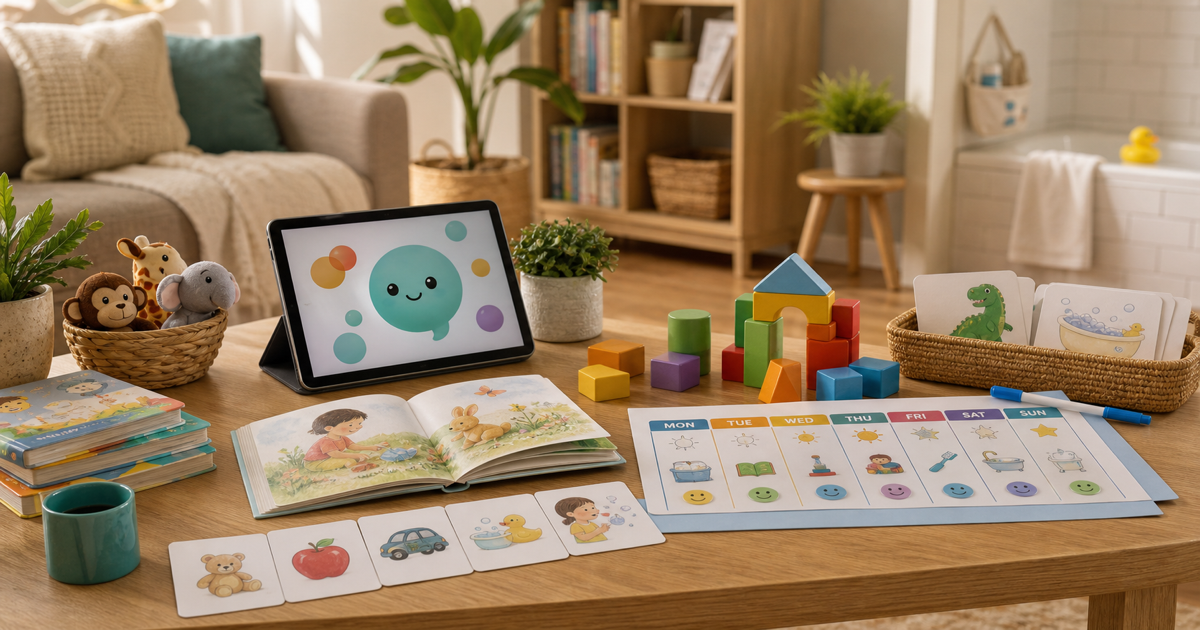
If you're hunting for toys that support pretend play in an autistic child, here's the short version: this isn't about finding a magic toy that unlocks talking. It's about noticing what your child already communicates and choosing toys that meet them where they are, then gently bridge from there. Instead of asking how to get your child talking right now, it helps to ask what your child is already communicating, and what kind of modeling or access would make the next step a little easier. That shift matters both for your relationship with your child and for the information you'll eventually hand to an SLP, pediatrician, early intervention team, or school team. Watch across several days, not one hard afternoon. Pay attention to gestures, pointing, and how your child plays, along with things like response to name, scripts, or AAC use, and whether they seem to understand more than they can say out loud. A pattern across routines tells you far more than any single moment does. This week, try picking one routine your child already does daily and modeling one useful word, phrase, AAC button, or gesture inside it. Pause afterward, longer than feels natural, and let your child respond however they can: an approximation, a sign, a point, a script, a tap on a device. All of that counts as communication. And if the moment starts sliding toward a battle, let it go. On the toy question specifically, the order matters. Start by validating the play your child already gravitates toward: lining things up, sorting, exploring cause and effect. These aren't lesser forms of play. Symbolic, pretend-style play can come later, as a bridge, if and when your child is ready for it, rather than something to force from the start. If this is part of a bigger pattern, it's worth asking for help sooner rather than later. That might mean a hearing check, an early intervention evaluation, a private SLP evaluation, a school-based evaluation, or a developmental assessment. Getting that support early isn't an overreaction. It just means your child gets access to communication help sooner. For related reading, the Neurodivergent Parenting hub is a good starting point, and you'll find more in the Parent Guides section. On AAC specifically, there's an AAC for autism starter guide, a roundup of the best AAC apps for toddlers in 2026, and a walkthrough on getting an AAC device through insurance. For toys and materials, there's an age-by-age guide to the best toys for speech delay and a piece on building sensory bins for speech work. And if you're navigating the wider family picture, there's honest advice on helping a neurotypical sibling, guidance on explaining a speech delay to grandparents, and a guide for raising a bilingual child with a speech delay. Little Words is meant as educational support for practice at home. It isn't a medical device, an AAC replacement, or a stand-in for a licensed speech-language pathologist, pediatrician, early intervention program, school team, or full developmental evaluation.
Buddy is a speech companion built for neurodivergent kids.

Little Words is a voice-first app where your child talks and plays with Buddy, at their own pace and in their own way. It is free to download.

See your child's planor download on the App Store