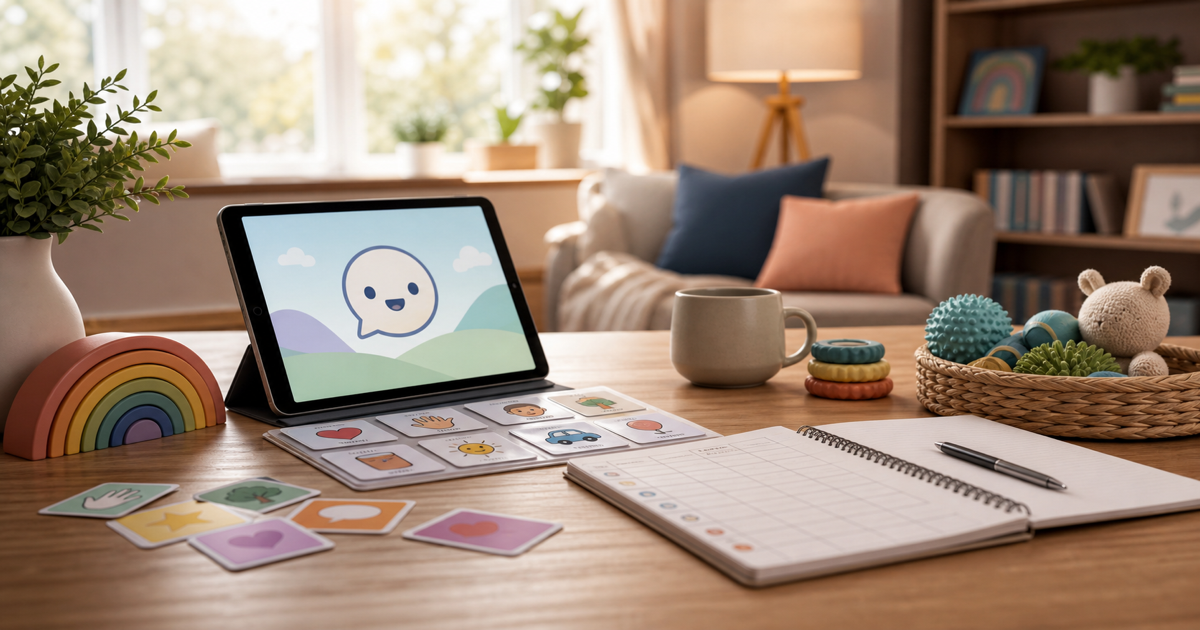
No, AAC will not stop your child from talking, and the research on this is actually pretty clear (Millar 2006, Romski 2010, Schlosser 2008). If anything, giving a child a reliable way to communicate tends to lower their frustration and increase how often they try to communicate at all, which usually supports spoken language rather than replacing it.
The worry itself makes sense, though. Handing a child a device or a picture board can feel like you're giving up on talking, or skipping a step you're supposed to earn. But the better question isn't how to get your child talking right now. It's what your child is already communicating, and what kind of access or modeling would make the next step a little easier. That reframing matters both for your own peace of mind and because it gives an SLP, pediatrician, early intervention team, or school team something more useful to work with than "they won't talk."
Watch your child across several different moments rather than judging from one hard afternoon. Pointing, imitation, pretend play, response to their name, frustration, scripts, sound attempts, AAC use, and the gap between what they understand and what they can say all tell you something. A single rough day doesn't mean much; a pattern across routines does.
For this week, pick one thing that already happens daily (snack time, bath time, getting shoes on) and model one word, phrase, gesture, or AAC button inside it. Then pause and give your child real time to respond, in whatever form that takes: an approximation, a sign, a point, a scripted phrase, a button press. All of that counts as communication. And if the moment starts turning into a battle, stop. That's not the hill to build language on.
If this concern is part of a bigger pattern, it's worth getting support sooner rather than later, whether that's a hearing check, an early intervention evaluation, a private or school-based SLP evaluation, or a broader developmental assessment. Asking for help early doesn't mean something is wrong with how you're parenting; it just means your child gets access to communication support sooner.
If you want to go deeper, the Neurodivergent Parenting hub and the full library of parent guides are good places to browse, and a few pieces pair especially well with this one: the plain-English AAC starter guide, a roundup of the best AAC apps for toddlers in 2026, ideas for kids who don't take to pretend play, age-by-age toy picks for speech delay, notes on supporting a neurotypical sibling, tips for explaining a speech delay to grandparents, a walkthrough of getting an AAC device through insurance, and guidance on raising a bilingual child with a speech delay.
Important: Little Words is educational support for home practice, not a medical device, an AAC replacement, or a substitute for a licensed speech-language pathologist, pediatrician, early intervention program, school team, or developmental evaluation.