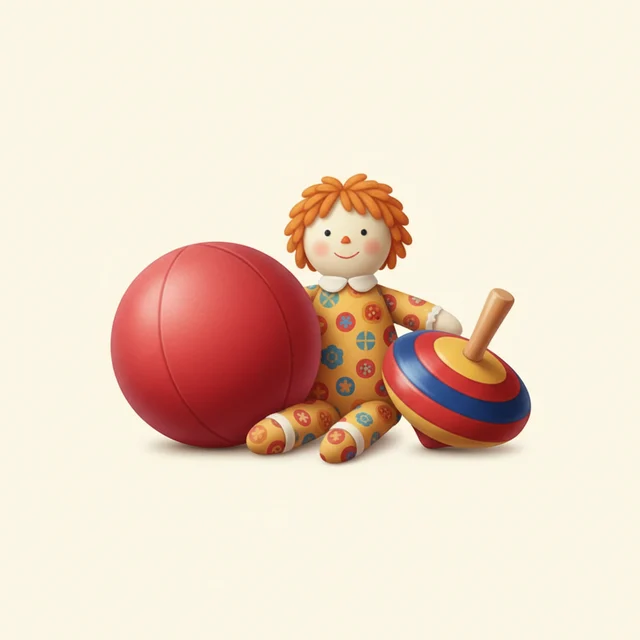
Twenty groups of three, each one drawn, spoken out loud, and ready to practice at word, phrase, or sentence level. Tap play and go.
Free in your browser · works on phones and tablets · no account needed
Each card shows three things that belong together and asks one question: what group are these in? The answer grows from a single word (fruit) to a phrase (they are all fruit) to a whole sentence. Tap any card to open the full player; every card speaks its question out loud.
The level dial rewrites every card live; the same picture grows with your child from single words to full sentences. Here’s card one:
Parent mode picks five words for today; animals, fruit, toys, clothes, vehicles; so a session can be two minutes on the couch, not a curriculum. Every card comes with a plain-language prompt like this one:
“Name the three pictures out loud, then say the one group they all belong to: animals. Then ask: Can you name one more animal?”
Working on this in speech sessions? The player also has a clinician side: draw on any card, jot a note, and use record-and-playback for listen-then-say practice. See the SLP tour →
Category words are the group names that sit above everyday nouns: fruit, animals, clothes, tools, vehicles. This free deck gives you 20 of them as talking flashcards. Every card shows three members of a group, asks what group they are in, and can grow the answer into a phrase or a full sentence.
Sorting is one of the ways children file vocabulary. Basic groups like food, animals, and clothes are usually named by about age three, and broader labels like vehicles or furniture come together nearer four or five. A word stored beside its neighbours is easier to pull back out, so category work often shows up as smoother word finding and faster naming.
Yes. All 20 cards, the audio, the level dial, and record-and-playback are free in your browser with no login, no download, and no locked cards.
Nowhere. Recordings play back on your device only; they are never uploaded or saved, and they disappear when you close the page.
No. Little Words is a practice tool for home and for sessions. If you have concerns about your child’s speech, a licensed speech-language pathologist can evaluate and guide you; these cards are a way to practice between conversations, not a diagnosis or a treatment plan.