
Access: Free
Download the printable
4 US Letter pages, 0.5 inch margins, black and white friendly. Free, no account needed.
Download the free PDF Browse all printablesWhat's inside
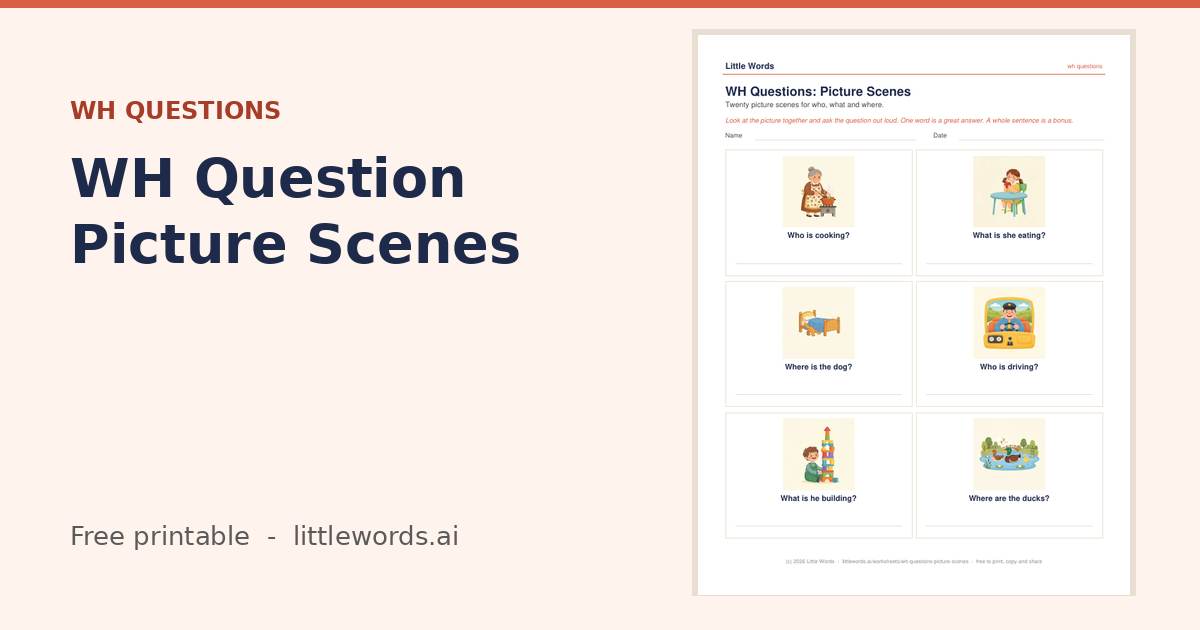
- Twenty scenes, six to a page
- The question printed under each picture
- A writing line for the answer
Everything on this sheet is built from the wh questions content already on the site, so the pictures and words match what your child sees when you practise on screen: Who is cooking?, What is she eating?, Where is the dog?, Who is driving?.
How to use it
- Ask the question, then wait. Waiting is the technique.
- One word is a real answer. Say the longer version back and move on.
- Six scenes is a session.
Practise it on screen too
- WH questions flashcardsThe same cards with audio, free on the site
- All printablesThe complete printable library on one page
More wh questions printables
- Action Verbs WH Question Picture Scenes4 pages, wh question picture scenes
- Action Verbs Answer Ladder1 page, answer ladder
- Action Verbs Printable Picture Cards5 pages, printable picture cards
- Action Verbs Memory Match Card Set3 pages, memory match card set
- Action Verbs Bingo Boards6 pages, bingo boards
- Action Verbs Colour and Say Sheets3 pages, colour and say sheets
- Action Verbs Five-day Practice Log1 page, five-day practice log
- Basic Concepts WH Question Picture Scenes4 pages, wh question picture scenes
- Basic Concepts Answer Ladder1 page, answer ladder
Frequently asked questions
Is this printable Free, no account needed?
Yes. Download the complete PDF with no account or email address.
What is on the wh question picture scenes?
4 US Letter pages: twenty scenes, six to a page; the question printed under each picture; a writing line for the answer.
Will it print in black and white?
It will. There are no filled backgrounds, so a school copier costs you the same ink as a blank page. Colour is a bonus, not a requirement.
How long should we spend on it?
Six scenes is a session.