Evidence note: The clinical boundaries on this page follow ASHA: Speech Sound Disorders. Product descriptions come from the current Little Words repository; volatile App Store details should be checked in the store before purchase.
Little Words at a glance
- Purpose
- Supervised speech and language practice at home
- Primary focus
- Children ages 2 to 8
- Full support
- Age-respectful activities through age 10
- Devices
- iPhone and iPad
- Cost
- Free download with optional subscription
- Ways to respond
- Speech, pictures, choices, gestures, and AAC alongside the app
- Not designed for
- Diagnosis, clinical treatment, or replacing AAC or an SLP
Adaptive conversation
Buddy can follow the child's interests, change the next prompt, and offer a smaller choice instead of repeating the same demand.
More than adult-style speech recognition
The interaction expects pauses, approximations, background noise, and uncertainty rather than treating every mismatch as failure.
Transparent limits
Parents are told that Little Words can misunderstand an attempt and that summaries are practice notes, not clinical accuracy scores.
Where AI genuinely helps
Traditional apps have a fixed sequence. A child taps the same card or repeats the same word no matter what they say. Generative AI makes a different interaction possible: Buddy can use the child's preferred topic, wait longer, change the difficulty, remember a tricky word, and build another opportunity into play.
This is especially useful for repetition. A child may resist hearing “say it again” from an adult but happily use the same sound or word several times because it changes a story or game.
Where AI is still unreliable
Little Words can misunderstand a child's attempt. The product treats recognition as uncertain: a meaningful approximation may be missed, or an unintended production may occasionally be accepted.
Little Words responds to uncertainty with warmth and a repair choice. It does not label the child wrong or convert recognition into a diagnostic score. Parents should supervise and rely on an SLP, not the app, to judge clinical accuracy.
The questions parents should ask any AI speech app
- Does the product clearly say whether it is practice, screening, or treatment?
- What happens when the AI misunderstands a child's speech?
- Can the child stop, ask for help, or answer another way?
- Can a parent control goals, pacing, interests, and session length?
- Are voice and child data practices explained plainly?
- Are progress reports descriptive, or do they imply clinical precision the system cannot support?
Privacy and adult supervision
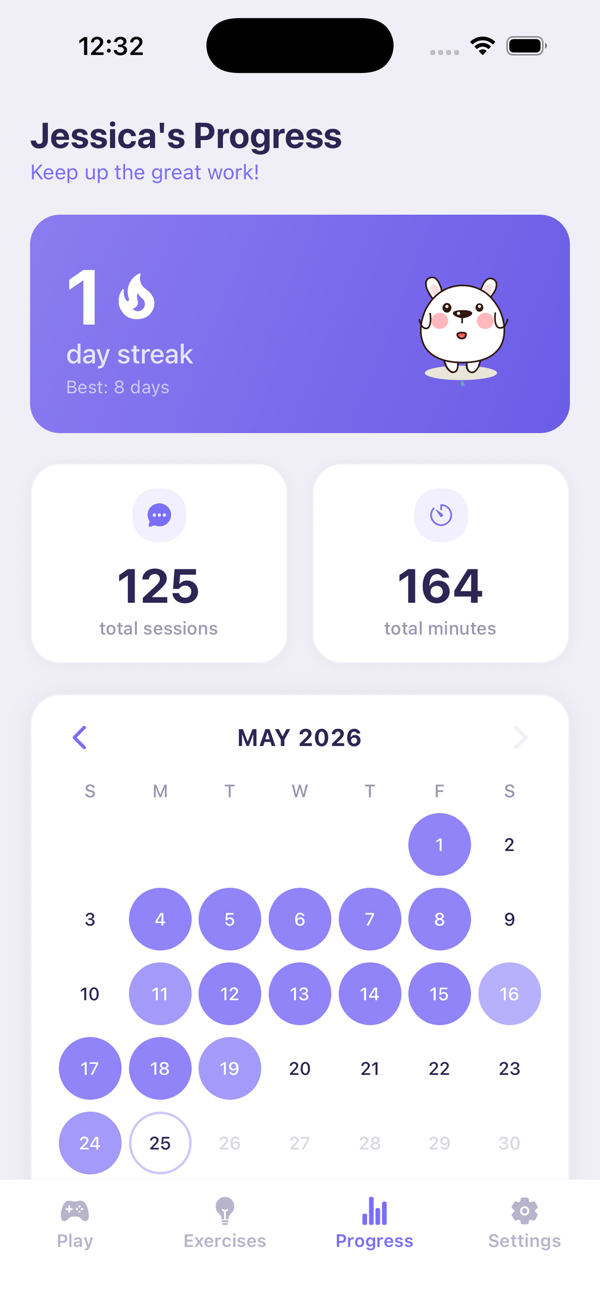
Little Words requires a parent account and is designed for supervised use. It has no third-party ads or child-directed advertising. Parents can control notifications, create PDF practice reports, delete profiles, and request account deletion or a privacy export. Review the current privacy policy and App Store privacy disclosure before use.
Questions parents ask
Does the AI grade my child's pronunciation?
No. Little Words does not present a clinical pronunciation score. It uses recognition to keep practice responsive and produces descriptive summaries for parents.
What happens when Buddy misunderstands?
Buddy stays neutral, waits, and can offer a small visual repair choice. A misunderstanding should never be presented as the child failing.
Can AI replace our SLP?
No. AI can vary and repeat practice, but it cannot perform a comprehensive assessment, make a diagnosis, or exercise the clinical judgment of a licensed SLP.
Is my child's voice stored?
Consult the current Little Words privacy policy and App Store privacy disclosure for the exact data handling in the current version. Parents control the account and can request deletion.
Why use AI instead of prerecorded games?
AI can respond to the child's topic, stage, and previous turns. Prerecorded games remain useful for fixed drills, but they cannot create the same flexible back-and-forth.
Clinical and product sources
How this page was prepared
We checked product statements against current Little Words product materials and linked clinical statements to primary or authoritative sources. Little Words makes the app, so product recommendations on this site carry that conflict. No clinical reviewer is implied unless a named reviewer is listed.
Last checked: . If you spot an error, tell us.