Evidence note: The clinical boundaries on this page follow ASHA: Early Identification of Communication Disorders. Product descriptions come from the current Little Words repository; volatile App Store details should be checked in the store before purchase.
Little Words at a glance
- Purpose
- Supervised speech and language practice at home
- Primary focus
- Children ages 2 to 8
- Full support
- Age-respectful activities through age 10
- Devices
- iPhone and iPad
- Cost
- Free download with optional subscription
- Ways to respond
- Speech, pictures, choices, gestures, and AAC alongside the app
- Not designed for
- Diagnosis, clinical treatment, or replacing AAC or an SLP
Meet the child at their current stage
Begin with a sound, word approximation, visual choice, single word, phrase, or full conversational response.
Practice useful language
Work on help, stop, more, different, directions, vocabulary, questions, and stories, not only object labels.
See patterns without turning them into scores
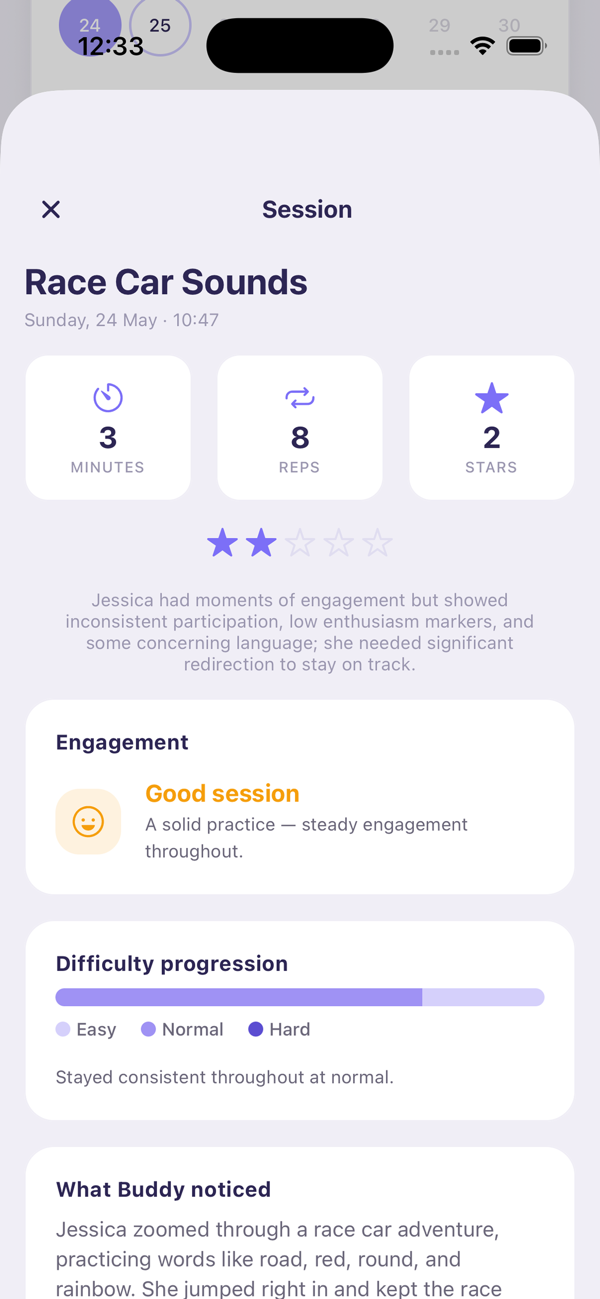
Parents receive descriptive summaries of what the child communicated and what support helped.
Speech delay is not one single problem
Parents use “speech delay” to describe many different concerns: few spoken words, unclear speech, difficulty combining words, trouble understanding directions, limited conversation, or a child who communicates well in one setting and struggles in another. Those patterns can have different causes and need different professional guidance.
Little Words does not choose a diagnosis. During setup, the parent describes how the child communicates now and selects practical goals. The app then adjusts the response level so a child is not repeatedly asked for language they cannot yet produce.
From first attempts to connected language
For an emerging communicator, a successful session may mean making a sound, choosing a picture, or using one functional word. For another child, it may mean combining two ideas, answering a WH-question, following a direction, retelling an event, or repairing a misunderstanding.
Age and communication access both matter. A two-year-old and a ten-year-old may need similar communication support, but the activity, vocabulary, interests, and tone should not look the same.
Use the app as one part of the next-step plan
Start with a hearing check and speech-language evaluation when those have been recommended. If the child is already in therapy, ask for two or three functional targets that can be practiced at home. Put those targets into Little Words and share the parent summary when useful.
If a child has lost words or other communication skills, tell the child's pediatric or developmental team about that change rather than asking an app to explain it.
A note about “late talker” searches
ASHA uses late language emergence for children ages 2 to 4 and discusses fewer than 50 words with no two-word combinations at 24 months as one commonly used criterion. Little Words supports children starting at age 2, but families should still use pediatric, hearing, and early-intervention guidance rather than treating an app as an evaluation.
Questions parents ask
Can Little Words tell me whether my child has a speech delay?
No. Little Words does not compare a child with diagnostic norms or provide a screening result. A pediatrician, audiologist, SLP, early-intervention program, or school team can guide evaluation.
Is Little Words for two-year-old late talkers?
Yes. Little Words supports children starting at age 2 and offers low-pressure communication practice. It does not screen, diagnose, or replace pediatric, hearing, speech-language, or early-intervention guidance.
What if my child says only approximations?
Approximations can participate. Buddy is designed to stay encouraging and can offer a smaller visual choice when the system is unsure.
Can it help with language as well as pronunciation?
Yes. Activities include vocabulary, functional words, directions, questions, storytelling, turn-taking, and social communication in addition to selected speech sounds.
What if my child loses words they previously used?
Contact the child's pediatric or developmental team promptly. Regression deserves professional evaluation and should not be managed by waiting for app practice to work.
Clinical and product sources
- ASHA: Early Identification of Communication Disorders
- ASHA: Spoken Language Disorders
- ASHA: Late Language Emergence
How this page was prepared
We checked product statements against current Little Words product materials and linked clinical statements to primary or authoritative sources. Little Words makes the app, so product recommendations on this site carry that conflict. No clinical reviewer is implied unless a named reviewer is listed.
Last checked: . If you spot an error, tell us.