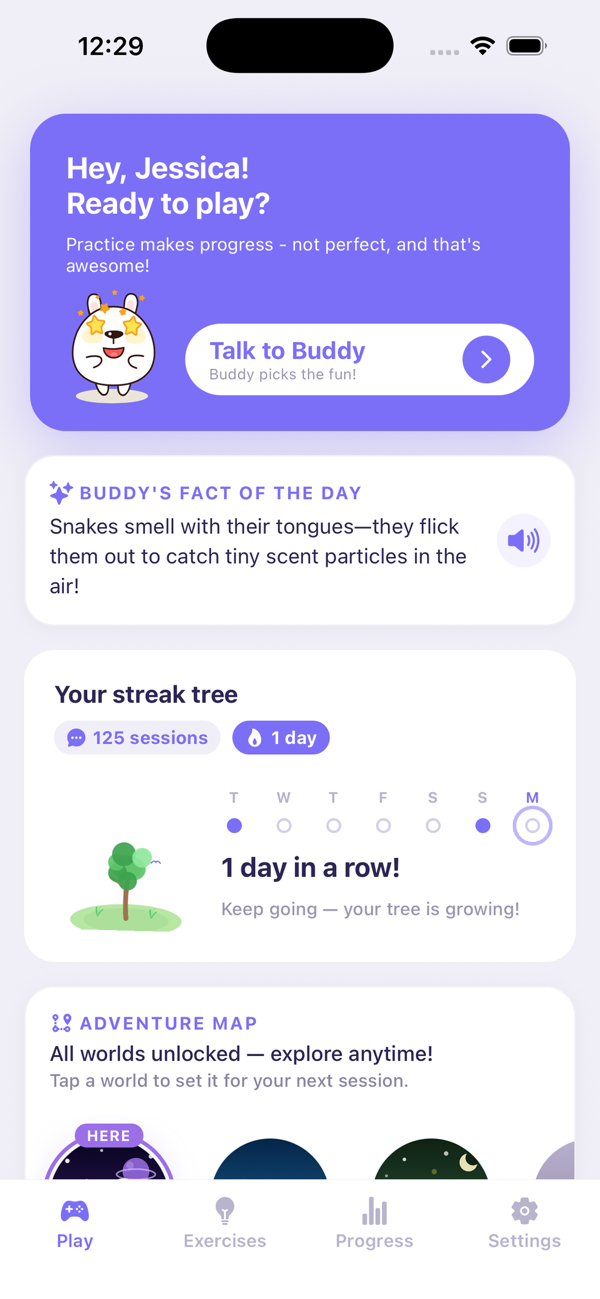
Evidence note: The clinical boundaries on this page follow ASHA: Autism Practice Portal. Product descriptions come from the current Little Words repository; volatile App Store details should be checked in the store before purchase.
Little Words at a glance
- Purpose
- Supervised speech and language practice at home
- Primary focus
- Children ages 2 to 8
- Full support
- Age-respectful activities through age 10
- Devices
- iPhone and iPad
- Cost
- Free download with optional subscription
- Ways to respond
- Speech, pictures, choices, gestures, and AAC alongside the app
- Not designed for
- Diagnosis, clinical treatment, or replacing AAC or an SLP
No eye-contact requirement
Children can listen, move, stim, look away, or respond side by side. Participation is not measured by eye contact.
Interests create the reason to talk
Dinosaurs, space, animals, games, or a child's current favorite topic can become the context for sounds, words, questions, and stories.
Communication stays available
Help, stop, again, different, and more remain meaningful choices. They are not rewards that have to be earned with speech.
What neurodivergent-affirming practice looks like
Autistic communication is varied. Some children speak in sentences, some use echolalia or familiar scripts, some speak a few words, some rely on AAC or pictures, and some move between methods depending on stress and sensory load. A responsible app should not treat one of those methods as the only successful answer.
Parents can increase Buddy's wait time, and the app can offer a smaller visual choice when recognition is uncertain. The interaction accepts approximations without treating them as failure.
Speech, AAC, and pictures can work together
Little Words is not a full AAC system and should not replace a child's established AAC device. It does, however, allow essential words and picture choices to remain available alongside speech practice. A child should not lose access to communication while working on spoken language.
ASHA's autism guidance recommends assessing verbal and nonverbal communication for function and intent. That is the principle here: recognize the message, support the child in repairing a misunderstanding, and let more than one communication mode count.
Practice without turning communication into compliance
Little Words does not require a child to look at Buddy, sit still, copy a social performance, or say a word before receiving access to help or a break. Current social scenarios include greetings, asking for help, making requests, classroom clarification, show-and-tell, and ordering. They are not used to train masking.
Parents can lower energy, shorten the session, increase wait time, choose a familiar interest, or end immediately based on the child's cues.
When to involve the child's team
Talk with an SLP or developmental team when a child loses previously used communication, has trouble understanding language, becomes highly frustrated because others cannot understand them, or needs a fuller AAC system. Little Words can support a plan, but it cannot determine the cause of a communication difference.
If the child already uses AAC, ask the SLP how Little Words vocabulary and activities should align with the child's established system. The aim is consistency and communication access, not competing tools.
Questions parents ask
Can a minimally speaking autistic child use Little Words?
Yes, when the child can engage with sounds, approximations, picture choices, essential words, or parent-supported gestures. An adult should supervise, and a child who needs robust AAC should continue to have that system available.
Does Little Words try to stop echolalia?
No. Echolalia can have communicative meaning. Little Words can respond to familiar language and help a child build flexible choices without treating repeated language as bad behavior.
Does the app require eye contact or sitting still?
No. A child can move, look away, stim, or participate side by side. Parents control pacing and session length.
Is this an AAC app?
No. Little Words includes supportive picture choices and essential words, but it is not a comprehensive AAC replacement. Keep the child's existing AAC available and follow the care team's recommendations.
Can Little Words diagnose autism or a language disorder?
No. It does not screen, evaluate, diagnose, or treat any condition. It provides educational practice and descriptive parent summaries.
Clinical and product sources
- ASHA: Autism Practice Portal
- National Autistic Society: Autism and Communication
- ASHA: Augmentative and Alternative Communication
How this page was prepared
We checked product statements against current Little Words product materials and linked clinical statements to primary or authoritative sources. Little Words makes the app, so product recommendations on this site carry that conflict. No clinical reviewer is implied unless a named reviewer is listed.
Last checked: . If you spot an error, tell us.