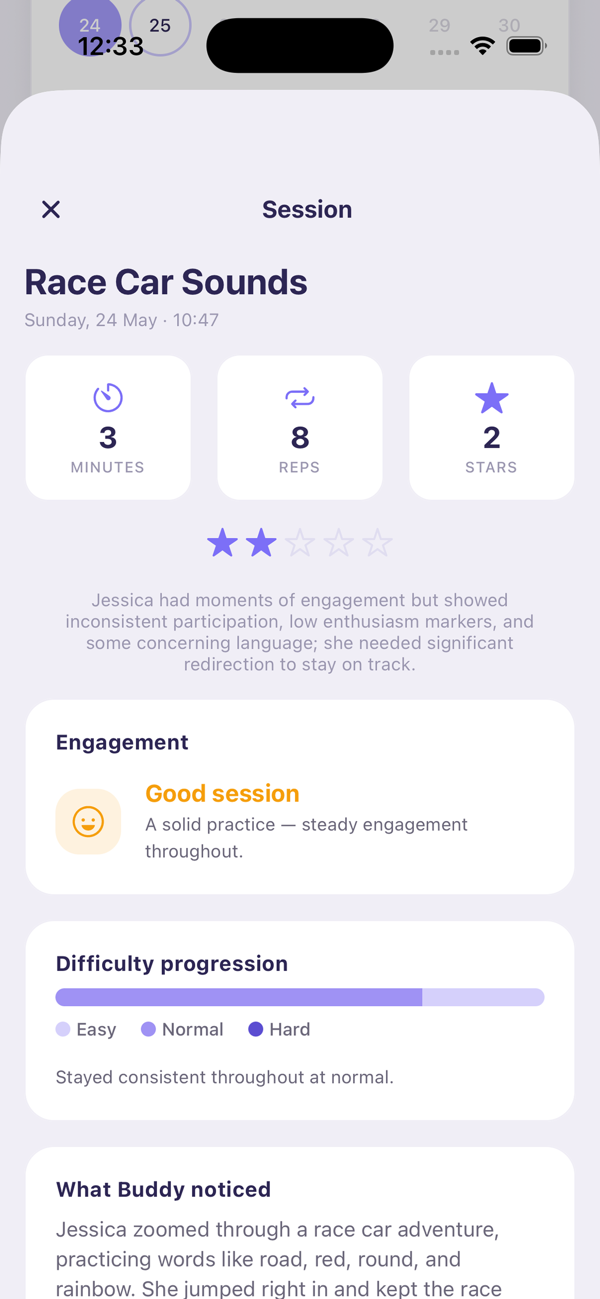
Evidence note: The clinical boundaries on this page follow ASHA: Childhood Apraxia of Speech. Product descriptions come from the current Little Words repository; volatile App Store details should be checked in the store before purchase.
Little Words at a glance
- Purpose
- Supervised speech and language practice at home
- Primary focus
- Children ages 2 to 8
- Full support
- Age-respectful activities through age 10
- Devices
- iPhone and iPad
- Cost
- Free download with optional subscription
- Ways to respond
- Speech, pictures, choices, gestures, and AAC alongside the app
- Not designed for
- Diagnosis, clinical treatment, or replacing AAC or an SLP
Use clinician-selected targets
Parents choose the sounds, words, phrases, interests, and session length rather than relying on a generic apraxia curriculum.
Move beyond isolated repetition
Practice can place a target inside a request, game, short phrase, or conversation after the SLP has established the movement pattern.
Keep communication accessible
A child can still use pictures, essential words, approximations, and an established AAC system while practicing speech.
Why apraxia needs specialist guidance
Childhood apraxia of speech is a motor-speech disorder involving the planning and programming of speech movements. ASHA notes that diagnosis is complex and that no single feature is necessary and sufficient. A comprehensive motor-speech assessment by an experienced SLP is essential.
That is why Little Words does not offer an “apraxia score,” automatic diagnosis, or one-size-fits-all word list. A consumer system cannot determine the child's movement pattern or select the correct clinical cue.
How to set up responsible home practice
- Ask the SLP for the current target words or syllable shapes.
- Ask what kind of model, cue, and feedback to use, and what not to use.
- Enter only that small target set and pair it with a strong interest.
- Keep sessions short enough for accurate, willing attempts.
- Share participation and generalization notes with the SLP before changing targets.
Recognition is not clinical accuracy
Little Words can misunderstand a child's attempt. Buddy keeps that uncertainty neutral and can offer another communication route; it does not certify a sound as clinically correct.
A parent should use the feedback approach supplied by the SLP. When that guidance is not available, avoid intensive self-directed motor-speech drilling.
AAC and speech practice are not opposites
A child with severe CAS may use robust AAC for communication access while also receiving motor-speech therapy. Little Words is not a robust AAC replacement, but picture choices and essential words can remain available so the child does not have to earn communication access through a difficult speech attempt.
Questions parents ask
Can Little Words diagnose childhood apraxia?
No. CAS requires a comprehensive motor-speech assessment by an experienced SLP. Little Words provides educational practice only.
Does the app know whether a production is clinically correct?
No. Child-speech recognition is not a substitute for expert perceptual and motor-speech judgment. Use the SLP's targets and feedback guidance.
How many repetitions should my child do?
Follow the treating SLP's dosage and the child's tolerance. More repetitions are not automatically better when the target, cueing, or movement pattern is wrong.
Can my child keep using AAC?
Yes. AAC and speech practice can be complementary. Never remove a child's established communication system to force speech practice.
What if my child becomes frustrated?
Stop, lower the demand, and share the pattern with the SLP. Frustration may mean the target, cue, pacing, or activity needs to change.
Clinical and product sources
- ASHA: Childhood Apraxia of Speech
- ASHA: Speech Sound Disorders
- ASHA: Augmentative and Alternative Communication
How this page was prepared
We checked product statements against current Little Words product materials and linked clinical statements to primary or authoritative sources. Little Words makes the app, so product recommendations on this site carry that conflict. No clinical reviewer is implied unless a named reviewer is listed.
Last checked: . If you spot an error, tell us.