Evidence note: The clinical boundaries on this page follow National Autistic Society: Communication Tips for Autistic Pupils. Product descriptions come from the current Little Words repository; volatile App Store details should be checked in the store before purchase.
Little Words at a glance
- Purpose
- Supervised speech and language practice at home
- Primary focus
- Children ages 2 to 8
- Full support
- Age-respectful activities through age 10
- Devices
- iPhone and iPad
- Cost
- Free download with optional subscription
- Ways to respond
- Speech, pictures, choices, gestures, and AAC alongside the app
- Not designed for
- Diagnosis, clinical treatment, or replacing AAC or an SLP
Adjustable energy
Parents choose calm, gentle, or higher-energy interaction based on the child today, not a permanent label.
Longer processing time
Buddy can wait through pauses and avoid filling every quiet moment with another instruction.
Predictable repair
When speech is unclear, Buddy stays neutral and offers one small choice instead of repeating a demand or playing an error sound.
The difference between calm design and sensory access
A pastel interface can still be overwhelming if it rushes or demands repeated spoken answers. Little Words provides parent-controlled pacing, wait time, session length, energy, visual choices, and a stop path.
Little Words also treats movement and stimming as compatible with participation. A child does not need to hold a “listening body” pose to be understood as engaged.
Set the session for today's capacity
The same child may want an energetic dinosaur game one day and a two-minute calm exchange the next. Parents can change the sensory preset, wait time, session length, goals, and notifications. Those controls make regulation part of the setup instead of something the child has to fail before the app responds.
Low pressure still includes real practice
Removing pressure does not mean removing learning. Buddy can repeat a model, return to a target, offer a meaningful choice, and expand a child's language. The difference is that the child retains agency and the interaction remains connected to an interest or communication purpose.
Stop, help, again, and different are part of communication. They are not escape behaviors to extinguish. A child who can change the interaction learns that communication works.
When the app should stay closed
Parents control whether a session starts and can stop it when the child appears distressed, tired, or unwilling to continue. If sound, screens, or conversational demands consistently overwhelm the child, discuss other practice formats with the child's SLP or OT.
Questions parents ask
What sensory controls are available?
Parents can adjust session energy, pace, wait time, length, interests, and notifications. The child also has meaningful stop, help, again, and different choices.
Does my child have to sit still?
No. Movement, looking away, and stimming are compatible with participation.
What happens if my child does not answer quickly?
Buddy can wait longer and offer a smaller visual choice rather than immediately repeating or escalating the prompt.
Will the app force us to keep a streak?
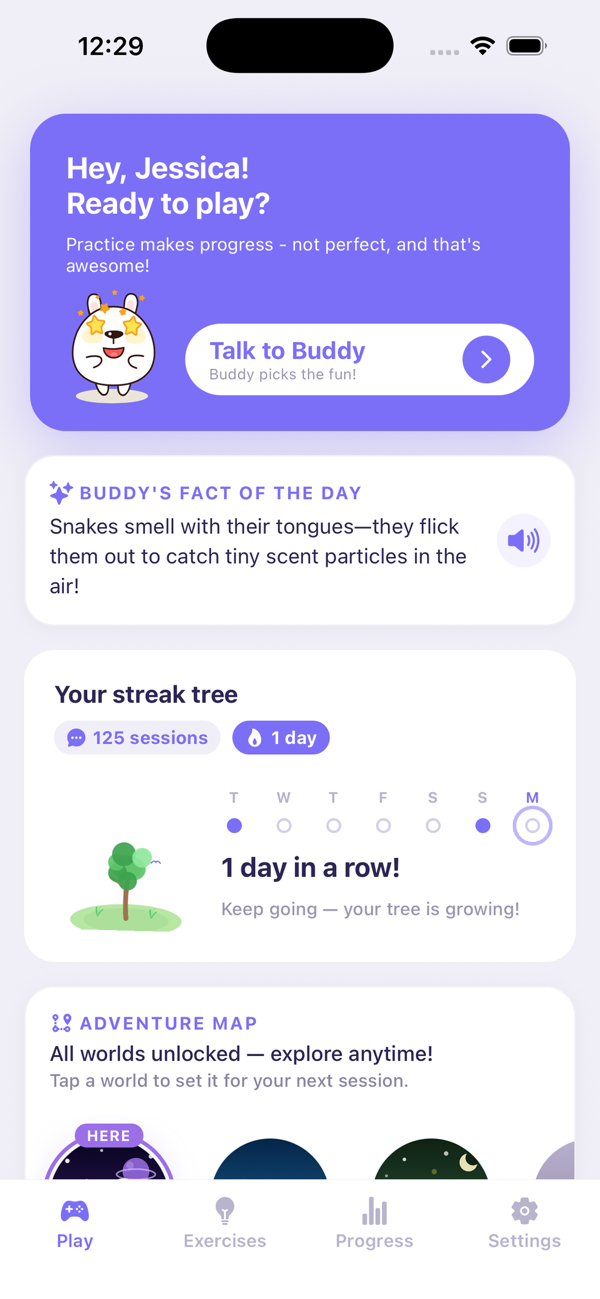
No. Practice history can help parents notice routines, but a child should skip or stop whenever needed.
Is sensory-friendly the same for every autistic child?
No. Observe the individual child's response to each setting and context. Parent controls are provided because one preset cannot fit every child or every day.
Clinical and product sources
- National Autistic Society: Communication Tips for Autistic Pupils
- National Autistic Society: Autism and Communication
- ASHA: Autism Practice Portal
How this page was prepared
We checked product statements against current Little Words product materials and linked clinical statements to primary or authoritative sources. Little Words makes the app, so product recommendations on this site carry that conflict. No clinical reviewer is implied unless a named reviewer is listed.
Last checked: . If you spot an error, tell us.